Iran Detains And Releases 10 U.S. Navy Sailors

By Samuel Miller
Impunity Watch Reporter, North America and Oceania

TEHRAN, Iran — Less than a day after 10 U.S. Navy sailors were detained in Iran when their boats drifted into Iranian waters, the sailors and their vessels were back safely Wednesday with the American fleet. The release appears to have ended a potential flash point, as Iran and world powers move toward the next steps in a landmark nuclear deal that limits Tehran’s atomic program in exchange for the easing of international economic sanctions.
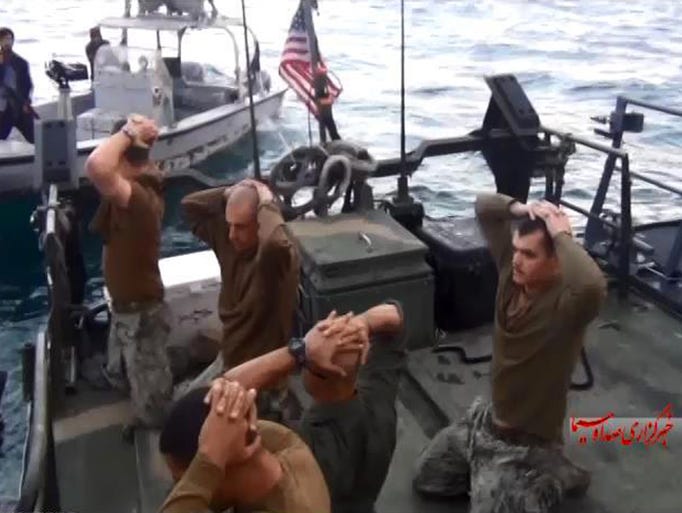
U.S. Sailors Surrender to Iranian Navy. (Photo Courtesy of USA Today)

The sailors were detained on Tuesday when one of their two vessels broke down while training in the Gulf.

CBS News correspondent Charlie D’Agata reported the American sailors were said to have been interrogated Wednesday morning by Revolutionary Guard forces on Farsi Island.

A senior defense official said the sailors were not harmed but would undergo medical evaluations and a debriefing in the Persian Gulf nation of Qatar. Meanwhile, their vessels were taken by another American crew to Bahrain, their original destination and home to the U.S. Navy’s Fifth Fleet.

The Revolutionary Guard’s official website published images of the U.S. sailors before their release, showing them sitting on the floor of a room. They look mostly bored or annoyed, though at least one of the sailors appears to be smiling.

U.S. Defense Secretary Ash Carter thanked Kerry after the sailors’ release and couched the incident in humanitarian terms, noting that “the U.S. Navy routinely provides assistance to foreign sailors in distress.”

Secretary of State John Kerry credited diplomatic strength and newly developed ties with Iran in helping secure the quick and safe release of the sailors.

“These are always situations as everybody here knows which have an ability, if not properly guided, to get out of control,” said Kerry in a speech at the National Defense University. “I’m appreciative for the quick and appropriate response of the Iranian authorities. All indications suggest or tell us that our sailors were well taken care of, provided with blankets and food and assisted with their return to the fleet earlier today.”

The rapid resolution also was a victory for moderate President Hassan Rouhani, who has promoted greater openness with the outside world despite strident opposition from deeply entrenched hard-liners at home.

Kerry said things might not have gone as smoothly before the U.S. opened dialogue with the country over its nuclear program, culminating in a deal to curb its operations reached between Iran and the U.S. along with five other world powers in July.

“I think we can all imagine how a similar situation might have played out three or four years ago,” said Kerry.

For more information, please see:

BBC News — US thanks Iran for swift release of 10 Navy sailors – 13 January 2016

CBS News – Iran frees U.S. sailors captured in Persian Gulf – 13 January 2016

Chicago Tribune — U.S. Navy sailors detained, released unharmed by Iran in less than a day – 13 January 2016

CNN — 10 U.S. sailors detained by Iran freed – 13 January 2016

TIME — Iran Releases 10 U.S. Sailors as the Sun Rises Over the Persian Gulf – 13 January 2016

USA Today — No apologies as Iran releases U.S. Navy sailors – 13 January 2016

Washington Post — Iran releases captured U.S. Navy crew members — 13 January 2016

WCPW Volume 10, Issue 22 – January 11, 2016

War Crimes Prosecution Watch is a bi-weekly e-newsletter that compiles official documents and articles from major news sources detailing and analyzing salient issues pertaining to the investigation and prosecution of war crimes throughout the world. To subscribe, please email warcrimeswatch@pilpg.org and type “subscribe” in the subject line.

Opinions expressed in the articles herein represent the views of their authors and are not necessarily those of the War Crimes Prosecution Watch staff, the Case Western Reserve University School of Law or Public International Law & Policy Group.

Contents

INTERNATIONAL CRIMINAL COURT

Central African Republic & Uganda

Darfur, Sudan

AFRICA

International Criminal Tribunal for Rwanda

Mali

Chad

EUROPE

Court of Bosnia & Herzegovina, War Crimes Chamber

International Criminal Tribunal for the Former Yugoslavia

Domestic Prosecutions In The Former Yugoslavia

MIDDLE EAST AND ASIA

Extraordinary Chambers in the Courts of Cambodia

Iraq

Islamic State of Iraq and the Levant

Special Tribunal for Lebanon

Bangladesh International Crimes Tribunal

War Crimes Investigations in Burma

TOPICS

Terrorism

Piracy

Gender-Based Violence

REPORTS

UN Reports

NGO Reports

WORTH READING

Lori Fossum: Cyber Conflict Bibliography, 2015 Update

Helen Brady and Ryan Liss: The Evolution of Persecution as a Crime Against Humanity

Sean D. Murphy: New Mechanisms for Punishing Atrocities Committed in Non-International Armed Conflicts

Barbara Miltner: Correction: The Mediterranean Migration Crisis: A Clash of the Titans’ Obligations?

Syria Justice and Accountability Centre: Addressing Human Trafficking in Times of Conflict

Worldwide, 21 million people are victims of human trafficking. In areas of conflict, people are particularly vulnerable to exploitation – erosion of the rule of law and government institutions creates a state of impunity where criminals act without fear of arrest and evade prosecution.

Today, January 11, is Human Trafficking Awareness Day. Last month, the UN Security Council held its first session on human trafficking in conflict and denounced terrorist groups that use trafficking as a tool of war. But trafficking in persons (TIP) is still far less documented than other crimes, and as a result, the number of TIP prosecutions is relatively low.

Both Syria and sub-Saharan Africa experience significant incidences of human trafficking due to ongoing conflict and instability. Syria Justice and Accountability Centre and IREX, through the Trafficking in Persons-Legal Assistance Program (TIP-LAP), are working to address this issue through documentation in Syria and strengthening legal frameworks in sub-Saharan Africa.

Crisis, conflict exacerbate trafficking

Not only are wartime societies less equipped to address trafficking due to a lack of resources, political will or capability to enforce laws, but the conflict itself opens the door to increased criminality and exploitation.

Displacement, impoverishment, and lack of income-generating opportunities make people particularly vulnerable to trafficking because they are left with few, if any, alternatives. Families are forced to rely on risky survival strategies such as early marriage, child labor, and prostitution, increasing exposure to trafficking. In many conflicts, TIP is used to fund war activities and can also serve a group’s ideological objectives by systematically targeting ethnic or religious minorities.

Trafficking as a weapon of war in Syria

Since 2011, mass destruction and displacement have ravaged much of Syria, internally displacing over 7.6 million Syrians and externally displacing over four million as refugees. What is particularly alarming in the Syrian context is the use of trafficking as a weapon of war.

The Islamic State of Iraq and al-Sham (ISIS), for example, has used trafficking to forcibly recruit and train children as soldiers on the front lines in the conflict. Whole families have been forced to work in agriculture or manufacturing for no pay under inhuman conditions. ISIS has also used trafficking to subjugate women and minorities, such as with its sexual enslavement of women and girls from the Yazidi minority group.

But ISIS is not the only perpetrator. The Syrian army and pro-government militias are forcibly recruiting Syrian boys to pose as informants and locate opposition groups prior to battle. Opposition forces, including the Kurdish Democratic Union Party (PYD), have also recruited child soldiers and abducted men and women to fight.

Documenting exploitation to end impunity

It is critical to collect documentation of exploitation and abuses to use once Syria emerges from conflict in order to address human trafficking within its transition process; otherwise, human trafficking crimes will persist and victims will remain in the shadows, susceptible to further exploitation without the services they need to heal and recover. Through the use of targeted prosecutions, truth commissions, and reparations programs that address the needs of victims, Syria can help end the culture of impunity surrounding these crimes.

Human trafficking, however, is complex and requires significant capacity building in order to train investigators, prosecutors, and judges on how to identify and try perpetrators. Syrian documentation groups like SJAC have started to document incidences of sexual and gender based violence (SGBV), but are in need of additional resources and training to ensure instances of human trafficking are properly identified and recorded. As the UN Security Council stated in its December resolution, human trafficking could constitute a war crime under international law, and as such, the Syrian human rights community should carefully consider TIP to ensure trafficking crimes are properly addressed in the country’s post-war transition.

Strengthening legislation and working with key stakeholders

In addition to careful documentation, a strong legal framework is needed to ensure the prosecution of traffickers, protection of victims, and prevention of human trafficking. Despite the Security Council’s resolution and the near worldwide adoption of counter trafficking laws, there are inconsistencies between international requirements and national legislation. Many states do not fully comply with the minimum standards set forth in international law, leading to confusion about what constitutes trafficking and the state’s role in prevention and protection measures. Additionally, some states’ prescribed penalties for trafficking are not sufficiently stringent to deter traffickers.

TIP-LAP is addressing legal loopholes such as these through partnerships with governments, civil society, and other key stakeholders in sub-Saharan Africa to create and implement anti-trafficking reform strategies. TIP-LAP also supports members of the advocacy community, trafficking-focused NGOs, the media, and government agencies to design and implement public awareness and outreach campaigns about the reform process, further strengthening the effectiveness of TIP legislation.

Through the documentation and legislative strengthening efforts, SJAC and TIP-LAP are working to end impunity and strengthen victims’ access to legal protections and justice. For more information and to provide feedback please email SJAC at info@syriaaccountability.org.  

This article was written in cooperation with the Trafficking in Persons – Legal Assistance Program (TIP-LAP) which assists partner governments in Sub-Saharan Africa to introduce or strengthen anti-trafficking legislation. TIP-LAP is funded by the US Department of State Office to Monitor and Combat Trafficking in Persons (J/TIP) and implemented by IREX.

The Deadliest Region for Human Rights Activist: Latin America

By Kaitlyn Degnan
Impunity Watch Reporter, South America

DUBLIN, Ireland — Latin America is the deadliest region for human rights and environmental activists, according to Ireland based group Front Line Defenders. The group released a report in early January citing “extreme violence” as the most worrying issue.

Mary Lawlor, Executive Director of Human Rights Defenders (courtesy of the Irish Independent).

According to the report, 156 human rights activists’ died globally due to violence or detention in the first 11 months of 2015 – 15 percent higher than the previous year. 88 of the killings took place in Latin America, with 54 deaths occurring in Colombia alone. 15 percent of the deaths in Latin America were defenders of LGBT rights.

The report called defending human rights in Latin America “extremely dangerous”, and noted ongoing criminalization of human rights and peaceful protest movements.

Some of the most targeted activists are those fighting for environmental rights, indigenous populations and LGBT rights.

“Extreme violence is being used more frequently and in more countries, while fabricated prosecutions and unfair trials have become the norm in many parts of the world,” said Mary Lawlor, the head of Front Line Defenders, speaking at the report’s launch in Dublin.

Ms. Lawlor also accused international reactions to human rights violations as weak in an editorial in the Irish Times. She called for Ireland and the EU to be strong in speaking up for human rights defenders, even in those countries where they have political and strategic interests.


For more information, please see:

Herald Sun – Killings of human rights defenders rise – 6 January 2016

Independent – Human rights activists ‘face new heights of violence’ – 6 January 2016

Irish Times – Latin America most dangerous place for human rights activists – 6 January 2016

Reuters – Killings of human rights defenders rise, LatAm fares worst: report – 6 January 2016 

Inside Costa Rica – Latin America is the deadliest region for human rights, environmental activists, group says – 7 January 2016

Latin One – Latin America Dubbed the ‘Deadliest Region for Human Rights Advocates’ – 7 January 2016

Irish Times – We must stop the killing of those who stand up for human rights – 8 January 2016