Christian TV Station Fire Could be Latest Attack Against Religious Minorities in Pakistan

By Christine Khamis

Impunity Watch Reporter, Asia


ISLAMABAD, Pakistan –

Police are investigating a fire at a Christian TV station in Karachi, a city in southern Pakistan. Police initially thought that the fire at Gawahi TV, a cable television station, had started due to an electrical short-circuit. However, the owner, Pastor Sarfraz Williams, believes that the fire was deliberately set.

Gawahi TV employed both Christians and Muslims and broadcasted gospel programming. The channel was preparing to release its Christmas programs before the fire occurred.

Mr. Williams made an official complaint to police following the fire, and a forensic investigation is underway. Mr. Williams has stated that the TV station had been getting threatening phone calls and messages.

Mr. Williams’ brother, Javed Williams, stated that the locks on the station’s doors appeared to have been cut open. Most of Gawahi’s materials, including religious books, were destroyed. The channel’s security system was destroyed during the fire, and security footage has not been found. Computers were either destroyed or missing entirely. The computers that were left to burn in the fire were missing their hard drives. Additionally, the cameras that the TV station had used were missing as well.

Around 15,000 booklets were destroyed in the fire at Gawahi TV. (Photo courtesy of the Express Tribune)

Mr. Williams also made a blasphemy complaint against those behind the fire, who are currently unidentified. It is remarkable that he made the blasphemy complaint, as such complaints are usually used in cases against Christians. The blasphemy law is implicated because the attack on Gawahi TV involved the burning of religious books.

Human rights groups have criticized the use of the blasphemy law in Pakistan because they believe that the complaint is misused by those seeking to settle personal feuds and those seeking to facilitate “land-grabbing”.

Karachi, which is Pakistan’s largest city, has a substantial Catholic population. Gawahi TV was located in the Akhtar Colony area, which is populated by several religious communities. The population’s makeup in the area is around 90% Muslim and 10% minorities.

There have recently been several other attacks against religious minorities in Pakistan. Churches were bombed in Lahore in March, leading to the deaths of over a dozen people. Last week, a mosque owned by the Ahmadis, a Muslim sect that Pakistan’s Sunni Muslim majority thinks unfavorably of, was attacked after a factory worker was accused of burning pages of the Quran.

Although Pakistan’s government has pledged to protect religious minorities, such attacks have continued. Some critics have questioned the government’s commitment to protecting religious minority groups.


For more information, please see:

Business Standard – Owner of Christian Channel Lodges Blasphemy Complaint in Pak – 28 November 2015

NBC News – Pakistan’s Gawahi Christian TV Station Gutted in Fire – 27 November 2015

The Express Tribune – Christian TV Channel Office Burnt to Ashes in Karachi – 26 November 2015

The New York Times – Pakistani Police Investigate Fire at Christian TV station – 26 November 2015
Opposition Leader Killed in Election Lead Up

By Kaitlyn Degnan
Impunity Watch Reporter, South America

CARACAS, Venezuela — Venezuelan President Nicolas Maduro’s government is facing intense scrutiny in the days leading up to the national election following the murder of an opposition leader last Wednesday. Luis Diaz, the Guarico States leader of the Democratic Action party of Guarico State was shot and killed during a public meeting.

Mr. Diaz was on stage with Lilian Tintori, a campaigner and activist. Ms. Tintori is married to opposition leader Leopoldo Lopez whose trial garnered worldwide criticism. It is unknown whether Ms. Tintori was also an intended target of the attack.

Other opposition figures have faced violence in the lead up to the election. Ms. Tintori alleged that she was the victim of at least two attacks, including the dismantling of brakes on a plane used by her team. Henrique Capriles, who lost the 2013 presidential election to Maduro has also been the victim of aggression.

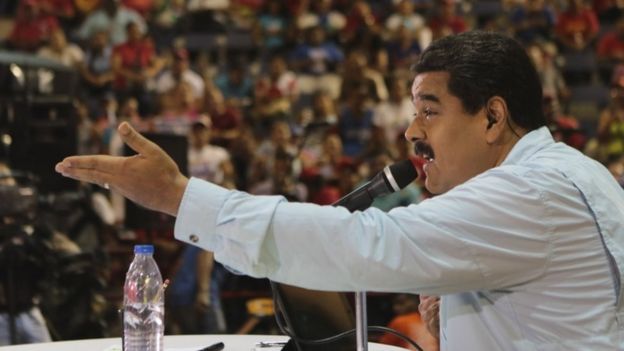
Venezuelan President Nicolas Maduro. (Photo courtesy of BBC).

President Maduro’s government has faced international criticisms in the aftermath of the killing, with statements of concern coming from a number of NGO and the United States. In a statement released the day after Diaz’s death, the Director of Amnesty International Venezuela, Marcos Gomez, said that the killing gave a “terrifying view of the state of human rights in Venezuela.”

The Democratic Action party is part of the Democratic Unity coalition, a bloc of opposition parties looking to unseat the Maduro’s Socialist Party. Democratic Action national leader Henry Ramos blames the Socialist party for Diaz’s death.

The Venezuelan government has denounced any connection between the ruling party and the killing, and has said that it would sue opposition leaders blaming the Socialist Party. Foreign Minister Delcy Rodriguez said in a tweet that trying to establish such links was in “bad faith.”

Venezuela has opened an investigation into the killing through the Public Prosecutor’s office. Government officials claim that Mr. Diaz was involve with a violent gang in Guarico, and that the killing was carried out on behest of a rival gang member.

The upcoming elections may be historical – there is a significant chance for the first time in 16 years that the Socialist Party may lose the legislature. In the past year alone, 43 people have died and hundreds have been injured during violence sparked by opposition protests..


For more information, please see:

Amnesty International – Venezuela: Killing of opposition politician sparks fears of spiraling violence – 26 November 2015

The Guardian – US condemns murder of opposition politician before Venezuela election – 26 November 2015

Reuters – Opposition activist’s murder shakes Venezuela before election – 26 November 2015

Business Insider – Venezuela lashes U.S., opposition amid blame over activist’s slaying – 27 November 2015

Global News – Calls for Venezuela to protect politicians after opposition leader killed – 27 November 2015

UN News Centre – Top UN human rights official calls for more safety after political opponent killing in Venezuela – 27 November 2015

Fox News – Slaying of Venezuelan opposition leader has become flashpoint ahead of elections – 28 November 2015


Mud from Brazil Dam Burst is Toxic: UN

By Kaitlyn Degnan
Impunity Watch Reporter, South America

BRASILIA, BRAZIL — A report from the United Nations Office of the High Commissioner for Human Rights states that the mud and residue unleashed in areas of Brazil earlier this month contains toxic heavy metals and chemicals at high levels. This is in contrast to declarations made by the dam’s owner that the mud released in the collapse did not present a danger to human health and that the water was not contaminated.

Mud and mine waste cover the Bento Rodrigues district following the dam collapse. (Photo courtesy of Reuters)

The report was authored by special rapporteurs John Knox and Baskut Tuncak. The rapporteurs expressed their concern that information about the toxicity of the disaster took three weeks to surface.

Samarco claims that the levels of metals and chemicals in the water, while high, are below what is considered dangerous. The Brazilian government has also backed the company’s claims that there was no increase in the presence of heavy metals.

However the report, citing data obtained from the town of Baixo Guandu’s water department, describes heavy metal levels that are “several thousand times the acceptable maximum.”

Mr. Tuncak has said that he finds it “difficult to imagine that you would see such high, elevated levels normally – in a region where people are eating fish and drinking the water – and not have major impacts on human health or the environment.”

The dam was located at an iron ore mine owned by Samarco, which is jointly owned by BHP Billton (Anglo-Australian) and Vale (Brazilian). The collapse released 60 million cubic meters of mud and mine waste into the city of Mariana and the Rio Doce.

The initial burst and resulting outpour of mud and waste killed 13 people. A quarter of a million people in the region depend on the river for drinking water, which has been cut off as a result of the incident. Thousands of fish in the river have also died.

The incident has been called Brazil’s worst environmental disaster to date. Brazil’s Environment Minister Izabella Teixeira told reporters that Brazil’s federal and state governments intend to sue Samarco for 20 billion reais ($7.2 billion) in damages.


For more information, please see:

Guardian – Mud from Brazil dam disaster is toxic, UN says, despite mine operator denials – 25 November 2015

Wall Street Journal – Brazil Dam’s Failure Flooded Region With Toxic Waste, U.N. Report Says – 25 November 2015

Gaurdian – Arsenic and mercury found in river days after Brazil dam burst – 26 November 2015

Reuters – Mud from Brazil dam burst is toxic, UN says – 26 November 2015

Sydney Morning Herald – Brazil to sue BHP, Vale for $7b in damages for Samarco dam burst – 28 November 2015

Reuters – RPT-UPDATE 2-Brazil to sue BHP, Vale for $5 bln in damages for dam burst – 29 November 2015

Water World – Brazil mine disaster: Doce River transporting “toxic sludge” towards protected habitat, says UN – 30 November 2015


War Crimes Prosecution Watch Volume 10, Issue 19 – November 30, 2015

War Crimes Prosecution Watch is a bi-weekly e-newsletter that compiles official documents and articles from major news sources detailing and analyzing salient issues pertaining to the investigation and prosecution of war crimes throughout the world. To subscribe, please email warcrimeswatch@pilpg.org and type “subscribe” in the subject line.

Opinions expressed in the articles herein represent the views of their authors and are not necessarily those of the War Crimes Prosecution Watch staff, the Case Western Reserve University School of Law or Public International Law & Policy Group.

Contents

EUROPE

Court of Bosnia & Herzegovina, War Crimes Chamber

International Criminal Tribunal for the Former Yugoslavia

Domestic Prosecutions In The Former Yugoslavia

MIDDLE EAST AND ASIA

Extraordinary Chambers in the Courts of Cambodia

Iraq

Islamic State of Iraq and the Levant

Special Tribunal for Lebanon

Bangladesh International Crimes Tribunal

War Crimes Investigations in Burma

TOPICS

Terrorism

Piracy

Gender-Based Violence

WORTH READING

WORTH READING

COMMENTARY AND PERSPECTIVES