NGO: Brazil’s Prisons a ‘Human Rights Disaster’

By Kaitlyn Degnan
Impunity Watch Reporter, South America 

BRASILIA, Brazil — Brazil’s correctional system has often been criticized for its overcrowding, but a new report released last week by Human Rights Watch sheds light on the wide scope of the problem. The report illustrates an environment of overcrowding and corruption.
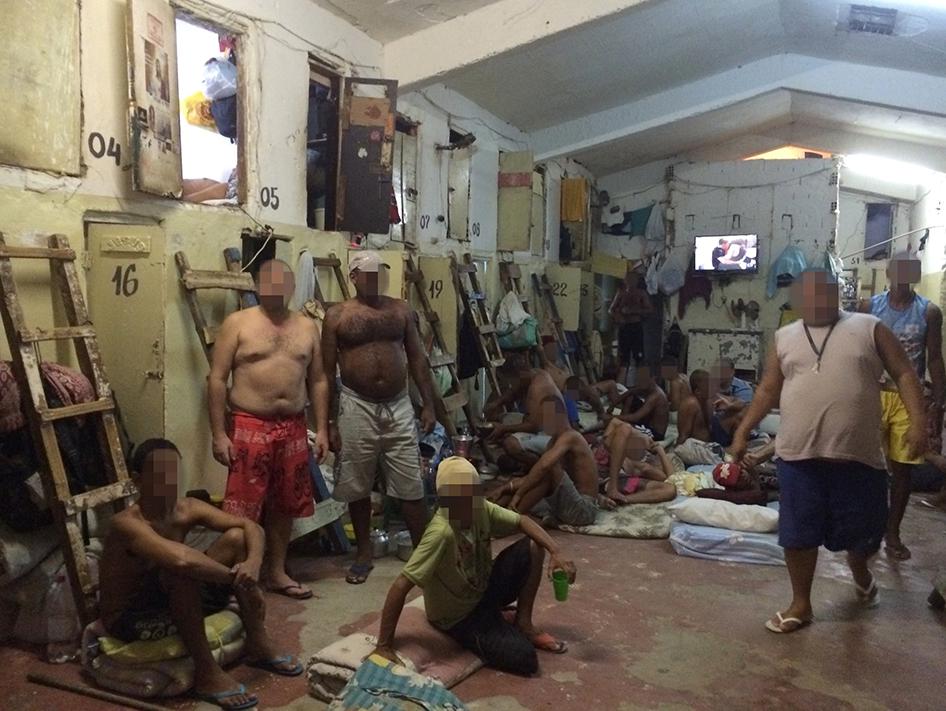
Makeshift “barracos,” or cubicles, inside Pavilion 7 at Presídio Juiz Antônio Luiz L. de Barros (PJALLB), in Recife. (Photo courtesy of Human Rights Watch)

The problem is most pronounced in Pernambuco, a small northeastern state. Prisons there are meant to hold a maximum of 10,500 inmates at a time. They currently hold about 32,000 inmates, which is about three times its intended capacity. Currently, there is a thirty prisoner to one guard ratio.

Due to severe understaffing, many of Brazil’s prisons, including Pernambuco, are not controlled by guards, but by inmates. In their report, Human Rights Watch described the use of “keyholders” to maintain order in Brazil’s severely overcrowded prisons.

These keyholders, designated by penitentiary staff, maintain control over almost all aspects of life in the prisons, including the sale of drugs. Keyholders are usually backed by “militias” – strongmen who beat, threaten, and extort other prisoners.

Keyholders themselves usually have private cells, with amenities such as televisions and bathrooms. They often charge inmates about 2,000 reais (the equivalent of USD 530) for a portion of a cell and often require payment of weekly “taxes” to avoid beatings.

Prison staff maintain control over outside pavilions, the areas surrounding multiple cell blocks. Officials have been accused of turning a blind eye to the corruption, or receiving kickbacks.

Sixty percent of inmates have not been convicted and are still awaiting trial. A large number of prisoners in Pernambuco are awaiting custody hearings, wherein a judge makes a determination whether to hold or release the arrestee pending trial. Pernambuco only began providing these hearings in August 2015.  Arrestees are entitled to these hearings under international law.

Additionally, there is no separation of those awaiting trial and those convicted of lesser crimes and convicted violent criminals. Packed, unsanitary conditions have led to outbreaks of tuberculosis, HIV and sexual violence amongst prisoners.

For more information, please see:

Human Rights Watch – Brazil: Where Inmates Run the Show – 19 October 2015

Human Rights Watch – The State Let Evil Take Over – 19 October 2015

Human Rights Watch – Pernambuco’s Privatized Prisons – 20 October 2015

Vice News – This Report on Brazil’s Prisons Exposes a ‘Human Rights Disaster’ – 20 October 2015

Newsweek – Brazil’s Prisons are a ‘Human-Rights Disaster’” HRW – 21 October 2015

New Zealand Herald – Watchdog group blasts Brazil’s violent, crowded prisons – 21 October 2015


European Leaders Discuss Refugee Crisis at Heated Summit

by Shelby Vcelka

Impunity Watch Desk Reporter, Europe

BRUSSELS, Belgium–

European leaders have met in Brussels to try to agree on a plan to deal with the large numbers of refugees making their way through impoverished Eastern European countries. The plan that was outlined before the conference began propositioned that Balkan and other Eastern European countries should stop allowing asylum seekers to cross the borders into neighboring countries without acquiring some kind of agreement on a quota system. It also included measures to send approximately 400 border guards to Western Balkans nations, and more maritime support off the coast of Greece within the next week. The European Union would also be tasked with speeding up repatriations of Afghans, Iraqis and others affected by war if their asylum claims were rejected.

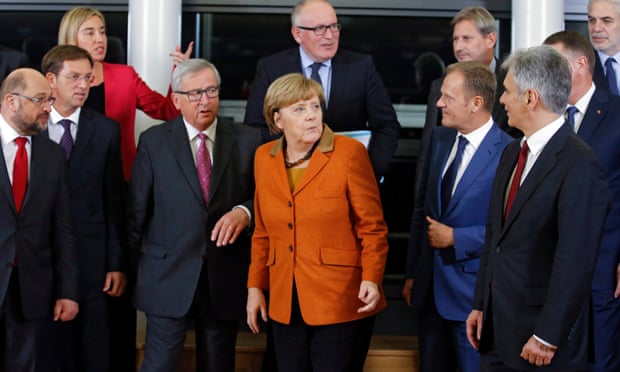
Leaders of EU member nations met in Brussels to discuss a comprehensive, coordinated plan for dealing with the refugee crisis. (Photo courtesy of The Guardian)

The European commission president, Jean-Claude Juncker, put the plan together and designed it to stem the flow of refugees through the Balkan and Central European “safe zone” towards Austria and Germany. The borders put up by Eastern European countries, Juncker reasoned, had already compromised the Schengen visa-free zone, and this plan would help stop the rising tensions between neighboring countries in an already unstable region. “If we do not deliver some immediate and concrete actions on the ground in the next few days and weeks I believe the EU and Europe as a whole will start falling apart,” he said.

As the cold weather approaches, both the EU member nations and international aid organizations are increasingly concerned about how the already overwhelmed countries will provide aid.   Medecins Sans Frontiers warned of coming frostbite and announced an critical need for food, warm shelters, and shower facilities at major transportation locations. Additionally, the UN has drawn up plans to distribute thousands of winter and raincoats, tarps, and socks to migrants in south Eastern Europe. Already, the temperatures have dropped to below freezing levels at night. The movement of refugees is not expected to slow once the cold weather arrives.   “Every day counts. Otherwise we will soon see families in cold rivers in the Balkans perish miserably,” Juncker said in an interview.

The summit was a move by Juncker and the German Chancellor, Angela Merkel, to raise pressure on the European states to coordinate on the migrant crisis and stop fighting between them. The hope was to help manage migration flow in a humane way.

For more information, please see

Reuters– EU’s Juncker summons leaders over Balkan refugee crisis— 21 October 2015

BBC– Migrant crisis: Emergency talks on Balkans under way— 25 October 2015

The Guardian– European leaders discuss refugee crisis at tense Brussels summit— 25 October 2015

The Telegraph– Refugees will freeze to death, warn EU head— 25 October 2015

U.S. News & World Report– EU leaders exchange barbs at migrant summit as refugees march by the thousands across Europe— 25 October 2015

Three Chinese Diplomats Shot in Philippines

By Christine Khamis

Impunity Watch Reporter, Asia


MANILA, Philippines –

Two Chinese diplomats were shot to death in a restaurant in Cebu, a central city in the Philippines, on Wednesday. Another Chinese diplomat was wounded after he was shot in the neck by the same shooter. Two of their colleagues are suspects in the shootings.

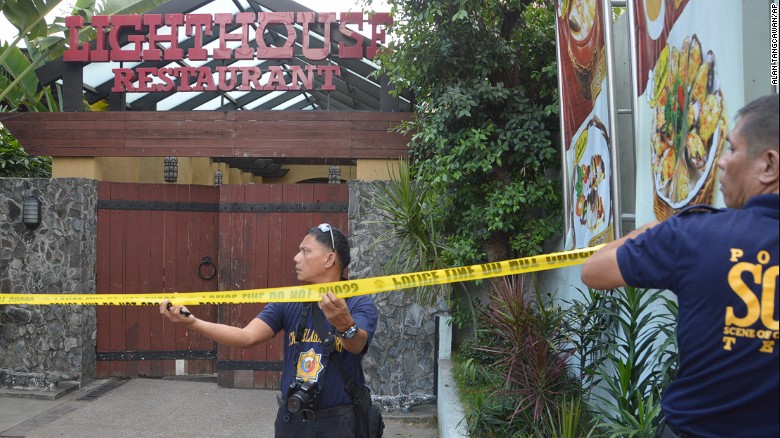
Police outside of the restaurant where Ms. Li, Mr. Sun, and Consul General Song were shot. (Photo courtesy of CNN)

Li Qingliang and his wife, Guo Jing, both employees at Cebu’s Chinese Consulate, have been identified as the suspects in the shooting. Police found a .45-caliber pistol left behind by the suspects at the restaurant. Police have not yet determined Mr. Li and Ms. Guo’s motive for the shootings. Mr. Li and Ms. Guo fled from the restaurant but were later arrested at Cebu’s consular office.

According to Colonel Romeo Santander, Superintendent of Cebu Police City Intelligence Branch, Li Hui and Sun Shen, employees of the Chinese Consulate, were shot while dining with their colleagues.

Ms. Li was a finance officer for the Chinese Consulate and Mr. Sun was the Consul General’s deputy. The Consul General, Song Ronghua, was also shot and wounded. He is currently in stable condition.

Colonel Santander said that video footage of the shootings shows an argument breaking out among the people seated at the table. Mr. Li then shot Ms. Li, Mr. Sun, and Consul General Song.

The Philippine Foreign Ministry has stated that both Mr. Li and Ms. Guo have diplomatic immunity pursuant to the Vienna Convention, as they are accredited Chinese diplomats. The Ministry’s spokesman, Charles Jose, says that both will handed over to China and will be subject to China’s legal process. China’s ministry of Foreign Affairs stated that the case will be handled according to applicable international treaties and bilateral consular agreements.

China and the Philippines have disputed over territorial claims in the South China Sea. Consul General Song recently took office and has been working to help China improve ties with the Philippines. Local reports say that Consul General Song stated that the two countries had “no excuses to quarrel” at a conference that took place last month.


For more information, please see:

CNN – Two Chinese Diplomats Accused of Killing Colleagues in the Philippines – 22 October 2015

BBC – Chinese Diplomats Shot Dead in Philippines Restaurant Attack – 21 October 2015

The New York Times – 2 Chinese Diplomats Shot to Death in Philippines – 21 October 2015

Voice of America – 2 Chinese Diplomats Killed in Philippines Shooting – 21 October 2015

The Wall Street Journal – Two Chinese Diplomats Killed by Gunman in Philippines – 21 October 2015

Putin Meets With Assad in Moscow to Discuss Syrian Crisis

by Shelby Vcelka

Impunity Watch Desk Reporter, Europe

MOSCOW, Russia–

In a surprise visit to Moscow, President Bashar al-Assad of Syria met with the Russian President Vladimir Putin to discuss the situation in Syria. Putin stressed that Russia’s support with military operations in Syria must lead to a political process that ends the conflict indefinitely.   The visit demonstrated strengthened confidences between the leaders, as Russia had recently escalated their support in the region, by carrying out airstrikes against the Syrian insurgents.

President Assad of Syria shakes hands with Russian President Vladimir Putin after meeting to discuss Russia’s involvement in the Syrian Civil War. Assad’s surprise visit to Moscow was indicative of Russia’s continuing support of his regime. (Photo courtesy of Reuters)

Moscow, a long time ally of the Assad regime, began an air raid and bombing campaign on September 30th, against alleged terrorist groups they claim threaten Assad’s rule in the region. However, the United States and other western nations state that the Russian intervention will end up bolstering the Assad regime, and create more conflict. While Putin claims that the Russian military is fighting against the Islamic State and other terrorist militants in Syria, many of the airstrikes have actually been conducted against Syrian rebels and other dissidents of the Assad regime. The Russian government is the latest nation to get involved in the Syrian Civil War.

“A long-term settlement can only be achieved as part of a political process with the participation of all political forces, ethnic and religious groups. The Syrian people have been putting up a fight against international terrorism effectively on its own for several years, sustaining sizable losses but it has achieved positive results recently,” Putin said.

Through the meetings, Putin made it clear that Russia seeks to have a leading role in any solutions regarding Syria’s political future, seemingly to ensure Russia’s sphere of influence in the Middle East. He further stated that Russia’s involvement in the Syrian crisis was “necessary,” as around 4,000 people from the former Soviet Union republics were fighting in Syria against the Syrian army. If these insurgents were allowed to return to Russia, Putin said, they might foment insecurity, and create violence at home.

For more information, please see

Huffington Post–Bashar Assad Meets With Vladimir Putin – In Moscow— 21 October 2015

Russian Times– Assad to Putin at Moscow talks: Terrorists would seize larger areas if Russia did not act— 21 October 2015

Washington Post– In rare foreign trip, Assad flies to Moscow to meet with Putin— 21 October 2o15

Mail & Guardian– Putin meets Assad – runs rings around Western critics— 22 October 2015

Syria Deeply: Uncovering Human Rights Abuses in Syria: Q&A with Dr. Anna Neistat

Dear Readers,

Welcome to the weekly Syria Deeply newsletter. We’ve rounded up the most important stories and developments about Syria and the Syrians in order to bring you valuable news and analysis.

Uncovering Human Rights Abuses in Syria: Q&A with Dr. Anna Neistat

Syria Deeply speaks with Dr. Anna Neistat about her undercover human rights work in Syria with Human Rights Watch’s Emergency Team, Russia’s widening role, the west’s hyper-focus on the Islamic State and the future of the conflict as she sees it.

Do-It-Yourself Alternative Energy in Besieged al-Ghouta

Syria Deeply speaks with a medical equipment engineer and member of the Union of Free Syrian Doctors in besieged eastern al-Ghouta to discuss the creative methods residents are using to overcome the government-imposed blockade.

Russia’s Air Campaign Benefits ISIS

That ISIS benefits from Russia’s military involvement is no surprise, and is not even a coincidence or unfortunate by-product, argues Sharif Nashashibi. The stronger ISIS gets, the more people will buy into the flawed notion that Assad is an indispensable partner in the group’s defeat. Assad hence becomes part of the solution to the Syrian conflict rather than part of the problem, or in fact the cause.

More Recent Stories to Look Out for at Syria Deeply:

• Repurposed Weddings Emerge From the Ashes of the Syrian Conflict
• My Syrian Diary: Part 44
• Without Committed Air Support, Kurdish Forces Cannot go on the Offensive Against ISIS 

Find our new reporting and analysis every weekday at www.syriadeeply.org. You can reach our team with any comments or suggestions at info@newsdeeply.org.