Germany Enforces Emergency Border Controls Due to Migrant Influx

by Shelby Vcelka

Impunity Watch Desk Reporter, Europe

BERLIN, Germany–

Interior Minister, Thomas de Maiziere, announced that Germany would impose temporary border controls on its border with Austria to deal with the massive influx of migrants. While affirming that Germany had the capacity to welcome a significant number of refugees, de Maiziere called on other European Union nations to do more, and reiterated that migrants cannot choose their host country.
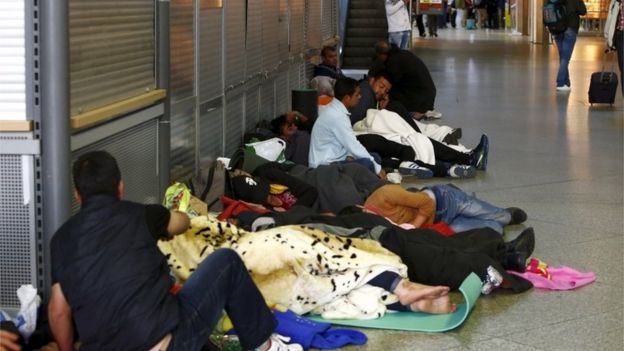
Migrants spend the night in a train station after arriving in Munich. Following Interior Minister Thomas de Maiziere’s announcement, the borders between Austria and Germany will be more strictly enforced. (Photo courtesy of BBC.)

Up until now, Germany has had an open policy regarding migration. However, the massive numbers of refugees, who have mainly been turned away from other countries, coming into Germany, has caused an overflow. “The aim of these measures is to limit the current inflows to Germany and to return to orderly procedures when people enter the country,” de Maiziere said at a news conference. Although this goes against the idea of the Schengen zone, which allows for free movement between several different European nations, the agreement permits individual countries to suspend the free movement on a temporary basis.

Germany has also announced that these measures are only temporary, and will only turn away migrants not fleeing war or persecution in their home country. Additional measures include shutting down borders to admit those with passports, and sending police and the army to patrol the borders. The emergency measures are a clear demonstration of how extensive the migrant crisis is, and how Germany has been stretched thin in the past couple of days.

In the meantime, trains between Germany and Austria have been suspended. They are set to resume Monday afternoon. This past Saturday alone, more than 13,000 migrants arrived in Munich, with a total of 800,000 migrants expected to arrive in total. Munich has borne the brunt of the arrivals, as it is the southernmost major city in Germany, closest to the border Austria.

The move to temporarily close the borders also serves as a threat to other European nations. de Maiziere mentioned in his statement that Germany would “first” close its borders with Austria, with the insinuation that borders with other countries would be soon to follow. The implication may be that other European Union countries will have to act to help ease the burden off of Germany.

For many migrants, the move means Germany is no longer pursuing a laissez-faire policy, and that the Dublin Rule of migration is still enforceable. With this, migrants will be forced to register with the first country they arrive in, and any others outside the strict migration quota will be turned away.

For more information, please see–

BBC–Migrant crisis: Germany to start temporary border controls— 13 September 2015

The Telegraph–Border controls return to Europe as continent struggles with refugee crisis— 13 September 2015

Time–Germany Imposes Emergency Border Controls as Migrants Continue to Arrive— 13 September 2015

USA Today–Germany imposes emergency border controls— 13 September 2015

Wall Street Journal–Germany Imposes Border Checks Amid Migrant Wave— 13 September 2015

Exiled Yemeni President Backs out of Peace Talks

By Brittani Howell

Impunity Watch Reporter, The Middle East

SANA’A, Yemen – On Sunday, Yemen’s exiled President, Abd Rabbu Mansour Hadi, announced that he will not participate in United Nation’s peace talks with the Houthi rebels. President Hadi stated that there will only be peace talks with the rebels in the event that the Houthis withdraw from the areas they seized and surrender any weapons.

Nader Mohammed, a doctor in Sana’a, in his apartment after an airstrike. (Photo Courtesy of New York Times)

The self-exiled government is making plans to return to the city of Aden by the end of this month. Over 200 soldiers from Saudi Arabia, United Arab Emirates, and Yemen, have travelled to Aden in order to secure the city so that the exiled government can return. Currently, part of Aden is under the control of al-Qaeda.

Previous attempts to end the conflict and to enter into peace-talks have all failed. Over 4,500 people have been killed since the conflict began. According to the United Nations Human Rights Commissioner, from the start of the Saudi-led offense and through June 30, 1,527 civilians have been killed. Of the 1,527 killed, 941 deaths were caused by airstrikes.

The Saudi-led coalition’s strikes have strayed from military targets and have struck civilian areas, causing many to accuse the coalition of punishing all who reside in areas under Houthi rebel control. Residents in northern Yemen, largely Shi’ite Muslims, have claimed the Saudi-led coalition attacks are a sectarian purge, as the coalition is largely Sunni Muslim.

“They kill innocents and claim to be killing Houthis. They are targeting the whole population.” Stated Adam Mujahid Abdullah, a survivor of an airstrike that targeted residential homes overlooking a university that had been used as a base for Houthi rebels.

Many people have been forced to take shelter in the mountains, as a result of the frequent airstrikes. Dr. Natalie Roberts, from Doctors Without Borders, stated “It’s no kind of life. Waiting in a cave to see if you’re going to get bombed.” Others have been forced South, most forced to walk on foot.

In the province of Marib, 25 fighters from both the rebels and the coalition were killed when the Saudi-led coalition advanced and cut off the Houthi rebels supply lines.

On Saturday, it was alleged that a United States drone attack killed 4 people in the province of Hadramawt. Security officials stated that masked gunmen prevented access to the site of the attack as the victims had been buried near by.

The United Arab Emirates on Saturday mourned the loss of 52 soldiers, who were killed in a Houthi rebels’ missile attack on September 5, 2015. This was the heaviest loss the country has seen since 1971.

For more information, please see:

Los Angeles Times – Yemen’s Exiled President Backs Out of Talks With Rebels – 13 September 2015

Reuters – Exiled Yemeni Government Pulls out of Planned Peace Talks – 13 September 2015

The Associated Press – Yemen’s Exiled President Backs out of Talks With Rebels – 13 September 2015

The New York Times – Airstrikes Take Toll on Civilians in Yemen War – 12 September 2015

UN General Assembly Adopts Resolution for International Day of Commemoration of Victims of Genocide

September 11, 2015

Today the UN General Assembly passed a resolution establishing 9 December as the International Day of Commemoration and Dignity of the Victims of the Crime of Genocide and of the Prevention of this Crime. The Global Centre for the Responsibility to Protect commends the Republic of Armenia for their leadership on this issue as well as the more than 80 member states who co-sponsored the resolution. On 9 December the Global Centre will join the international community in commemorating and honoring the victims of this most horrific crime.

As the resolution notes, the UN Convention on the Prevention and Punishment of the Crime of Genocide calls for memorialization of genocide as a means for preventing the future perpetration of this crime. This call was echoed in the UN Secretary-General’s 2013 report on the Responsibility to Protect where it was noted that many states, including Cambodia, Germany, Poland and Rwanda, have institutionalized the memory of past mass atrocity crimes as an element of preventive action, promoting greater understanding of the nature and legacy of such crimes.

During 2014 and 2015 the international community commemorated significant anniversaries of the most atrocious crimes of the last century including, the 100th anniversary of the Armenian genocide, 70th anniversary of the liberation of Auschwitz, 40th anniversary of the Khmer Rouge’s atrocities in Cambodia and the 20th anniversaries of the genocide in Rwanda and at Srebrenica, Bosnia and Herzegovina.

In the aftermath of these tragedies the UN and its member states have sometimes undertaken initiatives to respond to past failures, including the 2005 adoption of the principle of the Responsibility to Protect. But ongoing crises today underline the need for effective action to prevent the perpetration of genocide and other mass atrocity crimes wherever and whenever they occur.

This annual day of commemoration will serve as an opportunity for member states to annually address some of the core aims of the Responsibility to Protect – including preventing the incitement and enabling of genocide and ensuring justice for all victims of genocide. As we prepare for the inaugural day of commemoration, we also call upon all member states to sign and ratify the Convention on the Prevention and Punishment of the Crime of Genocide.

This Week in Syria Deeply September 11, 2015

WEEKLY UPDATE

September 11, 2015

Dear Readers,

Welcome to the weekly Syria Deeply newsletter. We’ve rounded up the most important stories and developments about Syria and the Syrians in order to bring you valuable news and analysis. 

Syrians Risk Lives to Reach Europe

More than 2,500 Syrians died throughout the summer as they tried to brave the Mediterranean Sea in order to reach the shores of Europe, where they hope to obtain asylum. Syria Deeply met with many of those refugees in Turkey, and spoke to a peoples muggler who facilitates their dangerous journeys.

Syrians Endure ‘Endless’ Agony Waiting for ‘Disappeared’ Relatives

Umm Ayman hasn’t seen her son since he was arrested by the Syrian government in February 2013. He is one of tens of thousands of Syrians who have “disappeared” and cannot be accounted for since the outbreak of the country’s civil war in March 2011.

Syrian Refugees Find Shelter in Lebanon’s Palestinian Camps

Umm Ali and her 10-member family fled Syria under barrel bombs and shells, only to find themselves in Shatila, a Palestinian refugee camp in Beirut, Lebanon. They are among the 45,000 Palestinian refugees who fled the camps in Syria to end up in poverty-stricken camps in neighboring Lebanon. Syria Deeply met her and others in Shatila.

More recent stories to look out for at Syria Deeply:

Find our new reporting and analysis every weekday at www.syriadeeply.org.
You can reach our team with any comments or suggestions at 
info@newsdeeply.org.

North and South Korea to Allow Reunion of Some Families Split up During Korean War

By Christine Khamis

Impunity Watch Reporter, Asia


SEOUL, South Korea –

Authorities in both North and South Korea have agreed to allow reunions of families split up during the Korean War. 100 people from each side will be allowed to reunite with their family members and other relatives from October 20-26 in North Korea.

During talks on Tuesday in the border village of Panmunjom, Red Cross Delegates from both Koreas discussed an agreement allowing families to reunite. The agreement states that North and South Korea will work to resolve humanitarian issues, according to South Korea’s Unification Ministry. The agreement was part of a deal ending the Koreas’ military standoff, which began when South Korea blamed North Korea for the deaths of two South Koreans in a land mine explosion.

North and South Korean Red Cross delegates making agreement to allow families to reunite. (Photo courtesy of Reuters)

There are many in North and South Korea who do not know whether their family members and other relatives are still alive because they are prohibited by their respective governments from attempting communication.

200 people were allowed to reunite for six days in February 2014 as a result of a previous agreement between North and South Korea. Emotions ran high as family members were reunited with each other. However, the meetings were brief, limited to just a few days. Families also had little privacy due to North Korean workers listening to their conversations.

It is not clear how North Korea chooses the people who will meet their families. There is a great deal of uncertainty for those in South Korea because they are required to participate in a lottery for the chance to meet their families. The South Korea Unification Ministry reports on its website that around 130,000 South Koreans have registered for the chance to meet their families since 1988. Out of that number, only 66,000 people are believed to still be alive. Many of the 66,000 are in their 80s and 90s. In the past, many older Koreans have died before they have the chance to reunite with their families.

During the Korean War, the Korean peninsula was split into North and South Korea. The war is technically still ongoing because instead of a formal peace treaty, the two sides agreed to a truce through the Korean Armistice Agreement of 1953.

Since the Korean Armistice Agreement, there have been other reunions in which around 22,500 Koreans have participated. Out of that number, around 18,822 people met with family members in person, while the remaining people reunited through video conferencing. None of the 22,500 have been allowed a second chance to see their relatives, according to South Korea’s Red Cross Delegation.


For more information, please see:

International Business Times – North and South Korea Agree to Hold Family Reunion for the Second Time After Split – 9 September 2015

CNN – North and South Korea Agree to Family Reunions in October – 8 September 2015

Reuters – North, South Agree to Hold Family Reunions in October: South – 8 September 2015

The New York Times – South Korea: North Agrees to Reunions – 7 September 2015

Reuters – North Korea Agrees to Talks With South on Family Reunions – 29 August 2015