Australia Agrees to Increase Refugee Intake

By Samuel Miller
Impunity Watch Reporter, North America and Oceania

CANBERRA, Australia — Prime Minister Tony Abbott on Wednesday announced that Australia would accept 12,000 Syrians from persecuted minorities. This increase will be a supplementary intake, in addition to the 13,750 overall intake of confirmed refugees for 2015; the increase is expected to consist largely of Syrian refugees.
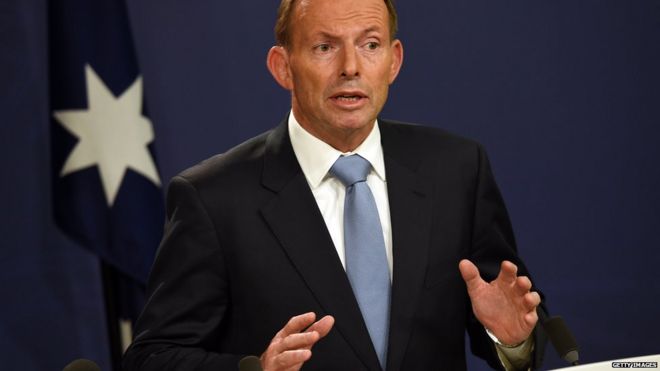
Prime Minister Tony Abbott Announces Australia’s Refugee Intake. (Photo Courtesy of BBC News)

Australia will also give AU$44 million, or roughly $32 million USD, to the United Nations to directly pay for the support of 240,000 displaced people in countries neighboring Syria and Iraq.

The increase will be a one-time increase, rather than a permanent increase, and the refugees are to be granted permanent residency. The focus for the additional intake will be on women, children and families from persecuted minorities.

Some of the Prime Minister’s colleagues called for the priority of Australia’s intake to be Christians, prompting the Labor Party and others to declare that the places should be allocated on a needs basis, without qualification or discrimination.

Recently, Prime Minister Abbott confirmed the intake would include Christians, but not exclusively.

“There are persecuted minorities that are Muslim, there are persecuted minorities that are non-Muslim, and our focus is on the persecuted minorities who have been displaced and are very unlikely ever to be able to go back to their original homes,” said Prime Minister Abbott.

Treasurer Joe Hockey said it might take more than two years to resettle all of the 12,000-Syrian-refugees in Australia announced this week, and Prime Minister Abbott refused to include refugees languishing in offshore detention in the emergency intake.

Also announced Wednesday, the government has also decided that Australian combat aircraft would join bombing raids in Syria, extending the existing mission beyond the borders of Iraq where the operations are at the invitation of the Iraqi government.

The government’s decision to extend air strikes into Syria, a sovereign state, has been criticized in some quarters. Unlike Iraq, Syria has not asked for international help to fight IS.

Independent MP Andrew Wilkie said the UN had not approved the air strikes and the government’s claim it could make the strikes under “collective self-defense” was not true.

Article 51 of the UN charter guarantees “the inherent right of individual or collective self-defense if an armed attack occurs against a member of the United Nations”.

Furthermore, in Papua New Guinea, Prime Minister Abbott insisted Syrian asylum seekers in Nauru and Manus Island detention centers would not be resettled as part of the intake. The Prime Minister stated that to do so “would encourage the evil trade of people smuggling.”

Australia refuses to resettle refugees who try to come to the country by boat and has a policy of turning back asylum-seeker boats, detaining refugees in Pacific camps and denying them resettlement in Australia even if they are found to be refugees.

For more information, please see:

Sydney Morning Herald — Migrant crisis: Australians throw open their doors to Syrian refugees – 10 September 2015

BBC News — Migrant crisis: Australia ups refugee intake and plans Syria strikes – 9 September 2015

Defense News — Australia Boosts Refugee Intake, Extends Airstrikes To Syria – 9 September 2015

Military Times — Australia to launch airstrikes in Syria, take more refugees – 9 September 2015
The Guardian — Australia to accept an extra 12,000 Syrian refugees and will join US-led airstrikes – 8 September 2015

War Crimes Prosecution Watch: Volume 10, Issue 13 – September 7, 2015

War Crimes Prosecution Watch is a bi-weekly e-newsletter that compiles official documents and articles from major news sources detailing and analyzing salient issues pertaining to the investigation and prosecution of war crimes throughout the world. To subscribe, please email warcrimeswatch@pilpg.org and type “subscribe” in the subject line.

Opinions expressed in the articles herein represent the views of their authors and are not necessarily those of the War Crimes Prosecution Watch staff, the Case Western Reserve University School of Law or Public International Law & Policy Group.

Click the links to read further 

Contents

Central African Republic & UgandaDarfur, SudanDemocratic Republic of the Congo

Kenya

Libya

Cote d’Ivoire (Ivory Coast)

EUROPE

Court of Bosnia & Herzegovina, War Crimes Chamber

International Criminal Tribunal for the Former Yugoslavia

Domestic Prosecutions In The Former Yugoslavia

MIDDLE EAST AND ASIA

Extraordinary Chambers in the Courts of Cambodia

Iraq and Syria

Islamic State of Iraq and the Levant

Special Tribunal for Lebanon

Bangladesh International Crimes Tribunal

War Crimes Investigations in Burma

WORTH READING

TRUTH AND RECONCILIATION COMMISSION

COMMENTARY AND PERSPECTIVES

Chile to take in Syrian Refugees

By Kaitlyn Degnan
Impunity Watch Reporter, South America

SANTIAGO, Chile — Chile will take in refugees, President Michelle Bachelet announced Monday. Speaking at a religious ceremony, she said, “Throughout our history, we have always had our doors open to those, sometimes coming from far away places, bringing their history and cultural to the construction of our nation.”

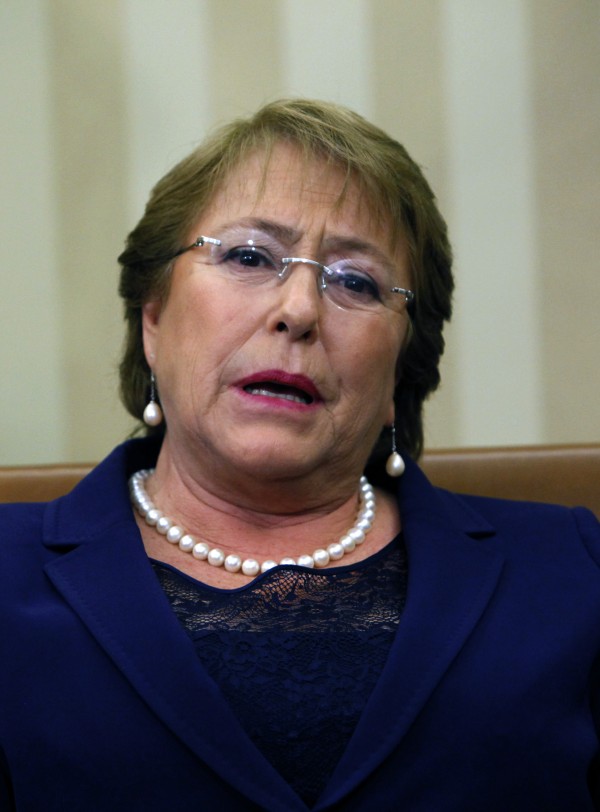
Chilean President Michelle Bachelet. (Photo courtesy of the Latin Post)

The foreign ministry confirmed the statement on Tuesday, saying that the refugees would come from Syria. A statement released by Foreign Minister Heraldo Munoz stated that “it will happen as soon as possible,” and that the country could initially take in 100 families.

The plan, reportedly presented to the government by a former minister of Syrian descent, would provide shelter for 50 to 100 families, and has the support of the Chilean Arab population.

Chile is expediting the visa process for those Syrians that have requested them.

Many world leaders, including spiritual figures like Pope Francis, have called on countries and communities around the world to take in refugees.

A number of other South American countries have also agreed to take in Syrian refugees, including Argentina and Venezuela. Argentina eased entrance requirements last year, but according to the UN High Commissioner for Refugees, less than 100 Syrians have arrived in Argentina so far. Venezuelan President Nicolas Maduro has announced that the country is prepared to grant asylum to 20,000 escaping the Syrian conflict.

Brazil has taken in 2,000 Syrian refugees so far, with over 1,400 granted asylum in 2014 alone.

However, not all resettlement schemes have been successful. Uruguay, who accepted a number of refugees last year as part of a resettlement program, is facing criticism from the refugees themselves. The resettled families, who have been living in Uruguay since October, have been protesting outside of the presidential offices, saying, “this is not a place for refugees.” The families say that they are “isolated and struggling,” which may be due to Uruguay’s minute Arab population and high costs of living.


For more information, please see:

US News & World Report – Argentina cabinet chief says the country’s doors are open to Syrian refugees fleeing war – 4 September 2015

Reuters – Chile mulls plan to take in Syrian refugees: newspaper – 6 September 2015

Latin Post – Syrian Refugee Crisis: Chile to welcome undisclosed number of refugees – 8 September 2015

Reuters – Chile government says it will take in Syrian refugees – 8 September 2015

Voice of America – Venezuela offers to take in 20,000 Syrian refugees – 8 September 2015

Yahoo News – Bachelet says Chile will welcome Syrian refugees – 8 September 2015

Yahoo News – Latin American nations offer to take in Syrian refugees – 8 September 2015


United Nations General Assembly Holds Successful Seventh Dialogue Marking Ten Years of the Responsibility to Protect

Curtesy of the Global Centre for the Responsibility to Protect 

Today the UN General Assembly held a successful seventh Informal Interactive Dialogue on the Responsibility to Protect (R2P). The Interactive Dialogue addressed the UN Secretary-General’s seventh annual report on R2P, entitled “A vital and enduring commitment: Implementing the responsibility to protect.”

During the dialogue, 69 member states and 1 regional organization delivered statements on behalf of 91 states. The 49-member Group of Friends of R2P also delivered a joint statement, read by the Netherlands. In addition to member states and the European Union, four civil society organizations, including the Global Centre for the Responsibility to Protect, delivered statements.

UN Secretary-General Ban Ki-moon opened the dialogue stating, “For ten years, R2P has offered an alternative to indifference and fatalism. The challenges of atrocity crimes are enormous – and the human cost is staggering. That is not a reason to be overwhelmed – it is a cause for urgent action. The collective weight of international action can make a difference. I count on your leadership in making sure that R2P provides real protection for people in dire need.”

The majority of member states reaffirmed the considerable progress made in advancing the principle since the 2005 World Summit. At least 16 individual states and the Group of Friends of R2P, showed support for a UN General Assembly resolution to mark the tenth anniversary. A number of states, including the Group of Friends, also expressed their support for moving R2P onto the formal agenda of the United Nations.

Member states also expressed concern about the dire situation facing civilians around the world, including in Syria, Iraq, South Sudan, Central African Republic and the Democratic People’s Republic of Korea. Recalling the special responsibility borne by the UN Security Council, many states raised the need for voluntary restraint on the use of the veto within the UN Security Council when dealing with situations where mass atrocity crimes are occurring. Specific attention was paid to the complementary initiatives of the Governments of France and Mexico and of the 25-member Accountability, Coherence and Transparency Group in this regard.

Recognizing the importance of intergovernmental networks for mass atrocity prevention, at least 26 speakers recalled the importance of appointing a national R2P Focal Point and participation in the Global Network of R2P Focal Points.

Dr. Simon Adams, in his statement on behalf of the Global Centre for the Responsibility to Protect, reminded the assembled states of “the plight of those untold millions of our fellow human beings” still threatened by mass atrocity crimes in Iraq, Syria, Sudan and elsewhere.

Dr. Adams said that, “their voices will not be heard in this chamber today, but the Responsibility to Protect was created for them. The success or failure of R2P must continue to be judged on the ability of the international community to meaningfully protect the vulnerable against those who would incite, plan or perpetrate genocide, war crimes, ethnic cleansing, and crimes against humanity.”

For the Global Centre’s statement at the interactive dialogue, please see:Statement of the Global Centre for the Responsibility to Protect at the 2015 UN General Assembly Informal Interactive Dialogue on the Responsibility to Protect.

To see a summary of the Secretary-General’s report and for more information about the dialogue, please see: UN General Assembly Informal Interactive Dialogue on the Responsibility to Protect: “A vital and enduring commitment: Implementing the responsibility to protect,” 2015. The Global Centre will be releasing a summary of the interactive dialogue shortly.

For more information or media inquiries please contact Evan Cinq-Mars at ecinq-mars@globalr2p.org or +1-212-817-1931.

Australia to Reconsider Syrian Refugee Intake

By Samuel Miller
Impunity Watch Reporter, North America and Oceania

CANBERRA, Australia — Prime Minister Tony Abbott has told Parliament the government will announce its response to the Syrian refugee crisis by the end of the day. On Sunday Prime Minister Abbott said the government would consider increasing the number of Syrians and Iraqis it would take as part of the humanitarian resettlement quota, but ruled out an overall increase in numbers.

Syrian Refugees Crossing the Border Between Greece and Macedonia. (Photo Courtesy of The Guardian)

Prime Minister Abbott has said more Syrian asylum seekers would be let into the country, but has stopped short of boosting overall refugee numbers. The increase would not mean Australia’s overall yearly intake of refugees would go up.

“Our focus will be on families and women and children, especially of persecuted minorities, who have sought refuge in camps neighboring Syria and Iraq,” the Prime Minister said.

Currently, Australia has set a quota for accepting refugees from around the world, which stands at 13,750 people. Last financial year, Australia settled more than 4,400 people from Syria and Iraq, Prime Minister Abbott said. The overall refugee intake will increase to 18,750 by 2018.

However, some within the Australian government are urging the Prime Minister and Australia to do more.

On Monday, Assistant Treasurer Josh Frydenberg called for temporary housing of Syrian and Iraqi asylum seekers. Mr. Frydenberg said there was a good case for a Kosovo-type solution that would see Syrian and Iraqi refugees housed in Australia, then returned home once the countries were safe.

Foreign Minister Julie Bishop said Australia was mostly looking at the plight of those minorities who wanted to flee Syria permanently. However, echoing Mr. Frydenberg, Ms. Bishop said there were a number of people currently fleeing Syria that would want to return home once the conflict was over.

“When the conflict is over people will want to return to Syria and Iraq. But there are some persecuted ethnic and religious minorities who will not want to go home so they are the ones we are focusing on as other countries are as well,” she said.

Ms. Bishop also said the government was still considering its options, including agreeing to an emergency Syrian intake as suggested by Labor yesterday.

“On a per capita basis we take in more refugees than any other country throughout the world,” she said. “When we see the photos, yes our hearts go out to these people, but let’s step back and ask where is the money coming from?”

Prime Minister Abbott has been urged to increase Australia’s refugee intake after photos of a drowned Syrian toddler on a Turkish beach shocked the world and put a human face to the dangers refugees risk trying to reach safety.

For more information, please see:

AU News — Julie Bishop says Australia will decide on upping the Syrian refugee intake in days – 8 September 2015

BBC News — Australia under pressure to boost total refugee intake – 7 September 2015

ABC News — Tony Abbott says Australia will accept more Syria refugees but within current intake, Peter Dutton to travel to Geneva for UN talks on crisis – 6 September 2015

The Guardian — Ministers press Tony Abbott for increase in refugee intake over Syria crisis – 6 September 2015