|
Chinese Journalist Arrested and Forced to Give Televised Confession
By Christine Khamis
Impunity Watch Reporter, Asia
BEIJING, China —
Chinese journalist Wang Xiaolu was arrested in late August for his article about the recent China stock market crisis, which affected the global economy. Mr. Wang was forced to confess on China Central Television, China’s state television network, that he had gathered information for his article using private sources and abnormal means. Mr. Wang also confessed that he had added his own subjective views to the information that he had found and that his article was “sensational” and “irresponsible”. Mr. Wang stated that he hoped for leniency from judicial authorities.

Mr. Wang, a reporter for business magazine Caijing, was arrested at his home and taken into police custody last Tuesday. His televised confession occurred before any formal court proceedings.
Mr. Wang’s article in Caijing about the stock market crisis indicated that China’s Securities Regulatory Commission (CSRC) planned to withdraw money from the already struggling stock market. The CSRC denied the story, but Chinese authorities believe that Mr. Wang’s article contributed to the stock market plunge in July 2015. According to Xinhua, China’s official press agency, Mr. Wangs’s article caused “abnormal fluctuations” in the stock market.
Mr. Wang has been accused of “ colluding with others and fabricating and spreading false information concerning securities and futures trading”, according to Xinhua. He has been placed under “criminal compulsory measures”, which could lead to jail, house arrest, residential surveillance, or other punishments.
It has been a surprise to many that the Chinese government has targeted Caijing. While the financial magazine has a reputation for pushing the boundaries of what the Chinese government deems admissible, Caijing has avoided covering topics prohibited by the government.
Mr. Wang’s arrest occurred in the midst of a government crackdown on the spread of rumors online. The Chinese Ministry of Public Security has charged nearly 200 people for “spreading rumors online”.
According to the Committee to Protect Journalists, major news sources in China have been instructed to delete articles about Beijing’s response to the stock market crisis.
Human rights groups and the Committee to Protect Journalists have called for the release of Mr. Wang. The Committee has stated that Chinese authorities’ sensitivity to changes in the financial markets is no reason to intimidate and jail a journalist.
Orville Schell, director of the Center on U.S.-China Relations at the Asia Society, believes that the punishment of Mr. Wang signifies a tightening of government control in China. In recent years, Chinese authorities have increased their use of televised confessions to use detainees’ cases as warnings to others. Authorities have employed the tactic with journalists, human rights activists, and lawyers.
For more information, please see:
New York Times – Caijing Journalist’s Shaming Signals China’s Growing Control Over News Media – 6 September 2015
Committee to Protect Journalists– Chinese State TV Airs Footage of Journalist Saying He Regrets Writing Stock Market Story – 31 August 2015
The Guardian – Chinese Reporter Makes On-Air ‘Confession’ After Market Chaos – 31 August 2015
The Independent – A Chinese Journalist Has Appeared on State Television ‘Confessing’ to Causing the Stock Market Chaos – 31 August 2015
New York Times – China Punishes Nearly 200 Over ‘Rumors’ About Stocks, Blasts and Parade – 31 August 2015
Al Jazeera – Chinese Journalist Jailed After Stock Market Crash Coverage – 27 August 2015
Germany Welcomes Thousands of Migrants from Austria, Hungary After Long Journey
by Shelby Vcelka
Impunity Watch Desk Reporter, Europe
BERLIN, Germany–
After ten long days of travel, the first wave of migrants traveling from Austria and Hungary reached Germany, with a second wave to follow shortly. Some 6,000 refugees had reached Munich by Saturday night, with another 1,800 expected to arrive by Sunday morning. Germans waived welcome signs and flags, and offered hot tea and food to those traveling, which was a change from the welcome they received in Hungary.

Earlier this week, violence and chaos broke out in Budapest, Hungary, as the Hungarian government refused to let the refugees pass through the country. However, many migrants refused to allow themselves to be registered as asylum seekers in Hungary, and wished to travel onwards to Germany, as the German government announced it would accept a significant number of refugees. Hundreds broke through security barriers and began walking towards the Hungarian border towards Austria, many of those with small children. Under international pressure, Hungary finally opened its borders and started providing shuttle service to the Austrian border. As many as 10,000 people are expected to cross the border over the weekend.
Hungary’s ultra-right wing government is in the process of erecting a barbed wire fence along its Serbian border to prevent illegal migration into the country. On Friday, lawmakers passed legislation to increase border security, and will vote on harsher legislation later in the month. Hungarian Prime Minister Viktor Orban said Hungary’s borders must be kept, or “tens of millions” will enter the country. “The supply of immigrants is inexhaustible,” Orban said Saturday. “If we let everyone in, we will destroy Europe.”
Austria has stated that they will not limit the number of refugees crossing the border, but will likely attempt to limit the number of asylum seekers who wish to stay in the country.
Angela Merkel, the German Chancellor, has announced that Germany has the capacity to deal with a large influx of refugees without raising taxes or jeopardizing its budget. Many refugees are seeking asylum in Germany for this reason.
In typical cases, the “Dublin Rules” would apply to asylum seekers. This EU rule states that asylum seekers must apply for asylum in the first country they reach. However, due to the nature of the crisis, Germany and Hungary have both agreed that the decision to open the borders was made for humanitarian reasons.
For more information, please see–
BBC–Migrants reach Austria and Germany after long ordeal— 5 September 2015
CNN–Thousands of jubilant migrants arrive in Austria from Hungary— 5 September 2015
Expatica–More migrants on march as refugees stream into Austria— 5 September 2015
New York Times– Germans Welcome Migrants After Long Journey Through Hungary and Austria— 5 September 2015
PBS–Photos: Thousands of migrants reach Austria as European officials call for comprehensive plan— 5 September 2015
Brazil indigenous population ‘under attack’
By Kaitlyn Degnan
Impunity Watch Reporter, South America
BRASILIA, Brazil — The Guarani-Kaiowa indigenous group of Mato Grasso de Sul reported being attacked by a group of men this week. About 30 armed men drove into the group’s territory and began shooting. The Guarani-Kaiowa fled into the woods to hide, and said that the men came back to shoot again in the evening.
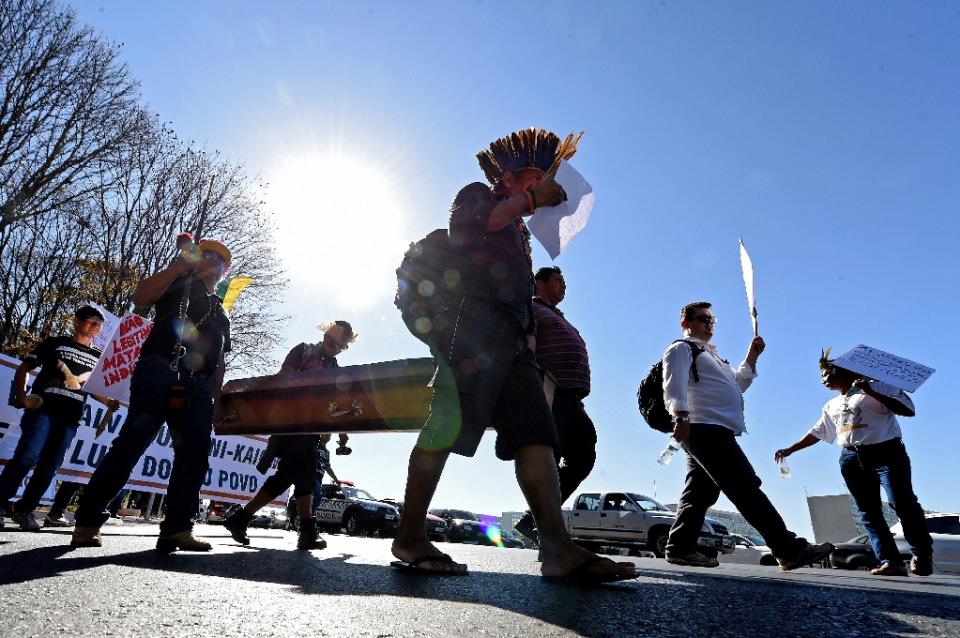
Tensions between the indigenous group and local ranchers began after about 1,000 members of the Guarani-Kaiowa occupied five ranches on August 22, in an offensive to take back their ancestral lands. A number of hostages were taken, but were later released.
Last week, the ranchers launched their own offensive to take back the land, killing indigenous leader Semião Vilhalva. The offensive pushed the Guarani-Kaiowa out of the ranches and cornered them back into a small area of land. Rancher-hired gunmen are reported to be patrolling the area.
They group has appealed to the Brazilian government for assistance, saying that the gunmen are preventing them from burying Vilhalva on their ancestral land.
Indigenous persons led protests in Brasilia following Vilhalva’s death.
Brazilian Justice Minister Jose Eduardo Cardozo condemned the killing. He has travelled to the region with a high-level delegation. Members include the director-general of the Federal Police and the president of government’s Indian agency. Federal troops have also been sent to the area.
There is a long standing history of fighting between the indigenous populations of the area and the ranchers. According to the Indigenous Missionary Council, there were 138 murders of indigenous persons in 2014 alone.
The ranches were located in an area which had been designated as indigenous territory, but the ranchers recently obtained an injunction suspending the process. The Brazilian Constitution required that all indigenous territory be mapped out and returned by 1993, but that promise has gone largely unfulfilled.
The United Nation’s expert on indigenous populations, Victoria Tauli-Corpez, called for a stop to the violence and for protection for the Guarani-Kaiowa.
For more information, please see:
Intercontinental Cry – Indigenous Brazilian Broadcasts Urgent Plea for Help – 2 September 2015
The Ecologist – Brazil: Guarani man murdered by ranchers’ gunmen – 2 September 2015
Yahoo News – Tensions mount over death of Brazil indigenous leader – 2 September 2015
BBC – Brazil indigenous leader’s killing raises tension – 3 September 2015
BBC – Brazil indigenous group Guarani-Kaiowa ‘attacked’ – 6 September 2015
Press Release: U.S./Belgian Citizen Arrested for his Alleged Participation in the Trade of Blood Diamonds during Sierra Leone’s Civil War
|