Three men believed to be involved in the murders of secular bloggers in Bangladesh were arrested during a raid in Dhaka on Monday.
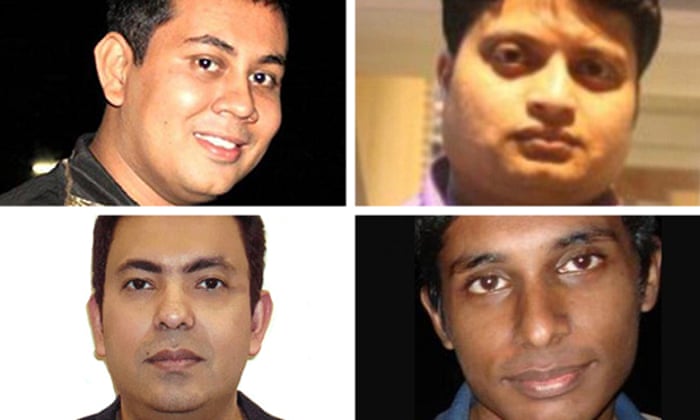
Four secular bloggers have been killed this year, including Avijit Roy and Ananta Bijoy Dash, who wrote for a website called Free Mind. Mr. Roy spoke out against religious extremism and formed a network of atheist bloggers in Bangladesh and abroad. Both Mr. Roy and Mr. Dash were hacked to death by machete.
The four secular bloggers who have been killed this year in Bangladesh. (Photo courtesy of the Guardian)
Commander Mufti Mahmud Khan, spokesman for Bangladesh’s Rapid Action Battalion, a police unit, stated that the three suspects are believed to be members of the Islamic organization Ansarullah Bangla Team, which has been banned in Bangladesh. The group was banned in May after it was accused of threatening and killing bloggers and writers.
Muhammad Jasimuddin Rahmani is the leader of Ansarullah Bangla Team. He is currently in prison for his murder of another blogger, Ahmed Rajib Haider, in 2013. It is believed that one of the suspects arrested in Monday’s raid, Sadek Ali, visited Mr. Rahmani in prison to receive instructions for the bloggers’ murders.
Another of the accused men, Tawhidur Rahman, is a British citizen of Bangladeshi origin. He moved back to Bangladesh in 2012 and joined Ansarullah Bangla Team because he was inspired by Mr. Rahmani’s philosophy. Mr. Rahman is believed to have planned the killings of Mr. Roy and Mr. Dash.
The third suspect, Aminul Mollick, worked at a passport office and made fake passports so that members of the Ansarullah Bangla Team could leave the country if needed.
Bangladeshi authorities have been criticized for their failure to prevent the killings and for their slow place in their investigation of the killings. Imran H. Sarker, head of the Blogger and Online Activist Network in Bangladesh, has stated that many are wondering whether the government is supporting the criminals killing the bloggers. Bangladesh’s top police official has denied accusations that police officers sympathize with the killers and are purposely delaying their investigations of the murders.
About a decade ago, a group of mostly atheist Bangladeshi bloggers started speaking out against Islamic and other religious groups online. While the bloggers became popular with secular Bangladeshis, their online posts drew the anger of the Muslim population in Bangladesh.
While most Bangladeshis are Muslims, Bangladesh is ruled by laws based on British common law. Religion-based political parties in Bangladesh have sought the establishment of blasphemy laws to protect their faith, while bloggers have called for those parties to be banned.
In 2013, Hefajat-e-Islam, a body of Islamist groups, submitted a list of 84 atheist bloggers to the Bangladeshi government, demanding their arrest and trial under blasphemy laws. Hefajat-e-Islam also set in motion mass protests calling for the execution of those bloggers, and attacks against the bloggers began occurring.
In the past two and a half years, five atheist bloggers and five secular activists have been killed in similar machete attacks in Bangladesh.
By Kaitlyn Degnan Impunity Watch Reporter, South America
BRASALIA, Brazil – Brazilian President Dilma Rousseff is struggling to maintain support amidst calls for her resignation following the conviction of Petrobras officials for organizing bribes to members of the Brazilian government in exchange for Korean contracts, paid out in funds stolen from the indebted oil company. Both the senate and the lower house are being investigated in the wake of the kickback scandal.
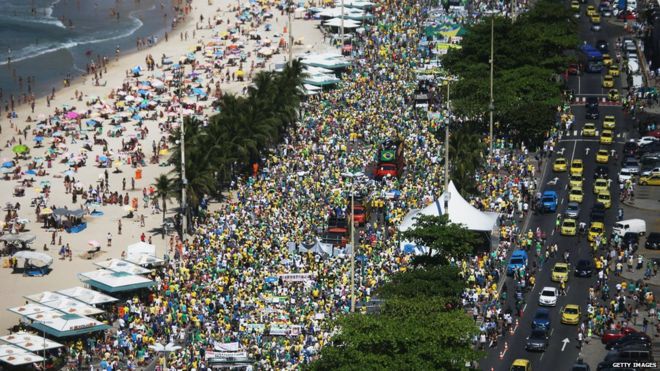
Protesters march on Copacabana Beach. (Photo courtesy of the BBC)
Rousseff served as chairwoman of Petrobras’ board in 2010, before her election to president and at the height of the kickbacks. Although she has officially been exonerated, many insist that she had to have had knowledge of the scheme. She has also been accused of receiving illegal contributions for her campaign, and that her government has misused state money to cover budget gaps.
President Rousseff has insisted that she will not resign.
Brazilians in past days have taken to the streets in protests, with many calling for the impeachment of President Rousseff. Protests drew thousands in Sao Paulo, Brasilia and Copacabana beach in Rio. The latest numbers list nation-wide support for the President to be as low as single digits (about 8 percent). Two out of three Brazilians surveyed think that Rousseff should be impeached, and her approval rating is currently the lowest of any Brazilian president since the end of military rule.
Protesters calling for impeachment do so despite the almost guaranteed instability that would follow. Pedro Lopes Siqueira, a public servant from Rio participating in the protests told the New York Times: “Impeachment would be momentarily destabilizing, but it’s allowed in the Constitution, and it needs to happen.
Some have even declared that they would welcome a military intervention as opposed to what is perceived by some as a highly corrupt government. Brazil recently celebrated 30 years since the end of the military dictatorship in March of this year.
This comes at a time where the Brazilian economy is struggling due to uncertainty and political corruption. Moody’s Investors Service reported that the Brazilian economy will contract about 2 percent this year. Businesses from motor vehicle manufacturers to small businesses and family owned restaurants have felt the effects of the economic downturn.
Business owners around the country have expressed concern regarding the potential repercussions if Rousseff is impeached – which will likely include a period of economic instability. Although business leaders and Rousseff historically have a rocky relationship, many have come out as unlikely allies of the president. “An impeachment is a traumatic affair that affects the political and business arena at a time when Brazil is struggling to regain its credibility abroad,” according to Alencar Burti, president of the Sao Paulo state Federation of Chambers of Commerce. The group represents 200,000 business owners in the area. They would be more in favor of some sort of economic deal.
Industrial groups and the media have also called for a deal to ensure stability.
By Kaitlyn Degnan,
Impunity Watch Reporter, South America
QUITO, Ecuador — Indigenous groups in Ecuador pretested against President Rafael Correra and his policies on Thursday. Thousands marched to Quito to support demands of the Confederation of Indigenous Nationalities of Ecuador (Conaie).
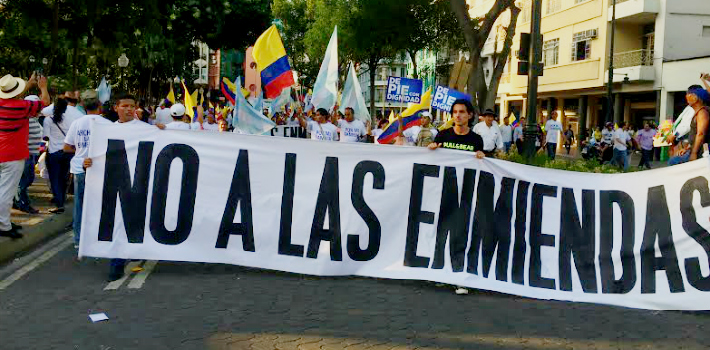
Indigenous Ecuadorians lead protests [Photo courtesy of PanAm Post]In Guayaquil, protesters gathered at the Plaza del Centenario and chanted against the government: “Yes to democracy, no to dictatorship.”
Indigenous activists, doctors, union workers and retirees led protests across Ecuador. Other government opponents joined in the protests as part of a national strike. Protesters blocked several highways around the country with rocks, trees and burning tires.
The marches were one of the largest demonstrations against Correra’s government yet. The protesters called out President Correra for failing to deliver on promised social programs and income equality. Indigenous populations had previously been major supporters of Correra.
President Correra spoke out against the protests in a twitter post: “They’re hurting the country, not the government. We cannot be submitted to the abuse of an absolute minority.” Correa said that that his fiscal reforms would help wealth distribution.
During the protests Correra celebrated the “Festival of Youth and Joy in Independence Plaza in Quito, expressing confidence that the protests would have little effect on his government and policies.
For the most part the protests were peaceful, though a handful of scuffles did break out in some areas. Demonstrators clashed with police using rocks and sticks. There were 47 protesters arrested, mostly in Quito, and 67 police officers were injured throughout the country.
The protesters list of demands include a rollback on proposed changes to the constitution, a halt to mining concessions, and the stoppage of negotiations for free trade with the European Union.
Ecuador has recently experienced and economic slowdown, partially the result of the falloff crude oil prices. Standard & Poor lowered Ecuador’s sovereign credit to B from B+ due to tension between Correra and the people.
Syrian refugees rushing through a hole in the fence near the Turkish border, June 14, 2015
On June 14, 2015, a terrified throng of men and women, many clutching babies and young children by the backs of their shirts, stampeded their way through a narrow opening in a chain-link and barbed-wire fence separating Tal Abyad, a city controlled by the Islamic State, and the Turkish border town of Akcakale. They were fleeing vicious fighting between ISIS militants and Kurdish forces, which were trying to regain Tal Abyad, even as the Turkish military, on the other side of the fence, was trying to keep the border closed. Within hours, several thousand Syrians—a majority of them women and children—squeezed through the gap until ISIS fighters stopped the exodus at gunpoint.
Yet one more horror in a war that has delivered them almost daily, the event nevertheless stood out for what it showed about the sheer complexity of the human catastrophe now unfolding in Syria. Back in the summer of 2013, when we undertook a comprehensive investigation for The New York Review of the Syrian refugee crisis, it seemed to us that it couldn’t get much worse. There were nearly three million officially registered refugees, and nearly one-third of Syria’s entire population of 22.5 million—a staggering number—had been uprooted from their homes. Visiting border areas in Jordan, Turkey, Lebanon, and Northern Iraq, we found Syrians struggling to survive, in makeshift encampments, abandoned buildings, dirt-floor houses, and squalid apartments. Almost half of them were children, and many were unable to go to school.
Still, there seemed to be many ways to address the crisis. However daunting such measures might be in practice, food could be distributed, camps erected, medical checkups provided, schools built. For humanitarian aid workers, the overriding concern was raising sufficient international funds—the UN target at the time was a record 5.2 billion dollars—and ensuring that there was sufficient infrastructure to cope with the vast numbers of people flowing into neighboring countries.
Even as we reported the story, however, there were signs that the conflict itself was turning in an ominous new direction. Turkey, we noted, had become a major conduit for fighters into Syria; while Jordan and Iraq, fearful of destabilization, were intermittently closing their borders. In Lebanon’s Bekaa Valley, we visited towns whose sons were fighting for the Syrian regime but that were filled with refugees who supported the opposition.
Then, in the second half of 2013, came the alarming and widely unanticipated spread of ISIS across much of eastern Syria. By the following spring, ISIS had decisively brought the conflict to western Iraq as well, creating a humanitarian crisis that now spanned most of the Levant. The conquest of Mosul alone, in June 2014, displaced some 500,000 people virtually overnight; in Tikrit, further south, almost the entire population of some 200,000 would be chased out of the city during nine months under ISIS rule. Even for an especially brutal conflict, upheavals on this scale were almost unimaginable two years ago.
Still worse off, however, were the millions of people, in both Syria and Iraq, who were now prevented from fleeing and largely cut off from international aid. In August 2014, Jan Egeland, a former UN diplomat and the director of the Norwegian Refugee Council, told us it was time for international organizations to get over their qualms and deliver food and medicine to Syrians trapped in areas held by the Islamic State. Few listened. As of June 2015, by the UN’s own account, it had managed to reach only 5 percent of the nearly five million people it estimated were in need in “hard to reach areas” of Syria; of these some 2.7 million were in ISIS-controlled territory, “where humanitarian access continued to decline.”
So ineffective has the international response become that in March 2015, a group of twenty-one leading NGOsformally accused the UN Security Council of “failing to implement” its own resolutions on Syria, abetting what they called the “worst year” of the Syrian crisis to date. Meanwhile, the numbers keep going up: there were 700,000 new Syrian refugees in the first four months of 2015 alone—a rate that exceeds that of any other period in the war—pushing the total number of Syrians registered with the UN to more than four million. As of the summer of 2015, nearly half the entire population of Syria is displaced; and in Syria and Iraq together, there are now some 14 million people in need of humanitarian assistance.
Meanwhile, much of the burden for helping those who have fled has fallen on Syria’s beleaguered neighbors, which have scarce resources to deal with them. There are now nearly two million Syrians in Turkey, more than a million in Lebanon (where they are now one of every five people), more than a half million in Jordan, and more than one hundred thousand in Egypt. With their situation increasingly precarious in these countries, many Syrians have died trying to get to Europe. Those remaining in the Middle East have increasingly been forced to put their children to work on the street to get what money they can to survive.
Among the more poignant stories we encountered in Lebanon in 2013 was that of Wafa Hamakurdi, a woman from Aleppo whose family had taken refuge in Shatila, the extremely poor, decades-old Palestinian refugee camp in south Beirut. They had gone to Shatila not because they are Palestinian—they are not—but because it was the only place they could afford. Two years hence, she says, her husband is still unable to work because he fears being caught by the Lebanese authorities. Recently, after her two daughters, fourteen and seventeen, were harassed, they moved to another poor neighborhood in south Beirut. Her three older sons, fifteen, twenty-two, and twenty-three, have dropped out of school and university to support the family; her youngest son, who is ten, has been unable to find a place in school, because there were too many Syrian students. If things got really bad in Lebanon, she said back in 2013, she would go back to Syria, because “if you die in your country, somebody will bury you.” Now, she says, that may no longer be true: most of their extended family has left Syria, too.
With Lebanon, Jordan, and Turkey unable or unwilling to absorb more Syrians, pressure has grown on wealthy Western countries to do more. There are now some 300,000 Syrians who have applied for asylum in Europe. Apart from Sweden and Germany, however, most countries have been reluctant to take them in. Among those have who managed—often through dangerous negotiations with smugglers—to reach Europe was Ahmet Nassan, the physician we met in Gaziantep, Turkey in 2013. We tracked him down in Dortmund, Germany, where he is looking for work. “It’s a very long story,” he said. But he is completely cut off from his family. His mother and sister and her two young children remain in Turkey; while his daughter and ex-wife are still in Syria, where he has not heard from them since the first year of the conflict. His brother-in-law was killed by a bomb in Syria.
The greatest threat facing Syria’s refugees today is indifference. On June 15, a day after legions of terrified Syrians fled from Tel Abyad to the Turkish border, Kurdish forces successfully retook the town from ISIS. This was an important strategic victory in the US-led campaign against the Islamic State. But despite pledges by Kurdish leaders to allow some 20,000 refugees—many of them Sunni Arabs and Turkmen—to return, few have been able to do so.
With the war now in its fifth year and Western governments preoccupied by fears of jihadists striking on their own soil, it is hard for humanitarian organizations even to make the case for Syrians in need. In early July 2015—during the holy month of Ramadan—the World Food Program and the UN Refugee Agency announced they were reducing food vouchers to Syrians in Lebanon by one third. And last week, facing severe budget shortfalls, the World Food Program cut food assistance by half to some 200,000 refugees in Jordan. A few weeks earlier, at a hearing on Syrian refugees in the US Congress, legislators from both parties raised concerns that terrorists would use the refugee system to gain access to the United States. The US has accepted fewer than one thousand Syrian refugees so far—more made it through that hole in the fence at the Syrian-Turkish border during a few hours in June.
Adapted from an essay in Flight from Syria: Refugee Stories, a collection of writing and photography supported by the Pulitzer Center that will be published on September 15.