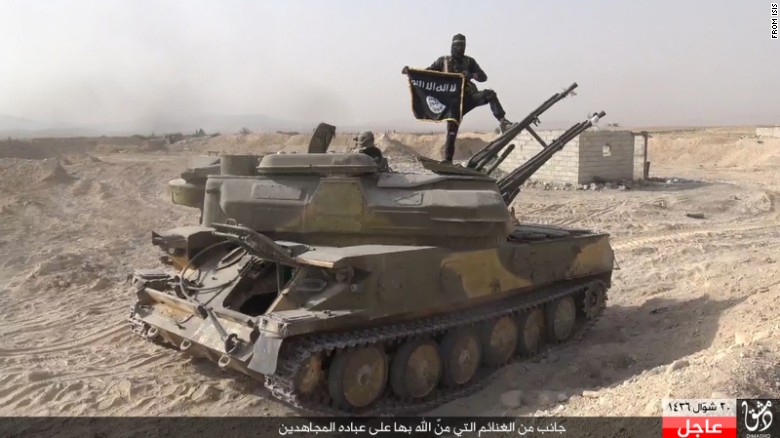
DAMASCUS, Syria—The Islamic State abducted over 230 people from Qaryatain on Thursday. Dozens of Christians were among those abducted according to the UK-based Syrian Observatory of Human Rights.
Islamic State militant stands with Islamic State flag after capturing the town of Qaryatain on August 6, 2015. (Photo Curtesy CNN)
The Syrian Observatory speculated that the abductions occurred either from “checkpoints or raids or from churches.” Among those kidnapped were 45 women and 9 children. Of those taken hostage, the other 170 individuals are Sunni Muslims.
Amnesty International called for the release of the detained citizens. An Amnesty International reporter stated, “the abhorrent abduction in Syria of more than 200 people by the Islamic State highlights the dreadful plight of civilians caught up in conflict in the country.”
Qaryatain lies in between Damascus, Palmyra, and Homs. The route between Damascus and Homs is often used to move supplies and fighters throughout the rest of the region.
This past February, the Islamic State kidnapped 220 Assyrian Christians. Only a few of those kidnapped in February have been released.
The Islamic State may be preparing to attack the nearby town of Sadad. Over 4,000 Chrisitian families reside in Sadad. According to an Assyrian activist, many of those living in Sadad have already begun to flee.
The Islamic State militants execute captives whom they deem to be “infidels,” including Shi’ite Muslims, Christians, and religious minorities. Sunni Muslims who do not swear allegiance are also executed. The militant group allows Christians to live under its rule as long as Christians pay a special tax.
The Islamic State has made advances into areas east and south of Homs. The Syrian Army has led a counter-offensive in hopes of re-capturing the city of Palmyra after it was lost to the Islamic State last May.
The Islamic State has been pushed back in Northern Syria by a surge of Kurdish-led forces. The Islamic State militants were evicted from the town of Tal Abyad in northern Syria by the Kurdish forces in June.
Last week marked a major shift in Russia’s position on the Syrian conflict. In a rare show of unity, Russia joined other members of the UN Security Council in adopting Resolution 2235 to form an international investigation unit for the purpose of identifying perpetrators of chemical weapons attacks, including chlorine gas attacks. During the same week, Iran announced that it will put forth a newly revisedpeace plan for Syria. As historically staunch supporters of Syrian President Bashar al-Assad, Russia and Iran’s recent actions may reflect a change in attitude with regard to Assad’s culpability.
As international attention shifts toward the possibility of a political settlement, the question of whether negotiations will include an amnesty deal looms large. Justice is often sidelined during peace negotiations under the rationale that an immediate end to bloodshed takes priority over accountability. Evidence from past conflicts, however, demonstrates that barring accountability may lead to renewed conflict and instability in the long-term. The below discussion looks at a variety of ways amnesty has been used in the past, with varying results.
1. Blanket Amnesty – No Truth, No Justice
Parties in conflict sometimes agree to blanket amnesty in order to negotiate an immediate end to violence. Under blanket amnesty, perpetrators are granted legal immunity for their crimes, which is a quick-fix that requires few government resources. Lebanon, for example, grantedblanket amnesty to perpetrators who committed crimes during its 15-year-long civil war without any additional measures to address violations. While this served to end the conflict in the short term, Lebanon continued to experience violence, including the 2005 assassination of Rafik al Hariri. The United Nations established the Special Tribunal for Lebanon to address the assassination, but did not mandate the Tribunal to examine past crimes. The conflict in neighboring Syria has exacerbated the already deep sectarian tensions in Lebanese communities that stem from the unresolved grievances of the civil war and continue to threaten the country’s stability.
2. No Amnesty – Insufficient Truth, Insufficient Justice
Some conflict states opt to avoid the issue of amnesty altogether and instead focus on prosecutions because of the political backlash amnesty could cause. Since amnesty inherently precludes justice, doing away with it might seem like a positive outcome. However, holding each and every person accountable for their actions is sometimes impossible and could lead to an impunity gap. In Iraq, for example, the post-conflict government used a combination of prosecutions and lustration, or “De-Baathification.” However, due to the large number of Baathists in the government, an arbitrary decision was made to target only high ranking officials and rehire lower-ranking officials. As a result, the system was perceived as unfair and inefficient. Without a well-thought-out plan for amnesty in place, Iraq’s transitional justice program led to haphazard and imbalanced results that gave unintentional amnesty to many suspected perpetrators.
3. Conditional Amnesty – Balancing Truth and Justice
Conditional amnesty occurs when a country grants perpetrators of atrocities immunity on the condition that they fulfill some other requirement, such as participation in a truth commission, monetary payments to victims, or testimony to help indict another, often higher-level, perpetrator. The South African Truth and Reconciliation Commission (TRC) is considered by many to be a successful example of conditional, or “smart amnesty”. Following the fall of the brutal apartheid regime in South Africa, the government gave perpetrators the opportunity to confess their crimes to the TRC in return for the possibility of amnesty if they met certain criteria. The TRC’s final report“named and shamed” individual perpetrators and also explained the structure of apartheid institutions and security apparatus. As a restorative justice model, the TRC aimed to balance the demand for truth and justice, butongoing violence in South Africa might indicate that the TRC was insufficient to fully address the trauma of apartheid.
—–
In a conflict like Syria, where widespread atrocities implicate a large number of people, blanket amnesty may seem like an appealing way to hasten an end to the conflict; however, Syrians are likely to oppose such measures and peace may be short-lived as a result. Equally problematic is a solution that only contemplates prosecutions. Syria may not have the capacity or the infrastructure to conduct transparent and fair trials for a large number of perpetrators, leading to an impunity gap that could trigger renewed violence.
Parties to a conflict often view amnesty and accountability as mutually exclusive, presenting a false choice between peace and justice. Conditional amnesty presents a balanced option, but also has its drawbacks. Citizens may be reluctant to entertain the idea of amnesty in any form. Moreover, conditional amnesty, without the credible threat of prosecutions, will essentially be seen as another form of blanket amnesty, failing to create an atmosphere of deterrence. Despite such challenges, there is a need for truth in Syria — truth about missing persons, information about high-level perpetrators, and knowledge of the institutions that allowed atrocities to occur. A well-thought-out plan for conditional amnesty could help prosecute those most culpable while also providing the space for truth-telling and reconciliation, particularly if used in combination with reparations, institutional reform, and memorialization programs.
Examples from other conflicts demonstrate that justice cannot be politicized and sidelined in favor of peace, and amnesty will not be an effective quick-fix solution to the complex problems Syrian society faces. The parties involved in negotiating a peace plan for Syria will need to keep these considerations in mind if they have a hope of achieving long-term, sustainable peace.
By Samuel Miller Impunity Watch Reporter, North America and Oceania
SYDNEY, Australia — Australian Prime Minister Tony Abbott’s conservative coalition government on Tuesday blocked its members from voting in favor of gay marriage, a politically risky move that effectively rules out a marriage equality bill passing under his government. Abbott’s ruling conservative coalition all but doomed legislation that would allow gay marriage by refusing to allow its lawmakers a free vote on the issue.
Australian PM Abbott Addresses the Media Wednesday. (Photo Courtesy of Sydney Morning Herald)
Prime Minister Tony Abbott said Wednesday that Australians would get a chance to vote on legalizing gay marriage if they re-elect his government next year, a promise his opponents argue is a stalling tactic to sideline the divisive issue ahead of the general elections.
Abbott effectively killed off chances of marriage equality until after next year’s elections, as two-thirds of coalition lawmakers supported his demand they vote as a bloc against such unions. But the six-hour debate exposed a divide even among Cabinet members.
“Abbott’s position is weaker now than it was just a few days ago,” said Haydon Manning, a politics professor at Flinders University in Adelaide. “He’s shored up his political base but at the cost of creating a noisy split in the ranks that may overwhelm his main message of being able to deliver good government.”
Prime Minister Tony Abbott addressed the media Tuesday, outlining his decision and answering questions regarding the meeting of the full coalition party.
“If you support the existing definition of marriage between a man and a woman, the coalition is absolutely on your side but if you would like to see change at some time in the future, the coalition is prepared to make that potentially possible,” Abbott told reporters after the near six-hour meeting, suggesting a public referendum on the matter.
Abbott extended an olive branch to marriage equality advocates, offering to allow the public to vote on gay marriage in a plebiscite if his government retains power at the next election. “The disposition is that it should happen through a people’s vote rather than simply through a parliament vote,” said Abbott.
Australia has become increasingly isolated among English-speaking nations on same-sex marriage. Ireland backed marriage equality in a May referendum and the U.S. Supreme Court in June recognized same-sex unions; Abbott’s conservative allies in U.K. and New Zealand, leaders David Cameron and John Key, support marriage equality.
Despite the ruling party decision, one government lawmaker, backbencher Warren Entsch, plans to introduce a private-member’s bill to Parliament on Monday that would allow same-sex marriage. But Enstch and other supporters concede that any bill will fail because government lawmakers will not be allowed to vote freely.
Opposition leader Bill Shorten, who introduced a same-sex marriage bill in June, has not given up hope that the Parliament will legalize gay marriage before the next election.
“When it comes time, if he gets re-elected at the next election, you can forget about marriage equality,” Shorten said. “The choice in this country is you either have Mr. Abbott or you have marriage equality. But you can’t have both.”