Syria Justice and Accountability Centre: UNSC Passes Historic Resolution but Overlooks Justice

UNSC

United Nations Security Council

August 7, 2015

Earlier today, the United Nations Security Council unanimously passed Resolution 2235 establishing a Joint Investigative Mechanism to look into the use of chemical weapons, including chlorine gas, during the Syrian conflict. Following months of negotiations between the United States and Russia, this Resolution is the first UN Security Council mandate to assign blame for the violation of international law in Syria. According to a statement issuedby the United Nations, “Holding the perpetrators of the toxic chemical attacks accountable may hopefully alleviate the prolonged suffering of the Syrian people.”

Today’s Resolution is the second regarding chemical weapon use in Syria. The first was Resolution 2118 passed last summer, in which the Organization for the Prohibition of Chemical Weapons (OPCW) was mandated with the safe destruction of Syria’s chemical weapons. Since then, however, reports of the indiscriminate use of chlorine gas against civilians has remained widespread. Resolution 2235 calls on Secretary-General Ban Ki Moon to work with the Director-General of the OPCW to establish a Joint Investigative Mechanism, which will then regularly report to the UN Security Council and determine the individuals and groups responsible.

The Syria Justice and Accountability Centre (SJAC) welcomes this long overdue Resolution, but expresses concern that the Resolution’s language does not call for accountability in strong enough terms. A commitment to refer the case to the International Criminal Court or to establish a tribunal to prosecute the perpetrators would have sent a much stronger signal that the international community stands firmly on the side of the victims.

For more information and to provide feedback, please email SJAC at info@syriaaccountability.org.

Press Release: Senior Coroner Has Ruled That Hermitage Capital is an ‘Interested Person’ in the Perepilichnyy Inquest in Surrey

Press Release

For Immediate Distribution

Senior Coroner Has Ruled That Hermitage Capital is an ‘Interested Person’ in the Perepilichnyy Inquest in Surrey

6 August 2015 – Today, the Senior Coroner ruled that Hermitage Capital will be recognized as aninterested person in the Alexander Perepilichnyy inquest which took place in Surrey, England today. Hermitage Capital made the application because of specific facts which pointed to the possibilitythat Alexander Perepilichnyy was murdered in November 2012 in Surrey.

Hermitage Capital was forced to intervene in the coroners inquest because the Surrey police decided that Alexander Perepilichnyy’s death was ‘not suspicious’ and ‘did not involve third parties’. In written and oral applications submitted by Geoffrey Robertson QC and Henrietta Hill QC, Hermitage disclosed how Alexander Perepilichnyy had described fears over being murdered by members of the Russian organised crime connected to the Russian government.

“We cannot allow the Russian government to get away with murder in the UK. We will make sure that all the facts surrounding Alexander Perepilichnyy’s death, including any suggestion that it was linked with his involement in exposing the Russian organised crime connected to the Magnitsky case are elucidated in full at the inquest,” said William Browder, leader of Justice for Sergei MagnitskyCampaign.

In 2010, Alexander Perepilichnyy provided evidence to Hermitage Capital which lead to the freezing of accounts belonging to Vladlen Stepanov, husband of a senior Russian tax official held in Swiss banks. He twice testified to the Swiss prosecutors and subsequently received death threats by various elements inside the Russian government.

Alexander Perepilichnyy died on 10 November 2012 after returning from a trip to Paris. The British police closed the case but the French authorities have since opened a full murder investigation.

For more information, please contact:

Justice for Sergei Magnitsky campaign

+44 207 440 1777

info@lawandorderinrussia.org

The Robert H. Jackson Center- Industrialized Killing: Accountability and Justice for Syria

Industrialized Killing: Accountability and Justice for Syria

July 21, 2015

Chautauqua Institution will host David M. Crane, Robert H. Jackson Center Board Chair and the former Chief Prosecutor for Special Court for Sierra Leone David Crane,  for a lecture on industrialized killing and the Syrian Crisis. The Lecture will take place Tuesday July 21st, 2015 3:30 p.m. at the Hall of Christ, Chautauqua Institution.

David M. Crane, former Chief Prosecutor for the Special Court for Sierra Leone (2002-2005) has worked to gain and provide support to Syria. In conjunction with Syracuse University College of Law students, Crane heads the Syrian Accountability Project (SAP). Crane and SAP work with several international organizations to provide impartial analysis of open source materials. The goal of these collaborations is to fairly prosecute President al-Assad, his subordinates, and members of the Syrian Opposition for war crimes, crimes against humanity, and violations of the Syrian Penal Law.

Having David Crane on the Board at the Jackson Center has been a tremendous success.  So, we wanted to gain some insight into what his lecture might entail.  Below are introductory questions concerning Crane’s upcoming lecture “Industrialized Killing: Accountability and Justice for Syria”

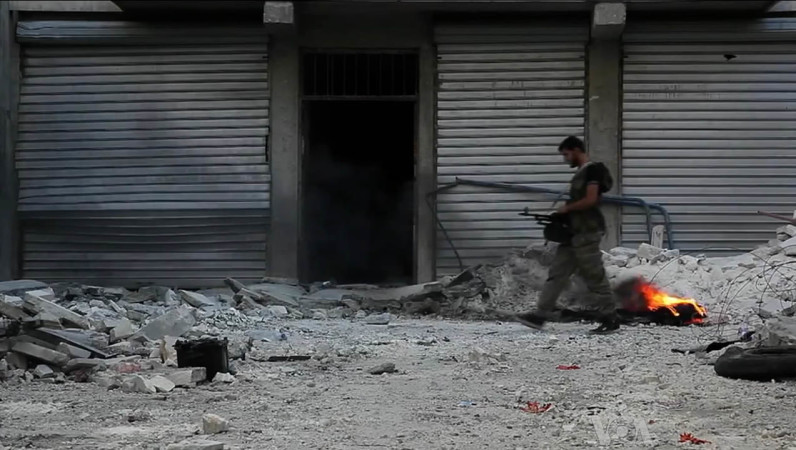
FREE SYRIAN ARMY SOLDIER WALKING AMONG RUBBLE IN ALEPPO DURING THE SYRIAN CIVIL WAR, 2012
CREDIT: VOICE OF AMERICA NEWS: SCOTT BOBB REPORTS FROM ALEPPO, SYRIA


Q: Why did you decide to title your lecture “Industrialized Killing”?

A: To raise awareness of the horror that is taking place in Syria. 


Q: What first interested you in finding justice for Syria?

A: The beast of impunity must be faced down wherever it raises its ugly head.  This is the 21st Century…mankind cannot turn its head and look away.


Q: What in your career led you to believe you could do something for the Syrian people?

A: As the founding Chief Prosecutor of the Special Court for Sierra Leone I developed a unique expertise to create a justice mechanism for oppressed peoples.


Q: How did you arrive at the idea for the Syrian Accountability Project (SAP) at SU Law?

A: Initially a seminar the project grew into an internationally recognized justice organization based on the techniques we used in successfully prosecuting a head of state and the leadership of the warring factions in West Africa.


Q: What are your goals for SAP?

A: Our goals are to develop a trial package for a future local, regional or international prosecutor to use in seeking justice for the Syrian people.


Q: How or where do you envision judicial action for Syria?  How can we avoid westernized justice once a Court is established?

A: Be aware that a justice mechanism is for and about the victims…the people of Syria.


Q: How do you think the IS problem affects the likelihood of justice in Syria?

A: The IS phenomenon complicates the entire process and may even permanently derail a justice mechanism, but that should not stop of us from our project.


Q: Does IS change the likelihood of President Assad stepping down?

A: I don’t see President Assad stepping down.  He may survive this.


Q: Do you have an opinion on the White House’s shift from demanding Assad’s removal to appeasing the Russians, focusing on IS, and stepping away from the Syrian Civil War for the time being?

A: The reality now is that Syria has become a sideshow in a larger geopolitical event and the administration has to deal with what is not what they would like it to be.


Q: Should the US be heavily involved in bringing the Syrian Conflict to a close, should the effort be global, or should the region be tasked with solving the issue?

A: The US is and has to be involved in this even though it is a reluctant participant.  The EU and the Arab States have to step up as well.