Voice of Sudan and Sudan Democratic Forum – Vision of New Sudan

On July 29, 2015 Voices for Sudan & Sudan Democratic Forum held a Round table Discussion Forum on the “New Sudan”, and Reflections on the Legacy of Dr. John Garang De Mabior. The discussion focused on the vison of New Sudan, ten years after the death of Dr. John Garang De Mabior, Chairman of the SLPM/A, and the current situation in Sudan and South Sudan. Please clink on the link to hear the different points of views offered in the discussion.
Roundtable discussion on the Vision of New Sudan .The video of the event.Link

Comment
Though I’d been at one point quite well informed on Sudan/South Sudan, more recently I’ve been less engaged and thus less aware of the goings-on.  Yesterday’s (July 29, 2015) Voices for Sudan (VFS) “discussion forum”, which focused on what has happened to Dr. John Garang’s vision for Sudan on the 10th anniversary of his death, was extremely informative on the current situation in South Sudan.  A variety of perspectives was offered by an impressive roster of invited speakers, incuding a former SPLA and South Sudanese elected official, other members of the diaspora, humanitarian NGOs, and USAID.  I was particularly impressed with the presentation by the Sudanese woman from Darfur Niemat Ahmadai from Darfur Women Action Group, who had a clear understanding of and ability to explain the complexities within and among all the factors impacting this very sad situation. Great job, VFS! Please continue to hold forums like this one so we can remain informed and motivated to take action.
Paulette Lee.

    Voices for Sudan Inc.

1400 16th Street N.W # 430, Washington, DC 20036.
For more info e-mail us at info@voicesforsudan.org

Global Centre to Protect Newsletter

Malaysia’s Trafficking in Persons Report Ranking is Upgraded, While Thailand Remains on the Worst Offender List

By Christine Khamis

Impunity Watch Reporter, Asia

KUALA LUMPUR, Malaysia —

Malaysia has been upgraded to the Tier 2 Watch List on the U.S. State Department’s yearly Trafficking in Persons Report ranking. This means that the United States no longer considers Malaysia one of the worst offenders when it comes to human trafficking. Thailand, on the other hand, is ranked among the worst offenders.

Countries are placed in one of four tiers on the Trafficking in Persons Report. Tier 1 includes countries that fully comply with the United States’ Trafficking Victims Protection Act (TVPA). Tier 2 includes countries that do not fully comply with the TVPA, but who are making significant efforts to comply. The Tier 2 Watch List includes countries who do not fully comply and still have negative indicators, yet who are are making significant efforts to comply. Tier 3 includes countries who do not fully comply and are not making significant efforts to do so.

Thailand remains in Tier 3, the lowest ranking group, for a second consecutive year. Only two other countries from the Asia region, North Korea and the Marshall Islands, were placed in Tier 3. In part, Thailand was downgraded from the Tier 2 Watch list in last year’s report because of labor abuses in its fishing industry. There is also a U.S. State Department Rule that countries have to be either upgraded or downgraded after two years on the Tier 2 Watch list.

Both Malaysia and Thailand have been internationally criticized this year for their trafficking of Rohingya and Bangladeshi migrants on overcrowded ships. Human traffickers transported the migrants,then leaft thousands stranded at sea with meager supplies.

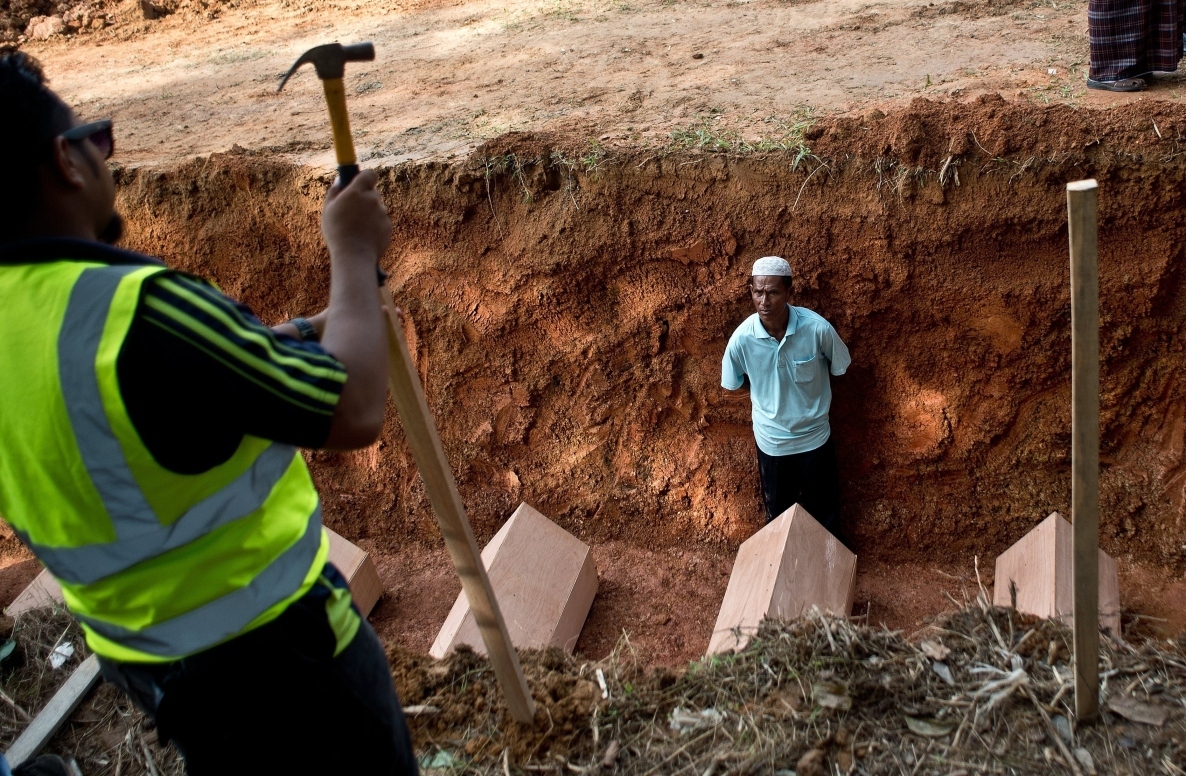
Graves of Rohingya and Bangladeshi migrants were also found about two months ago in abandoned camps on both sides of the Thai-Malaysian border, along with pens that appear to have been used as cages for the migrants.

One of the many migrant graves found in Thailand

The Thai Minister of Foreign Affairs has released a statement that Thailand’s ranking is not an accurate portrayal of the efforts Thailand has made to decrease human trafficking. For instance, Thai state prosecutors brought charges against more than 100 people last week who have been suspected of trafficking migrants.

Lawmakers and human rights groups have criticized Malaysia’s upgrade, claiming that Malaysia was upgraded from Tier 3 to the Tier 2 Watch List for politicized reasons. They believe that the upgrade is politicized because it enables Malaysia to be a participating country in the Asia-Pacific trade agreement, the Trans Pacific Partnership (TPP). In June, the United States Congress approved legislation that limits President Obama’s ability to make free trade agreements with Tier 3 countries.

To counter those claims, Sarah Sewall, the U.S. Under Secretary of State for Civilian Security, Democracy and Human Rights has stated that Malaysia has made the effort to reform its trafficking victim protection system as well as to increase the number of investigations and prosecutions connected to human trafficking. However, convictions of human traffickers have decreased in Malaysia. Ms. Sewall denies that Malaysia’s upgrade was politicized.

Human rights groups assert that Malaysia has not sufficiently improved its handling of human trafficking issues to justify its upgrade from a Tier 3 country. They also claim that Malaysia’s upgrade diminishes the reliability of the Trafficking of Persons report.


For more information, please see:

CNN – Who’s Fighting Human Trafficking? U.S. Releases Rankings – 28 July 2015

Associated Press – Malaysia, Cuba Taken off U.S. Human Trafficking Blacklist – 27 July 2015

New York Times – Key Shift on Malaysia Before Trans-Pacific Partnership Deal – 27 July 2015

Reuters – U.S. Softens View of Malaysia, Cuba in Human Trafficking Report – 27 July 2015


Press Release: Global Magnitsky Act Receives Unanimous Approval from the Senate Foreign Relations Committee

For Immediate Distribution

 30 July 2015 – Yesterday, in a landmark vote, the U.S. Senate Foreign Relations Committee unanimously approved “The Global Magnitsky Human Rights Accountability Act,” paving the way for its approval for a full vote in the Senate. The Global Magnitsky Act extends the concept of personalised sanctions on kleptocrats and human rights violators around the world, giving hope to victims from any country where those abuses occurred.

Sergei Magnitsky‘s epic battle against evil, his faith in the law, and his ultimate sacrifice continue to empower and inspire lawmakers around the world to take concrete action and create real consequences for human rights abusers“, said William Browder, leader of the Magnitsky Justice campaign.

The new legislation is authored by U.S. Senator Ben Cardin (D-MD), Ranking Member of the Senate Foreign Relations Committee, who in 2010 together with Senator John McCain initiated the “Sergei Magnitsky Rule of Law Accountability Act,” an innovative 21-century piece of legislation that for the first time has provided redress and a meaningful way to deter impunity for corruption and human rights abuses in Russia.

The Russia-specific Magnitsky bill became law in December 2012. Over 30 persons have been included on the public sanctions list since. Persons included on the sanctions list are publicly named on the federal register, prohibited from obtaining U.S. visas and subject to a freeze on all their U.S. assets and bank accounts.

The Global Magnitsky bill authorises the President to create similar consequences for persons involved in corruption, extrajudicial killings, torture and other human rights violations from all countries around the world.

“This is an important step in a long road of targeting human rights abusers and corrupt individuals around the globe who threaten the rule of law and deny human rights or fundamental freedoms,”said Senator Cardin.

The bill authorizes the Secretary of State and the Secretary of the Treasury to report annually to Congress regarding actions taken against human rights abusers. In determining the sanctions list, the President must consider requests made by the Chairperson and Ranking Member of one of a number of congressional committee.

For more information, please contact:

Magnitsky Justice Campaign

+44 2074401777

info@lawandorderinrussia.org

See also the US Senate Foreign Relations Committee press release on the passing of the Global Magnitsky Bill:

http://www.foreign.senate.gov/press/ranking/release/cardin-legislation-the-global-magnitsky-human-rights-accountability-act-approved-by-senate-foreign-relations-committee


“Bookkeeper of Auschwitz” Sentenced for Nazi Killings

by Shelby Vcelka

Impunity Watch Desk Reporter, Europe

BERLIN, Germany–

A German court sentenced Oskar Gröening, a 94-year-old former guard at Auschwitz concentration camp, to four years in prison on July 15th on 300,000 accounts of accessory to murder from May to July 1944. A judge in the city of Luenenburg convicted the “Bookkeeper of Auschwitz” for his role in collecting and cataloguing money and the belongings of Jewish prisoners as they entered the camp. Gröening’s trial is expected to be one of the last trials of surviving Nazis for their atrocities in the camps.

Oskar Gröening, 94, was convicted of 300,000 accounts of accessory to murder for collecting and recording the belongings of Jewish prisoners at Auschwitz-Birkenau concentration camp from May-July 1944.

Due to Gröening’s age, it is unclear how he will serve his sentence. However, his age was a factor in determining the length of his sentence, as the judge stated “he must still have the chance to spend part of his life in freedom after serving imprisonment.” The four years exceeds the three-and-a-half year sentence wanted by the prosecution.

Although Gröening did not dispute the charges against him, he admitted “moral guilt” for the murders that took place at the camp. He stated his belief that he was a “cog” in a Nazi killing machine, but was not directly responsible for the mass murders that took place. During testimony, Gröening commented, “Auschwitz was a place where you could not simply take part. I agree with that. I sincerely regret that I did not recognize that earlier. I am truly sorry.”

Throughout the trial, Gröening was brutally honest about the horrors he witnessed during his tenure at Auschwitz. He detailed how prison guards decided which prisoners would be killed immediately and which would be selected for work. During the two month period Gröening was convicted for, at least 137 cattle car trains rolled through Auschwitz. Of the 425,000 people that those trains carried, Gröning said 300,000 were immediately chosen for the gas chambers.

The 2011 conviction of concentration camp guard John Demjanjuk as an accessory to mass murder allowed German prosecutors to seek out charges against other former Nazis. Previously, a prison guard had to be convicted of a specific murder in order to be considered for charges. With the conviction of Demjanjuk, the pathway for more Nazi convictions opened, and allowed German prosecutors to seek charges against former officials even if a crime against a specific individual could not be proved. Gröening had faced similar charges in 1985, but the case was dropped due to a lack of evidence.

For more information, please see–

CBS– Auschwitz “accountant” jailed over Nazi killings— 15 July 2015

The Guardian– Former Auschwitz guard Oskar Gröening jailed over mass murder— 15 July 2015

Newsweek–Former Auschwitz Guard Convicted of 300,000 Counts of Accessory to Murder— 15 July 2015

USA Today– Ex-Auschwitz guard, 94, is sentenced to prison— 15 July 2015

Wall Street Journal– Former Auschwitz Guard Oskar Gröning Convicted on 300,000 Counts of Accessory to Murder— 15 July 2015

Washington Post– “Accountant of Auschwitz” sentenced to four years in prison for 300,000 deaths— 15 July 2015