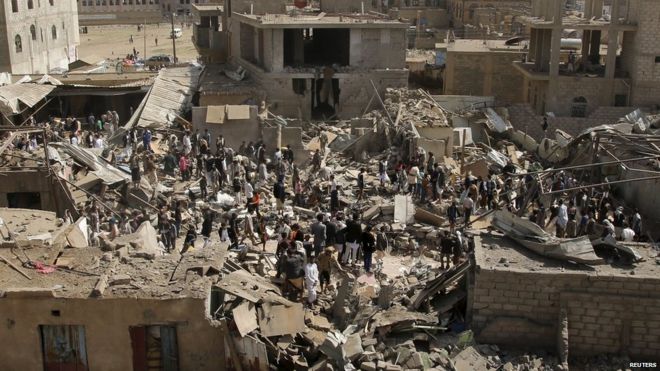
SNHR: Three Bloody Days in Syria during Eid-al-Fitr 2015
Colombia and FARC Agree to De-escalate
By Kaitlyn Degnan
Impunity Watch Reporter, South America
BOGOTA, Colombia — Colombia has agreed to de-escalate attacks against FARC rebels, so long as FARC maintains their unilateral ceasefire. FARC representatives announced on July 8th that they would initiate a ceasefire starting July 20th. The Colombian government agreed to de-escalate actions against FARC. Representatives of the two parties announced the agreement in a joint press release from the ongoing peace conference, held in Havana, Cuba.
Talks have been ongoing for about two and a half years, but have recently suffered set-backs caused by a significant escalation of violence between the parties in recent months. The most recent ceasefire (called for by FARC in December 2014) ended after 11 Colombian soldiers were killed in April. FARC officially ended the ceasefire on May 22, and relations between the parties (and the quality of the peace talks) have deteriorated since.
Following the initial April incident, Colombia resumed bombing campaigns against FARC-held positions. FARC responded by targeting Colombian oil pipelines. June was the most violent month in the Colombian/FARC conflict since 2012, with the Conflict Analysis Resource Center (in Bogota) logging 83 armed attacks during the month.
Although FARC has called for bilateral ceasefires in the past, the Colombian government has rejected the notion each time. The lead negotiator for the Colombian government, Humberto de la Calle, has emphasized that this agreement does not constitute a bilateral cease fire.
Speaking following the announcement of the agreement, de la Calle said, “We are not going to just paralyze government forces for a simple illusion that will later prove frustrating.” He specified that Colombian forces will continue to respond to any instances of violence coming from FARC rebels.
Talks have been ongoing between Colombia and FARC in Havana since November 2012. Cuba and Norway are both acting as guarantors to the peace process, and have each called for a truce. Pope Francis has also offered Vatican assistance in the peace process.
Colombian President Santos has pledged that the government and FARC will work together towards a final peace agreement “without delay.” He also announced that he will make a decision in four months on whether to continue the process, or not.
220,000 people have died in the 50 year conflict between the government and the rebels, and millions of civilians have been displaced.
For more information, please see:
BBC – Colombia agrees to reduce attacks against the Farc – 12 July 2015
REUTERS – Colombia says to de-escalate war if rebels uphold ceasefire – 12 July 2015
TeleSur – FARC and Colombian Government Agree to Ease Hostilities – 12 July 2015
ABC News – Pope Offers Vatican Assistance to Colombia Peace Process – 13 July 2015
Russia Blocks UN Security Council Resolution Recognizing Srebrenica Massacre as “Genocide”
by Shelby Vcelka
Impunity Watch Desk Reporter, Europe
UNITED NATIONS–
UN Security Council held a session last Wednesday on a resolution that would have condemned the Srebrenica massacre of 1995 as a “crime of genocide.” The text of the resolution stated that the “acceptance of the tragic events at Srebrenica as genocide is a prerequisite for reconciliation.” Of the fifteen members of the Security Council, four members abstained from the vote, while ten voted in favor. Only Russia voted against the resolution. The resolution’s failure to pass marks a new low in international politics and relations among the Western powers.

This week marks the 20th anniversary of the killing of 8,000 Muslim men and boys by Bosnian Serb troops in the worst massacre since the Second Word War. The victims were shot and buried in a mass grave after Serbian forces overran a safe zone watched by Dutch United Nations peacekeepers during the final months of the Bosnian War.
The Russian ambassador, Vitaly Churkin, described the resolution as “counter productive, confrontational and politically motivated.” He claimed that the resolution blamed the Bosnian Serbs for atrocities that were committed by all parties involved in the conflict. The resolution would further “doom the region to tension,” Mr. Churkin claimed, as Serbia was opposed to the motion. Russia and Serbia have close political ties.
Prior to the vote, the United States, Russia, and Britain attempted to come to a compromise on the language of the text. The American ambassador, Samantha Power, stated that the writers of the draft attempted to tackle many of Russia’s concerns, but Russia spurned the definition of genocide offered by the resolution. The vote had been pushed back a day to address other issues Russia had, but to no avail.
Serbia, who does not have a seat on the Security Council, has denied the allegations that the massacre was a “genocide,” and asked ally Russia to block the resolution. The denial is in spite of a UN war crimes tribunal in the Hague and other international courts recognizing the event as a genocide. Serbia admits that a “grave crime” was committed as it created closer ties with the West, but refuses to call acknowledge the legal definition of genocide.
For more information, please see–
BBC– Russia vetoes UN move to call Srebrenica ‘genocide’— 08 July 2015
Business Insider–Russia blocks U.N. condemnation of Srebrenica as a genocide— 08 July 2015
DW.com– Russia blocks UN resolution condemning Srebrenica ‘genocide’— 08 July 2015
New York Times– Russia Vetoes U.N. Resolution Calling Srebrenica Massacre ‘Crime of Genocide’— 08 July 2015
The Telegraph– Russia blocks UN resolution condemning Srebrenica massacre as genocide— 08 July 2015
President Obama Grants Clemency to Non-violent Drug Offenders
By Samuel Miller
Impunity Watch Reporter, North America and Oceania
WASHINGTON, D.C., United States of America — On Monday, as a part of a renewed effort to reform the criminal justice system, President Barack Obama has commuted the prison sentences of 46 drug offenders. Obama said the move was part of his larger attempt to reform the criminal justice system, including reviewing sentencing laws and reducing punishments for non-violent crimes.

The prisoners will all be released by Nov. 10.
“I believe that at its heart, America is a nation of second chances,” President Obama stated, “and I believe these folks deserve their second chance.” Furthermore, the President went on to say, “Their [the prisoners] punishments didn’t fit the crime, and if they had been sentenced under today’s laws, nearly all of them would have already served their time.”
President Obama’s action brought the total number of commutations he has issued to 89, exceeding that of any president since Lyndon B. Johnson, who commuted 226 sentences. In fact, President Obama has now commuted more sentences than the last four presidents combined.
Of the 89 commutations Obama has granted while in office, 76 have gone to nonviolent drug offenders who met criteria set by the Justice Department last year. The commutations come as the administration is working to reduce costs and overcrowding in federal prisons and to provide relief to inmates who were sentenced under the harsh guidelines put in place in the late 1980s as the country was grappling with the crack cocaine epidemic.
The president also called on Republicans and Democrats in Congress to change anomalies in federal sentencing laws, kicking off a week of presidential events devoted to the criminal justice system. Noting that Republicans have also expressed interest in criminal justice reform, Obama said, “The nation is spending too much money on incarceration of individuals who received long sentences for relatively minor drug crimes.”
This week’s focus on criminal justice signals a renewed bid by President Obama’s administration to tackle what he sees as a lack of fairness in the system. On Thursday, President Obama is expected to become the first sitting president to visit a federal prison when he goes to the El Reno Federal Correctional Institution outside of Oklahoma City.
For more information, please see:
BBC News — Obama frees drug offenders whose terms ‘didn’t fit crimes’ – 13 July 2015
CNN — President Barack Obama commutes sentences of 46 drug offenders – 13 July 2015
NY Times — Obama Commutes Sentences for 46 Drug Offenders – 13 July 2015
USA Today — Obama’s clemency grant largest since the 1960s – 13 July 2015
Washington Post — Obama commutes sentences of 46 nonviolent drug offenders – 13 July 2015