Saudi Arabia Mosque Bombing Claimed by the Islamic State
By Brittani Howell
Impunity Watch Reporter, Middle East
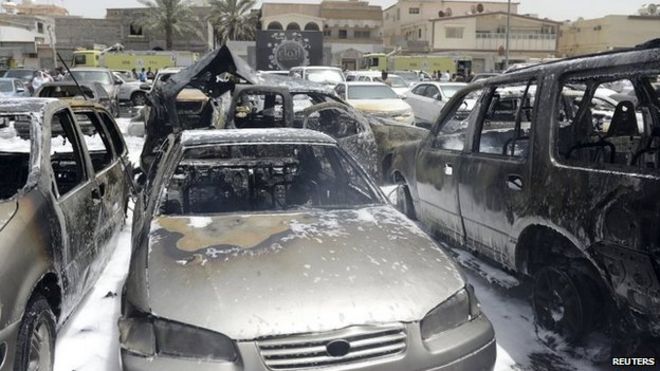
RIYADH, Saudi Arabia – On Friday afternoon, a suicide bomber dressed in women’s clothing detonated his bomb in front of a Shi’ite mosque killing three other people. The Islamic State claimed that they were behind the bombing, making this the second in two weeks.
One week ago, the Islamic State claimed to be behind a bombing of a Shi’ite mosque, which killed 22 people.
The majority of Saudi Arabia is Sunni Muslim with a minority being Shi’ite Muslim. The attack occurred in al-Qadeeh, a predominately Shi’ite neighborhood. On Friday night, Shi’ite protesters in Dammam and al-Qadeeh demanded an end to sectarianism.
Some have suggested that Saudi Arabia has not done enough to deter online abuse of Shi’ites, suggesting that the online abuse is a gateway to overt acts against the minority sect.
The Islamic State admits to pursuing sectarian goals. The Islamic State wanted to aggravate the tension between the Saudi Arabia state and Saudi Arabian Shi’ites. Currently, Saudia Arabia is leading a coalition in an air campaign in Yemen against the Shi’ite Houthi rebels. Saudi Arabia denies any sectarian objectives in forming the coalition against the Houthi rebels.
A witness to the bombing claimed to have seen a quick explosion and men preventing the bomber from entering the mosque. Security guards had become suspicious of a man in a vehicle near the mosque, and when they approached the vehicle, it exploded. The explosion resulted in other cars catching on fire and the death of three Shi’ite worshipers.
Of those killed, one was an undergraduate student at Wichita State University. Abduljaleel Alarbash was returning to Saudi Arabia to be married and intended to return to school in the fall.
The Islamic State identified the bomber as Abu Jandal al-Jazrawi. The Islamic State posted online that the bomber was a “soldier of the Caliphate.” Saudi Arabia has previously been threatened by the Islamic State because of Saudi Arabia’s involvement in a U.S. coalition against the Islamic State.
For further information, please see:
BBC- Saudi Arabian Mosque Hit by Bomb Attack – 29 May 2015
CNN- ISIS Claims 2nd Saudi Mosque Attack– 29 May 2015
New York Times- Explosion Near Shiite Mosque Kills 4 in Eastern Saudi Arabia – 29 May 2015
Reuters- Islamic State Suicide Bomber in Women’s Garb Kills Three in Saudi Arabia– 29 May 2015
SNHR: Prisoners get Executed in Areas Prone to Break out of Government Forces’ Control
Joshua Wong, Hong Kong Activist, Barred From Entering Malaysia
By Christine Khamis
Impunity Watch Reporter, Asia
KUALA LUMPUR – Malaysia
Joshua Wong, an 18-year-old democracy activist from Hong Kong, was barred from entering Malaysia on Tuesday. Mr. Wong was scheduled to speak at forums overseen by Malaysian youth activist groups, including the Malaysia Youth and Student Democratic Movement. The forums commemorate the 26th anniversary of the crackdown on Tiananmen Square protestors in Beijing in June 1989.

Mr. Wong is the leader of Scholarism, a student activist organization in Hong Kong. In the scheduled forums, Mr. Wong was going to speak about the democratic movement in China. Specifically, he was going to speak about his experiences as one of the leaders of the Umbrella Movement, a student-led protest in Hong King last year during which tens of thousands of activists gathered and demanded free elections of leaders. Chinese officials ultimately used force to break up the gathering and refused to give in to the protestors’ demands.
Mr. Wong was sent back to Hong Kong on Tuesday and stated that he was told by Malaysian immigration officers that a government order banned his entry into the country. A Hong-Kong immigration department spokesman said that the Hong Kong government had no control over the entry of its residents to other countries.
Ahmad Zahid Hamidi, Malaysian minister of home affairs, said he did not know that Mr. Wong was denied from entering Malaysia and that he would speak with the director-general of immigration about the issue, according to Malaysiakini, a Malaysian news website.
In a statement made by Mustafa Ibrahim, director-general of the Malaysian Immigration Department, it was stated that Mr. Wong was on the list of people barred from entering Malaysia. The statement did not give a reason as to why Mr. Wong was on the list.
Organizers of the forums at which Mr. Wong was scheduled to speak have demanded an answer to why he was barred from entering Malaysia. Critics are calling the denial of Mr. Wong’s entry an act of political censorship by the Malaysian government.
Eric Paulson, co-founder of the Malaysian civil rights organization Lawyers for Liberty, has stated that the Malaysian government was attempting to contain the influence that Mr. Wong may have had on Malaysian youth. Youth in Malaysia are discontent with widespread corruption and increases in the cost of living and have participated in street protests this year.
The Malaysian Working Group on the 26th Anniversary of June 4 said that the forums commemorating the 26th anniversary of the 1989 Tiananmen crackdown will still be held. Mr. Wong stated that he intended to try to address those attending the forums in Malaysia through videoconference.
For more information, please see:
BBC – Hong Kong Activist Joshua Wong Refused Entry to Malaysia – 26 May 2015
The New York Times – Malaysia Denies Entry to Joshua Wong, Hong Kong Democracy Activist – 26 May 2015
Voice of America – Hong Kong Democracy Activist Denied Entry to Malaysia – 26 May 2015
The Wall Street Journal – Hong Kong Student Activist Joshua Wong Barred From Malaysia – 26 May 2015
Peace Talks, And Violence, Resumes In Colombia
By Kaitlyn Degnan
Impunity Watch Reporter, South America
BOGOTA, Colombia — The Colombian military conducted strikes against FARC rebels on Monday, the same day peace talks resumed between government and rebel representatives in Cuba. The Colombian air force bombed rebel positions near Riosucio in the Choco province.
The strikes reportedly killed FARC commander Alfredo Alarcon Machado, known as Ramon Ruiz, who led the 18th division operating out of north-west Colombia.
The strikes yesterday were the latest in the new wave of fighting between government forces and rebels since fighting resumed in April.
26 FARC rebels were also killed on Thursday May 21 in a military operation against rebels in Southwestern Colombia. The operation was reportedly part of an ongoing offensive against illegal drug and mining activities in the area.
Following the attack, the FARC suspended their unilateral ceasefire.
In December 2014, the FARC declared a unilateral ceasefire as a show of good faith in the peace talks. The Colombian military did not call a ceasefire, citing previous incidences where the rebels had used ceasefires as a way to regroup and re-arm, but did discontinue its bombing campaigns against rebel forces.
Colombian military forces resumed the bombing campaign against the rebels after April 15, when FARC rebels ambushed and killed 11 Colombian soldiers in Cauca. Following the ambush, President Juan Manuel Santos ordered the military to resume bombing.
Colombia’s Inspector General Alejandro Ordoñez is opening an investigation into the ambush, following an investigation by the NGO, Broad Front for Peace. The NGO reported eyewitness accounts which differed with the military’s version of the incident, but also with other eyewitness attacks.
Ordoñez will look into whether there was a failure to follow protocol, and whether details of the attack specifically regarding weapons used was concealed from the forensic investigation.

There is concern that the latest incidences between the government and the FARC will set back the peace talks in Cuba. Despite ending the ceasefire, the FARC has said that it remains committed to the peace process. President Santos has called on the FARC to step up the pace on the peace talks.
Peace talks between the Colombian government and the FARC were officially initiated back in November 2012. The two sides have come to minor agreements since then, including pledges to eliminate illegal drug trafficking, and to work together to remove landmines.
For more information please see:
BBC – Colombian Farc rebels push ahead with peace talks – 25 May 2015
BBC – Colombian Farc rebel leader Roman Ruiz ‘killed in raid’ – 26 May 2015
International Crisis Group – Colombia Peace Process: Lurching Backwards – 26 May 2015
Stabroek News – Colombia’s FARC says end of ceasefire a ‘step back’ in peace talks – 26 May 2015