Humanitarian Problems Grow as ISIS Seize Palestinian Refugee Camp

By Max Bartels 

Impunity Watch Reporter, The Middle East 


Damascus, Syria

This week ISIS fighters attacked and seized a large portion of the Yarmouk Palestinian refugee camp outside of Damascus in Syria. The camp has been a humanitarian issue for years, when fighting in Syria broke out many groups such as Hamas supported Sunni rebels efforts to topple Assad’s government. Prior to ISIS involvement Assad limited food and aid coming into the camp. Over the last four years the camp has been virtually destroyed by the conflict between various factions. Most recently, ISIS has entered the fight for the camp with the intention of using it as a platform for further advances into the South of Syria and into Damascus itself.
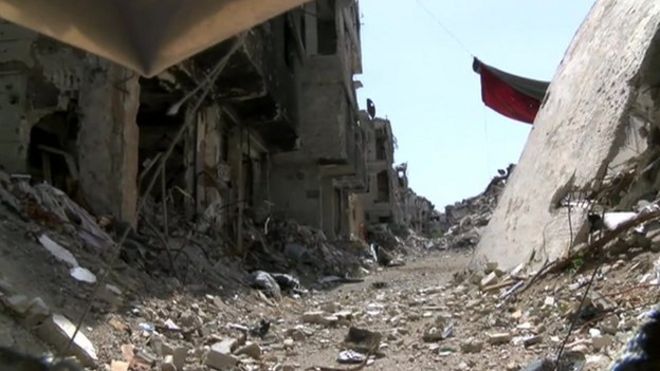
A street devastated by fighting in the Yarmouk Refugee camp. (Photo Curtesy of the BBC).

ISIS has overrun the Palestinian militia group called Aknaf Beit al-Maqdis, a group aligned with Hamas to control an estimated 70 percent of the camp. It is reported that ISIS has support from one of its chief rivals in Syria, the al-Qaeda affiliated al-Nusra front. Civilians left in the camp are caught in the crossfire between ISIS, its allies and various Palestinian rebel factions. Prior to the fighting in Syria the camp composed of about 150,000 Palestinian refugees, now that number has been reduced to just 18,000. 2,000 residents were evacuated during the latest outbreak of fighting by the U.N. and other international aid groups.

The humanitarian situation in Yarmouk is concerning. The camp has no water or power and the residents face constant shelling from forces on all sides. Aid has been unable to enter the camp because of the intense shelling and fighting since ISIS has entered the fold. In response to the worsening humanitarian situation the International Red Cross, among other agencies have called for all sides and all factions to allow aid to enter the camp immediately and for these agencies to be allowed to evacuate as many of the estimated 18,00 civilians still trapped inside the camp as possible.

Palestinian leaders in the West Bank have reported that they have come to an agreement with Assad’s government for the Syrian army to take military action to push ISIS out of the camp. Officials in the West Bank have stated clear support for the Syrian government and their effort to push ISIS out of Yarmouk however; there are Palestinian groups in the camp who have opposed Assad’s government since the beginning of the conflict. As of now it is unclear whether all the Palestinian factions in Yarmouk support the deal  between the West Bank and Assad for a Syrian military offensive to retake the camp.

For more information, please see: 

BBC News — Syria Conflict: Huge Suffering in Yarmouk, Activist Says — 8 April, 2015

Al Jazeera America — ISIL Takeover of Yarmouk a “Siege Within a Siege” — 8 April, 2015 

Reuters — PLO Backs Syrian Army Drive to Regain Yarmouk Camp From Militants — 9 April, 2015

Yahoo News — Palestinian Envoy: “Military Option Agreed for Syria Camp — 9 April, 2015


Ukraine Refugee Situation Causing Problems in Nearby Countries

By Kyle Herda

Impunity Watch Reporter, Europe

KIEV, Ukraine – As the unrest in Eastern Ukraine continues on, those living in the east are facing severe problems that compile more by the day. In particular, economic woes are plaguing Eastern Ukraine, as well as a constant military threat and plenty of destruction to civilian areas. Many from the east have been displaced in the past year and more continue to look elsewhere to escape the instability, but nearby countries are beginning to close up their borders to Ukrainian refugees.

A woman in Sloviansk stands in what remains of her home. (Photo courtesy of Gulf Times)

Over 1 million people have been displaced since fighting began over a year ago in Eastern Ukraine, and applications for refugee status have typically been denied in countries around Ukraine. Only 70 people sought asylum in Lithuania, but only 31 were granted that status. Further, Lithuania states that it is suspending asylum applications from Ukraine due to the increase (Lithuania typically only receives around 5 asylum applications per year). A U.N. refugee agency claims that non-EU countries like Moldova and Belarus received 300,000 applications for asylum, while even further EU countries also received numerous applications. For example, France received 1,415 asylum applications last year, and only accepted 35. Russia also saw roughly 300,000 refugees seeking asylum who fled east after the conflict sparked up.

While fighting in Eastern Ukraine appears to have died down some momentarily, both sides appear to be taking the down time to fortify and dig in. This may actually be an opportunity for both sides to bulk up, as is furthered by a new report claiming that both pro-Russian rebels as well as Kiev and the United States believe a major offensive by Russia is due to occur within the next two months. 60,000 Russian troops are along the border with Ukraine, and Mariupol may be the target of an impending attack. While over 6,000 have been killed in fighting over the past year, only about 100 have died since the February 12th ceasefire deal in Minsk was agreed to.

Given that the situation in Eastern Ukraine is already bad, compounded by the impending reawakening of heavy fighting, many civilians are fleeing before things heat up again. Times are already tough as is, and the future looks dark for now. Other countries, however, are unsure of what will come of all this fighting and unrest, and so they are even more hesitant to take action, much to the dismay of those seeking asylum.

For more information, please see:

Newsweek – Pro-Russian Rebels Told: Major Attack on Ukraine Imminent – 8 April 2015

IBT – Lithuania Suspends Asylum Applications for Ukrainians Fleeing War – 8 April 2015

The Local – Norway sees Ukrainian asylum seeker boom – 31 March 2015

The Local – France rejects hundreds of Ukrainian asylum bids – 26 March 2015

The Local – Sweden sees Ukrainian asylum seeker boom – 26 March 2015

Gulf Times – Ukrainian refugees facing dwindling options in Poland – 26 March 2015

Radio Free Europe Radio Liberty – Russia Says Almost 300,000 Ukrainians Asked For Asylum – 16 February 2015

US Holocaust Memorial Museum: Lessons Learned from Rwanda

Dear friend,On this day, 21 years ago, the Rwandan genocide began, and in just 100 days between 500,000 and one million Rwandans, predominantly Tutsi, were killed.

This genocide remains one of the most horrifying examples of state-directed mass violence against civilians since the Holocaust.

The Museum’s Simon-Skjodt Center for the Prevention of Genocide is today releasing the findings from a conference examining the failure of the international community to prevent or effectively respond to the genocide and exploring whether and how it might have been averted. Review the findings now.

Kigali Genocide Memorial

LEARN MORE

Co-organized by the Museum, the National Security Archive at George Washington University, and The Hague Institute for Global Justice, the conference, held in June 2014, brought together former peacemakers, peacekeepers, and peace monitors from more than a dozen countries.

The conference findings include an annotated transcript of the discussion, with references to over 100 newly declassified documents; a report detailing the main areas of discussion, debate, and lessons learned that emerged; and a compendium of original source documents that reconstruct key moments in the international decision-making up to and throughout the genocide.

This Rwanda conference is part of a broader Museum initiative to examine pivotal moments when international action could have prevented genocide. In the coming months and timed to coincide with the 20th anniversary of the event, we will analyze the international decision-making surrounding the fall of the “safe area” of Srebrenica in July 1995, termed a genocide through ICTY proceedings in 2004, where over 8,000 Bosnian Muslims were killed.

We hope this initiative will lead to greater understanding of the causes of genocide and how to prevent it, as well as new scholarship and research about these tragic events.

Sincerely,

Cameron Hudson
Director, Simon-Skjodt Center for the Prevention of Genocide

Photo: A display of victims’ photographs at the Kigali Genocide Memorial in Rwanda. US Holocaust Memorial Museum