
Syria Urgent Call to Protect Civilians Caught Between Fires in Besieged Yarmouk Camp
Violations Documentation Center in Syria – VDC Syria: Urgent call to protect civilians caught between fires in besieged Yarmouk Camp
9 April 2015.
In view of the dramatic deterioration of the humanitarian situation in the Palestinian Yarmouk refugee camp (located South Damascus), the undersigned organizations urge all parties on the ground to abide by their obligations under international law and to ensure protection of the lives of civilians trapped in the fighting. The international community should take urgent measures to protect thousands of civilians at risk and alleviate the suffering of the most vulnerable. For almost two years, the area has subjected to a lengthy siege imposed by Syrian governmental forces backed by allied militias, which already resulted in a severe humanitarian crisis characterized by unprecedented starvation of civilian populations and shortage in basic food and aid supplies. On April 1 2015, the organization “Islamic State in Iraq and Syria (ISIS)” launched an attack on the Yarmouk camp seemingly coordinated in an alliance with the Al Qaeda-linked “Jabhat Al Nusra” Front.
As ISIS fighters took over several areas in the camp which were previously controlled by the anti-governmental battalion “Aknaf Beit al-Maqdis”, random mortar shelling reportedly resulted in the death of media activist Jamal Abu-Khalifah and civil society activist Abdallatif Al-Rimawi. Scores of others were injured, including medical personnel of the Palestine Hospital which was targeted by governmental forces on 1st April, an attack which resulted in the death of two ISIS fighters and several casualties, according to information provided to the EMHRN by activists based inside the camp.
On 4 April, the Syrian Air Force launched air raids on the camp and dropped explosive barrels on civilian populated areas, including Magharba St., Palestine St. and Said Alas St. Governmental forces and supporting militias tried to invade the camp from the North, causing scores of casualties and injuries amongst civilians, thus escalating the suffering of a civilian population already weakened by the siege imposed on the camp for two years.
A number of civilians who attempted to flee through the Northern part of the camp – controlled by pro-governmental forces – remain detained in the Zeinab Al Hilalia School in the Tadamon area, which is adjacent to the camp, according to local rights activists. In parallel, hundreds of civilians were compelled to seek refuge outside the camp in neighboring areas South of Damascus including a large proportion of women and children. These events occur in a context where the international community, including UN agencies, is failing to address the urgent humanitarian needs of the civilian population in Syria, notably Palestinian refugees.
At this date, thousands of civilians, including a large proportion of women and children, remain stranded and are suffering under a siege imposed by both governmental forces and the ISIS. The situation in the camp continues to rapidly deteriorate and is expected to turn into a large scale humanitarian tragedy if safe humanitarian corridors are not immediately secured.
As basic medical supplies run out in health facilities in the camp, such as the Palestine Hospital and al-Basil Hospital, fighting parties refuse to allow the International Committee of the Red Cross (ICRC) to provide humanitarian aid to civilians in the camp and to evacuate the scores of injured civilians.
The undersigned organizations urge the international community to take urgent steps to facilitate access of humanitarian aid in compliance with UN Security Council resolutions 2139 (2013) and 2165 (2014) which demand unhindered passage to all areas for humanitarian personnel, equipment and transport as well as safe and unhindered evacuation of all civilians who wish to leave certain areas. The Syrian government should therefore allow the ICRC unfettered access to the camp in order to deliver food and medical supplies and evacuate wounded civilians.
Targeted measures also need to be urgently enforced in order to protect humanitarian and human rights defenders who are exposed to critical threats from both armed groups and governmental security apparatus. Before the recent assault, several activists were assassinated inside the camp by unknown assailants, such as the case of Mr Firas Al Naji, member in the Palestinian Human Rights League in Syria who was shot dead on 23 February 2015, as well as Mr Yehia Hourani, a Red Crescent activist, who was killed on 30 March in the camp. An unknown number of aid workers were reportedly arrested by governmental forces for attempting to smuggle aid inside the camp.
The Syrian government should abide by its obligations under IHL by immediately ending the siege imposed on Yarmouk Camp, and cease indiscriminate and disproportionate air shelling and the use of explosive barrels. All fighting parties should cease their military operations in civilian populated areas in the camp, refrain from targeting non-violent activists, humanitarian workers and civilians regardless of their political affiliations.
Signatory Organizations:
Assyrian Human Rights Network – AHRN
Committee for the Defense of Prisoners of Conscience in Syria
Damascus Center for Human Rights Studies – DCHRS
Euro-Mediterranean Human Rights Network – EMHRN
Front Line Defenders – FLD
Palestinian Human Rights Organization – PHRO
Syrian Center for Legal Studies and Research
Syrian Center for Statistics and Research
Syrian League for Citizenship – SL4C
Syrian Network for Human Rights – SNHR
The Day After – TDA
Palestinian League for Human Rights- Syria
Violations Documentation Center in Syria – VDC
Humanitarian Problems Grow as ISIS Seize Palestinian Refugee Camp
By Max Bartels
Impunity Watch Reporter, The Middle East
Damascus, Syria
This week ISIS fighters attacked and seized a large portion of the Yarmouk Palestinian refugee camp outside of Damascus in Syria. The camp has been a humanitarian issue for years, when fighting in Syria broke out many groups such as Hamas supported Sunni rebels efforts to topple Assad’s government. Prior to ISIS involvement Assad limited food and aid coming into the camp. Over the last four years the camp has been virtually destroyed by the conflict between various factions. Most recently, ISIS has entered the fight for the camp with the intention of using it as a platform for further advances into the South of Syria and into Damascus itself.
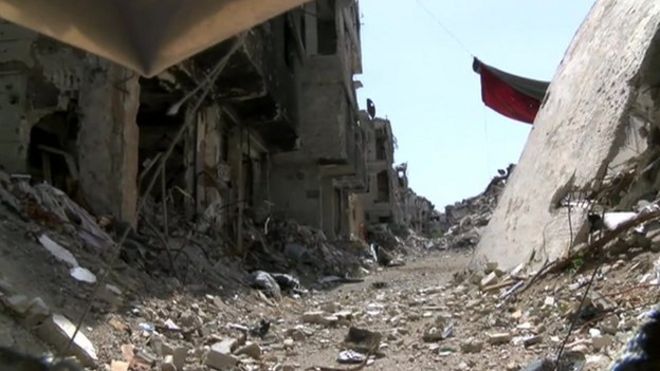
ISIS has overrun the Palestinian militia group called Aknaf Beit al-Maqdis, a group aligned with Hamas to control an estimated 70 percent of the camp. It is reported that ISIS has support from one of its chief rivals in Syria, the al-Qaeda affiliated al-Nusra front. Civilians left in the camp are caught in the crossfire between ISIS, its allies and various Palestinian rebel factions. Prior to the fighting in Syria the camp composed of about 150,000 Palestinian refugees, now that number has been reduced to just 18,000. 2,000 residents were evacuated during the latest outbreak of fighting by the U.N. and other international aid groups.
The humanitarian situation in Yarmouk is concerning. The camp has no water or power and the residents face constant shelling from forces on all sides. Aid has been unable to enter the camp because of the intense shelling and fighting since ISIS has entered the fold. In response to the worsening humanitarian situation the International Red Cross, among other agencies have called for all sides and all factions to allow aid to enter the camp immediately and for these agencies to be allowed to evacuate as many of the estimated 18,00 civilians still trapped inside the camp as possible.
Palestinian leaders in the West Bank have reported that they have come to an agreement with Assad’s government for the Syrian army to take military action to push ISIS out of the camp. Officials in the West Bank have stated clear support for the Syrian government and their effort to push ISIS out of Yarmouk however; there are Palestinian groups in the camp who have opposed Assad’s government since the beginning of the conflict. As of now it is unclear whether all the Palestinian factions in Yarmouk support the deal between the West Bank and Assad for a Syrian military offensive to retake the camp.
For more information, please see:
BBC News — Syria Conflict: Huge Suffering in Yarmouk, Activist Says — 8 April, 2015
Al Jazeera America — ISIL Takeover of Yarmouk a “Siege Within a Siege” — 8 April, 2015
Reuters — PLO Backs Syrian Army Drive to Regain Yarmouk Camp From Militants — 9 April, 2015
Yahoo News — Palestinian Envoy: “Military Option Agreed for Syria Camp — 9 April, 2015
The Monthly Statistical Report on victims March 2015 Violations Documentation Center in Syria – VDC
Ukraine Refugee Situation Causing Problems in Nearby Countries
By Kyle Herda
Impunity Watch Reporter, Europe
KIEV, Ukraine – As the unrest in Eastern Ukraine continues on, those living in the east are facing severe problems that compile more by the day. In particular, economic woes are plaguing Eastern Ukraine, as well as a constant military threat and plenty of destruction to civilian areas. Many from the east have been displaced in the past year and more continue to look elsewhere to escape the instability, but nearby countries are beginning to close up their borders to Ukrainian refugees.

Over 1 million people have been displaced since fighting began over a year ago in Eastern Ukraine, and applications for refugee status have typically been denied in countries around Ukraine. Only 70 people sought asylum in Lithuania, but only 31 were granted that status. Further, Lithuania states that it is suspending asylum applications from Ukraine due to the increase (Lithuania typically only receives around 5 asylum applications per year). A U.N. refugee agency claims that non-EU countries like Moldova and Belarus received 300,000 applications for asylum, while even further EU countries also received numerous applications. For example, France received 1,415 asylum applications last year, and only accepted 35. Russia also saw roughly 300,000 refugees seeking asylum who fled east after the conflict sparked up.
While fighting in Eastern Ukraine appears to have died down some momentarily, both sides appear to be taking the down time to fortify and dig in. This may actually be an opportunity for both sides to bulk up, as is furthered by a new report claiming that both pro-Russian rebels as well as Kiev and the United States believe a major offensive by Russia is due to occur within the next two months. 60,000 Russian troops are along the border with Ukraine, and Mariupol may be the target of an impending attack. While over 6,000 have been killed in fighting over the past year, only about 100 have died since the February 12th ceasefire deal in Minsk was agreed to.
Given that the situation in Eastern Ukraine is already bad, compounded by the impending reawakening of heavy fighting, many civilians are fleeing before things heat up again. Times are already tough as is, and the future looks dark for now. Other countries, however, are unsure of what will come of all this fighting and unrest, and so they are even more hesitant to take action, much to the dismay of those seeking asylum.
For more information, please see:
Newsweek – Pro-Russian Rebels Told: Major Attack on Ukraine Imminent – 8 April 2015
IBT – Lithuania Suspends Asylum Applications for Ukrainians Fleeing War – 8 April 2015
The Local – Norway sees Ukrainian asylum seeker boom – 31 March 2015
The Local – France rejects hundreds of Ukrainian asylum bids – 26 March 2015
The Local – Sweden sees Ukrainian asylum seeker boom – 26 March 2015
Gulf Times – Ukrainian refugees facing dwindling options in Poland – 26 March 2015
Radio Free Europe Radio Liberty – Russia Says Almost 300,000 Ukrainians Asked For Asylum – 16 February 2015