Violations Documentation Center in Syria – VDC: The Monthly Statistical Report of Victims – March 2015
[Embed]https://www.scribd.com/doc/261020019/The-Monthly-Statistical-Report-March-2015[/embed]
By Lyndsey Kelly
Impunity Watch Reporter, North America
WASHINGTON D.C., United States of America – A lawsuit filed in Baltimore City Circuit Court seeks $1 billion in damages from defendant Johns Hopkins University for its alleged role in the deliberate infection of hundreds of Guatemalans with syphilis, gonorrhea and other sexually transmitted diseases (STDs), during a government medical experiment program in the 1940s and 1950s.

The lawsuit, which also names the philanthropic Rockefeller Foundation, alleges that both institutions helped design, support, and finance the experiments by employing scientists and physicians. According to the U.S. Department of Health and Human Services, researchers initially infected Guatemalan sex workers in order to research the spread of STDs and then ascertain if penicillin could prevent the diseases. Later the experiment extended to orphans, prisoners and mental health patients.
The experiments were kept secret until they were discovered in 2010 by a college professor, Susan Reverby. The then secretary of state, Hillary Clinton apologized for the program after a presidential bioethics commissions found the experiments “involved unconscionable basic violations of ethics.” Ultimately, the program published no findings and did not inform the Guatemalans of the consequences of the infection, and they were also not provided with the necessary follow up medical care to inform them of ways to prevent the infections from spreading.
A federal lawsuit for damages under the Federal Tort Claims Act failed in 2012 after a judge determined that the United States Government could not be held liable for actions outside the United States. Lawyers for the victims believe that the new lawsuit stands a a greater chance for success as it is against private entities.
For more information, please see the following:
AL JAZEERA – Johns Hopkins Sued Over STD Study in Guatemala – 1 April 2015.
FOX NEWS – Johns Hopkins Sued For $1B Over Guatemala Venereal Disease Study – 3 April 2015.
THE GUARDIAN – Guatemalans Deliberately Infected With STDs Sue Johns Hopkins University for $1bn – 2 April 2015.
WASHINGTON POST – Johns Hopkins Faces $1 Billion Lawsuit For Role In STD Study in Guatemala – 1 April 2015.
By Kathryn Maureen Ryan
Impunity Watch, Managing editor
DAMASCUS, Syria – Syrian’s President Bashar al-Assad, whose regime has been engaged in a brutal civil war in Syria since 2011, sat down with CBS News journalist Charlie Rose for a 60 Minutes interview last week. During the interview Assad dismissed charges that his regime has used chlorine gas against his own people and has systematic used indiscriminate barrel bombs against civilian targets as media propaganda. Assad argued that claims that his regime has committed war crimes, including the use of chemical weapons against civilians, is part of the malicious propaganda against Syria.”
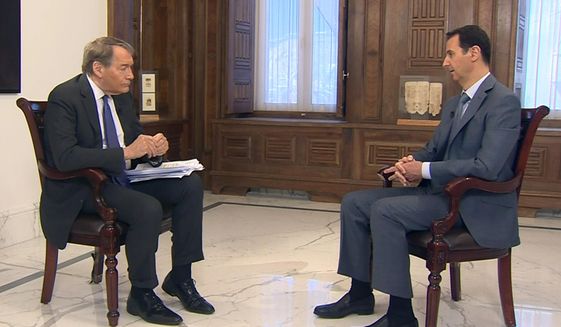
Assad accused the media of participating in “malicious Propaganda” against his regime. He argued that calls for chemical weapons inspectors and accusing that his regime used chemical weapons against the Syrian people were “part of the propaganda because, as you know, in the media when it bleeds it leads. And they always look for something that bleeds, which is the chlorine gas and the barrel bombs.” He also argued “chlorine gas is not military gas” because “you can buy it anywhere” he also argued that Chlorine gas is ineffective and said that if it were more effective as a weapon “the terrorists” would have used it on a larger scale.
While Charlie Rose addressed several alleged atrocities committed by the Assad regime during the interview some journalists criticized 60 Minutes for allowing the interview to move forward, arguing that it simply gives a mouthpiece and a degree of legitimacy to an alleged war criminal. The interview was given under the condition that it be filled by Iranian television cameramen leaving the regime with a great deal of control of the interview.
Despite Assad’s continued denial that chemical weapons have been used by his regime the international community has little uncertainty about the source of the attacks. Last month, The United Nations Security Council passed a resolution condemning, in the highest terms, the use of chlorine gas as a chemical weapon in Syria. The Council also signaled it would take Chapter IV action if such weapons were used again in Syria. Resolution 2209 (2015) was adopted with a vote of 14 in favor, zero against, and only one abstention (Venezuela). The Council adopted the resolution expressing deep concern that toxic chemicals had been used as a weapon in Syria, as concluded with a “high degree of confidence” by the Organization for the prohibition of Chemical Weapons (OPCW) fact-finding mission in Syria. Syria’s Civil war has killed more than 200,000 people and has created more than 4 million refugees.
For more information please see:
The Washington Times – Assad Interview Just Latest Case of Malfeasance for ‘60 Minutes’ – 1 April 2015
CBS News – Syrian President Bashar Al-Assad on 60 Minutes – 29 March 2015
CBS News – Assad: Chlorine Gas, Barrel Bomb Claims “Propaganda” – 27 March 2015
United Nations Press Release – Adopting Resolution 2209 (2015), Security Council Condemns Use of Chlorine Gas as Weapon in Syria – 6 March 2015
By Max Bartels
Impunity Watch Reporter, The Middle East
The Hague, Netherlands
On Wednesday Palestine officially joined the International Court of Justice after signing the Rome Statute in January if this year. Palestine seeks to pursue charges against Israel for alleged war crimes committed on Palestinian territory by Israeli troops. Israel is not a party to the Rome Statue however; military and civilian officials could still face charges if the court believes that crimes were committed on Palestinian territory. The signing of the Rome Statute by Palestine also opens up Palestinian officials and militants to be prosecuted by the court.
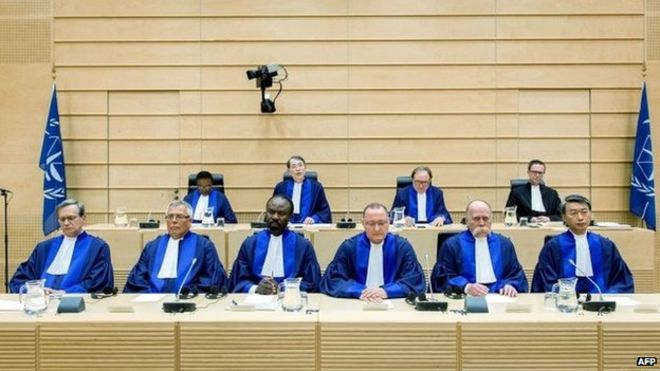
There are reports that several Palestinian are set to file complaints with the ICC, however it is the prosecutors and the judges who decide which cases to pursue. When Palestine signed the Statute in January, ICC prosecutor Fatou Bensouda launched a preliminary to determine if there will be a formal investigation into Palestinian grievances.
The Israeli government objected to the Palestinian Authority joining the Court, stating that Palestine is not recognized as a sovereign state. The U.S has also objected to the addition of Palestine to the Court for the same reason and warned that it would cut funding for the Palestinian authority. The Israeli government froze about $400 million in tax revenues collected by Israel on behalf of the Palestinian organization. Human Rights Watch called for governments who are penalizing Palestine for joining the Court to end their pressure. Human Rights Watch claims that it documented what it believed to be war crimes during the 2014 Gaza conflict which claimed 2,000 Palestinian lives as well as 73 Israeli. However, both sides had prevented meaningful justice for these incidents. Israel has launched investigations into the incidents in Gaza but the Palestinian authority has not announced an investigation of its own.
It remains to be seen whether the Court will chose to launch formal investigations into the Israeli- Palestinian conflict. The Court will be hesitant of being dragged into such a heavily politicized case. Furthermore, the ICC does not investigate cases that are already being looked into by other judicial institutions. The Court will not investigate these allegations if an Israeli judicial institution is investigating the case up to the standards if the International Criminal Court. Experts have stated that if the Court does open formal investigations they will not open them in an area that includes only Israel, they will want to look into both sides.
For more information, please see:
Al Jazeera — Palestine Formally Joins International Criminal Court — 1 April, 2015
BBC News — Palestinians Formally Join International Criminal Court — 1 April, 2015
Reuters — Dilemma for Israel as Palestinians Join War Crimes Court — 31 March, 2015