Remnants of War and Prospects for Renewed Fighting Continue to Slow Recovery in Eastern Ukraine

By Kyle Herda

Impunity Watch Reporter, Europe

KIEV, Ukraine – While pro-Russian rebels in Eastern Ukraine may have initially been happy when they gained control of some land, they are now facing the struggles that come with disassociating from the parent nation. Economic times are tough in rebel-held territory, and those living in Eastern Ukraine are struggling.

Fighting in parts of Eastern Ukraine, particularly near this hotel around the Donetsk airport, has caused massive destruction that pro-Russian rebels are finding difficult to recover from. (Photo courtesy of National Journal)

After losing sections of Eastern Ukraine to pro-Russian rebels, Kiev installed some cuts to the banking system and also imposed some travel restrictions. In effect, these moves have caused those already in East Ukraine to become trapped without much aid or assistance from outside, increasing the poverty issue for those in pro-Russian land. The Ukrainian military is claimed to be denying aid to the East, and the pro-Russian rebel’s People’s Republic of Donetsk has handled the need for aid by denying there is a need for it. Either way, both sides are denying aid to those in need.

Some kids living in Eastern Ukraine are also being denied school by their parents due to concerns that it is not safe. Those who remain speak about the damaged homes and loved ones who were killed in the fighting, as well as the many who have already left to move either further West or into Russia. Despite the ceasefire, fighting has yet to completely halt in Eastern Ukraine, as artillery fire reportedly hit rebel-held Donetsk on Sunday. It appears that the shelling originated near the Donetsk airport, and Ukrainian soldiers further report that small arms, 82mm mortar shells, and rocket-propelled grenades were used against government troops near the airport overnight; three people have been injured in the attacks.

Ukrainian soldiers also report small arms fire and 120mm mortar shells were fired upon them in Luhansk and near Mariupol, and further that there were nine incidents where pro-Russian rebel drones were seen in the air. NATO’s joint intelligence unit in the United Kingdom, according to U.S. Air Force General Philip Breedlove, has also confirmed that Russia continues to send military and economic support into Eastern Ukraine for the pro-Russian rebels.

Perhaps pressured by all of this, neighboring NATO countries, particularly in the Baltics, have been very concerned over the past year that they may be next in sight for Russia. In an effort to increase pressure on Moscow and ease concerns of military takeover in other Eastern European nations, the United States is currently engages in “Operation Dragoon Ride,” which involves a parade of Strykers and the US Army’s 2nd Cavalry Regiment riding throughout Eastern Europe.

For more information, please see:

Sky News (AU) – Artillery rocks Ukraine rebel base Donetsk – 23 March 2015

USA Today – For pro-separatist Ukrainians, hardship replaces hope – 22 March 2015

Bloomberg View – NATO Says Russia’s Still Pouring Arms Into Ukraine – 22 March 2015

RT – US military convoy parades through Eastern Europe – 22 March 2015
U.N. Investigators Sharing Reports of Syrian War Crimes with European Authorities

By Kathryn Maureen Ryan
Impunity Watch, Managing Editor

DAMASCUS, Syria – A team of United Nations Investigators have begun sharing details from their secret database on Syrian war crimes with European Authorities pursing domestic court cases. The Database contains detailed information on suspected war crimes committed in Syria during the course of the country’s Civil War which has now entered its fifth year. The move by the investigators could pave the way for the perpetrators of mass atrocities including killing and torture on all sides of the brutal conflict to be brought to justice. The goal is to go around the deadlocked United Nations Security Council, where Russia and China, which hold veto power, have prevented the cases from being referred to the International Criminal Court (ICC) for prosecution.

Paulo Pinheiro, chairperson of the International Commission of Inquiry on Syria, speaks during a news conference at the United Nations in Geneva November 14, 2104. (Photo courtesy of Reuters)

Paulo Pinheiro, the chairman of the United Nations’ commission of inquiry, urged national authorities to contact the independent investigators who have compiled five confidential lists of suspected war crimes over nearly four years. Pinheiro and his team of investigators, including former U.N. war crimes prosecutor Carla del Ponte, said last month they planned to publish names of the suspected perpetrators of atrocities in Syria and push for new ways to bring them to justice, especially if the Security Council continues to fail to act.

Carla Del Ponte, who served as the former chief prosecutor of the International Criminal Tribunal For Former Yugoslavia (ICTY), which was established to investigate suspected war crimes committed during the Balkan conflicts in the 1990s, argued that that the International Criminal Tribunal For Former Yugoslavia serves as an example of how an ad-hoc tribunal could eventually be established to bring justice to Syria. Del Ponte; “At the beginning I was for the ICC but now with the changing situation, I think an ad-hoc tribunal could be more efficient and work faster,” Del Ponte told the Guardian in an interview in Geneva. “First of all, the ICC would prosecute only three, four, five perpetrators, not more. I think an ad-hoc tribunal could prepare a list of over a hundred, like the tribunal for the former Yugoslavia … An ad-hoc tribunal could also be based near the region, facilitating access of witnesses, documentation and so on.”

The Assad Regime’s Ambassador to the United Nations, Hussam Edin Aala, dismissed the database created by the four year investigation claiming that a “biased and selective approach” was used by the United Nations investigators. He also claimed they had ignored crimes by Islamist insurgent groups. The regime of Syrian President Bashar al-Assad has been accused of committing war crimes and crimes against Humanity throughout the civil war, which began when the regime turned its guns on peaceful protesters demanding democratic reforms.  More than 200,000 people have been killed during the Syrian Civil War which began in 2011.

For more information please see:

Al Arabiya – U.N. Investigators to Share Syria War Crimes List – 17 March 2015

The Daily Mail – UN Investigators to Share Names Of Syria War Crimes Suspects – 17 March 2015

The Guardian – Call for Special Tribunal to Investigate War Crimes and Mass Atrocities in Syria – 17 March 2015

Reuters – U.N. Investigators Sharing Syria War Crimes Findings with European Authorities – 17 March 2015

New Reports Seem to Confirm Russian Rocket Responsible for Downing MH17 over Ukraine

By Kyle Herda

Impunity Watch Reporter, Europe

KIEV, Ukraine – A fragment found at the crash site of MH17 has been tested and appears to have come from a Russian BUK missile.

A piece of flight MH17 being removed from the crash site. (Photo courtesy of Reuters)

A Dutch journalist recovered a fragment from the July 17 crash that killed 298 people. The fragment was later tested by international forensic experts, which included defense analyst HIS Jane’s in London. Tests on the fragment show that it appears to have come from the Russian BUK missile, an anti-aircraft missile that fires from a truck to engage aircraft up to 13 miles off the ground.

Testing on fragments has revealed a low-grade steel alloy consistent with BUK missiles, and a fragment believed to have come from a warhead includes numbers that seem consistent with a serial number and a Russian alphabet letter. IHS Jane reports the warhead came from a BUK-9M317, which is the newer version of a BUK 1-2. German rocket scientists Marksu Schiller and Robert Schmucker also believe the IHS Jane report, claiming “only a Buk missile can take out the aircraft at such a height, in such a short time, and cause so much damage.”

Until this new report came out, reports merely claimed “high velocity projectiles” hit the plane but could confirm no more. Both sides continue to blame the other; Kiev and Western nations believe it was fired either by Russia or more likely pro-Russian rebels armed with a Russian missile, while Russia and pro-Russian rebels tend to claim Kiev is responsible.

Ukraine has been more stable as of late given a cease-fire that has created more peace in the country’s East than has been seen in months. There is one problem, however, as the cease-fire is contingent on both sides pulling away heavy weapons 15 to 45 miles from the front, yet reports show that both sides have failed to do so, and are actively moving heavy weapons near the front. On Wednesday, reports claim Kiev transported a tank and large-caliber gun in Avdiivka, near the front, and reports from Friday claim that two tanks and two 120mm guns were taken to the front in rebel territory near Donetsk. Lack of willingness by both sides to honor the cease-fire terms, along with reports officially linking Russia to the MH17 crash, create concerns that the cease-fire may again fall apart to renewed fighting that has already killed 6,000.

For more information, please see:

Yahoo – Confidence in Ukraine’s cease-fire hurt by arms violations – 21 March 2015

Business Insider – More proof that a Russian BUK missile shot down passenger plane MH17 – 19 March 2015

NL Times – Russian BUK Missile Took Out MH17: Dutch Forensic Researcher – 19 March 2015

Reuters – Fragment from MH17 crash site supports missile theory: Dutch TV – 19 March 2015

Mosque attacks in Yemen kill over 100; many more wounded

By Ashley Repp

New Desk Reporter, Middle East

SANAA, Yemen-

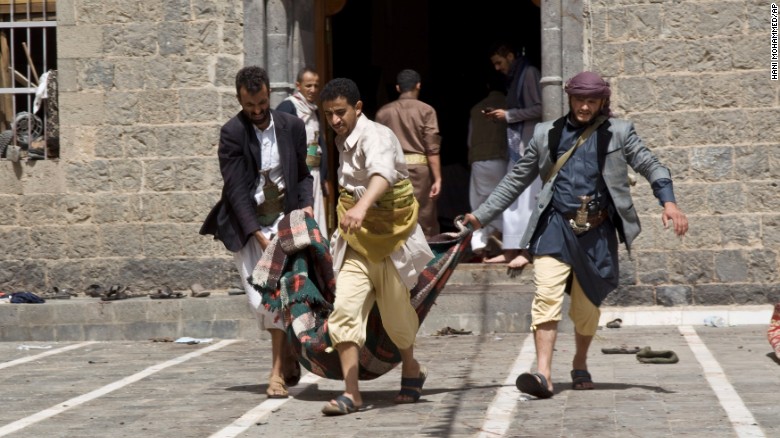
As hundreds of Shi’ites gathered at two mosques in Sanaa, the capital of Yemen, for Friday prayer services, attackers blended into the scenery using medical casts to conceal explosives. The bombers within the mosques then detonated the bombs, killing scores of worshipers. As people fled the mosques, bombers stationed outside then detonated a second round of bombs amidst the fleeing crowd. The death toll has not been officially set, but the number of those dead is estimated to be at least 130, and there are over 300 hundred wounded. Hospitals were overwhelmed by the number of individuals rushed in for emergency care, and staff made a call for immediate donations of blood to accommodate the pressing need in the wake of the attacks.

Yemen attack
Photo courtesy of CNN


While officials have not determined who is responsible for the attacks on the mosques, some point to ISIS, a Sunni extremist organization that considers the Shi’ite Houthi rebels to be heretics. Supporting this assertion, a twitter account that prominently features ISIS propaganda asserted that the mosque attacks were the first wave of attacks in Yemen. Some officials are skeptical that this was the work of ISIS, as the organization only recently set up in Yemen in November of 2014, and argued that, more realistically, this was the work of al-Queda in the Arabian Peninsula (AQAP). AQAP has denied these allegations though, and asserts that it was given orders to refrain from attacking mosques and markets.

If this attack was indeed orchestrated by ISIS, it represents the ever growing concern that ISIS is expanding its reach quickly and effectively, and has the capacity to incite world wide security concerns. Compounding the concern, the attack in Yemen on Friday follows just on the heels of a terror attack in a Tunisian museum on Wednesday, for which ISIS also claimed responsibility. If ISIS continues to develop a stronghold in Yemen, the already precarious civil situation between Sunnis and Shi’ite Houthi rebels, could be further deteriorate and evolve into a civil war.


For more information, please visit:

BBC- Yemen Crisis: Islamic State claims Sanaa mosque attacks– Mar. 20, 2015

Al Jazeera- Scores killed in suicide attacks on Yemen mosques– Mar. 21, 2015

CNN- Yemen: Bombs kill 137 at mosques; ISIS purportedly lays claim– Mar. 20, 2015