26 March 2015 – The Canadian House of Commons has unanimously passed a motion calling for the imposition of targeted visa sanctions and asset freezes against those responsible for Sergei Magnitsky’s torture, death, and the subsequent cover-up.
The motion introduced by Hon. Irwin Cotler MP, Liberal party spokesman on International Justice and one of 21 parliamentarians from 13 countries who form the Justice for Sergei Magnitsky Inter-Parliamentary Group, calls on the Canadian government to:
“Explore and encourage sanctions against any foreign nationals who were responsible for the detention, torture or death of Sergei Magnitsky, or who have been involved in covering up the crimes he exposed.” (http://irwincotler.liberal.
ca/blog/motion-sanctions- human-rights-violators- magnitsky-case/) “The unanimous support of this motion sends a clear signal to human rights violators in Russia and around the world that they will be held to account for their crimes,” said Irwin Cotler MP. “By imposing sanctions, we can impose meaningful penalties on human rights violators and deter future violations.”
The Magnitsky Sanctions motion voted on yesterday in the Canadian parliament also calls on the government to sanction human rights abusers around the world, stating that targeted Magnitsky sanctions are “appropriate against any foreign nationals responsible for violations of internationally recognized human rights in a foreign country.”
“We are pleased to see Canada taking such a definitive stance against human rights abusers,” said Bill Browder. “This legislation will be an important step in ensuring that the legacy of Sergei Magnitsky will continue to protect victims of human rights abuse, both in Russia and around the world.”
The Magnitsky Sanctions motion adopted in the Canadian House of Commons follows a private members bill introduced by Irwin Cotler in October 2013, calling for sanctions to be imposed on those responsible for the torture and death of Sergei Magnitsky (https://openparliament.ca/
bills/41-2/C-339/). A similar motion has also been introduced in the Canadian Senate.
Seven Canadian Parliamentarians from four different political parties, along with Bill Browder, leader of the Magnitsky Justice Campaign, presented their support for the motion in a press conference at the Canadian Parliament yesterday. Parliamentarians in attendance included Irwin Cotler MP, Senator? Raynell Andreychuk, Conservative MP and Parliamentary Secretary to the Minister of Foreign Affairs David Anderson, Liberal Foreign Affairs Critic Marc Garneau, NDP MP Murray Rankin, Conservative Senator Linda Frum, and Green Party leader Elizabeth May.
“The Sergei Magnitsky case is today recognized as a symbol of what can happen when the principles of fundamental justice and rule of law are manipulated for personal gain,” said Senator Andreychuk, who introduced the motion in the Senate. “I hope that the Senate will soon join with the House of Commons and parliaments around the world to express our commitment to accountability for foreign nationals who commit the most serious violations of human rights.”
“The tragedy of Sergei Magnitsky’s death in Russian custody and appalling posthumous show trial are stark symbols of the precipitous decline of Russian democracy,” added Green Party leader Elizabeth May. “Bill Browder’s inexhaustible efforts to commemorate the life of his lawyer and friend are laudable and instructive. I urge the Government to give full support to Mr. Cotler’s call for sanctions that will hold the perpetrators of Sergei Magnitsky’s torture accountable. Today’s motion is an important step in the international effort to achieve justice for Magnitsky and help to guarantee the human rights of all Russian citizens.”
Sergei Magnitsky was killed in Russian pre-trial detention in 2009 after uncovering a $230 million corruption scheme and testifying against the government officials involved.
Following his death, the US passed the 2012 Sergei Magnitsky Rule of Law Accountability Act, which imposes visa bans and asset freezes against those involved in Sergei’s case. 34 individuals are currently banned from the US under the Act. (http://www.treasury.gov/
resource-center/sanctions/ OFAC-Enforcement/pages/ 20130412.aspx; http://www.treasury.gov/ resource-center/sanctions/ ofac-enforcement/pages/ 20140520.aspx;http://www.treasury.gov/ resource-center/sanctions/ OFAC-Enforcement/Pages/ 20141229.aspx). The European Parliament passed a similar resolution in 2014, calling for 32 individuals to be sanctioned. (http://www.europarl.europa.
eu/sides/getDoc.do?type=TA& language=EN&reference=P7-TA- 2014-0258). Motions and resolutions calling for sanctions have also been passed by the OSCE, PACE, the UK, Holland, Sweden, Italy and Poland. For more information, please contact:
Magnitsky Justice Campaign
e-mail: info@lawandorderinrussia.org
website: www.lawandorderinrussia.org
Facebook: http://on.fb.me/hvIuVI
Saudi Led Coalition Commences Airstrikes in Yemen
By Max Bartels
Impunity Watch Reporter, The Middle East
Sanna, Yemen
Saudi Arabia commenced air strikes in Yemen on Thursday in an attempt to halt the advances of the Houthi militia in Yemen. Saudi Arabia has gathered together a coalition of Arab nations to combat the Houthis, the Saudis are leading the coalition with 100 fighter jets, followed by the United Arab Emirates with 30 aircraft, 15 from Kuwait and Bahrain, 10 from Qatar and Jordan as well as naval support from Pakistan and Egypt. The coalition is made up of all Sunni nations, targeting the Iranian backed Shiite Houthi militia. The Saudis, as well as the other nations in the coalition are concerned about an Iranian run Shiite state on the Arabian Peninsula.

Iran has expressed concern over the coalition airstrikes against the Houthi militia, claiming it further complicates an already complicated situation of internal strife. The Iranian Foreign Ministry claims the coalition attack on the Houthis will allow groups like ISIS and Al Qaeda of the Arabian Peninsula to grow unchecked and take advantage of the chaos. The IranianForeign Ministry has also denied any military intervention in support of the Houthi militia. On the other hand, the U.S has expressed support for the Saudi led coalition, although Secretary of State Kerry has stated that the U.S will not intervene in the Yemen situation. The U.S supported the now deposed Saudi backed Yemeni government because of their support for the U.S drone strike campaign against Al Qaeda targets in Yemen. The U.S claims it will assist the coalition with intelligence sharing, targeting assistance and logistical support.
The Houthis have emerged as the dominant power in Yemen. The Sunni, Saudi backed Yemeni President Hadi was removed from power in January by the Houthis, since then the country has been in a state of chaos with differnet factions vying for power. The Saudis claim that their military operations are in support of Hadi and the legitimately elected government of Yemen. In support of these operations the Saudis have deployed 150,000 Saudi troops at the Yemen border in case a ground offense is undertaken against the Houthi militia. The Houthis claim that the coalition airstrikes into Yemen only serve to unite the people of Yemen to the Houthi cause. There is little the Houthi forces can do in response to persistent airstrikes but the militia claims that if Saudi ground forces invade they will be repulsed.
For more information, please see:
The Washington Post — Saudi Arabia Launches Airstrikes in Yemen — 25 March, 2015
Reuters — Saudi Arabia Leads Airstrikes Against Yemen’s Houthi Rebels — 26 March, 2015
CNBC — Saudi Arabia, Allies Launch Airstrikes in Yemen Against Houthi Fighters — 26 March, 2015
CNN — Saudi – Led Coalition Strikes Houthi Rebels in Yemen — 26 March, 2015
At Least 54 Colombian Girls Report Being Sexually Abused by US Military
By Delisa Morris
Impunity Watch Reporter, South America
BOGOTA, Colombia–Between 2003 and 2007, according to a recently released historic document on the Colombian conflict, US soldiers and military contractors sexually abused more than 54 children in Colombia. Allegedly, the suspects have not and will not be prosecuted due to immunity clauses in bilateral agreements.
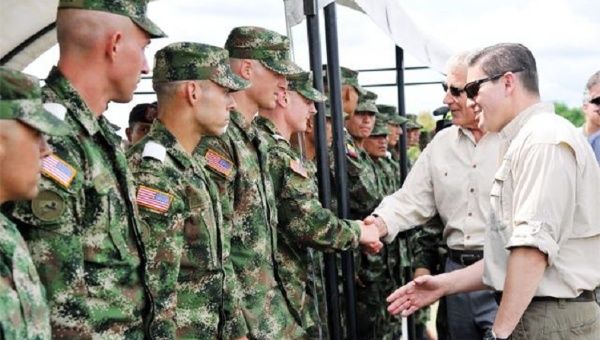
The report, 800 pages in length, was commissioned by the Colombian government and rebel group FARC to establish the causes and violent agitators of the 50-year-long conflict between leftist rebels and the state while they are negotiating peace.
Officials hope that the document will help negotiators determine who is responsible for the 7 million victims or the armed conflict between leftist rebels and the state while they are negotiating peace.
One of the scholars that helped redact the historians’ report, Renan Vega of the Pedagogic University in Bogota, focused part of this historic document on the American military that has actively supported the Colombian state in its fight against drug trafficking and leftist rebel groups like the FARC.
“[T]here exists abundant information about the sexual violence, in absolute impunity thanks to the bilateral agreements and the diplomatic immunity of United States officials.”
One incident cited in the report was a 2004 case in the central Colombian town of Melgar where 53 underage girls were sexually abused by nearby stationed military contractors “who moreover filmed [the abuse] and sold the films as pornographic material.”
According to Colombian newspaper, El Tiempo, the victims of the sexual abuse practices were forced to flee the region after their families received death threats.
The case that has called the most attention was in 2007 when a 12-year-old girl was raped by a US Army sergeant and a former US military officer who was working in Melgar as a military contractor.
Colombian prosecutors established that the girl had been drugged and subsequently raped inside the military base by the officers. The prosecution officials were not allowed to arrest the suspected child rapists who were flown out of the country after the news broke.
The rape victim, her little sister and her mother were forced to flee to the city of Medellin as forces loyal to the suspects were threatening the family, the mother told Colombian television.
The special envoy will possibly have to deal with the role of the US military and its members in the alleged victimization of Colombians.
For more information, please see:
Colombia Reports – At least 54 Colombian girls sexually abused by immune US military: Report – 23 Mar. 2015
El Tiempo – Seven years of shameful impunity for girl raped in Melgar – 22 Mar. 2015
El Turbion – Impunity for soldiers Plan Colombia – 15 Feb. 2009
telesur – US Military Sexually Abused at Least 54 Colombian Children – 23 Mar. 2015
Remnants of War and Prospects for Renewed Fighting Continue to Slow Recovery in Eastern Ukraine
By Kyle Herda
Impunity Watch Reporter, Europe
KIEV, Ukraine – While pro-Russian rebels in Eastern Ukraine may have initially been happy when they gained control of some land, they are now facing the struggles that come with disassociating from the parent nation. Economic times are tough in rebel-held territory, and those living in Eastern Ukraine are struggling.

After losing sections of Eastern Ukraine to pro-Russian rebels, Kiev installed some cuts to the banking system and also imposed some travel restrictions. In effect, these moves have caused those already in East Ukraine to become trapped without much aid or assistance from outside, increasing the poverty issue for those in pro-Russian land. The Ukrainian military is claimed to be denying aid to the East, and the pro-Russian rebel’s People’s Republic of Donetsk has handled the need for aid by denying there is a need for it. Either way, both sides are denying aid to those in need.
Some kids living in Eastern Ukraine are also being denied school by their parents due to concerns that it is not safe. Those who remain speak about the damaged homes and loved ones who were killed in the fighting, as well as the many who have already left to move either further West or into Russia. Despite the ceasefire, fighting has yet to completely halt in Eastern Ukraine, as artillery fire reportedly hit rebel-held Donetsk on Sunday. It appears that the shelling originated near the Donetsk airport, and Ukrainian soldiers further report that small arms, 82mm mortar shells, and rocket-propelled grenades were used against government troops near the airport overnight; three people have been injured in the attacks.
Ukrainian soldiers also report small arms fire and 120mm mortar shells were fired upon them in Luhansk and near Mariupol, and further that there were nine incidents where pro-Russian rebel drones were seen in the air. NATO’s joint intelligence unit in the United Kingdom, according to U.S. Air Force General Philip Breedlove, has also confirmed that Russia continues to send military and economic support into Eastern Ukraine for the pro-Russian rebels.
Perhaps pressured by all of this, neighboring NATO countries, particularly in the Baltics, have been very concerned over the past year that they may be next in sight for Russia. In an effort to increase pressure on Moscow and ease concerns of military takeover in other Eastern European nations, the United States is currently engages in “Operation Dragoon Ride,” which involves a parade of Strykers and the US Army’s 2nd Cavalry Regiment riding throughout Eastern Europe.
For more information, please see:
Sky News (AU) – Artillery rocks Ukraine rebel base Donetsk – 23 March 2015
USA Today – For pro-separatist Ukrainians, hardship replaces hope – 22 March 2015
Bloomberg View – NATO Says Russia’s Still Pouring Arms Into Ukraine – 22 March 2015
RT – US military convoy parades through Eastern Europe – 22 March 2015
U.N. Investigators Sharing Reports of Syrian War Crimes with European Authorities
By Kathryn Maureen Ryan
Impunity Watch, Managing Editor
DAMASCUS, Syria – A team of United Nations Investigators have begun sharing details from their secret database on Syrian war crimes with European Authorities pursing domestic court cases. The Database contains detailed information on suspected war crimes committed in Syria during the course of the country’s Civil War which has now entered its fifth year. The move by the investigators could pave the way for the perpetrators of mass atrocities including killing and torture on all sides of the brutal conflict to be brought to justice. The goal is to go around the deadlocked United Nations Security Council, where Russia and China, which hold veto power, have prevented the cases from being referred to the International Criminal Court (ICC) for prosecution.
Paulo Pinheiro, the chairman of the United Nations’ commission of inquiry, urged national authorities to contact the independent investigators who have compiled five confidential lists of suspected war crimes over nearly four years. Pinheiro and his team of investigators, including former U.N. war crimes prosecutor Carla del Ponte, said last month they planned to publish names of the suspected perpetrators of atrocities in Syria and push for new ways to bring them to justice, especially if the Security Council continues to fail to act.
Carla Del Ponte, who served as the former chief prosecutor of the International Criminal Tribunal For Former Yugoslavia (ICTY), which was established to investigate suspected war crimes committed during the Balkan conflicts in the 1990s, argued that that the International Criminal Tribunal For Former Yugoslavia serves as an example of how an ad-hoc tribunal could eventually be established to bring justice to Syria. Del Ponte; “At the beginning I was for the ICC but now with the changing situation, I think an ad-hoc tribunal could be more efficient and work faster,” Del Ponte told the Guardian in an interview in Geneva. “First of all, the ICC would prosecute only three, four, five perpetrators, not more. I think an ad-hoc tribunal could prepare a list of over a hundred, like the tribunal for the former Yugoslavia … An ad-hoc tribunal could also be based near the region, facilitating access of witnesses, documentation and so on.”
The Assad Regime’s Ambassador to the United Nations, Hussam Edin Aala, dismissed the database created by the four year investigation claiming that a “biased and selective approach” was used by the United Nations investigators. He also claimed they had ignored crimes by Islamist insurgent groups. The regime of Syrian President Bashar al-Assad has been accused of committing war crimes and crimes against Humanity throughout the civil war, which began when the regime turned its guns on peaceful protesters demanding democratic reforms. More than 200,000 people have been killed during the Syrian Civil War which began in 2011.
For more information please see:
Al Arabiya – U.N. Investigators to Share Syria War Crimes List – 17 March 2015
The Daily Mail – UN Investigators to Share Names Of Syria War Crimes Suspects – 17 March 2015
The Guardian – Call for Special Tribunal to Investigate War Crimes and Mass Atrocities in Syria – 17 March 2015
Reuters – U.N. Investigators Sharing Syria War Crimes Findings with European Authorities – 17 March 2015