Upcoming Conversation: Reconciliation Post-Conflict: Approaches, Practices and Realities

Newsletter |F ebruary 2015
Upcoming Conversation:

Reconciliation Post-Conflict: Approaches, Practices and Realities

Join New Tactics in Human Rights for an online conversation on Reconciliation Post-Conflict: Approaches, Practices and Realities — February 23-27, 2015.

Daily headlines around the globe portray the numerous conflicts that arise as a result of heated points of contention. Seemingly disparate ideologies, unequal distribution of resources, political, ethnic, cultural and religious differences can all be contributing factors in the emergence of conflict between groups. In the aftermath of conflict, what role can reconciliation play as a path forward; toward healing, peaceful relations, improved communication and functioning societies?

Where does the process of reconciliation begin, with whom and when? These questions and more will be discussed in New Tactics in Human Rights Conversation – Reconciliation Post-Conflict: Approaches, Practices and Realities. This online conversation will seek to identify the role of reconciliation in post-conflict environments. Practitioners will share experiences, lessons learned, approaches and challenges with the reconciliation process from the perspective of reconciliation efforts around the globe.

New Tactics is looking for practitioners with experience in this area to be Conversation Leaders. Would you or someone in your network be perfect to take part as a Conversation Leader? Contact Brent Jensen at newtactics@cvt.org

The Latest From New Tactics

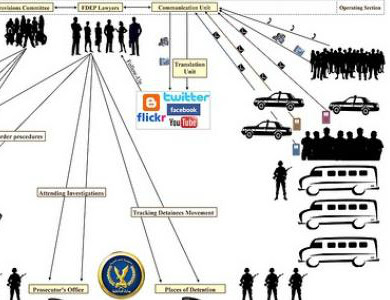
Featured Tactic: Utilizing SMS to facilitate communication between detainees and human rights groups to provide medical help and legal assistance Link >
Blog: Intersectionality: A Tool for Realizing Human Rights — Yolande Tomlinson Link >

Ceasefire Deal reached for Eastern Ukraine

By Kathryn Maureen Ryan
Impunity Watch, Managing Editor

KIEV, Ukraine – a ceasefire deal was announced Thursday after more than 16 hours of discussions between the Petro Poroshenko and Vladimir Putin, the leaders of Ukraine and Russia in Minsk, brokered by German Chancellor Angela Merkel and French President Francois Hollande. The ceasefire is due to enter into effect on Sunday. The ceasefire is considered a breakthrough in the 10-month conflict which has claimed the lives of more than 5,000 people, many of them civilians and relations between Russia and the West to their lowest point since the end of the Cold War. German Chancellor Angela Merkel, speaking alongside French President Francois Hollande, said that while more work remained to be done to end the conflict in eastern Ukraine “what we have on the table gives us great hope.” Merkel acknowledged that the agreement is not perfect but argued it is an opportunity for progress in addressing the tensions in the region and is “clearly preferable to the situation if we had done nothing.”

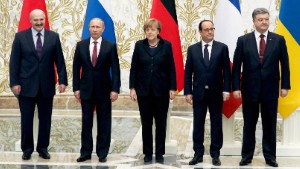
Belarussian President Alexander Lukashenko, Russian President Vladimir Putin, German Chancellor Angela Merkel, French President Francois Hollande and Ukrainian President Petro Poroshenko. (photo courtesy of CNN International)

In a joint declaration, released by the German government, the four leaders stated “their full respect for the sovereignty and territorial integrity of Ukraine” and sated that they “firmly believe that there is no alternative to an exclusively peaceful settlement.” The declaration stated leaders “will use their influence on relevant parties” to ensure the package of measures are put into place. “Leaders share the conviction that improved cooperation between the EU, Ukraine and Russia will be conducive to the crisis settlement,” it added.

During a press conference after the Minsk talks, Russian President Vladimir Putin said all parties had agreed to the ceasefire starting February 15 and called for restraint before the ceasefire is set to go into effect. “I call on both sides to end the bloodshed as soon as possible” and come to a political solution to the conflict, he said. Putin argued that the talks between Russia, Ukraine, France and Germany took so long, he said, because authorities in Kiev still refuse to have direct talks with separatists.

United State President Barack Obama issued a statement on the breakthrough ceasefire agreement  “The United States welcomes the agreement reached today in Minsk” it said. “The agreement represents a potentially significant step toward a peaceful resolution of the conflict and the restoration of Ukraine’s sovereignty.” However, the United States has continued to expresses concern that the spirit of the accord has been challenged by continued, intense frightening continued in the region.

A Ukrainian military spokesman said around 50 tanks, 40 missile systems and 40 armored vehicles had crossed the border between Ukraine and Russia overnight, accusations that were dismissed by the Putin regime. NATO, however, has said there is overwhelming evidence of Russian military equipment and personnel entering Ukraine but declined to comment on the latest report from the Ukrainian military “The intensity of fighting is evidenced by a sharp increase in the number of people trying to leave front-line towns,” said NATO spokesman Andriy Lysenko.

Ukraine’s territorial integrity and sovereignty was a key issue going into the discussions. Russia annexed the Crimea region of Ukraine last spring, shortly before pro-Russian separatists in the Donetsk and Lugansk regions declared independence from Kiev. “Ukraine will always be a unitary state. No federalization whatsoever! #UnitedForUkraine,” Poroshenko tweeted after the deal was announced. In Facebook post, he said that “we did not agree to a single ultimatum.”

For more information please see:

CNN International – Ukraine Ceasefire Deal Reached After Marathon Minsk Talks – 12 February 2015

The Guardian – Ukraine Ceasefire Aims To Pave Way for Comprehensive Settlement of Crisis – 12 February 2015

National Public Radio – Ukraine Cease-Fire Is Reached, Along With $40 Billion Aid Deal – 12 February 2015

Reuters – ‘Glimmer of Hope’ For Ukraine after New Ceasefire Deal – 12 February 2015

Highlights of Visit from UN High Commissioner for Human Rights

unnamed (1)

Dear friend,

“Human rights are the only meaningful rampart against barbarity.”

With these words, the new United Nations High Commissioner for Human Rights, Zeid Ra’ad Al Hussein, called for a renewed focus on protecting human rights during a speech he gave last week at the United States Holocaust Memorial Museum. “Essentially, if I may boil down a massive topic into one sentence, states must be willing to protect the human rights of their people, and people must be able to hold the state responsible.”

Watch a short video about the High Commissioner’s visit to the Museum.

Zeid Ra'ad Al Hussein

WATCH THE VIDEO

Zeid delivered the speech at the Museum during his first official visit to the United States as High Commissioner—a role he assumed in September 2014—and at a time of expanding violence and extremism. He urged the international community not to give in to the “dark allure of hatred” but rather to “strengthen our ethics, our clarity and openness of thought, and our moral courage.”

The High Commissioner’s emphasis on education, on early warning to prevent crises from escalating, and on learning from the past to improve the future aligns with many aspects of our work at the Center for the Prevention of Genocide.

We were honored to host him for this major policy address, which serves as a call to action—when the world desperately needs to hear it—to prevent genocide and promote human dignity.

Sincerely,

Cameron Hudson
Director, Center for the Prevention of Genocide

Bill Browder’s Red Notice Hits New York Times Best-Seller List in First Week

Press Release

For Immediate Distribution

Bill Browder’s Red Notice Hits New York Times Best-Seller List in First Week

12 February 2015 – Bill Browder’s new book: ‘Red Notice: A True Story of High Finance, Murder, and One Man’s Fight for Justice’ has become an instant best-seller, according to the list published weekly by the New York Times.

‘Red Notice’ features at number 11 on the New York Times bestseller list in the first week of sales since its release on February 3rd in the US. The New York Times rankings reflect sales reported by vendors offering a wide range of general interest titles, including independent book retailers; national, regional and local chains; online and multimedia entertainment retailers; supermarkets, university, gift and discount department stores; and newsstands.

‘Red Notice’ is a story about how Bill Browder went from being the largest portfolio investor in Russia to one of the most outspoken human rights activists in the West calling out the kleptocratic nature of the Putin’s regime.

“Everyone in the west needs to know this story,” said William Browder.

‘Red Notice’ has received over 30 5-star reviews on amazon which include the following feedback from readers:

  • “Once I started reading, I could not put it down. An eye opener.”

  • “I’ve lost a lot of sleep this week staying up late reading this story, which I only heard of quite by chance when I saw Bill Browder on The Daily Show.”
  • “I ordered the book for the Kindle on my Surface. That was last friday. It’s Tuesday and I’m done with the book. WOW.”
  • “A well written, heart felt true story of finance, personal growth, courage, and danger that is so shocking that it expunges any drops of political naivety that the reader might still cling to about life in Russia if Putin is challenged.”
  • “Delivered in an easy conversational style, this book makes you feel as though it is being told by friend. Mr. Browder’s analogy of Russian business being like a prison culture seems apt.”

To learn more, visit the ‘Red Notice’ website: http://billbrowder.com

For more information, please contact:

Magnitsky Justice Campaign

Jordan’s Vengeance against ISIS Sets Bad Precedent for Syria

SJAC-logo-Cover

jets

United States and Royal Jordanian air forces conducting exercises over the Dead Sea in Jordan (Photo Credit: US Air Force)

Earlier this month, the Islamic State in Iraq and al-Sham (ISIS) burned the captured Jordanian pilot Moath al-Kasasbeh alive, filmed his execution with cinematic levels of production, and released the video worldwide. The brutality of the act was shocking, even for ISIS, and drew immediate outrage from all members of the international community. In Jordan, calls for vengeance were swift. Demonstrators throughout the country demanded retribution and the spokesman for the Jordanian Armed Forces vowed that al-Kasasbeh’s “blood will not be shed in vain.”

Within hours, Jordan executed two prisoners convicted of terrorism and promised that the response “will [continue to] be strong, decisive and swift.” Jordanian courts had sentenced one prisoner to death in 2005, and the other in 2007, so both were awaiting execution on death row. However, their hasty executions hours after the video was released and the language of high-level Jordanian officials confirm that revenge was a primary motivation for the executions and the subsequent air strikes against ISIS targets.

In an armed conflict, detainees must be protected from murder, torture, and other forms of cruel or degrading treatment. Thus, ISIS’s murder of al-Kasasbeh was a clear violation of international law and dignity. However, the Syria Justice and Accountability Centre (SJAC) is wary of the precedent that Jordan’s response may set for Syria going forward. While justice will be an important aspect of the reconciliation process in Syria, it must comprise processes that conform to and promote the rule of law rather than act on blood lust or in vengeful retaliation. Some members of the anti-ISIS coalition have lauded Jordan’s decisive actions, and the United States denied any wrongdoing on the part of Jordan’s leaders. Statements such as those by the United States and others overlook how Jordan’s reaction has affected perceptions among Syrians who are closely following these events.

Regionally, governments have set bad examples for how to implement justice processes, and Jordan’s recent behavior is just the latest demonstration of a poor response to extremism. In the Middle East, countless instances of judiciaries’ institutional corruption and their failures to adhere to consistent processes have created the perception that the people must take justice into their own hands, otherwise the perpetrator will escape justice. Even before Jordan’s hastily-staged executions, some Syrians viewed a Muammar Qaddafi-style, on-the-spot execution as preferable to a corrupt process whereby a former leader escapes punishment, as was the case in Egypt.

Jordan’s response to ISIS,therefore, may only affirm Syrians’ desire for revenge. Shortly after the video was released, Syrian Kurds, who have been battling ISIS in Kobane, promised to carry out revenge attacks “on behalf of the martyr al-Kasasbeh.” Many others, including al-Kasasbeh’s father, have demanded revenge. While such sentiments might be understandable, the immediate executions and increased bombing campaign as a method of vengeance show the state bending to these desires.When a state punishes violators responsible for crimes, one of its primary purposes and duties is to enforce retribution on behalf of the victims through formal mechanisms governed by clear standards and laws. These processes require that criminals be punished for only their own crimes and not for the crimes of others and that a government not  succumb to its own sense of injury and/or that of its people. Now that Jordan has demonstrated that its system can be used for vengeance, what will stop other Jordanians or Syrians from demanding revenge executions of their own?

As Syria’s conflict continues with no resolution in sight, patience for transitional justice is fading. A recent SJAC study to be released on February 19th indicates growing anger and a hardening resolve for an all-or-nothing fight to the finish when compared to Syrians surveyed last year. With supporters of sides in the Syrian conflict increasingly desirous of revenge and retribution against the other, the likelihood of effective transitional justice processes could be put at risk. By documenting crimes perpetrated by all parties and conducting outreach to Syrians and the international community on transitional justice processes, SJAC promotes measured and transparent responses to ISIS, opposition, and regime atrocities that will lay the groundwork for long term stability and impartiality in Syria.

For more information and to provide feedback please email SJAC at info@syriaaccountability.org. To attend the launch event for SJAC’s report on Syrian perspectives on local ceasefires, RSVPwith Eventbrite.