Mexican Drug Kingpin Wont Be Extradited To The United States

By Lyndsey Kelly
Impunity Watch Reporter, North America

MEXICO CITY, Mexico – After his February arrest in the Pacific Coast tourist resort of Mazatian, notorious drug lord Jaoquin Guzman, best known as El Chapo, will be serving out his jail sentence in Mexico. Guzman headed the Sinaloa Cartel, one of the most powerful drug smuggling enterprises in the world. Captured for the first time in 1993, Guzman was on the run as Mexico’s most wanted man after he escaped from prison in 2001. Jaoquin is currently being housed at a maximum-security prison near the capital.

Joaquin Guzman is pictured during his detention in Mexico City (Photo Courtesy of Reuters).

Guzman is wanted in the United States on a number of criminal charges including drug smuggling, money laundering, running a criminal enterprise and murder. US Congressional leaders have called for Guzman’s extradition, but a formal request has yet to be made. Mexican Attorney General, Jesus Murillo, said that a request from Washington was imminent for the extradition of Guzman. Washington wants to prosecute Guzman on drug trafficking charges; however, the Mexican government has no plan to extradite Guzman in the imminent future. Mexican lawyer, Murillo told reporters that El Chapo will remain in Mexico to complete his sentence, and only after his sentence has been completed, which he states is “about 300 or 400 years” from now, will he be extradited to the United States.

Murillo has strongly argued that keeping Guzman in the Mexican prison system is the correct response to the situation. He has adamantly dismissed any concerns that Guzman may escape from prison a second time, stating that the risk “does not exist.” Guzman has stated that while sending the United States would save Mexico money, keeping him in the country is a mater of national sovereignty.


For more information, please see the following:

BUSINESS INSIDER – The World’s Most Notorious Drug Kingpin Won’t Be In the US Anytime Soon – 28 Jan. 2015.

DAILY PROGRESS – Mexico: Captured Drug Lord ‘Chapo’ Guzman To Stay Put – 29 Jan. 2015.

THE GUARDIAN – Mexico Rules Out ‘El Chapo’ Extradition – 28 Jan. 2015.

REUTERS – Mexico Not Planning to Extradite Drug Kingpin Guzman: Official – 28 Jan. 2015.
CAR Government Rejects Militias’ Ceasefire Deal

By Ashley Repp

News Desk Reporter, Africa


Bangui- Central African Republic

For over a year, the Central African Republic has been in a state of turmoil, chaos, and religious conflict.  In 2013, the Seleka group, a primarily Muslim militant organization, overthrew the government, and installed their choice of president, Djotodia.  The country’s first Muslim president, Djotodia stepped down in January 2014 in response to international pressure.  Djotodia was criticized for his inability to quell the violence and tension that had begun to spiral out of control in CAR in 2013.  Crimes included widespread rape and murder.  Compounding the issue, poverty was severe and widespread as well.

CAR ceasefire
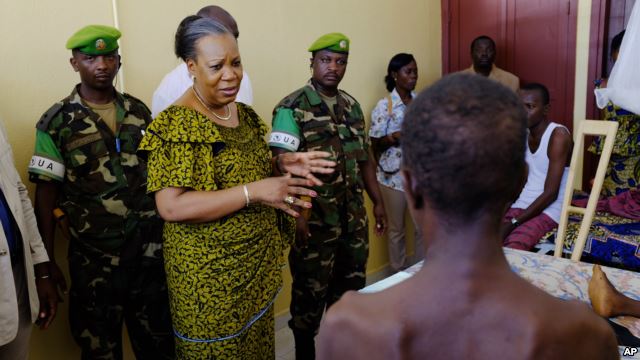
President Catherine Samba-Panza- Photo courtesy Voices of America


An interim government, with President Catherine Samba-Panza at the helm, stepped in an effort to attempt, once more, to ease the violence.  Despite these efforts, the Seleka group and the anti-Balaka Christian group, have been struggling against one another, further thrusting the unstable CAR into crisis.  As a result, significant and widespread murder, poverty, and instability have dominated the lives of many CAR citizens.  Nearly a quarter of the population has fled in an effort to avoid the violence.

On Friday of last week, heads of both the Seleka group and the anti-Balaka group, met in Kenya to conduct a meeting on the possibility of a cease-fire.  This appears to be one of the first sincere ceasefire agreements between the two groups.  Previous peace talks have been low level and unsuccessful.  Though the details of the engagement are currently unknown, the two groups drafted an ‘accord,’ which calls for a ceasefire between the warring factions that have led to thousands of lives lost.

Despite the efforts of these groups to agree to a ceasefire arrangement, the CAR official interim government refuses to acknowledge the validity of the agreement between the Seleka and the anti-Balaka.  The government is refusing to acknowledge the accord, asserting that the agreement has no legal or functional basis, as it was agreed to and drafted outside of the scope of the official government and had not relationship to government peace talks and efforts.  In fact, government officials have candidly expressed their opposition to the validity of this accord, contending that it is nothing more than an arrangement between two groups that have terrorized, and held hostage, the CAR since 2013.

For more information, please visit:

VOA- Central African Republic’s government rejects militias’ cease-fire accord– 29 Jan. 2015

Reuters- Central African Republic government says rejects ceasefire deal- 29 Jan. 2015

BBC News- Central African Republic factions announce ceasefire deal- 24 Jul, 2014

Daily Mail- Central African militias agree ceasefire days mediator– 28 Jan. 2015

Colombia Takes a Stand Against Venezuela’s Socialist Government

Colombian President Juan Manuel Santos has decided to crack down on Venezuela’s socialist government as ask for the freedom of a prominent opposition leader.  In the past Colombia has preferred a hands-off approach in dealing with Venezuela, in hopes for the country’s support in peace talks with Colombian rebels.

Colombia and Chile former Presidents denied entrance to prison to see activist Leopoldo Lopez

This changing climate comes at a time when Venezuela’s deepening economic crisis has fellow Latin American countries reconsidering how the renewed unrest from the opposition in Colombia should be responded to.  This is not the first time the countries have been on opposing sides.

In 2008, there was tension that led to talks of war on both sides of the border.  Colombia became the first Latin American country to call for the release of activist Leopoldo Lopez late Monday evening.

Almost a year ago anti-government rallies stormed Venezuela, with Lopez being one of the people at the helm.  Lopez has been incarcerated for almost 11 months on charges of instigating violence at the rallies.  Until Monday Venezuela’s neighbors preferred to push dialogue with the government, while the U.S. and European governments openly condemn Lopez’s jailing.  The governments are also concerned with Venezuelan President Maduro’s crackdown on his opposition after the rallies.

“I don’t pretend for Colombia ever to adopt our socialist model or break its dependence on U.S. imperialism,” Maduro said at a military ceremony. “But nobody can accept lessons imparted from abroad about who can or cannot be jailed.”

It is clear that Maduro is not happy about the countries supporting his opposition.  Over the weekend former Colombian President Andres Pastrana attempted to visit Lopez in jail,  in addition to former Chilean President Sebastian Pinera.  The two leaders were barred from entering the military facility outside of Caracas where Lopez is jailed.  Following this Maduro said in a speech at the wo the countries have “”blood on their hands” for supporting groups trying to oust him.

While Maduro is unhappy, his Venezuelan opposition celebrated Colombia’s statement almost immediately.

“Our hearts are smiling,” Lopez’s wife, Lilian Tintori, told Bogota’s Caracol Radio. “We thank you for this statement because we need your help.”

Maduro has never been friendly with Colombia, constantly claiming that Colombia is working with the U.S., to overthrow him.  Santos has largely ignored Maduro’s jabs, but seems to be interested in distancing himself from the country.

However, Maduro and Santos came to a consensus on Wednesday in Costa Rica, where they both attended a meeting for Caribbean and South American leaders.

For more information, please see: 

Buenos Aires Herald – Free Leopoldo Lopez – 27 Jan. 15

ABC News – Colombia Angers Venezuela With Call to Free Jailed Opponent – 27 Jan. 2015

Colombia Reports – Venezuela defuses diplomatic tensions with Colombia – 29 Jan. 2015

The Washington Post – Colombia Angers Venezuela With Call to Free Jailed Opponent – 27 Jan. 2015

Russia Bans Bill Browder’s New Book “Red Notice”, a Searing Expose Featuring Putin’s Involvement in the Cover up of Sergei Magnitsky’s Murder

29 January 2015 – On February 3rd 2015, Bill Browder, CEO and founder of Hermitage Capital Management, launches an explosive book about Russia entitled “Red Notice: A true story of High Finance, Murder, and One Man’s Fight for Justice” (UK edition: “Red Notice, How I Became Putin’s Number One Enemy” published on 5th February.)

“Red Notice” describes Browder’s fight against corruption and impunity in Russia and is a devastating expose of how Putin and his regime will do anything to illegally acquire wealth, including torture and cover-up of murder.

“Anybody who previously thought that Putin is a normal leader or that Russia is a normal country will think otherwise after reading this book,” says Bill Browder.

“Red Notice” will be published in 14 countries, but has so far been blocked by all major Russian publishers.

Numerous Russian publishing houses, ranging from Eksmo to Alpina, have avoided involvement in this book, for apparent fear of reprisal from the Putin regime.

Members of Pussy Riot, a Russian punk group who have been jailed for an anti-Putin protest, described the Kremlin position on Browder in their endorsement of “Red Notice” by saying:

“Bill Browder has become one of the most sincerely hated men in the Kremlin over the years – and that is something to be incredibly proud of… This book shows the difference that one person can make when they refuse to back down, as told by a fellow soldier in the battle to hold Putin to account.”

A Russian version of “Red Notice” will be available in the Russian language and published outside of Russia.

“This marks the return of the days of Soviet “samizdat” when books critical of the Soviet government were banned. Many were published abroad, and then had to be secretly copied, circulated by hand and passed from reader to reader,” says Browder.

Some of the Soviet Union’s most acclaimed ‘samizdat’ authors were Varlam Shalamov and Aleksandr Solzhenitsyn, both former inmates of Stalin’s gulag, who drew global attention to Joseph Stalin’s forced labor camps, where millions of Soviet citizens were summarily interned and many ultimately died.

To learn more, visit the ‘Red Notice’ book website: http://billbrowder.com

For more information, please contact:

ICTJ: World Report

AFRICAIn Uganda, members of Parliament have joined civil society leaders in petitioning the government to formulate an official transitional justice policy to address human rights violations in the north. Soon after, Lord’s Resistance Army leader Dominic Ongwen surrendered to authorities earlier this month, and he has been transferred to the ICC. The ICC upheld its conviction of Thomas Lubanga, who had previously been sentenced to 14 years in prison for using child soldiers. Also, closing arguments were heard in the war crimes trial of former Congolese vice-president Jean-Pierre Bemba, the first of its kind at the ICC to focus on rape as a weapon of war. Meanwhile, reports indicate that unidentified rebels in the DRC are responsible for killing at least 184 civilians since October. In Rwanda, plans areunderway to digitize and make accessible the documents produced by the Gacaca Courts during the country’s transitional justice process. An international seminar in Mali in November drewrepresentatives of civil society, political parties, members of the security forces, human rights groups and more together to adopt a roadmap for the country’s truth, justice and reconciliation process.

Read More…

AMERICASIn Colombia, FARC announced an indefinite unilateral ceasefire. Since then, President Santos hasasked rebel group ELN to join the ceasefire and to formalize peace talks with the government. The Inter-American Court for Human Rights convicted the Colombian state for disappearing 11 people in the 1985 military retake of the Palace of Justice. In Guatemala, a former police chief was sentenced to 40 years in prison for his role in the 1980 deadly raid on the Spanish embassy. Meanwhile, the retrial on genocide charges of ex-military ruler General Efrain Rios Montt was suspended after it began because the court accepted defense appeals that one judge was not impartial. The Court of Appeals in Chile sentenced eleven former Pinochet agents for their roles in the forced disappearances of two Uruguayan citizens in 1973. In the United States, members of the Ferguson, Missouri community areorganizing a commission to analyze the social and economic conditions that led to the shooting of unarmed Michael Brown by police officer Darren Wilson.

Read More…

ASIAIn Nepal, major political parties continue to meet to expedite the formation of the Truth and Reconciliation Commission and Disappearance Commission. In December, the UN Human Rights Committee gave Nepal a 180-day deadline to report on their delay to bring justice to the victims of enforced disappearances. Meanwhile, political parties have proposed chairpersons for the two commissions, yet victims claim to have been excluded from the entire process. On January 12, the TRC-Recommendations Committee publicized the short list of candidates to both commissions. A total of 69 people have applied for the posts of chairperson or member of the commissions. However, the committee has not submitted a final list to the government. Writ petitions filed by the conflict victims challenging the TRC Act are still subjudice in the Supreme Court. In Myanmar peace talks between ethnic minority groups and the government were jeopardized by the killing of about 23 rebels by the military in November. The second trial of two ex-Khmer Rouge leaders in Cambodia, set to begin last July, was yet again postponed by boycotts from lawyers representing the defense. Meanwhile, 40 non-Cambodian NGOs have signed a letter to the ICC requesting an investigation into crimes against humanity—including the eviction of over 770,000 Cambodians—by the country’s ruling elite. Meanwhile, in the Philippines, the Moro Islamic Liberation Front is set to begin commissioning its arms this month as preparations for a transitional government are underway.

Read More…

EUROPEThe UN estimates that about 13 people are killed each day in eastern Ukraine since the a ceasefire was issued in September. A UN OHCHR report issued in December accused Kiev-controlled volunteer battalions and the Ukrainian Security Service of torture, enforced disappearances and inhumane treatment of civilians. The government of Ireland will ask the European Court of Human Rights to revisit its decision on the “hooded men”—14 men who say they were subjected to torture during their internment without trial in 1971. Also in Ireland, the Chief Constable of the PSNI, George Hamilton, announced the formation of the Legacy Investigations Unit to replace the Historical Enquiries Team in 2015. Meanwhile, a new murder investigation into the events surrounding BloodySunday will begin this month in Ireland. Police in Bosnia arrested ten Bosnian Serb wartime security officials on accusations of crimes against humanity. Bosnian Serb MP Vasic and two former police officials were charged with for their roles in the Srebrenica genocide in 1995.

Read More…

MENAIn December 2014, the families of the missing and forcibly disappeared in Lebanon handed over the official investigation report related to the persons who disappeared during the civil war in Lebanon, to the International Committee of the Red Cross. UN Secretary General Ban Ki-moon announced thatPalestine will join the ICC on April 1st. A new Human Rights Watch report has criticized Tunisia in its efforts to pursue accountability for unlawful killings during the recent uprising there. The UN Commission of Inquiry on Syria issued its first report on ISIL in November, stating that fighters are committing war crimes and crimes against humanity on a massive scale. Shortly thereafter chief prosecutor of the ICC announced that she was weighing bringing war crimes charges against ISIL. A new law in Egypt has been criticized that allows the military to assist the police in protecting vital facilities. Meanwhile, an Egyptian court dismissed charges against former President Hosni Mubarak, an interior minister and six aides over the killings of protestors following the 2011 uprising. Dozens of Egyptian Islamists have been sentenced to jail for up to 15 years for attacks around the country.

Read More…


Publications

Pursuing Accountability for Serious Crimes in Uganda’s Courts: Reflections on the Thomas Kwoyelo CaseThis paper describes proceedings in Uganda’s national courts against Thomas Kwoyelo, a former mid-level commander of the Lord’s Resistance Army, for war crimes and crimes against humanity. It analyzes the opportunities and challenges for the prosecution of serious crimes in Uganda and concludes with recommendations to enhance accountability in the country.

View Report

Confronting the Legacy of Political Violence in Lebanon: An Agenda for ChangeThis document presents wide-ranging recommendations for political and social reforms in Lebanon developed by a consortium of Lebanese civil society actors, as part of an ICTJ project.

View Report

More Publications

=