https://impunitywatch.com/wp-content/uploads/2015/04/1420581008-English.pdf
By Max Bartels
Impunity Watch Reporter, Oceania
Jakarta, Indonesia
On Saturday the Indonesian government executed six convicted drug smugglers by firing squad. Only one of the six was an Indonesian citizen, the other five were foreign nationals that had been convicted of drug smuggling in Indonesia. The five foreigners were Malawian, Nigerian, Vietnamese, Brazilian and Dutch. Indonesian President Joko Widodo rejected the clemency appeals of all six of the convicted criminals as well as rejected pleas from international rights organizations and the national governments of the some of the convicts.

Both the Brazilian and Dutch governments reached out extensively to President Widodo to plea for the lives of their citizens. The Brazilian President Dilma Rousseff made a plea to Widodo saying she respected Indonesian sovereignty but she was pleading as a mother and a head of state for humanitarian reasons. Widodo was understanding of her concern but in the end said there was nothing he could do because the full process of the law had been followed. The Dutch government also reached out to Widodo in the form of Foreign Minister Bert Koenders, as well as Prime Minister Mark Rutte and King Willem- Alexander. Foreign Minister Koender referred to the executions as a “cruel and inhumane punishment and an unacceptable denial of dignity and integrity.” Both the Brazilian and Dutch ambassadors have been recalled from Indonesia since the executions.
The Brazilian, 53 year old Marco Moreira was arrested in 2003 after police at the Jakarta airport found about 13.4 kilos of cocaine in his hand glider. Dutchman Ang Kiem Soe aged 52 was also arrested in 2003 when police in Jakarta found equipment that they estimated could produce 15,000 ecstasy pills each day for three years. The police also confiscated 8,000 pills and thousands of dollars from Soe. Currently, there is also a second Brazilian national on death row in Indonesia for drug charges.
President Widodo took office in November and these six executions are the first of his term. The President has declared to take a hard stance on drug smugglers and intends the executions to act as a deterrent to combat Indonesians rising drug problem. The President has also refused to grant clemency for 64 other convicted drug smugglers currently on death row. The President has declared that a second round of executions will take place later this year. Currently one third of the individuals on death row, most for drug offenses are foreign nationals.
For more information, please see:
BBC News — Indonesia Executions: Brazil and Dutch Envoys Recalled — 18 January 2015
CNN — Indonesia Executes 6 for Drug Offenses, sets off Diplomatic Storm — 18 January 2015
NY Times — Indonesia’s Execution of Foreigners Prompts Diplomatic Storm — 19 January 2015
By Kathryn Maureen Ryan
Impunity Watch, Managing Editor
AMMAN, Jordan – The United Nation’s High Commissioner for Refugees has called on the International Community to help alleviate the “desperate living conditions” of Syrian refugees now living away from Jordan’s main camps. According to a recent United Nations study, one in six refugees living outside of Jordan’s main camps is living in extreme poverty. UN High Commissioner for Refugees António Guterres warned large numbers of Syrian refugees continuing to slide into abject poverty at an alarming rate, due to the magnitude of the crisis in Syria and insufficient support from the international community.

Commissioner Guterres made a statement on the crisis during the launch of the new UNHCR study, living in the Shadows, which reveals evidence of a deepening humanitarian crisis. The Commissioner made a two-day visit to Jordan, where met with refugees profiled in the UN study in Amman and others at the Za’atari refugee camp. “I am here to express my solidarity with Syrian refugees, as the impact of snowstorm Huda is still tangible and posing an even greater strain on their already dire living conditions,” he said.
Jordan has a registered Syrian refugee population of 620,000. 84 percent of its refugee population live outside of refugee camps. “This represents a dramatic pressure in the economy and the society of the country not to mention the terrible security impact of the Syria crisis in itself,” Commissioner Guterres said. “The generosity of the Jordanian people and the Government needs to be matched by massive support from the international community – support for the refugees themselves and for the local populations hosting them, but also structural and budgetary support to the Jordanian Government for education, health, water and sanitation and electricity to enable it to cope with this enormous challenge.”
Commissioner Guterres emphasized that the Syrian Civil war and the refugee crisis it has created can be mitigated if the international community steps up efforts to alleviate the suffering of the refugee populations. He praised the efforts of the Jordanian authorities, UNHCR and its partners to address the urgent needs of refugees during the recent heavy snowstorm which threatened the health and safety of refugees.
Extreme winter weather in the region threatened the lives and safety of refugees living in the Za’atari refugee camp. The Za’atari refugee camp is the largest refugee camp in Jordan with a population of nearly 85,000 Syrians. In the camp dozens of families were forced to abandon their family’s tents and camped in emergency shelters after their tents collapsed under the weight of snow.
Fatima, a 20 year old Syrian refugee, and her husband Mohammed were trying to protect their three small children from the cold when the roof of their tent collapsed. “We had a small stove burning in the tent to keep warm, and it fell onto my son and burned his back,” she told visitors from UNHCR to the shelter where she and her children are living with seven other families.
For more information please see:
BBC News – Syria Refugees: UN Warns Of Extreme Poverty in Jordan – 14 January 2015
The UNHCR – UNHCR Study Shows Rapid Deterioration in Living Conditions Of Syrian Refugees in Jordan – 14 January 2015
The UNHCR – Winter Storms Bring More Hardship to Refugees in Jordan’s Za’atari Camp – 9 January 2015
U.S News and World Report – The Challenge of the Syrian Refugee Response – 8 January 2015
By Kathryn Maureen Ryan
Impunity Watch, Managing Editor
SANAA, Yemen – Houthi fighters reportedly entered Yemen’s presidential palace after a brief clash with the presidential compound’s security guards, witnesses and security sources said. The attack comes a day after some of the worst fighting reported in the capital in several years. Guards at the presidential compound, which houses the main office of President Abd-Rabbu Mansour Hadi, said they handed over the compound to Houthi fighters after a brief clash.
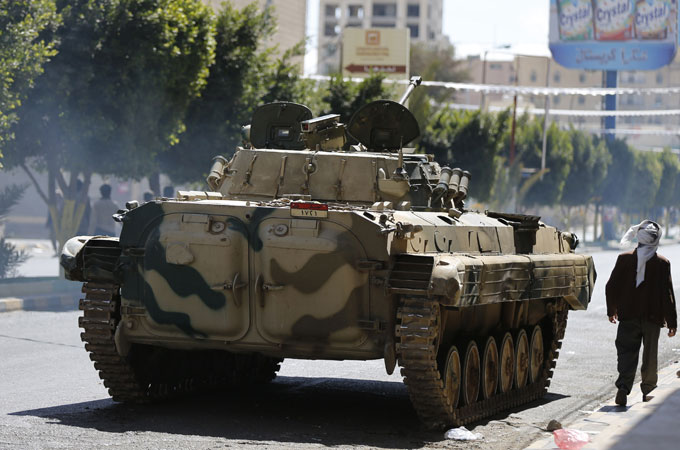
Before the fighters stormed the Presidential compound A tense calm seemed the be holding in Sanaa as Houthi rebels continued to surround the prime minister’s residence as well as the presidential palace, despite the fighters and the government reaching a ceasefire after a day of violence on Monday. As of Monday evening, nine people have been killed and at least 90 wounded in the fighting.
After Monday’s fighting a heavy presence of Houthi fighters was seen throughout Sanaa on Tuesday, as the rebels fortified their positions in the capital, which they seized after fighting in September last year.
Before the taking of the Presidential compound Al Jazeera’s Omar Al Saleh, reporting from Yemen, said the situation in the City was “tense but calm”. He said “A meeting is supposed to take place between all political players; President Abd Rabbu Mansour Hadi, Prime Minister Bahah and representatives of the Houthis, but it remains unclear if these talks have started.” “We’re all waiting to hear from this meeting,” he said, adding that the United Nations Security Council was scheduled to discuss the situation in Yemen in a closed session on Tuesday.
President Hadi and the Houthis fighters in Yemen accuse each other of failing to implement a United Nations brokered peace agreement calling for Hadi to form a new national unity government and reform government agencies and for the Houthis to withdraw their fighters from Yemen’s cities. The Houthis have also demanded integration of their militiamen into Yemen’s security forces which are dominated by Hadi. The ongoing power struggle between the Hadi and the Houthis has undermined Yemen’s ability to fight al-Qaeda’s Yemeni affiliate, al-Qaeda in the Arabian Peninsula.
United Nations Secretary-General Ban Ki-moon has condemned the recent fighting in Yemen, on January 7, his office released a statement condemning in the strongest terms an attack against a policy academy in Yemen’s capital which killed at leaste 37 people. A statement issued by his office said he “expresses his condolences to the victims’ families and wishes a swift recover to all those wounded.” The Statement also said, “The Secretary-General reiterates his previous calls to all Yemenis to work together and to fight terrorism and to bring security and stability to Yemen.”
The United Nations High Commissioner for Human Rights Zeid Ra’ad Al Hussein called on the international community to pay greater attention to the ongoing violence in Yemmen. “Perhaps because of the violence engulfing so many other countries – relatively little attention is being paid to the situation in Yemen,” He said. “The past few weeks have seen dozens of people killed in a succession of bomb attacks in Yemen. Such wanton acts of indiscriminate violence are utterly deplorable.”
For more information please see:
Al Jazeera – Yemen’s Sanaa Tense But Calm As Truce Holds – 20 January 2015
Reuters – Houthis Take Yemen Presidential Palace-Witnesses, Sources – 20 January 2015
United Nations News Centre – UN Rights Chief Urges More Global Attention to ‘Wanton’ Violence in Yemen – 9 January 2015
United Nations News Centre – Yemen: Ban Condemns Deadly Attack on Police Academy, Calls for Accountability – 20 January 2015
By Kathryn Maureen Ryan
Impunity Watch, Managing Editor
DAMASCUS, Syria – The Iranian government confirmed Monday that one of its generals was killed in an Israeli airstrike that also killed several Hezbollah fighters in southern Syria on Sunday. The death of the Iranian general, Mohammad Ali Allahdadi, offers evidence of Iran’s possible deep military involvement in the Syrian Civil War. The airstrike itself however, seems to show a strong departure from the tactical agreement in several foreign players — Israel, Iran, Hezbollah, Turkey, the United States, and its Persian Gulf Arab allies — have increasingly intervened openly in the Syrian Civil War while avoiding direct conflicts with one another. The Israeli news media reported that Israeli officials believed Hezbollah was planning an attack on Israelis from the area, near the Golan Heights region, the reports cited anonymous intelligence sources. “Syria has become an open field,” said Kamel Wazne, a Lebanese political studying Hezbollah and Iran. “Everything can happen at any minute.”
Sunday’s drone strike hit a convoy carrying Jihad Moughniyah and Commander Mohamad Issa, known as Abu Issa, in the Syrian province of Quneitra, near the Golan Heights region, which is occupied by Israel. The strike killed six Hezbollah members in all, Hezbollah said in a statement. Hezbollah received strong backing from Iran. The group’s last major conflict with Israel occurred in 2006. Hezbollah is a major ally of the region of Syrian President Bashar al-Assad.
General Allahdadi’s death was announced on the Revolutionary Guards’ website and by news media affiliated with both Hezbollah and the Iranian government. The announcement said the general had been advising the Syrian government on how to fight terrorism, which is how the Syrian Regime characterizes the opposing sides of the civil war which began four years ago when the regime first turned its guns on peaceful protesters. It remains unclear whether the Israeli military knowingly targeted Allahdadi or other individuals in the two vehicles that were fired upon on Sunday. The United Nations force patrolling the region said the vehicles were hit by fire from Israeli drones, not helicopters as Hezbollah and Iran had reported.
United Nations peacekeepers stationed in the Golan Heights along Syria’s border with Israeli reportedly saw drones flying across the border from the Israeli side before and after an airstrike that killed top several Hezbollah figures was carried out, the United Nations said on Monday. Sky News Arabic reported that the anti-rocket batteries used by the Israeli Defense Force for the Iron Dome System had been maneuvered in case of further escalation on the border with Syria and Lebanon.
For more information please see:
BBC News – Iran General Died In ‘Israeli Strike’ In Syrian Golan – 19 January 2015
Reuters UK – U.N. Saw Drones Over Syria Before Israel Strike In Breach Of Truce – 19 January 2015
Jerusalem Post – Report: Iron Dome Deployed To Northern Israel After Alleged Syria Strike – 19 January 2015
The New York Times – Iran Confirms Israeli Airstrike In Southern Syria – 19 January 2015