Nigerian Oil Workers Plan Three Day Strike in Protest of Unfair Labor Practice

By Kathryn Maureen Ryan
Impunity Watch, Managing Editor

ABUJA, Nigeria – Nigeria’s two oil unions are planning to start a three-day strike this week to protest what they say are the unfair labor practices of the oil sector. The Unions are also planning to put pressure on the Nigerian government to pass the Petroleum Industry Bill (PIB), a bill that experts believe is unlikely to pass before February’s elections. The strike is being organized by The Petroleum and Natural Gas Senior Staff Association of Nigeria (PENGASSAN) and the Nigerian Union of Petroleum and Natural Gas Workers (NUPENG), and has been described as a “warning strike” intended to remind the Nigerian government, as well as the oil sector as a whole, of the power held by the Nigerian oil worker.

Nigeria is Africa’s largest producer of crude oil. While the sector makes up the largest proportion of the Nigerian economy, the sector has had a devastating impact on the Nigerian Environment with oil workers put at risk. (Photo courtesy of BBC News)

The union alleges that the industry has failed to recognize and reach adequate collective bargaining agreements, failed to restate wrongly terminated employees and failed to promote qualified workers in the industry among other concerns. The union also alleged that oil workers have faced unfair victimization by their employees. The Union also alleges high levels of corruption within the Nigerian government, essentially in regard to the issues of oil theft and vandalism which has had a devastating effect on Nigeria’s environment and places oil workers at risk. PENGASSAN alleges a high level collaboration between agencies, politicians and highly placed Nigerians in the buccaneering racket of oil and gas installations, adding that the ugly trend signifies a looming extinction of the oil and gas industry with attendant job losses.

The strike follows the end of a 14-day ultimatum issued by the National Executive Council (NEC) of PENGASSAN to the federal government and other concerned employers’ and agencies in the oil sector. The NEC said the ultimatum had expired without any meaningful resolution or commitment from either the government or the concerned employers’ and agencies at resolving the issues. A statement issued by the oil workers union said all organs of the union have been fully mobilized for the strike actions which they say will affect every value chain in the upstream, midstream and downstream oil and gas industry.

Nigeria is Africa’s largest producer of oil as well as the continent’s largest economy. Oil wealth from crude oil production accounts for 70% of the government’s revenue and 95% of the foreign exchange income. The majority of the country’s oil is extracted by major foreign corporation with more than 80% being pumped by Royal Dutch Shell Plc, Exxon Mobil Corp., Chevron Corp., Total SA and Eni SpA in joint ventures with state-owned NNPC.

Speaking from Lagos, Nigeria’s industrial capital, Babatunde Oke, a spokesman of the Petroleum and Natural Gas Senior Staff Association of Nigeria, said by phone from Lagos, said the exact timing of the strike will be announced once all plans are finalized. “Oil workers have concluded plans to shut down all oil and gas installations in the country due to the anti-labor activities of some employers,” Oke said in an earlier statement.

For more information please see:

All Africa – Nigeria: PENGASSAN to Embark on a Three-Day Warning Strike Over Non-Passage of PIB – 8 December 2014

Bloomberg – Nigeria Oil Unions Plan Three-Day Strike Over Labor Practices – 8 December 2014

Reuters – UPDATE 1-Nigeria oil bill unlikely to pass before Feb election – finance min – 18 November 2014

BBC News – Nigeria Profile –5 November 2014

Anniversary of Unarmed Teenager’s Death by Police Officer Brings Renewed Violent Protests in Athens

By Kyle Herda

Impunity Watch Reporter, Europe

ATHENS, Greece – Protests in Athens have erupted into violent clashes with police today on the anniversary of an unarmed teenager being killed by a police officer.

Petrol bombs erupt in Athens as protesters clash with riot police. (Photo courtesy of BBC)

On December 6, 2008, 15-year-old Alexandros Grigoropoulos was shot and killed in Athens. Grigoropoulos and a friend were arguing with two police officers and one officer went back to his patrol car to get a gun, then returned and shot Grigoropoulos dead. Violent protests lasted for two weeks following the killing. Epaminondas Korkoneas, the police officer who killed Grigoropoulos, is serving a life sentence for the murder. Vasilis Saraliotis, the other police officer involved in the incident, is serving a 10 year sentence for accessory to murder.

Now, nearly 6,000 people are protesting in Athens again to mark the anniversary, and around 18,500 police officers are ready for the protests. Marches turned violent as protesters broke into a clothing store and stole clothes to burn in the street. The neighborhoods of Exarchia and Thessaloniki have held most of the fighting, with police firing tear gas and pepper spray. Over 200 protesters have been arrested, and so far no casualties have been reported. Fighting and protests appear to be going strong into the night.

Prime Minister Antonis Samaras is going to meet with the parents of Nikos Romanos, a friend of Grigoropoulos who was present for his killing. Followers of Romanos have been some of the leaders of current protests, as Romanos is currently being hospitalized due to a hunger strike that has lasted nearly a month, and he was imprisoned anyways due to participation in a bank robbery including a hostage early last year.

For more information, please see:

Huffington Post – Violent Protests Mark Anniversary of Police Killing in Greece – 6 December 2014

BBC – Clashes at Greek Protests to Mark Police Shooting – 6 December 2014

ABC News – Protests in Greece on Police Shooting Anniversary – 6 December 2014

The Telegraph – Violence Erupts in Greece – 6 December 2014

Greek Reporter – Alexandros Grigoropoulos: The Killing that Shook Greece – 6 December 2014

The True Cost of Wal-Mart’s ‘Everyday Low Prices’: Victims of Bangladesh’s Tazreen Factory Fire Still Wait For Compensation From U.S. Companies

By Kathryn Maureen Ryan
Managing Editor, Impunity Watch

DHAKA, Bangladesh – Two years ago last month a deadly fire broke out in the in the Tazreen Fashion factory in the Ashulia district on the outskirts of Dhaka, Bangladesh. At least 17 women and girls were killed in the factory, which made clothing for several major American brands including Wal-Mart and the Walt Disney Company. The fire injured at least 200 workers, making it the deadliest factory fire in Bangladeshi history. Workers in the factory were subjected to sweatshop labor conditions and low pay, as well as an unsafe working environment. Many of the women and girls who worked in the factory were trapped inside when the fire broke out on 24 November 2012 because the factory management had padlocked the exits to prevent workers from leaving early or even taking breaks. Several workers jumped out of windows in an attempt to escape the flames engulfing the factory floor. One survivor, Mohammad Ripu, who jumped from the second floor in an attempt to escape the flames, said that the factory manager had said to the workers after the fire alarm began sounding that “the fire alarm had just gone out of order. Go back to work.”

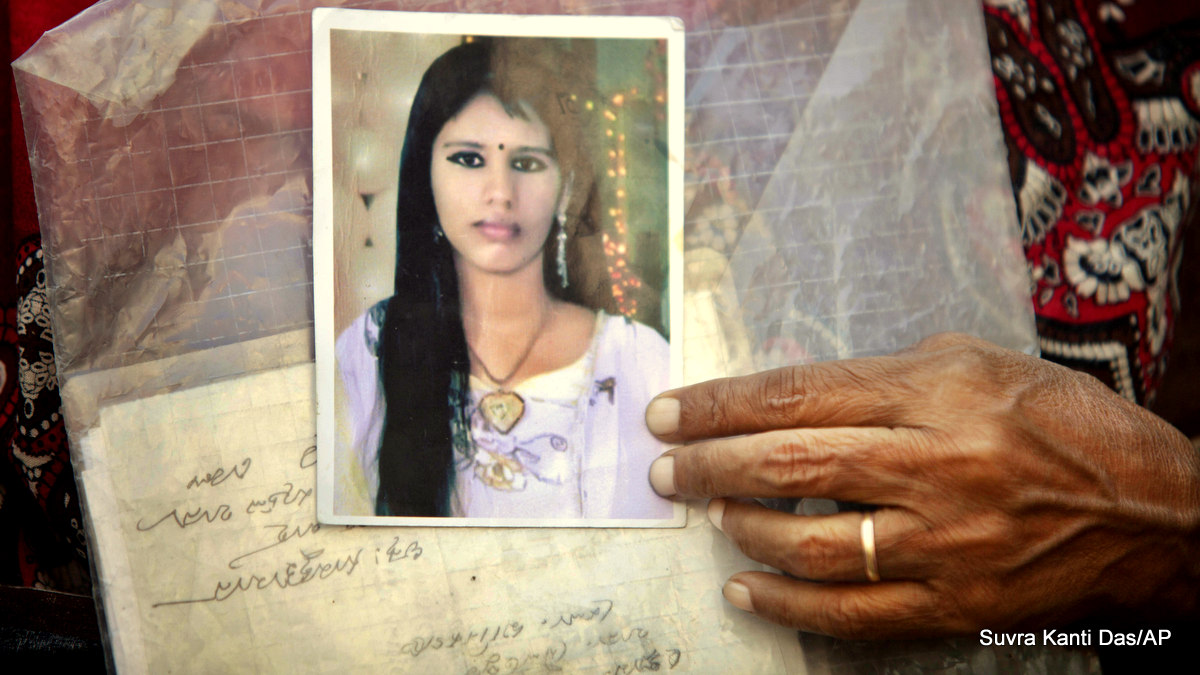
A Bangladeshi woman holds a portrait of her relative who went missing in the Nov. 24, 2012 fire at Tazreen Fashions factory as she forms a human chain with others during a protest in Dhaka, Bangladesh calling for an end to poor working conditions. (Photo courtesy of Mint Press News)

Three supervisors from the factory were arrested on 28 November 2012, on charges of criminal negligence. Police cited the practice of padlocking exits allegedly used by factory management. Tazreen Factory owner Delwar Hossain claimed that the premises were not unsafe, adding, “It is a huge loss for my staff and my factory. This is the first time we have ever had a fire at one of my seven factories.” However, it was known that the building was not up to code. Investigators found that the fire safety certificates for the facility had expired. This level of negligence is common in factories across the developing world, especially in the garment industry, where workers are underpaid and often subjected to sub-standard working conditions.

Two years after the fire, survivors continued to share their stories. “I jumped from the fourth floor. I lost my eye and broke my spinal cord and leg,” Shahnaz Begum, a Tazreen worker said. “I can’t stand straight and I can’t lie down. I can’t work – I don’t know if I’ll ever be able to. I’m still waiting for fair compensation.” Even two years after the deadly fire took the lives of at least 17 people and sparked international outrage over the poor working conditions in sweatshops across Bangladesh and around the world, the victims of the deadly event and their families are still waiting for compensation from the western companies that contracted with the factory, including well known American brands.

These brands include labels produced by Wal-Mart Stores, Inc., reportedly the largest buyer at the Tazreen factory, as well as Walt Disney Co., Sears Holdings Corp, Dickies, Delta Apparel, Sean Jean, and several others. Advocacy groups say these brands continue to refuse not only to offer adequate compensation, but to even enter into discussions regarding the events with representatives of survivors and their families forward. Essentially, these brands have attempted to distance themselves from the horrific events that unfunded at the Tazreen factory in order to avoid drawing attention to the fact that their business models depend on the use of slave-like sweatshop labor.

“Wal-Mart has yet to take any responsibility for the workers killed and injured,” Babul Akhter, a representative the Bangladesh Garment and Industrial Workers Federation, said last week. Workers at the Tazreen factory say that when the fire broke out, they had just finished filling a shipment to Wal-Mart. According to IndustriALL Global Union, an umbrella group with 50 million members worldwide, US brands that bought projects from the factories continue to refuse to move forward on compensation talks. “None of these brands have paid a cent towards compensation,” IndustriALL states.

The Tazreen factory fire is often compared to the Triangle Shirtwaist Factory fire of 1911, which took the lives of more than 100 garment workers in a sweatshop in Manhattan, many of the women and girls who were killed in the fire jumped to their deaths to escape the smoke and flames after they were locked into the building. The Triangle Shirtwaist Factory fire became one of the most significant events in the American Labor Movement sparking calls for stricter workplace safety standards, fair pay, and unionization across the United States. The Tazreen factory fire has had a similar effect in Bangladesh. The event reminded the world that low-priced clothing comes at a cost, and strengthened calls among factory workers in Bangladesh and around the world to demand safer working conditions, fair compensation, and even the right to join a labor union.

For more information please see:

Mint Press News – Two Years On, Bangladeshi Garment Workers Still Awaiting Compensation from Major US Brands – 4 December 2014

Clean Clothes Campaign – Agreement on Tazreen compensation announced – 23 November 2014

The New York Times – Documents Reveal New Details about Walmart’s Connection to Tazreen Factory Fire – 10 December 2012

The Wall Street Journal – Bangladesh Fire: What Wal-Mart’s Supplier Network Missed – 10 December 2014

Assad Regime Cuts Welfare to Fund Military Campaign against Rebels and Civilians

By Kathryn Maureen Ryan
Impunity Watch, Managing Editor

DAMASCUS, Syria – In response to increasing economic instability the regime of Syrian president Bashar al-Assad has scaled back on subsidies given to citizens for goods ranging from water to heating oil, necessary for surviving the cold Syrian winter, over the past six month. The Syrian people already suffer extreme economic hardship due to the county’s high unemployment rate, hovering at around 50%, crippling inflation and massive infrastructure damage and damage to industry suffered as a result of the country’s long civil war which is entering its fourth year. As Syria approaches the long winter months power outages and food shortages have worried across the country. Despite the continues splintering of rebel groups  and Syria as well as the efforts by the United States and coalition airstrikes to halt the spread of the Islamic State of Iraq and the Levant in the region the Assad regimes feels the need to divert funding from Syria’s vulnerable poor populations in order to support its continued war efforts.

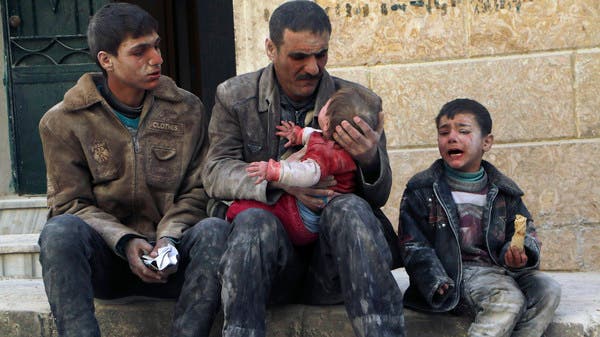
A man holds a baby saved from under rubble, who survived what activists say was an air strike by forces loyal to Syrian President Bashar al-Assad, in Masaken Hanano in Aleppo, in this Feb. 14, 2014. The Assad regime has recently cut welfare intended to provide vital resources to the Syrian poor in order to continue its campaign against the Syrian rebels, often targeting civilians the regime believes to be loyal to rebel groups. (Photo courtesy of Al Arabiya)

Other economic problems such as falling tax revenues, a collapse in the currency and rising bills for imports have also pushed the regime deeper into “survival mode,” said Riad Kahwaji, an analyst and chief executive of the Dubai-based Institute for Near East and Gulf ­Military Analysis. Although the government’s budget figures are not made public, analysts say Damascus has had to shift priorities to pay for the war effort.

In response to its economic woes, which have hindered the regime’s ability to continue its brutal campaign against rebels and populations deemed to be sympathetic to rebel groups the Assad regime has slashed spending on social welfare, including cutting subsidies for water and electricity over the summer. Last month, the government began to cut funding for diesel and heating oil.

In a rare interview published by Paris Match, a French language magazine, on Thursday Syrian President Bashar al-Assad vowed that he would remain in power, despite calls from the rebels on the ground in Syria as well as much of the international community for him to step down. He also asserted that the Syrian Civil war will be long and difficult because his army could not be everywhere at once, apparently an attempt to justify increased spending on the war effort at the expense of government welfare programs.

“The Syrian army cannot be everywhere at once. Where it is not present, terrorists take the opportunity to cross borders and infiltrate in one area or another,” said the French language magazine in comments apparently quoting the Syrian president.  “It is not about a war between two armies, where one occupies a territory and the other another one. It is another type of war. We are dealing with terrorist groups that infiltrate a town or village. So this war will be long and difficult,” it continued. The text was also published by Syrian state media on Thursday.

According to the Syrian Observatory for Human Rights the Syrian Civil War, which has created millions of refugees and internally displaced persons, has taken the lives of more than 200,000 people in its four year history.  “We have documented the killing of 202,354 people since March 2011,” Syrian Observatory for Human Rights director Rami Abdel Rahman said.

For more information please see:

Newsweek – Assad Says Syrian War Will Be “Long and Difficult” In Rare Interview – 4 December 2014

Foreign Policy – Assad Airstrikes Aren’t Helping Me; Hollande you’re As Popular as ISIS

Al Arabiya – Syria Death Toll Now Exceeds 200,000: Monitor – 2 December 2014

The Washington Post – Syria’s Assad Regime Cuts Subsidies, Focuses Ailing Economy on War Effort – 29 November 2014