Southern Europe Still Struggles with How to Handle Syrian Refugees

By Kyle Herda

Impunity Watch Reporter, Europe

ATHENS, Greece – Over 200 Syrian refugees in Greece have had enough of the lack of rights given to refugees, and so a hunger strike has begun in the capital. Overcrowding of refugees in Greece, as well as in other nations, has led to decreases in space and care for refugees, leading many of them to struggle in Europe.

Syrian refugees in Athens take part in a hunger strike, demanding more aid and benefits to Syrian refugees coming into Greece. (Photo courtesy of The Wall Street Journal)

The number of Syrian refugees has recently skyrocketed in Greece. In 2013, Greece saw 8,500 Syrian refugees, while just 10 months into 2014 there has already been around 29,000 refugees from Syria. Overall, roughly 165,000 Syrian refugees have come into Europe since the start of the Syrian war.

An EU regulation, “Dublin II”, requires refugees to apply for asylum in the EU country they first “step foot in”. This prevents Syrian refugees from applying for asylum in harder to reach countries like Germany that would grant more rights along with asylum. Instead, the refugees must settle for nations like Greece, Albania, or Bulgaria that offer less rights to refugees.

The issue is certainly pressing as more and more Syrian refugees attempt to make their way into southern Europe. One such country that has seen its fair share of refugees is Italy, which began rescuing refugees stranded in the Mediterranean Sea earlier this year after one tragedy led Pope Francis to ask Italy to intervene. These sea missions are still very recent, with another 270 Syrian refugees being rescued today off the North Cypriot coast. The High Refugee Commission has stated that over 2,500 migrants have drowned in the Mediterranean Sea already this year while trying to cross into Europe.

Another big problem facing the Syrian refugees in Europe is the lack of jobs in the easier to reach countries like Greece. The economies in these nations are struggling even with their own citizens, and their own citizens seem to be taking priority in the eyes of locals and the governments. So Syrian refugees are left with a tough decision: apply for asylum in the first nation they can make it to and try to make due with the little out there and the few rights given, or attempt to make it to a country like Germany that has more to offer, but risk the consequences of getting caught along the way by another nation, like Albania, that has shot at Syrian refugees trying to cross the border.

For more information, please see:

The Wall Street Journal – Syrian Refugees in Greece Launch Hunger Strike for Asylum, Aid – 24 November 2014

Irish Times – Syrian refugees seek fresh start from Greek destitution – 24 November 2014

Middle East Monitor – 270 Syrian refugees rescued off North Cypriot coast – 24 November 2014

Global Post – For Syrian refugees fleeing to Europe, Bulgaria isn’t enough – 18 November 2014

BBC – Syria’s refugees yearning for the lost ‘old life’ – 17 November 2014
Bangladesh: Continuous Death Sentences for Islamist Leaders for War Crimes

By Hojin Choi

Impunity Watch Reporter, Asia

DHAKA, Bangladesh – A controversial war crimes court in Bangladesh upheld its rigorous rulings on the nation’s war crimes cases originating from the country’s 1971 breakaway from Pakistan. The court was set up as a special war crimes tribunal in 2010 by Prime Minister Sheikh Hasina’s regime. Within the last few weeks, three Islamist Party leaders were sentenced to death.

The top leader of Bangladesh’s largest Islamist Party, Motiur Rahman Nizami, was sentenced to death last month, and few days later another high official of the party Mir Quasem Ali was sentenced to death. In early November, Mohammad Kamaruzzaman, the Assistant Secretary-General of the party, was sentenced to death for conviction of genocide and torture of civilians in 1971.

The incident at issue in 1971 was a civil war that the West and East Pakistan armies fought for the autonomy and independence of East Pakistanis. East Pakistan became the independent country of Bangladesh in December 1971. During the nine months of civil war, over 10 million people fled to a neighboring country, India. According to the government, three million people died and 200,000 women were raped during the incident.

Since 2010, the court has convicted 12 people for the war crimes. Most of them were senior officials of the Islamist Party. Last year, Bangladesh people in support of the party had massive protests where tens of thousands protesters clashed with police. Reportedly, over 500 people died in the protests. The recent convictions of party leaders seem to be bringing more social unrest. After the decisions, party supporters called a nationwide strike. No violence or casualties were yet seen, but many schools and businesses closed with worry of possible dangers.

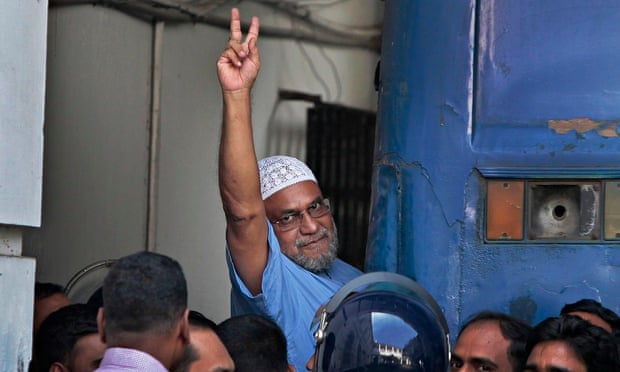
Mir Quashem Ali after being sentenced to death (AP)

According to an Al Jazeera, “under Bangladesh jail code, the execution of an accused could be carried out within 21 days and before 28 days of the Supreme Court’s latest upholding of a death sentence.” Defendants’ review petitions only “buy a little more time, or hope for presidential clemency, which is unlikely to be granted under the present government.” The government argues that it should keep running the tribunal to rebuild social justice systems in Bangladesh by punishing the war criminals, but people, especially party supporters, suspect that the government is using the power to oppress the opposition party.

Human rights groups also called for attention to the continuous death sentences in Bangladesh. Human Rights Watch showed deep concern regarding the use of the death penalty and its quick process. According to the organization’s report, Kamaruzzamn was transferred to Dhaka Central Jail, which is a signal of his impending execution, even though he has not received the full text of the final verdict, which is necessary to file a petition for review. The group also argued that several cases, including the most recent cases, did not meet the fair trial standards because they did not fully grant defendants’ rights. It also pointed out that the past executions of the death penalty, such as hanging, after alleged unfair trials were against international law.

Brad Adams, the Asia Director at Human Rights Watch, said that “Human Rights Watch has long supported justice and accountability for the horrific crimes that occurred in 1971, but we have also stated repeatedly that these trials must meet international fair trial standards in order to properly deliver on those promises for the victims.” Adams added that “delivering justice requires adhering to the highest standards, particularly when a life is at stake. The death penalty is irreversible and cruel, and Bangladesh needs to get rid of it once and for all.”

For more information please see:

ALJAZEERA – Bangladesh party official faces death penalty – 3 November 2014

BBC – Death for Bangladesh Islamist leader Mir Quasem Ali – 2 November 2014

The Guardian – Islamist party member in Bangladesh sentenced to death for 1971 war crimes – 2 November 2014

Human Rights Watch – Bangladesh: Halt Execution of War Crimes Accused – 9 November 2014


50 Arrested in Pakistan for Lynching and Killing a Christian Couple

Hojin Choi

Impunity Watch Reporter, Asia

ISLAMABAD, Pakistan – Fifty Pakistani people were arrested for torturing and killing a Christian couple last week in the Punjab province, where religious conflicts have recently intensified, according to local police.

Before the murder, the Christian couple was accused of desecrating the Quran, and a local mullah announced that the couple was guilty of blasphemy. Allegedly, burned pages of the Quran had been found in trash of the couple’s house. A man who had financial conflicts with the couple accused them of blasphemy when the couple refused to pay back some money they owed to him.

The police reported that hundreds of people marched to the couple’s house, some of them broke the door and beat them hard after dragging them out of their home. Then, the crowd threw the couple into brick kiln. When police arrived, they were already burned to death. The local police chief, Jawad Qamar, said that “their bodies were totally burned.” He added that 48 people were arrested, while at least 460 were under investigation for criminal charges.

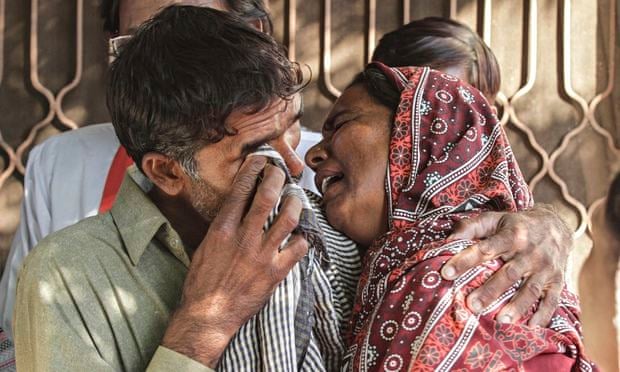
Relatives of the victims (EPA)

Police later identified the burned bodies as Shahzad Masih and Shama Masih, who had four children. They were in their mid-20s. The province’s chief minister says that their remaining family members will receive for compensation about $49,000 in U.S. dollars.

In Pakistan, a person charged with blasphemy can receive, at maximum, the death penalty. The law is problematic since it does not specifically and clearly define what words or behaviors will violate the law. Rather, the law is often used to oppress minority religions in Pakistan. About 4% of people in Pakistan are Christians, and Sunni Muslim militants often target them for terror attacks, such as bombing. Moreover, according to human rights groups, the controversial law is often used for personal revenge or hatred since the accused will be targeted by mob violence. The religious minorities in Pakistan have long been complaining about the government’s failure to protect them.

Whenever victims of the blasphemy law appear in Pakistan, the incidents have called for the world’s attention. Recently, Asia Bibi, a Pakistani Christian woman, was sentenced to death, and human rights activists of the world have been requesting her release. Pakistani government officials who tried to save her were assassinated by people in support of maintaining the blasphemy law. In 2013, a Pakistani Taliban splinter group allegedly attacked a Christian church in Pakistan where 85 people died by the attack.

For more information please see:

CNN – 50 arrested in slaying of Christian Pakistani couple 6 November 2014

New York Times – Pakistani Christian Couple Are Tortured and Burned to Death by Angry Mob – 4 November 2014

The Guardian – Pakistan arrests dozens over Christian lynchings – 5 November 2014

ALJAZEERA – Taliban splinter group claims Pakistan-India border attack – 3 November 2014

Amnesty International: At least 17 Syrian Refugees Shot and Killed by Turkish Border Guards

Kathryn Maureen Ryan
Impunity Watch, Managing Editor

Ankara, Turkey – According to an Amnesty International report, Turkey has denied entry to Syrian refugees fleeing the civil war and mass atrocities in their home country, while its border guards have shot and killed at least 17 refugees at remote border crossings. The report found that while Turkey has maintained an open border policy during the three and a half year conflict between the Assad regime and various rebel groups, allowing refugees to enter Turkey and the relative safety of refugee camps along the countries border, it found that only two border crossing are fully open to refugees and that refugees without passports have been denied entry into the country unless they had urgent needs.

A Kurdish refugee mother and son from the town of Kobani in Syria walk beside their tent in a refugee camp in the southeastern town of Suruc Turkey. (Photo courtesy of Amnesty International)

The Amnesty International Report also claimed that at least 17 people had been shot and killed by border guards at unofficial crossing points between December 2013 and August 2014. Amnesty International shared its findings with Turkish authorities.

More than 1.6 million Syrian refugees have fled into neighboring turkey since the conflict began in 2011. Roughly half of the refugees who have fled the conflict over the past three and a half years have fled to turkey and are now struggling to survive. About 220,000 refugees are living in government-run refugee camps that Amnesty reports are now operating at full capacity. “Turkey is clearly struggling to meet even the most basic needs of hundreds of thousands of Syrian refugees. The result is that many of those who have made it across the border have been abandoned to a life of destitution,” said Andrew Gardner, Amnesty International’s Turkey researcher.

While the roughly 220,000 refugees who are living in 22 government-run camps have access to food and essential services, Amnesty International reports that the remaining 1.38 million – more than 85% – are living outside of the  camp system without access to government sponsored series. Most of these refugees are living in makeshift communities along the Turkey-Syrian border.

Tensions between the Turkish population and the incoming refugee population have been on the rise over the past several moth as Turkish resources have been stretched to capacity. The Turkish government has failed to grant refugee status to Syrians fleeing the brutal armed conflict in their home country and instead has labeled them as “guests” who enjoy temporary protection. This lack of protection and legal recognition has made the matter worse for Syrian’s attempting to support themselves in Turkey, many are facing backlashes from Turkish residents who see them as unwanted guests and unwanted competition for local resources.

The Amnesty report states that an increasing number of refugees are now being denied access to Turkey and many of those who still attempt to cross the border into the Turkish territory have become victims of abuse. “There can be no excuse for ‘pushbacks’ into war-torn Syria or for beating or shooting at refugees seeking safety in the country,” Andrew Gardner said. “The response of the international community to the Syrian refugee crisis has been pitiful both in terms of resettling refugees from the region and taking financial responsibility for the reception of Syrian refugees in Turkey.”

The Amnesty International Report documents dozens of cases of Syrian refugees who have been severely beaten, shot at or otherwise ill-treated by Turkish border guards. At least 17 refugees were shot and killed by border guards. This change in Turkey’s policy towards refugees fleeing the war is a clear violation of the non-refoulement principle, which prohibits any country from returning refugees to conflict zones where their lives are in danger. Despite this principle, many Syrians are being pushed back at the Turkish border where they face an uncertain future.

For more information please see:

Amnesty International – Turkey: Border Abuses and Destitution Aggravating Plight of Syria Refugees – 21 November 2014

The Guardian – Amnesty Report Reveals Desperate Plight of Syrian Refugees in Turkey – 20 November 2014

International Business Times (United Kingdom) – Amnesty Report: Syrian Refugees Killed By Border Guards As Turkey Feels Strain – 20 November 2014

The Telegraph – Syria Refugees ‘Shot and Killed By Turkey Border Guards’ – 20 November 2014


Major Tobacco Company Praised For Taking Steps to End Child Labor Is Still Targeting Children in International Ad Campaign

By Kathryn Maureen Ryan
Impunity Watch, Managing Editor

WASHINGTON DC, United States of America – In a major PR move Philip Morris International, which sells Marlboro among other leading cigarette brands, announced that it will begin buying US-grown tobacco exclusively through third-party leaf supply companies, rather than directly from tobacco farmers in what the company says is an effort to combat child labor, which has become a major problem on U.S. tobacco farms. Despite its stated commitment to end child labor practices on Tobacco farms, known to cause devastating illnesses linked to nicotine exposure, the company continues to target children in its international advertisements.

an advertisement used by Philip Morris as part of its “be Marlboro” international ad campaign. Like many in the series, the ad features young adults and appears to be targeting teens. The ad appeared in Germany in 2012. (Photo courtesy of the International Business Times)

Human Rights Watch in a May 2014 report found that, like smokers, children working on tobacco farms in the United States are exposed to toxic, addictive and highly carcinogenic chemicals like nicotine and toxic pesticides as well as extreme heat, and other dangers. Most of the children interviewed for the report stated that they were experiencing troubling symptoms including nausea, vomiting, headaches, or dizziness while working – symptoms that are consistent with acute nicotine poisoning.

“Philip Morris International’s new purchasing model means thousands of US tobacco farms will now need to meet higher child labor standards that should protect children from the most dangerous work in tobacco farming,” said Margaret Wurth, children’s rights researcher at Human Rights Watch. “Philip Morris International should carefully monitor suppliers to ensure they know the rules and follow them.” Human Rights Watch has urged Tobacco companies to ban children under the age of 18 from working in tobacco supply chains where their risk of exposure is high. “All tobacco companies should do more to protect children from the hazards of tobacco farming,” Wurth said. “Each company should adopt policies to prohibit children under 18 from doing hazardous work, including all work that involves direct contact with tobacco.”

While Philip Morris has been praised for taking the step to limit child labor in the United States the company still targets children in advertisement used in its overseas markets, particularly in the growing Asian markets where legal restrictions on tobacco production, sale and advertiments are few and far between. A report issued March 12, 2014, by the Campaign for Tobacco-Free Kids and other international public health organizations including Alliance for the Control of Tobacco Use Brazil, Corporate Accountability International, Framework Convention Alliance, InterAmerican Heart Foundation, and Southeast Asia Tobacco Control Alliance. Stated that how Philip Morris International’s ‘Be Marlboro’ marketing campaign uses themes and images that appeal almost exclusively to youth.  The company has expanded the campaign to more than 50 countries despite being banned by a German court and fined in Brazil for targeting teens and sparking similar concerns in other countries.

Smoking in western countries has been on a steady decline over the past several decades since the 1964 Surgeon Generals Report on Smoking and Health was published in the Untied Sates sparking a steady stream of restrictions on smoking and tobacco advertising in several countries. Companies like Philip morose have begun targeting developing nations for new smokers, once again adopting the practice of targeting youth in the hopes of getting children addicted for life and ensuring the industries survival. Philip Morris claims its ads do not target teens. However the ad campaign clearly targets the millennial generation and its younger counterparts.  Jesse Bragg, Corporate Accountability International’s press secretary, said the “Be Marlboro” campaign, which employs coercive slogans urging consumers to “be” like the young-adult actors depicted in the ads, is the same coercive and subliminal advertisement method used to attract kids to Philip Morris for decades. “This is just an updated 21st-century version of the Marlboro Man in a lot of ways, built for a global market as opposed to a U.S. market,” he said.

For more information please see:

Human Rights Watch – US: Tobacco Giant’s Move Could Reduce Child Labor – 5 November 2014

Philip Morris International – Press Release – 5 November 2014

Campaign for Tobacco-Free Kids – Despite Outrage, Philip Morris International Expands Global “Be Marlboro” Campaign – 15 July 2014

International Business Times – Philip Morris International (PM) Wants Millennial Smokers, But Health Advocates Say Marlboro Ads Target Teenagers – 5 March 2014