The untold story of Syria’s smallest victims: The “bucket children”

By: Ashley Repp

News Desk Reporter, Middle East

East Ghouta-Syria

In an area the UN has declared one of the most dangerous places on earth, roam young Syrians carrying pots and pails. They are called Syria’s “bucket children,” and as their world, safety, and health deteriorate around them, these youngsters will roam up to 15 kilometers a day in a desperate search for scraps of food; anything edible to get them, and their families, by for another day. After the war sufficiently devastated the East Ghouta area in 2012, little food has made its way to the markets. With few survival options, despairing parents send their children out in groups to search for scraps. And while many of these children smile for photos, and enjoy a sense of comradery as they search for food together, their situation is dire.
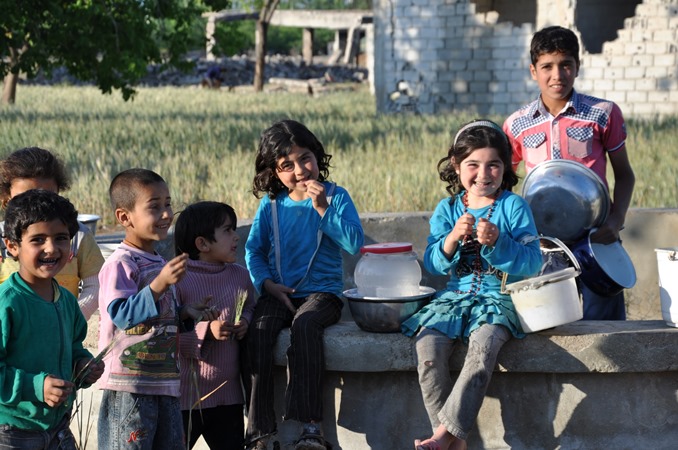
bucket children
Syrian “bucket children” looking for food- photo courtesy of Al Jazeera

The psychological and developmental implications of homelessness, war, and hunger, are incredibly grave. The bucket children suffer from severe malnutrition in many cases, and while they endlessly search for food, their brains become trained to focus solely on hunger and finding sustenance. As a result, psychologists concede that most of these children will have serious developmental delays and will struggle to concentrate on quite tasks, including reading and writing. The devastating impact malnutrition has on development and cognitive ability cannot be overstated, and the longer malnutrition continues, the more irreversible and serious the effects are on brain and physical development.

The bucket children are also exposed to serious dangers to their person when they venture out onto the streets to search for food. The children are often sexually assaulted or physically abused while out on their search. They are also exposed to sniper fire and crossfire. Death and injury become part and parcel of the fight for survival on the war torn streets.

Further compounding the issues of food shortage, is the difficulty many NGO and IGO organizations have in obtaining permission from the Syrian government to enter the country and distribute food and supplies to those in most serious need. It is nearly impossible for these organizations to have any impact, and many are ready and willing to help these bucket children and their families. And while aide waits at the door for permission to enter Syria, the dire conditions in which these children live deteriorate further with each passing day, as the war rages on around them. Without access to food and safety, most of these children do not have promising fates, and many will die as they struggle to survive another day, buckets in hand.

For more information, please visit:

Al Jazeera- Syria’s bucket children desperate for aide– 10 Nov., 2014

UNICEF- Syria Children’s Appeal

NBC- Hungry, homeless, helpless, Syria’s children know too much about war

Save the Children- Help and hope for Syria’s children and refugees
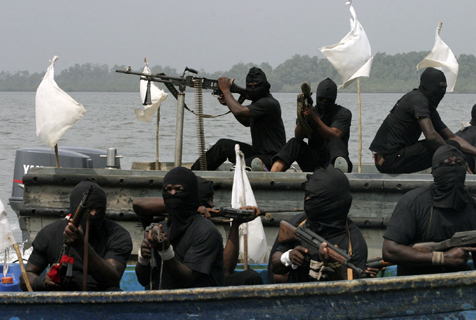
Pirate attacks in the Niger Delta; Government left to pay over $131 million in ransoms

By: Ashley Repp

News Desk Reporter, Africa


Abuja, Nigeria-

Though the international community began to associate piracy with the waters off of the coast of Somalia, the piracy practice is even more rampant off of the coast of West Africa. And while world piracy rates have largely fallen throughout most of the world, recently, the number of attacks on ships near Nigeria has increased. In the final days of last month, two attacks in the same week sent shock waves through the Niger delta region, and intelligence suggests that rate of attacks is likely to continue to rise, as elections are coming up. Intelligence sources assert that election time will likely contribute to increased rates of pirate attacks in the region, particularly because many of those campaigning will procure support and funds from illegal sources. In order to generate some of these funds, piracy will come into play as an economic resource.

pirates
Niger Delta Pirates- Photo Courtesy of Shipsandsports.com

In the two recent October attacks, over a dozen people were abducted, several were killed. In one of the attacks, the primary target was the gun boat, as it had a store of arms. In both of these cases, the pirates had more fire power than the police forces, and easily overpowered security. Furthermore, the ships were both oil company ships, which are typical pirate targets. In recent decades, piracy rose with rise of oil production in the Niger Delta, and then fell again. In fact, until the past few years, pirate attacks occurred on an almost basis. Many seafarers and security in the region are concerned that another spike in pirate attacks is at the doorstep of the Niger Delta, and the possibility of returning back to an era of daily pirate attacks is terrifying for many.

It is likely that the abducted men are being held as hostages. As they work for oil companies, the pirates offer equate holding these men hostages with a hefty ransom. According to the Contemporary Maritime Piracy Database, it has cost the Nigerian government and companies over $131 Million dollars in just the last three years alone to recover abducted men and pay pirate ransoms. This is no small price to pay for a government that already struggles financially, but with such high level oil drilling on Nigerian soil, piracy is likely to continue to remain a problematic and dangerous reality, not only for the government, but for those working on the ships and security boats.

For more information, please visit:

BBC News- Danger Zone: Chasing West Africa’s Pirates– 13 Nov., 2014

Times Live- Priates Hijack Gunboat, Kidnap Workers in Niger Delta– 28 Oct., 2014

Sahara Reporters- Niger Delta Pirates Seize Police Gunboat, Kill Four Policemen and Kidnap Six Oil Workers in Bayelsa– 25 Oct., 2014

gCaptain- Pirates Launch Deadly Niger Delta Attacks– 27 Oct., 2014

Report: Chinese Officials Linked to Elephant Poaching in Tanzania

By Kathryn Maureen Ryan
Impunity Watch, Managing Editor

DODOMA, Tanzania – Across Africa the population of the world’s largest land animal, the majestic African Elephant, have been declining an alarming rate. Experts believe 100,000 elephants have been killed across the continent in just past three years, all to feed the illegal Ivory trade. Growing demand for elephant ivory from in China is devastating Tanzania’s elephant population. Tanzania now loses more of its elephant to poaching than any other African State. According to the Environmental Investigation Agency (EIA), a London based environmental group, the country’s Selous reserve is a hotspot for illegal hunting. Elephant numbers in the park have fallen from an estimated 70,000 in 2006 to 13,000 in 2013. An EIA report places blame for the influx in ivory pouching in Tanzania on “collusion between corrupt officials and criminal enterprises,” accusing rangers, police officers and revenue and customs officers of corruption. According to Mary Rice, EIA’s executive director, the report “shows clearly that without a zero tolerance approach, the future of Tanzania’s elephants and its tourism industry are extremely precarious.” Rice explained, “The ivory trade must be disrupted at all levels of criminality, the entire prosecution chain needs to be systemically restructured, corruption rooted out and all stakeholders, including communities exploited by the criminal syndicates and those on the front lines of enforcement, given unequivocal support.”

An ivory bust of Mao Zedong for sale in Guangzhou, China this year. the Chinese demand for ivory drives elephant poaching, threatening the future of the species. (Photo courtesy of The Guardian)

Tanzania is the largest source of illegal Ivory, one out of every three elephants pouched in Africa is killed in Tanzania. The government of President Jakaya Kikwete has made some public efforts to fight poaching over the past year, including issuing a promise to destroy the nation’s stockpile of 112 metric tons of Ivory, worth an estimated $50 million. However, the government has failed to investigate the illegal pouching activities and prosecute high-level offenders.

State corruption drives Tanzania’s illicit ivory trade. Police have even been known to escort convoys carrying illegal ivory. The states corruption however does not at Tanzania’s borders. The EIA report cites several incidence where Chinese nationals, and even government officials have participated the illegal ivory trade. EIA cited the case of Yu Bo, a Chinese national who was detained in December 2013 while attempting to deliver 81 elephant tusks to two officers from a Chinese naval task force on an official visit to the Dar es Salaam port in the Kurasini region. Yu was caught at a checkpoint after paying bribes totaling $20,000. Market traders also told the undercover investigators that during a visit by Chinese president Xi Jinping in March 2013 the black market price of ivory doubled to $700 per kilo. A spokesman for the Chinese foreign ministry said it was “strongly dissatisfied” with the report. “We attach importance to the protection of wild animals like elephants,” he said. “We have been cooperating with other countries in this area.”

Elephants are a migratory animal, roaming across international borders. Protections are only truly effective if they are enforced in all countries where the animals roam. Elephant conservation is not only a valuable opportunity for the protection of wildlife and environmental health but for economic opportunity. Elephants bring millions of dollars into the region’s economy each year, helping to drive the tourism industry. The demand for trinkets and other goods made from ivory, the only part of the elephant poachers take, is fueling a pouching epidemic that threatens the future of the species, environmental health and may threaten the future economic growth of the region.

For more information please see:

The Economist – Big game poachers – 8 November 2014

National Geographic, Q&A: Report Alleges Governments’ Complicity in Tanzanian Elephant Poaching – 8 November 2014

The Guardian – Chinese demand for ivory is devastating Tanzania’s elephant population – 6 November 2014

The Toronto Star – Report links Chinese to elephant poaching in Tanzania – 6 November 2014

Report: Military Activities Carried Out By Myanmar Regime May Constitute War Crimes

By Kathryn Maureen Ryan
Impunity Watch, Managing Editor

RANGOON, Burma (Myanmar) – World Leaders have converged in Myanmar’s remote capital for the summit for the Association of South-East Asian Nations (Asean). The Summit marks the first time the country has hosted such an event since the country began adopting political reforms four years ago. United States President Barack Obama, Indian Prime Minister Narendra Modi, his Japanese counterpart Shinzo Abe and Chinese Prime Minister Li Keqiang will join ASEAN leaders in the capital Naypyidaw for the meetings that will likely address crucial issues facing the region including territorial disputes in the South China Sea. For the Myanmar government the Asean summit is intended to highlight the country’s recent reforms and serve as a symbol that the country is abandoning military dictatorship and joining the international community.

A young Rohingya woman carries her sick baby to a clinic at Dar Baing Muslim refugee camp near Sittwe, Rakhine State, in western Myanmar, on Monday. The Rohingya minority lives under apartheid like conditions in Myanmar, many living in camps for internally displaced peoples. (Photo Courtesy of The Wall Street Journal)

Under Thein Sein, a reformist former general, most sanctions against the state have been lifted and foreign investment have begun to flow into the country as it has been welcomed back into the international community after enacting sweeping reforms including the release of most political prisoners, including opposition leader and Nobel Peace Prize winner Aung San Suu Kyi. The Myanmar regime has also promised to hold free and fair elections next year. Despite reforms, which have been rewarded by the international community with investments and the Asean Summit, granting legitimacy to the regime, the Myanmar government has been criticized for the continued mistreatment of the country’s 1.3 million Rohingya Muslims. More than 100,000 Rohingya have fled the country by boat in the last two years. Another 140,000 are living under apartheid conditions in displacement camp.

Just days before world leaders landed in Myanmar for the summit a Harvard University study was released detailing alleged war crimes committed under the regime’s military dictatorship. According to the report, published by human rights researchers at Harvard Law School Military activities carried out by Myanmar’s powerful Minister of Home Affairs Minister Ko Ko, who was head of the army’s Southern Command while the country was ruled as a military dictatorship could constitute war crimes. The report cites evidence that the Home Affairs Minister and two other generals were responsible for the executions, torture and enslavement of Burmese civilians by military officials during a large-scale offensive against ethnic rebels.

The authors of the report say there is enough evidence to justify the issuance of arrest warrants by the International Criminal Court. The Myanmar government responded to the report by saying that what happens during times of conflict is often unavoidable and argued that now is a time to look forward and not back. “We are going through a democratic transition,” said Nay Zin Latt, one of the president’s political advisers and an ex-army officer. “Everyone should be encouraging the reform process rather than putting further obstacles along the way.”

However Ko Ko remains a high ranking official, now in command of internal security, overseeing the police force. “Ko Ko oversaw egregious rights violations in eastern Myanmar,” Matthew Bugher, global justice fellow at Harvard Law School and a principal author of the report said. “His prominent position in Myanmar’s Cabinet calls into question the government’s commitment to reform.”

For more information please see:

Al Jazeera – Myanmar hosts world leaders for ASEAN summit – 12 November 2014

The Wall Street Journal – U.N. Chief Urges Myanmar to Protect Minority Rohingya – 12 November 2014

CNN International – Myanmar: Rohingya not welcome – 11 November 2014

The New York Times – report cites evidence of war crimes in Myanmar – 5 November 2014

Russia Appears to be Repeating Crimea Tactic in Donetsk

By Kyle Herda

Impunity Watch Reporter, Europe

KIEV, Ukraine – The already-shaky ceasefire agreed to on September 5 in Minsk, Belarus seems to be in its final days. NATO has confirmed a new Russian presence in and around Donetsk, Ukraine, following reports from the past few days of Russian tanks, troops, and supply trucks crossing the Ukrainian border after mobilizing for the past week along the Russian side of the border. As seen in Crimea, however, they all remain unmarked and without identifying insignia.

A column of unmarked tanks spotted near Donetsk, a pro-Russian stronghold. (Photo courtesy of the New York Times)

Ukrainian military officials, monitors for the Organization for Security and Cooperation in Europe, and NATO have all confirmed the presence of Russian troops and various military equipment in and around Donetsk and flowing into the country. One convoy of 43 unmarked military trucks was witnessed Tuesday heading towards Donetsk. Five of the trucks were towing 120mm howitzer artillery pieces, and five others were carrying multi-launch rocket systems. A report last week reported more than 40 Russian trucks and tankers, also unmarked, and 19 of which were towing 122mm howitzers, were in Ukraine. There is an estimated 7,000 Russian troops inside Ukraine now, along with an estimated 100 Russian tanks, more than 400 armored vehicles, and more than 150 self-propelled artillery and multiple rocket launchers.

Along the border of Ukraine on the Russian side is a very alarming sight as well. According to Phillip Karber, a former Pentagon strategy advisor who has worked with the Ukrainian government, between 40,000 and 50,000 Russian troops remain just across the border, along with another 350 to 400 tanks, more than 1,000 armored vehicles, and 800 self-propelled artillery.

In a fight that has claimed over 4,000 lives, it appears that fighting may go back to pre-ceasefire numbers and could claim many more lives very shortly. Although the Russian troops, vehicles, and equipment in Ukraine are all unmarked, U.S. General and NATO Supreme Allied Commander in Europe Philip Breedlove states, “[t]here is no question any more about Russia’s direct military involvement in Ukraine.” Russia continues to deny any of the alleged involvement. In response, Ukrainian Defence Minister Stepan Poltorak said Ukraine will no longer pay attention to Moscow’s denials of involvement, that Ukraine is “repositioning our armed forces to respond to the actions of the fighters.”

For more information, please see:

New York Times – Russian Troops Crossing Into Ukraine, NATO Says – 12 November 2014

Reuters – Ukraine redeploys troops, fearing new rebel offensive – 12 November 2014

Time – Russia Sends More Convoys Into Ukraine as Cease-Fire Collapses – 12 November 2014

CNN – Ukraine violence flares as ceasefire collapses – 11 November 2014

Daily Beast – Thousands of Putin’s Troops Now in Ukraine, Analysts Say – 11 November 2014