African Leaders Vote to Give Themselves Impunity from War Crimes Prosecutions

By Kathryn Maureen Ryan
Impunity Watch Managing Editor

MALABO, Equatorial Guinea – In a move Amnesty International called “a backward step in the fight against impunity and a betrayal of victims of serious violations of human rights.” African leaders voted to grant themselves and their allies’ immunity from prosecution for war crimes, crimes against humanity and genocide at the new .


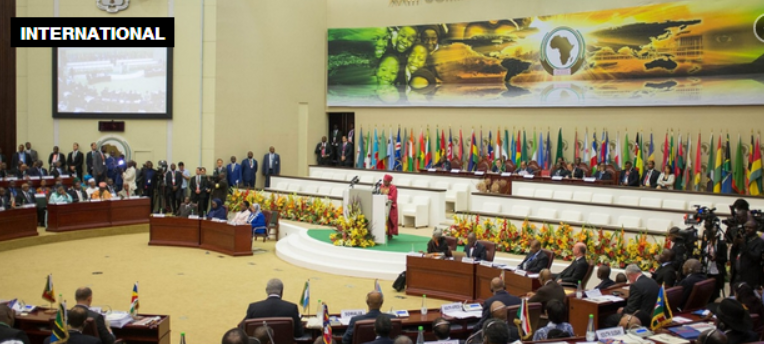
During an African Union Summit in Equatorial Guinea African leaders voted to expand the scope of the African Court of Justice and Human Rights, to include such crimes as crimes against humanity and genocide; however these leaders also voted to grant themselves immunity by preventing the court from having the ability to prosecute sitting heads of state and their allies for these crimes. (Photo Courtesy of Al Jazeera America)

The vote came Friday at an African Union summit in Equatorial Guinea. Journalists were excluded from the summit, Amnesty International said. News of the vote was communicated in a statement Monday night about the outcomes of the Summit. A paragraph of the statement listed the legal instruments agreed to at the meeting included the “Protocol on Amendments to the Protocol on the Statute of the African Court of Justice and Human Rights.” The amendment bars the court from prosecuting sitting African leaders as well as “senior officials.”

The court was formally created by the African Union six years ago. However, it is not yet operational nor is it clear when it will be. Last week leaders at the African Union summit also voted to expan the courts scope by moving to expand the court from its intial mandate as a civil tribuman to a criminal court with the authority to hear cases dealing with the most serious crimes including crimes agasint humanity, genocide and piracy.

Forty-two African and international civil society and rights groups had objected to the amendment, arguing in an open letter before the summit that giving impunity to these leaders violates both international and domestic laws as well as the constitution of the African Union.

Netsanet Belay, Amnesty International’s Africa Director for Research and Advocacy, addressed the amendment saying that, “At a time when the African continent is struggling to ensure there is accountability for serious human rights violations and abuses, it is impossible to justify this decision which undermines the integrity of the African Court of Justice and Human Rights, even before it becomes operational.”

Some critics argue the newly expanded African Court of Justice and Human Rights is an attempt to limit the scope of the International Criminal Court in Africa. However, According to Amnesty International the African Union’s decision to grant immunity to African leaders at the African Court of Justice and Human Rights will not affect the International Criminal Court’s right to investigate sitting heads of state and government. The I.C.C. has indicted two sitting presidents; Omar Hassan al-Bashir of The Sudan and Uhuru Kenyatta of Kenya. Bashir and others have attempted to argue that the court is a neocolonial weapon designed to punish Africans. However, the court’s chief prosecutor, Fatou Bensouda, who is from the Gambia, has said the claim that the court has an anti-African bias is “one of the biggest misperceptions about the court.”

For more information please see:

Al Jazeera America – African Leaders Vote To Give Themselves Immunity from War Crimes – 1 June 2014

Standard Digital – African Union Gives Presidents Immunity from War Crimes – 1 June 2014

The New York Times – African Leaders Grant Themselves Immunity in Proposed Court – 1 June 2014

Al Jazeera America – Does The ICC Have An Africa Problem? – 7 February 2014

ICC Press Release: Resignation of ICC Judge Hans-Peter Kaul


We regret to announce that Judge Hans-Peter Kaul has resigned from the International Criminal Court (ICC) for health reasons. His resignation will take effect on 1 July 2014. Judge Kaul’s full term at the ICC would have ended on 11 March 2015.

The President of the ICC, Judge Sang-Hyun Song, expressed deep regret over Judge Kaul’s departure from the Court and the circumstances which necessitated his resignation. “I thank Judge Hans-Peter Kaul wholeheartedly for his dedicated service to the Court and his pioneering role in the ICC’s development, even before the Court was established”, President Song stated. “I worked closely with Judge Kaul, particularly when we were first sworn in together in 2003 and when he served with me in the Presidency as Second Vice-President from 2009 to 2012. I have enormous respect for his deeply humanist personality and his substantial contributions to international justice, which will continue to guide the Court in the future.”

A German national, Judge Kaul has served as an ICC Judge for 11 years. In the first elections of ICC judges in February 2003, he was elected by the States Parties to the Rome Statute for a three-year term and assumed his duty on 11 March 2003. He was re-elected in 2006 for a further term of nine years.

Judge Kaul was a member of the ICC’s Pre-Trial Division, serving as the Division’s President from 2004 to 2009, as well as from 8 April 2014 until his resignation. He contributed to important decisions in proceedings regarding situations in Uganda, the Democratic Republic of the Congo, Darfur (Sudan), the Central African Republic, Kenya, Libya and Côte d’Ivoire and related cases.

Judge Kaul also served for several years on various committees related to the Permanent Premises: he was chairman of the Inter-Organ Committee on the Permanent Premises (2003-2008), the senior representative of the Court in the Jury of the International Architectural Design Competition, and contributed to the work of the Oversight Committee of States Parties, playing an important pioneering role in the process which eventually led to the planning and construction of the ICC’s future permanent home.

From 1996 to 2003, Hans-Peter Kaul served as chief negotiator and head of the German delegation during the process leading to the establishment of the International Criminal Court.

Israel Bombs Palestine after Missing Israeli Teenagers were Found Dead

By Kathryn Maureen Ryan
Impunity Watch Managing Editor


Ramallah, Palestine – Just hours after the bodies of three young Israeli settlers were found dead in the West Bank the Israel military launched air-strikes into the Hamas-controlled Gaza Strip. The missing settlers, Eyal Yifrah, aged 19, Gilad Shaar, aged 16, and Naftali Fraenkel, a 16-year-old with dual Israeli-American citizenship, disappeared about two weeks ago while they were hitchhiking home from their religious seminary in Kfar Etzion, an illegal settlement in the West Bank. The Israeli army said the bodies were found near Hebron in the Occupied West Bank. “The bodies are currently going through forensic identification. The families of the abducted teens have been notified,” a military spokesperson said.

Palestinians throw stones, as smoke rises from tires they have set on fire, during clashes with Israeli police Shuafat, an Arab suburb of Jerusalem, on July 2, 2014 after a young Palestinian boy was found murdered in a Jerusalem forest. (Photo courtesy of Reuters)

The disappearance of the three young Israeli men promoted the largest military operations by the Israeli government in the occupied West bank since the end of the Second Intifada. The disappearances of these three young men sparked a massive man-hunt led by the Israel government. In the weeks since the boys went missing more than 400 Palestinians were arrested, thousands of Palestine homes were raided and five people were killed by Israeli gunfire.

The Israeli military launched dozens of air strikes across the Gaza Strip overnight on Monday, only hours after the bodies of three missing Israeli settlers were found. Israeli claimed the strikes were a response to recent and ongoing rocket fire from the Gaza Strip into Israel Proper. However, the attacks came just after Israeli Prime Minister, Binyamin Netanyahu, who blames Hamas for the kidnapping and murder of the Israeli boys, vowed the militant Islamist group Hamas would “pay a heavy price.” The attacks struck 34 locations in the Gaza Strip. The air strikes came as troops on the West Bank killed an 18 year-old Palestinian boy during a raid in Jenin. Israeli authorities claim the teenager was a member of Hamas who threw an explosive device at Israeli soldiers.

Nitzan Alon, commander of the Israeli military said in a statement that “the mission is not over”: “The army, alongside the general security service and the police will continue, for as long as necessary to find the kidnappers, the terrorist from Hamas. We will not rest and not stop until that mission is complete.” Some Israeli politicians have called for harsher steps to be taken against Hamas, some even calling for targeted assassinations. “I don’t know how many leaders of Hamas will remain alive after tonight,” said deputy foreign minister Tzachi Hanegbi.

On Wednesday the body of a young Palestine boy was found in a Jerusalem forest, just days after the discovery of the three young Israel teenagers. The killing raised suspicions that the Arab youth was murdered in a revenge killing carried out by a group of Israelis to avenge the death of the three abducted Jewish teenagers. Residents in Shuafat, an Arab suburb of Jerusalem, said that they had seen a teenager forced into a vehicle outside a supermarket on Tuesday night. They identified the boy as Mohammed Abu Khudair, aged 16.

Following the strikes The United Nations Human Rights office called on all Israelis and Palestinians to exercise “maximum restraint” as the tension across Israel and occupied Palestinian territory escalated as a result of this tragic incident.

“We reiterate our call for strict adherence to international law by all relevant actors to avoid further loss of life, injuries and negative impact on human rights,” The United Nations Human Rights spokesperson, Ravina Shamdasani, said in Geneva. “We urge all parties to refrain from punishing individuals for offences they have not personally committed or by imposing collective penalties.”

For more information please see:

Reuters – Palestinian Teen Killed In Possible Revenge Attack – 2 June 2014

Al Jazeera – Israel Bombs Gaza after Settlers Found Killed – 1 June 2014

The Guardian – Israeli Jets Pound Gaza As Netanyahu Blames Hamas for Teenagers’ Deaths – 1 June 2014

Al Jazeera – Bodies of Missing Settlers Found in West Bank – 30 June 2014

Deadly Bomb Hits Nigeria Market

By: Danielle L. Cowan (Gwozdz)
Senior Desk Operator, Africa

ABUJA, Nigeria – At least 18 people have been killed in an explosion at a market in Maiduguri, north-eastern Nigeria, a medical worker told BBC news.

Several cars were destroyed in the explosion (photo courtesy of AP)


The explosives were reportedly hidden in a vehicle carrying charcoal.

It is believed that Boko Haram has carried out the attack, though no group has stepped forward and claimed this violent bombing. Maiduguri is the center of Boko Haram’s violent campaign.

This same group is the one linked to the 200 schoolgirls kidnapped.

“A van loaded with charcoal and IED (improvised explosive device) exploded at Monday Market in Maiduguri this morning. The location has been cordoned,” the defense headquarters stated on its Twitter account.

The vehicle exploded into a huge fireball, AFP further added.

About 55 people were injured due to the explosion.

One resident, Babagana Hausari, told BBC that “I heard a very loud explosion right from my house and rushed to the place.”

He further added, “When I got there I saw many people lying after they were hit by explosives.”

One student who rushed to the scene said “I saw police and troops picking out victims.”

Several vehicles were damaged due to the bombing, including the driver of the vehicle carrying the charcoal and the bomb.

After the accident, Nigeria’s military stated it raided a Boko Haram intelligence unit thought to be linked to the abduction of the schoolgirls.

The Boko Haram cell leader was arrested.

The cell leader has not commented on the allegations of the bombing.

This year alone, more than 2,000 people have been killed in attacks blamed on the Boko Haram militants.

For more information, please visit:
BBC News – Nigeria’s Boko Haram crisis: Deadly bomb hits Maiduguri – 1 July 2014
Tert.am – Nigeria’s Boko Haram crisis: Deadly bomb hits Maiduguri – 1 July 2014
The Sun – Boko Haram crisis: Deadly bomb hits Maiduguri – 1 July 2014
NewsBreakNigeria – Nigeria’s Boko Haram crisis: Deadly bomb hits Maiduguri – BBC News – 1 July 2014


Pending Expansion of Magnitsky Act Increases Pressure on Russia

By Kyle Herda

Impunity Watch Reporter, Europe

WASHINGTON, D.C., United States – The U.S. Senate Foreign Relations Committee approved a new Global Magnitsky Bill (S. 1933) that strengthens and expands an earlier legislation targeting Russia.

Sergei Magnitsky’s grave in Moscow. Circumstances surrounding his death in 2009 led to the US passing the Magnitsky Act. (Photo courtesy of BBC)

In December 2012, the Magnitsky Act passed, allowing targeting of individuals in Russia who were related to the case of Sergei Magnitsky. Mr. Magnitsky was a Russian lawyer working for the Hermitage Fund who investigated into and testified against top police officials in Russia for embezzling $230 million in taxes. Mr. Magnitsky was later arrested and sent to prison without trial, and he died nearly a year into his time in prison due to poor health in questionable circumstances.

A few months after passing the Magnitsky Act, 18 names were released in connection with Mr. Magnitsky’s death. On May 20, 2014, the US Treasury Department sanctioned another 12 Russian individuals pursuant to the Act due to their involvement in the detention, abuse or death of Mr. Magnitsky.

On June 24, 2014, the U.S. Senate Foreign Relations Committee voted to globally expand the provisions of the Russia-centered Act. The new bill, the Global Magnitsky Human Rights Accountability Act, would bar human rights violators from all around the world from entering into the United States. Further, it would prohibit these violators from using U.S. financial institutions. U.S. Senators Ben Cardin (Democrat-Maryland) and John McCain (Republican-Arizona) drafted the bill.

Now that the bill has passed the Senate Foreign Relations Committee vote, it will go to the Senate floor to be voted on. Should it pass that vote, the House of Representatives will hold a vote on the bill. Finally, the bill would go to President Obama to sign before enactment.

This bill, if enacted, would be another weapon for the United States in the fight against human rights violations, but now expanded globally rather than just for the narrow issue concerning the Magnitsky death. This global expansion could also have a profound effect on Russia, as Russia already has 30 names on the list solely from the Magnitsky death. This increased financial pressure on Russia could prove to be an effective tool in negotiations between Russia and the United States or even Europe. Given the problems in Ukraine and disputes between Russia and the West, this bill would serve to further increase pressure on Russia to cooperate and negotiate with the West to come to peace along the eastern European border.

For more information, please see:

EU Reporter – Global Magnitsky human rights and anti-corruption bill approved by US Senate Foreign Relations Committee 1 July 2014

Radio Free Europe Radio Liberty – Global Version Of Magnitsky Act Adopted In Senate Committee 24 June 2014

Lexology – US sanctions 12 Russian individuals under Magnitsky Act 30 May 2014

The Washington Post – The man behind the Magnitsky Act explains why now is the time to go after the Russian elite’s assets 3 March 2014