
This Week in Syria, Deeply: Sunday, 2 February 2014
[scribd id=204131534 key=key-22finw3wvwrzlmq73hiv mode=scroll]
By Darrin Simmons
Impunity Watch Reporter, Middle East
DAMASCUS, Syria-A twin car bombing attack on near Syria’s northern city of Aleppo occurred Sunday morning. The attack was led by Al Qaeda and targeted and killed their rival leader of the Islamic brigade.

The attack occurred on the cuff of rebel fighting throughout the Syrian civil war, as government forces continue the intense bombarding of opposition-held areas. Syrian aircrafts bombed buildings, which buried people underneath rubble near the Bab Neirab area.
The series of military aircraft droppings of explosives over rebel-held areas on Saturday killed dozens, including one attack that killed 34 people in al-Bab. Activists have claimed the bombings have driven Syrian forces into the eastern neighborhoods of Aleppo.
The twin suicide bombing that killed the military leader of a rebel group also resulted in the death of 26 other people. The attack targeted the Tawheed Brigades and killed Commander Adnan Bakkour.
Al-Qaeda also killed another prominent commander, Abu Hussein al-Dik of the Suqour al-Sham, further proving that key headquarters, strategic checkpoints, and senior influential commanders were being targeted.
On Saturday, a Lebanese extremist group claimed responsibility for a suicide car bombing in a Shi’ite town that killed at least three people. This attack was also linked to the Syrian civil war.
The bombing occurred in the northeast town of Hermel and was claimed to punish the Lebanese Shi’ite group Hezbollah, which fights with the forces of Syria President Bashar Assad. It is the third bombing that the Nusra Front in Lebanon has claimed responsibility.
Also on Sunday, a video was posted to social networks showing a Sunni fighter beheading another man and children and adults gathered to watch.
The video shows adults cheering as the fighter cuts the other man’s head off with a small knife. The man’s hands are tied and it was unclear if he was alive during the beheading. Photos of the body and severed head were also posted to a separate Instagram account by a supporter of al Qaeda.
For more information, please see the following:
Al Jazeera-Al-Qaeda fighters kill Syrian rebel leaders-2 February 2014
CBS News-Al Qaeda in Syria kills rival rebel leader-2 February 2014
Hindu-Al-Qaeda fighters kill rival rebel leader in Aleppo-2 February 2014
Los Angeles Times-Al Qaeda-linked rebel leader reported killed in Syria-2 February 2014
By Ben Kopp
Impunity Watch Reporter, Europe
KYIV, Ukraine – Ukrainian tensions remained high following President Yanukovich’s attempted relief to the opposition. However, world leaders offered help.

Unseen since taking sick leave, Ukrainian President Viktor Yanukovich repealed anti-protest legislation, and signed an amnesty into law for activists detained during massive protests. Amidst news reports of a prominent opposition activist’s kidnapping and torture claims, many rejected Yanukovich’s decision because he conditioned it on activists leaving occupied buildings.
“There’s no point in signing this amnesty law,” said an improvised clinic worker at Kyiv’s occupied city hall. “No one will leave here until this government is gone.”
Concerned for demonstrators’ health in Arctic temperatures, opposition leaders urged protesters not to take to the streets for their weekly rallies. However, media outlets continued to replay video of activist Dmytro Bulatov’s story of kidnap and torture, which has kept anti-government tensions high.
Bulatov disappeared on 22 January 2014, at the hands of unknown kidnappers. Since Bulatov’s return, an interior ministry official has accused him of faking his claims to stir unrest.
“There isn’t a spot on my body that hasn’t been beaten. My face has been cut. They promised to poke my eye out. They cut off my ear,” Bulatov said. “They crucified me by nailing me to a door with something and beat me strongly all the while.”
In a statement, the Defense Ministry said, “The military and the Ukrainian armed forces … called on the supreme commander to take immediate steps, within the framework of the law, to stabilize the situation in the country and reach agreement with society.”
While Yanukovich has expressed concerns that Ukraine is on the verge of civil war, the military refused to take sides. A Defense Ministry news website quoted retired Admiral Serhiy Rybak, as he recalled Ukrainian peacekeeping missions abroad: “No political ambition is worth a drop of human blood.”
NATO Secretary General Anders Fogh Rasmussen tweeted that the “military must remain neutral” even if it were to become involved in the crisis.
Moscow highlighted its economic over Ukraine by refusing its planned purchase of $2 billion of Ukrainian government bonds. The move contributed to the currency falling to its lowest point against the dollar in over four years.
U.S. Secretary of State John Kerry planned to meet opposition leaders, on the sidelines of a security conference in Munich.
“Our message to Ukraine’s opposition will be the full support of President Obama and of the American people for their efforts,” Kerry said in Berlin before the meetings. “But we will also say to them that if you get that reform agenda… we would urge them to engage in that because further standoff, or further violence that becomes uncontrollable, is not in anybody’s interests.”
Kerry also said, “We would … say to our friends in Russia this does not have to be a zero (sum) game, this is not something where Ukraine should become a proxy and trapped in some kind of larger ambition for Russia or the United States.”
For further information, please see:
Al Jazeera – Tension Grips Ukraine over Torture Claims – February 1, 2014
BBC News – Stand-Off over ‘Tortured’ Ukrainian Activist Dmytro Bulatov – January 31, 2014
Reuters – Ukraine President Signs Amnesty but Anger Remains, Currency Slumps – January 31, 2014
RT – Russia’s Emergency Loan to Ukraine on Hold until Govt Forms – January 30, 2014
Times Of India – Ukrainian President Takes Sick Leave, No Crisis Solution in Sight – January 30, 2014
By Kathryn Maureen Ryan
Impunity Watch, Middle East
DOHA, Qatar – Organizers of the 2022 FIFA World Cup have been given a tight deadline by Fédération Internationale de Football Association (FIFA) to explain what is being done to improve working conditions for migrant labourers working on the construction process for various buildings associated with the World Cup. FIFA is demanding that The Supreme Committee for Delivery and Legacy in Qatar Provide the organization with “detailed report” by February 12 with “information on specific steps” being taken to improve conditions faced by migrant works, who make up the majority of the construction workforce in Qatar.
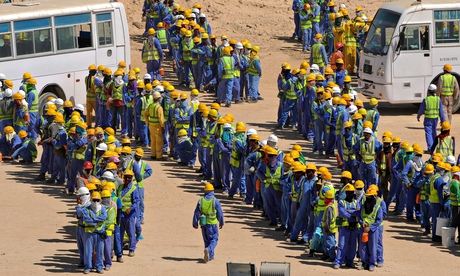
Concerns over the working conditions of migrant workers, who are often subjected to near slave-like conditions, in Qatar was reported extensively in a report by Amnesty International last year.
FIFA as initially criticized for failing to adequately address the concerns over Qatar’s history of worker abuses. However, after the report was made public FIFA president Sepp Blatter publicly described the situation as “unacceptable” and raised during a visit to Doha last November.
FIFA plans to use the report to prepare for the hearing on the matter of workers’ rights in the Arab emirate at the European Parliament in Brussels on 13 February 2014. In a press release FIFA announced that “the application of international norms of behaviour is a FIFA principle and part of all of FIFA’s activities, and is expected from all hosts of its events.” Doctor Theo Zwanziger, who was appointed by FIFA to spearhead efforts to address the issue of labour rights in Qatar associated with the World Cup, has held several meetings with human rights and labour organisations including Amnesty International and the ILO, in order to strengthen the dialogue between various interest groups and to reach a sanctioned approach.
According to Zwanziger FIFA is “currently in the middle of an intensive process, which is exclusively aimed at improving the situation of workers in Qatar.” A complete report will be delivered to the FIFA Executive Committee at its meeting on 20 and 21 March. Zwanziger stated that clear rules and an outlined process will be needed in order to “build trust and ensure that the situation, which is unacceptable at the moment, improves in a sustainable manner.”
The choice of Qatar as the host nation for the 2022 FIFA World Cup has been criticized since the organization made the decision to allow the Arab state to host the games. Concerns about the health risks associated with acute summer temperatures in Qatar has led FIFA to delay the competition to the winter. The origination has also been criticized by several human rights organizations and activist for choosing Qatar to host the games despite its long history of Labour rights abuses.
FIFA has stated that it ”firmly believes in the power of the World Cup in triggering positive social change in Qatar, including improving the labour rights and conditions of migrant workers.”
What is clear is that the decision to host world’s most popular sporting event in Qatar has brought the issue of migrant rights and labour conditions in Qatar into the public eye.
For more information please see:
CNN International – Qatar Set Deadline by FIFA over Conditions For Migrant Workers – 31 January 2014
Fédération Internationale De Football Association – FIFA Requests Update On Working Conditions In Qatar – 31 January 2014
Bloomberg – FIFA Demands Report from Qatar on World Cup Construction Deaths – 30 January 2014
The Guardian – Qatar World Cup: FIFA Demands Update on Efforts to Improve Worker Conditions – 30 January 2014