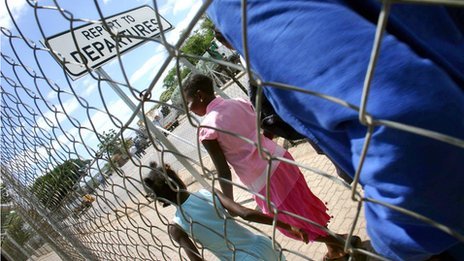
UN Official: Qatar must reform Labour Relations

By Kathryn Maureen Ryan
Impunity Watch Reporter, Middle East

DOHA, Qatar – Francois Crepeau, the United Nations Special Rapporteur on the Human Rights of Migrants, called on Quarter to improve labour relations and respect the rights of migrant workers in the country, which is preparing to host the Fédération Internationale de Football Association (FIFA) World Cup.

Working conditions for migrant workers have been under scrutiny in Qatar, which has the highest percentage of migrant workers in the world (Photo Courtesy of Al Jazeera)


According to the United Nations Qatar should allow workers to organize into unions, abolish the discriminatory “kafala” system, adopt legislation to protect labour rights, and properly enforce existing legislation, to protect workers in the country.

Crepeau said on Sunday that there have been some positive developments for migrant workers but argued that the state must adopt reforms in order to protect the rights of migrant workers in the Country which has the highest ratio of migrant workers in the world.

Migrant workers make up approximately 88% of Qatar’s population. Qatar currently has a high demand for construction workers as the country undertakes several massive development projects including construction projects connected with the 2022 FIFA World Cup.

Crepeau’s speech came at the end of an 8 day visit to Qatar to investigate allegations of abuses of the rights of migrant workers. The plight of migrant workers in Qatar gained international attention after The Guardian published a report on the issue earlier this fall. During his visit, Crepeau met with government officials, migrant workers, academics, and members of Qatar’s National Human Rights Committee.

While Qatar has announced plans to improve conditions of labourers in the country the state has been criticized for failing to enforce existing labour laws meant to protect worker rights. Qatar has fought to keep the images of labour conditions in the country from being seen by the international community. In October the Guardian reported that two German film makers, Peter Giesel the head of a Munich-based production company, and his cameraman Robin Ahne were detained for 27 hours after filming the working conditions of workers in Qatar from the balcony of the Mercure Grand hotel in Doha.

Despite continued concerns about the labour rights situation in Qatar the Fédération Internationale de Football Association organizations has remained committed to house the 20202 World Cup in Qatar. According to FIFA President Sepp Blatter has said that the decision to award the 2022 World Cup to Qatar is “not reversible”.

On Saturday Blatter told reporters in Doha after meeting the emir of Qatar, Sheikh Tamim bin Hamad Al Thani that “There is no doubt that the World Cup in 2022 will be organised in Qatar.”

For More Information Please See:

Al Jazeera – UN official urges Qatar labour reforms – 11 November 2013

Al Jazeera –  UN recommendations on Qatar migrant rights – 10 November 2013

Al Jazeera – Blatter: World Cup in Qatar is not reversible – 9 November 2013

The Guardian – Qatar detained two Germans who filmed World Cup labour conditions – 14 October 2013

San Salvador Archbishop Closes Human Rights and Legal Aid Office

By Ellis Cortez
Impunity Watch Reporter, South America

SAN SALVADOR, El Salvador – The Roman Catholic Church in El Salvador has abruptly closed its important human rights and legal aid office, which for years denounced and investigated the most egregious massacre cases of the 1980’s civil war.

Salvadoran President Mauricio Funes, responding to the closure of the Tutela Legal office in San Salvador, said he was “worried about the bad signal this sends.”
Salvadoran President Mauricio Funes, responding to the closure of the Tutela Legal office in San Salvador. (Photo Courtesy of Roberto Escobar / European Pressphoto Agency)

The closure triggered national and international condemnation from faith, human rights and solidarity groups. They called for the preservation of Tutela Legal’s extensive archive, which contains evidence for unresolved criminal cases.

On September 30, employees showed up for work at the Tutela Legal office and found the locks changed on the doors and armed guards at the door. They were allowed 10 minutes to clear their desks. Attorneys who have worked with survivors and victims’ families for decades now have no access to evidence in the cases.

The current Archbishop, José Luis Escobar Alas, had closed Tutela Legal and issued a statement saying its work was “no longer relevant.” Employees said they were told that, with the war long over, the office was no longer necessary.

“We had no idea this was going to happen,” Tutela’s director, Ovidio Mauricio Gonzalez, said. “It is a strange coincidence. Just as they are talking about the amnesty, they close Tutela Legal, they close access to the archive, and abandon it to its fate,” he said.

The timing of the closure has caused widespread suspicion. The closure of Tutela Legal comes in the wake of a Supreme Court decision to consider vacating an “Amnesty Law” that has long protected perpetrators of war crimes.

The amnesty law, passed in 1993 by the military-allied Nationalist Republican Alliance government, protected numerous government officials, military officers and guerrilla leaders from prosecution for acts committed during the civil war that took place between 1980 and 1992, in which approximately 80,000 people died.

The court’s decisions renewed hope of the amnesty law being repealed and the possibility of reopening several prominent human rights cases that were investigated and documented by Tutela Legal. 

Late last year, the Inter-American Court of Human Rights ruled that the law cannot be used to protect those who ordered and carried out the single largest massacre in the war: the 1981 El Mozote massacre in which at least 800 peasants, including children, were killed by the army.

“I am worried about the bad signal this sends,” President Mauricio Funes said in a news conference, adding he did not know the reasons behind the closing. “The Catholic Church, and especially the archbishop of San Salvador, are not determined to accompany the just causes of the people,” Funes added.

Archbishop Oscar Arnulfo Romero founded the Human Rights Office, originally known as Socorro Juridico (Legal Relief) in 1977, in order to document human rights violations from across the country. In addition to counselling the poor and oppressed, it was one of the only places people could go to report state-sponsored crimes. Every Sunday until his assassination in March 1980, Romero would broadcast a homily from the grand cathedral in San Salvador which included the latest denunciations.

Since then, Tutela Legal has documented more than 50,000 cases of human rights abuses. It holds the most comprehensive archive of El Salvador’s bloody history and its lawyers continue to represent survivors of notorious massacres including El Mozote and Rio Sumpul.

In the past two decades Tutela Legal’s work has proven crucial in cases brought against senior military figures living in the United States.Tutela Legal was also active in new cases, such as the 2007 Red car battery factory lead-poisoning case, and ran education programs and human rights training across El Salvador. Tutela’s work has recently included studies of gang violence, abuses tied to the expanded role of the military in policing, and important legal work for the poor.

Members of the Tutela Legal staff have been examining alternatives. There were suggestions that the office reopen as an independent human rights organization, without the auspices of the church.

For more information please see:

Al Jazeera El Salvador shutters historic rights clinic 12 October 2013

National Catholic Reporter Salvadoran archbishop closes legal aid office 4 October 2013

Los Angeles Times Catholic Church in El Salvador shuts down rights and legal office 2 October 2013

Center for Democracy in the Americas San Salvador Archbishop shuts down historic human rights office, Tutela Legal 2 October 2013

Orphanage Worker Charged With Poisoning Children

By: Danielle L. Gwozdz
Impunity Watch News Reporter, Africa

PRETORIA, South Africa – An orphanage worker in South Africa has been charged after 20 young children were rushed to hospital with symptoms of poisoning, police say.

Children playing soccer in South Africa (photo courtesy of AFP)

The children are mostly Aids orphans living in the Malerato Centre for Hope in Mamelodi township outside Pretoria.

Children at the Centre complained of stomach ache shortly after lunch on Thursday, according to police spokesman Tsekiso Mofokeng.

“Twenty kids were admitted,” he said.

“A woman 35 years of age was arrested on suspicion of poisoning and charged with assault with the intent of causing grievous bodily harm,” he told AFP.

The children are reported to have consumed the poison in powder form with their lunch. After they complained of stomach pain, they started crying and vomiting.

Two of the children were in a critical condition with one being airlifted to Johannesburg hospital and the other rushed to Steve Biko hospital in Pretoria.

Eighteen others were rushed to various hospitals. Eight of the children have since been discharged from the hospital.

The Centre houses 42 abandoned children, as well as orphans, whose parents died from AIDS, according to South Africa’s Sunday Times.

The orphanage’s principal, Johanna Mashapa, told local media the children had been given powder.

“We were so worried. They were vomiting and crying. They had runny stomachs and were so sick,” she told South Africa’s Sunday Times.

Government inspectors were sent to the orphanage to investigate.

Staff at Malerato Centre for Hope orphanage was taken for forensic testing.

For more information, please visit:

BBC News – South Africa orphanage worker charged in poisoning – 10 November 2013
The China Post – Suspected poisoning at an orphanage hospitalizes 20 – 10 November 2013
Yahoo! News – S. Africa Orphanage worker held after suspected poisoning – 10 November 2013
msn news – Twenty orphans poisoned in Sth Africa – 10 November 2013
sabc – Woman to appear in court for child poisoning – 10 November 2013
france 24 – Orphanage worker held after suspected poisoning in S. Africa – 10 November 2013

United Nations Urges Qatar Labor Reform

By Darrin Simmons
Impunity Watch Reporter, Middle East

DOHA, Qatar-Pressure is being raised by the United Nations against Qatar, the 2022 World Cup host, to end labor abuse.  Qatar has implemented a sponsorship system for migrant workers that is at the root of the abuse.

Migrant workers doing construction in preparation for 2022 FIFA World Cup (photo courtesy of Aljazeera)

“This marks a stain on Qatar’s reputation and is something that can be improved right away,” said Francois Crepeau, a U.N. Special Rapporteur on the human rights of migrants.   Crepeau reported that living conditions of foreign workers tended to be poor, referencing them to “slums.”

With the World Cup quickly approaching, Qatar has been scrambling to complete major construction and infrastructure projects, increasing the number of its estimated 1.8 million foreigners (88 percent of Qatar’s population) working on projects for the event.

The system that Qatar has implemented prohibits employees from changing jobs or leaving the country without permission from their sponsors, who are frequently labor supply companies or wealth Qatar individuals who provide workers to personal profit businesses.

“A majority of the employee sponsors confiscate their passports for the duration of their contract, placing most of the workers in the construction and domestic work sectors.  Qatari Labor Ministry officials were not immediately available for comment.

“This system that is used to regulate the relationship between employers and migrant workers, with a work permit linked to a single employer, is problematic and a source of abuse against migrants,” said Crepeau.

Crepeau visited Qatar, meeting with government officials, migrant workers, academics, and Qatar’s National Human Rights committee.  He was able to visit every location that he wished to see and sat down to discuss drafting laws for domestic workers and a blacklist of companies who abuse migrant workers.

Crepeau also certified the establishment of a minium wage, a more developed labor inspection system, and the kafala system, the system that binds workers to a single employer and forbids the to change jobs or acquire an exit visa.

Living conditions were criticized by Crepeau,  “The dwellings I have visited do not conform to Qatari legislation.  I saw bunk beds, which are prohibited.  I saw overcrowding.  I saw very shoddy construction of these camps.  One place in particular had no kitchens…the latrines are, let’s say, minimal.  Access to water was problematic at times.”

In September, dozens of Nepali workers died during the summer in Qatar as laborers were not given enough food and water.  However, Nepal recalled its ambassador from Qatar this past Thursday after she claimed that Qatar was an “open jail” for Nepalis who suffer labor abuses.

For more information, please see the following: 

Aljazeera-UN official urges Qatar labour reforms-10 November 2013

Gulf News-UN urges Qatar to improve migrant labour conditions-10 November 2013

Reuters-U.N. expert on labour abuse urges Qatar to end sponsorship system-10 November 2013

Guardian-Qatar under pressure over migrant labour abuse-26 September 2013