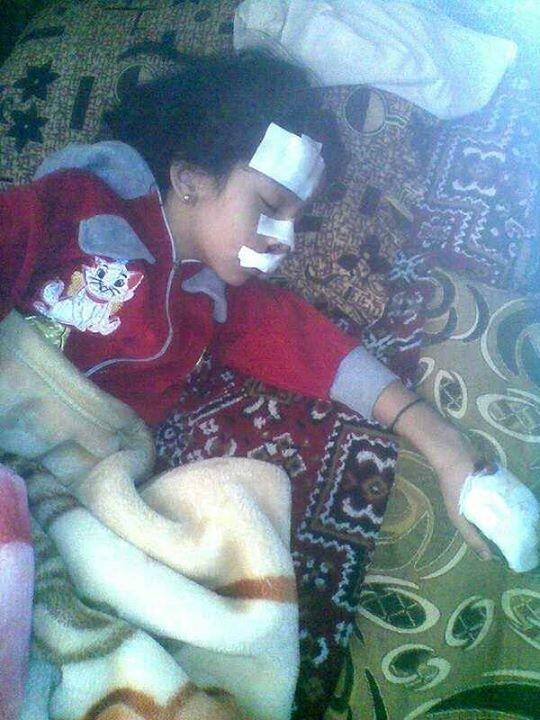
Prepared by Syrian Network for Human Rights
The report presents aspects of the besiege imposed by government forces on the town of Moadamyeh since 18 November 2013. It also details how government forces have displaced, starved, and shelled civilians.
The report is based on six testimonies from Moadamyeh residents including a doctor, an eyewitnesses who saw or heard the government forces arrest relatives and then execute them.
This report has been prepared by SNHR team in the Damascus countryside and logistics team outside Syria in cooperation with the residents and local activists in Moadamyeh.
Moadamyeh is located west of Damascus city in East Ghouta, and is administratively affiliated with the Darya district of Damascus countryside. The current population is 12,000 people.
The town is bounded to the North by three regiments of the 4th Division and from the South-East of the Palestinian organization’s camp of the regime’s army, from West officers’ housing, Saraya Al-Sira’ brigades and Yusuf al-‘Azma barracks of regime’s forces, and East Mezzeh military airport.
Location map:
https://maps.google.com/maps?q=33.461127,36.19222&num=1&t=h&z=15
The siege began on 18 November 2012, when Government forces surrounded the city on all sides with military checkpoints and military armored vehicles, and surrounded the entrance of the city and main roads with about 20 checkpoints of 4th Division and Air Force Intelligence, backed by tanks t-72 and t-82, and ZSU-23-4 “Shilka.”
Testimony of Mahmoud Abo Ali resident in Moadamyeh:
“The city is suffering from scarcity of all food materials, medical, drugs, and fuel, in addition to the heavy and daily shelling on the city, the regime also used chemical weapons, the people of this city have been exposed to different type of death, even starvation, recently 7 children died as a result of hunger, adding to cut off electricity, water and connections.”
You can communicate with the witness through his Skype account:
mrkazmoadamiaalsham
Testimony of Amir Almoadamani ,resident in Moadamyeh:
“Hospitals and Dispensaries are totally destroyed, almost 80% of schools and mosques are destroyed, and some razed to the ground, houses have not been spared of shelling, where 75% of the city has destroyed, hunger totally dominate the area, regime’s forces prevented the entry of food, medicines and fuel, tragedies in Moadamyeh greater than from being counted in numbers.”
You can communicate with the witness through his Skype account:
adsport19821
==================================
Many Governments, senior United Nations officials, and human rights groups including Syrian Network for Human Rights call on the Syrian Government to grant humanitarian access to Qusayer during fighting in May and June/2013. But the Security Council did not issue a statement on the right of access until the end of fighting because of Russian obstructionism.
The Syrian Government has rejected international calls for the evacuation of civilians and has refused to grant access to independent observers who were able to facilitate evacuation operations.
On 2 June, Syrian Foreign Minister Walid Muallem said that Syria will not grant the International Committee of the Red Cross access right of entrance until the end of hostilities.
The Syrian Government has blocked the entry of food, bread and flour, medicine, baby milk, and fuel, in a policy to starve the residents. The so-called “people’s committees (militiamen)” prevent the entrance of United Nations assistance to the region, leading to the fully closure of markets.
Syrian Network for Human Rights’ director Fadel Abdulghani said: “Syrian regime carries out systematic starvation and impoverishment operations to push the residents to compare their conditions before they rise up against the Syrian regime and after, and which to return to their old conditions, where they used to eat and drink regardless tyranny, oppression, gagged, and humiliation of dignity, they do so in the areas that out of their control, as example price of bread bag is 20 Syrian Pound, while in Damascus countryside reach to 300 Syrian pound if any.”
SNHR documented the murder of 11 residents, including 10 children, who were deprived of food and medical supplies. SNHR’s director said “They didn’t kill because of shelling or executions, but starved to death.”
The following link contain names, photos, and other victim’s details:
https://docs.google.com/document/d/1bu2UHeQ4xly4cBdVWaF3id8Z3eDJv5gy9aQ4K7nArNE/edit?usp=sharing
====================================
Testimony of Mr. Yasser who visited large number of families that left Moadamyeh told us:
” I visited large more than 8 families who could get out of Moadamyeh by the Red Crescent, and inquired about many things like military, service, medical , humanitarian, relief and even personal subjects…
Dealing between people in Moadamyah is by barter, not sale and purchase, because there are no Currency in the city
There is no food in the city, people eat herbs, leaves of trees and plants
Of course people there are literally skeletons have souls, People dies cause of hunger, relief materials don’t reach the city because of the siege imposed by government forces.
There are no water, no electricity, no communications.
Most of the families lost many of their children.”
In addition to shutting off electricity, water, and connections in the city by Syrian Government, Government Forces also with its daily shelling use various types of weapons destroyed 60% of the residential buildings in full, shelling often targeted public facilities (hospitals, schools, mosques, and clinics).
In addition to shelling the city with chemical weapons on 21 August 2013.
Medical Situation:
All of the hospitals, dispensaries, and medical centers were shelled, and do not function anymore, except for two small medical centers with five doctors and 40 nurses, suffer from shortage in medical materials. Because of this, some manufactured equipments meant to be used once, are used several times after sterilization, and this exacerbated injured conditions, amputated infected parts, and stopped treating other wounded.
Testimony of Dr. Omar Alhakim, works in Moadamyeh medical centre:
“The city has been severely suppressed by the security forces and militiamen since the beginning of the peaceful protests, about 10 months after FSA fended off the regime’s forces repeated attempts to storm the town. They imposed a severe siege, the humanitarian situation has deteriorated , where we suffer from running out the food supplies in the city; nothing lefts for the residents to eat only plants, the city is totally empty from food, there are approximately 12,000 civilians trapped since 10 months including 7 thousand children and women, Electricity cut off from 10 months, flour is missing from 7 months, dry bread missing from 5 months, and now all Foodstuffs run out.
In addition to losing the entire medical substances, treatment the injuries with primitive tools and materials intended for one use by using them for several times, Drugs are almost non-existent, and antibiotic medications are only given one pill to a patient in extreme necessity conditions, the city is now at the gates of a real humanitarian disaster ”
You can communicate with the witness through his Skype account:
mohanad198938
============================
Educational status:
In Moadamyah 22 schools are closed, 15 of them are totally destroyed from shelling by government forces, the rest are extensively damaged. They are out of service and cannot function anymore.
Photo of school on 1/3/2013
http://www.youtube.com/watch?v=Drt3lncQFuE
11 mosques in the city, large parts of them destroyed from shelling.
Photo of Omari mosque on 14/8/2013:
https://docs.google.com/file/d/0B9Bj18tlYYKBWXJGUWhaellRMzA/edit?usp=sharing
Initiative to bring out the civilians
On Saturday 16 October 2013, Red Cross members provided help to the residents to display from the city, Government forces warned the families that they should evacuate the city, because it was announced by the official media as military zone, during displacement and at the western entrance of the city, government forces targeted them by heavy artillery led to kill 1 victim and almost 20 injuries:
Victim: Ziad Shihabi, Moadamyah of Damascus countryside:
http://youtu.be/WZozYcncQIM
Testimony of media activist Murad Alshami, who was present while trying to evacuate the civilians:
You can communicate with the witness by Skype account:
Morad.773
“The city of Moadamyah have been besieged since the beginning of Daria battle, because of the very important location of the city, as it is between Mezzah military airport and Sumarieah housing and Eastern neighborhood, officers’ housing, Saraya Al-Sira’ brigades and Yusuf al-‘Azma suburb, 4th Division and their housings and regiment 100.
Moadamyah is military zone, there is no entrance or exist way since the beginning of Daria battle.
That’s mean there is no military barrier for inspection or otherwise…. snipers at all entrance, transit from and to the city is forbidden … that’s mean its prison anyone try to get out immediately sniped, and targeted by Shilka armored , heavy machine guns, thermal scope snipers, and Alwite People’s committee barriers.
From four months ago, we have identified more than 10 dates for getting out the civilians with United Nation Commission.
There were many connections with Red Cross, where they pledged to enter the aids, but they didn’t enter foods or unwind siege.
Red cross and ministry of national reconciliation intervened in one thing which is city evacuation
Nun Fadia Allaham entered the city and asked for guarantees, I was one of those who helped her and secured her, as she can take out whomever she wants, we told her to act as she wants.
First day 13/10/2013, about 1000 civilians came out, the next day almost 2000 civilians gathered , but only 500 of them could leave and they told the rest for tomorrow .
when the people gathered, Fadia and her friends arrived, she told us that she prepared buses for men to go out not just women, they told her continue with children and women temporarily
After a while, almost 10 minutes, shelling on Free Syrian Army barriers, which was almost 200 miters away from regime’s barriers ,was started, then shelling on civilians who were trapped in the middle, victims were from FSA then women and children.
Thousands of civilians were trapped in the city.”
Testimony of one of the displaced, where she was there during the shelling, and refused to disclose her identity
“First thing the agreement became between day and night, no one knew about it ..
who arrange the agreement is two persons of Moadamyah ( Samir and Ali Ghandour ), for sure they lived outside Moadamyah, but they found that this is the best solution, the mediation between the regime and Moadamyah’s residents were Red Cross and Nun Fadia Allaham.
Indeed the first three days, many civilians have been evacuated
good number of them
who get out alone survived, but those who rode regime’s buses , they prevent them to get out the places where they kept them until they have someone out of Moadamyah to sign guarantee for them, ( that’s mean if he/she has someone to ensure they will let him out, if not he/she will stay )
When people get out of Moadamyah, security forces checked the ID’s to see if they have their names or not, many detention cases took place.
Of course who get out not only from Moadamyah, also from Daria
next day almost 3000 civilians tried to go out, and gathered at buses point.
Then shelling from 4th division started on this area, they were in, which is near Asia factories at Jdidt Artouz side ( the west side of the city ) , particularly Arbaeen highway.
First, the regime shelled by one mortar, amost 50 meter far away from civilians.
Team of Red Cross and Nun withdrew directly.
after their withdrawal, artillery shelling on civilians started, many of them fell between victims and injuries
Free Syrian Army intervened, and tried to evacuate civilians, ambulance injuries, and take victims.
Clashes between FSA and regime’s forces that tried to take civilians as humans shields, the civilians already are humans shields in this area, because it is occupied by the regime…
Two of the government forces were dead, and five get injured
FSA eventually could move civilians of Daria and Moadamyah to inside of Moadamyah via fields
Fields area usually one of the most targeted areas, because usually FSA holed there.
That’s mean they back again to worse besiege, shelling was continuing in that moment very badly.
Who went out by his car alone, he could get his relatives, people who went with regime, they took them to a school in Qudsia suburb.”
==================================
Evidences:
Video shows civilians, children and women, used as human shields in Moadamyah during their displacement:
http://youtu.be/YBDPt_ZGGTg
Video shows injuries from shelling civilians gathering’s point during their displacement with Red Cross:
http://youtu.be/Am6QoYOQsNM
http://youtu.be/DQK-yNCX-Qw
Video shows shelling on displacements gathering point:
http://youtu.be/vpFjjg7ti8c
==============================
Government forces imposed a severe besiege on these villages, which makes it extremely difficult to provide medical and food supplies, and deprived hundreds of families who now must leave and move to safe areas. This is a flagrant violation of international humanitarian law governing conflict in Syria, where they should allow the provision ofof food and medicine, and if there is a need to take the approval from the Syrian Government and also allow them to carry out inspections of those convoys, but it is illegal to prevent these convoys abusively as they are now, and are considered as a form of collective punishment of the civilians. Here, the international community must intervene urgently to provide humanitarian relief in Moadamyah and save them from being starved to death.
Exert real pressure on the Syrian Government to give all medical and food aids and to allow civilians to leave. They should pressure the Syrian Government to obey them and hand over its stock of chemical weapons under threat of force.