11 October 2013 – On Monday, 14 October 2013, at 10:30 am, at the Queen’s Bench of the High Court in London, Justice Simon will be delivering the judgment in the case of Pavel Karpov vs William Browder, Jamison Firestone and Hermitage Capital Management. The judge will decide whether Karpov’s lawsuit is an abuse of court process and should be struck out.
The judgment will decide on legal arguments which were presented to theHigh Court on 24-25 July 2013.
Pavel Karpov, an unemployed ex police officer, has been added to the OFAC sanctions list by the U.S. Government for his role in the Magnitskyaffair. He is suing colleagues of late Sergei Magnitsky for defamation in the UK in relation to their campaign for justice for his unlawful death.
Karpov has been represented by Geraldine Proudler of Olswang, and Andrew Caldecotte, QC, and Ian Helme.
Colleagues of Sergei Magnitsky have been represented by Mark Stephens ofHowardKennedyFsi, Antony White, QC, Geoffrey Robertson QC, and Catrin Evans.
By Darrin Simmons Impunity Watch Reporter, Middle East
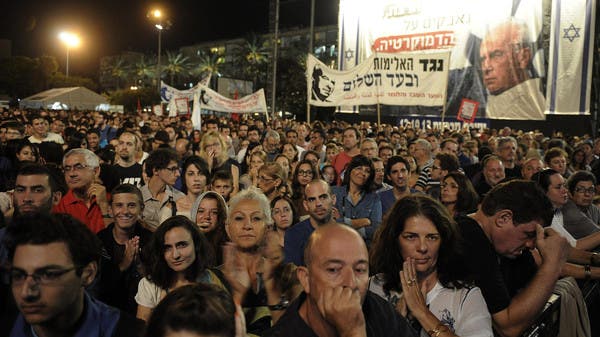
JERUSALEM, Israel-In honor of his life and peace-seeking mission, tens of thousands of Israelis gathered in Tel-Aviv to mourn the loss of Prime Minister Yitzhak Rabin, who was assassinated eighteen years ago.
Thousands of Israelis gather to mourn the assassination of former Prime Minister Yitzhak Rabin (photo courtesy of Al Arabiya)
The majority of the protestors were young people from a wide range of political ideals, coming together to protest against Israeli radicals who oppose peace with Palestine. Rabin was assassinated following a speech in the same square as the protest on November 4, 1995.
Portraits of Rabin and banners with slogans condemning racism and intolerance were waved as protestors held their vigilance. On banner, referring to the colloquially named “price tag” attacks on Palestinians by Jewish extremists, read “Stop the price tag, defend democracy.”
Yonatan Ben-Artzi, Rabin’s grandson, gave a peace talk at the rally saying, “For the first time in years, a special opportunity has been put in your path, to take advantage of a unique situation in order to bring peace and solve both the Iranian and Palestinian conflicts at the same time. All of this with support and encouragement from the international community.”
“This will not be easy, and certainly will not always be popular. But history shows that leaders’ [merits] are tested in unpopular times. I believe this is your time,” further stated Ben-Artzi.
Other speakers at the rally encompassed a wide range of Israeli society, including people who were close to Rabin and those who identified with movements opposing the Oslo Accords.
The current Prime Minister, Binyamin Netanyahu, was the leader of the opposition when Rabin was slain and harshly criticized the 1993 Oslo Accords, a land mark agreement aimed at resolving decades of old conflict, that Rabin signed with then-Palestinian leader Yasser Arafat.
Netanyahu participated in protests against Rabin and his government in the months prior to his murder. Many Israelis believe that Netanyahu played a role in inciting violence against Rabin and his followers.
“The years have passed. My pain remains but I am not here to blame you for what happened, Ben-Artzi told Netanyahu during his speech as he continued to stress the importance of finding peace and not spreading blame.
Organizers of the rally stated that this year’s purpose was to be a call for “a renewal of our basic obligations as a society—that we work and stand guard to strengthen the democracy of Israel.”
While no official estimate of the size of the crowd was given by police, reporters in attendance estimated there to be around 35,000 protestors, a larger number than recent years.
An official ceremony is to be held on Tuesday at the Jerusalem cemetery where Rabin is laid to rest.
MOSCOW, Russia – Reports demonstrate that Russian authorities waited until fights broke out before making arrests at a gay rights rally. Nevertheless, attacks on the Russian LGBT community remain high.
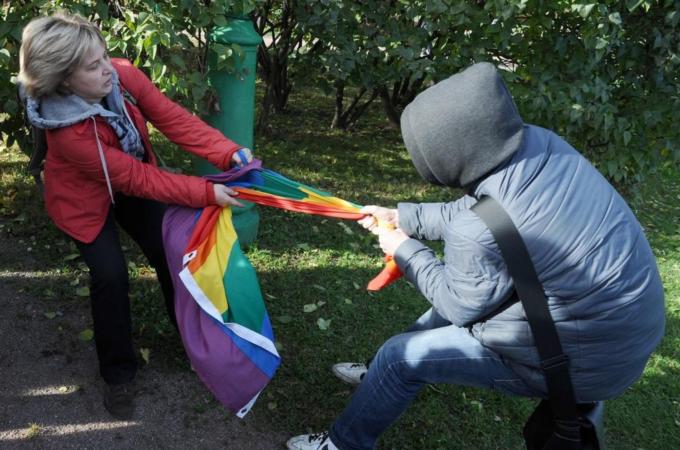
Fights broke out at the recent St. Petersburg gay rights rally when an opponent attempted to steal an activist’s rainbow flag. (Photo courtesy of Al Jazeera)
In June 2013, Russia’s law banning homosexual “propaganda” directed at minors sparked various protests by lesbian, gay, bisexual, and transgender (LGBT) rights campaigners, who claim the law diminishes homosexuals’ rights to free speech and assembly. In the light of international attention, activists have called for Winter Olympics participants and sponsors to boycott the Sochi games next year as a form of protest.
For clarification, the International Olympics Committee requested more information on the law and its effects on the Winter Olympics. President Putin has prohibited all demonstrations and rallies for 10 weeks around the games.
In September 2013, police broke up a gay rights protest outside the Winter Olympics headquarters in Moscow.
On 12 October 2013, gay rights activists planned a rally in St. Petersburg at the “Field of Mars”, which allows demonstrations without special sanctions. However, nearly 200 opponents of gay rights arrived earlier than the scheduled rally time, dressed as Cossacks and Orthodox priests.
Many opponents sang hymns and recited prayers. Although heavily outnumbered by opponents, several dozen LGBT rights activists had gathered to celebrate “International Coming Out Day”.
The fights began when an anti-gay demonstrator tore a rainbow flag from a woman’s hands. Immediately, the police rushed in to arrest fighters. Russian authorities arrested 67 participants in fights between gay rights activists and opponents.
Despite Russia’s prohibition on homosexual “propaganda”, St. Petersburg sanctioned the rally.
While homosexuality has been legal in Russia since 1993 and un-labeled as a “mental illness” since 1999, reported attacks against homosexuals have increased sharply. Some attacks involve gay men being lured into meeting people who then attack them. Additionally, homophobia has been suspected in several homicides.
Recently, one group of anti-LGBT campaigners, “Occupy-Pedofilyay” began posting “sinister” videos online of teenagers it suspects of being gay.
Nikolai Alexeyev, the leader of LGBT-rights group Gay Russia, said that despite their frequency, attacks on homosexuals are almost never investigated as hate crimes. “Homophobic hysteria is being increasingly promoted in Russia.”
Citing to recent attacks on homosexuals, the United States Congress sent the U.S. Olympic Committee a letter requesting assurances of safety for athletes and spectators.
Unlike countries in which large portions of the population have come out in support of the LGBT community, with a large outcry against homosexuality, news from Russia suggests the June 2013 law will be difficult to overcome.
By Thomas Murphy
Impunity Watch Reporter, Middle East
DAMASCUS, Syria – The Human Rights Watch has issued a report that alleges Syrian rebels killed 190 civilians and took 200 hostages during a single offensive in August. The particular offensive occurred on August 4th in the Latakia province, which is home to many Alawites, a minority sect that supports President Bashar al-Assad.
The inside of a local Latakia house after the 4 August rebel attack. (Photo Courtesy of Human Rights Watch)
The attack began in the dawn hours and targeted more than a dozen villages. The report cites evidence, which includes video footage, that demonstrates the rebels attacked with a strategy focused on killing civilian men and keeping their women and children as hostages.
“Eight survivors and witnesses described how opposition forces executed residents and opened fire on civilians, sometimes killing or attempting to kill entire families who were either in their homes unarmed or fleeing from the attack, and at other times killing adult male family members, and holding the female relatives and children hostage,” the report says.
Joe Stork, acting Middle East director at HRW, said the abuses were “not the actions of rogue fighters.”
“This operation was a co-ordinated, planned attack on the civilian population in these Alawite villages,” he said.
The report states that out of the 190 dead civilians at least 67 were executed or unlawfully killed. For example, a video posted online by the rebels shows a fighter leading a peaceful woman in good health out of her house, yet she was found buried days later.
Additionally, two rebel groups are still holding over 200 hostages from the attack according to opposition sources. While negotiations for their release are ongoing, Human Rights Watch has called for their release and demanded that they be treated humanely.
In conducting the report, Human Rights Watch interviewed more than 35 people, including survivors, emergency responders, and fighters on both sides. Further, the group completed an on-site investigation, documenting the destruction caused by the attack. The group also received medical reports for several victims that were consistent with execution.
The report “strongly suggests that the killings, hostage taking, and other abuses committed by opposition forces on and after August 4 rise to the level of crimes against humanity.”
By Kathryn Maureen Ryan Impunity Watch Reporter, Middle East
CAIRO, Egypt – Speaking shortly after arriving in Malaysia, United States Secretary of State John Kerry addressed the United States’ cut in military aid to Egypt. According to Secretary Kerry, the Obama Administrations decision to suspend shipments of large-scale military systems, as well as suspend $260 million dollars in military aid to Egypt Wednesday, was made in response to the behaviour of Egypt’s rulers.
U.S. Secretary of State John Kerry arriving at the Royal Malaysian Air Force base in Subang, outside Kuala Lumpur. (Photo Courtesy of USA Today)
Secretary Kerry said the United States will consider restoring its aid, which amounts to approximately $1.5 billion to Egypt “on the basis of performance” that encourages democracy through elections.
Kerry said the suspension of a portion of the country’s military aid to Egypt does not signal a severing of ties between Washington D.C. and the military-backed government in Cairo over the ousting of democratically elected President Mohamed Morsy on July 3. Kerry said, “The interim government understands very well our commitment to the success of this government… and by no means is this a withdrawal from our relationship or a severing of our serious commitment to helping the government.”
Since Wednesday, the Egyptian government has slammed the Obama administration’s move to cut aid. Egypt’s Ministry of Foreign Affairs, Badr Abdel Atty, said Thursday, “It raises serious questions about U.S. readiness to provide stable, strategic support to Egyptian security programs amid threats and terrorism challenges it has been facing.”
The State Department announced its decision to freeze $260 million of the United States’ $1.5 billion annual aid package to Egypt is an attempt to pressure the Egypt’s military regime to restore democratic rule as soon as possible.
The United States will maintain aid to support for health and education and counterterrorism, spare military parts, military training and education, border security and security assistance in the Sinai Peninsula.
Israel Finance Minister Yair Lapid said that the Administration’s suspension of aid to Egypt should be adjusted to maintain Egypt’s commitment to maintain peace with Israel and counties to combat terrorism in the region.
Eric Trager of the Washington Institute for Near East Policy said the administration’s cut to military aid was poorly timed. He argued it sends the wrong message to the Egyptian people. He said, “Cutting aid to Egypt at this moment sends the signal that America doesn’t have Egypt’s back when it’s facing significant challenges.” Trager argued that many Egyptians say the Muslim Brotherhood and the Morsy regime as an emerging fascist dictatorship. However, the administrations cut to aid comes as a direct response to the continued violence that has plagued the nation since the military government began cracking down on Muslim Brotherhood supporters.