Palestinians Express Frustration with Progress of Peace Talks with Israel

By Kathryn Maureen Ryan
Impunity Watch, Middle East

RAMALLAH, West Bank — A Palestinian official told the Associated Press on Wednesday that the Palestinian Authority is frustrated with the progress made so far in its peace talks with Israel, which has proposed to maintain dozens of Jewish Settlement within the West Bank intact and allow the Jewish state to maintain its military bases in the Palestinian territory.

Police arrested fifteen demonstrators at al-Aqsa mosque in East Jerusalem. (Photo courtesy of Al Jazeera)

The Palestinian official argued that “Israel is using the issue of security to take land. From the general discussions we had in the last couple of weeks, the Israelis have shown no intention to dismantle any settlement.” He argued that the current proposals indicated that Israel would seek to retain control over about 40% of the West Bank, much more than the 2008 proposal made under Prime Minister Ehud Olmert. In those talks Israel offered a complete withdrawal from roughly 94% of the West Bank, and offered a “land swap” for the remaining 6%.

In a statement made for Rosh Hashanah, the Jewish New Year, which began Wednesday evening, Israeli Prime Minister Benjamin Netanyahu expressed his hope that the ongoing peace talks will be successful. Netanyahu said, “We want a real, genuine and enduring peace and this must be anchored in recognition of Israel as a Jewish state and in our security. This is what ultimately is needed.”

However, Yasser Abed Rabbo, a top aide to Palestinian President Mahmoud Abbas, expressed frustration with the talks in an interview for the Voice of Palestine radio station. He said, “Until now, there are no signs of progress. The Israeli position has not changed. It’s the one that we know on the ground, through daily settlement expansion.” Rabbo said the United States must put pressure on Israel to end the expansion of settlements; he said that without this, “there will be no progress.”

The frustration felt by Palestinians over the progress of the talks so far has resulted in demonstrations in Jerusalem’s Old city, which have led to clashes with police.

On Wednesday, Israeli police arrested seven Palestinian demonstrators in Jerusalem’s Old City after the protesters allegedly threw stones at police officers. Israeli security forces had increased their presence in the area for Rosh Hashanah.

Micky Rosenfeld, a police spokesman, said the clashes erupted after about 300 Palestinian demonstrators attempted to block worshipers from reaching the Temple Mount compound. The site is considered holy to both Jewish and Muslim worshipers. Temple Mount is the holiest site in Judaism. The compound is known to Muslims as the “Noble Sanctuary,” it is Islam’s third-holiest site. The demonstrators were masked and began to throw stones at visitors which prompted police forces to move in.

On Wednesday, the protesters sought refuge from security forces inside Al Aqsa Mosque. The security forces did not enter the mosque that day and no one was injured. However, on Friday Israeli police fired stun grenades to disperse Palestinian worshipers who allegedly threw rocks at police after Friday prayers at the Al Aqsa Mosque compound. According Rosenfeld, two Israeli policemen suffered minor injuries during the incident.

For more information, please see:

Al Jazeera –  Israeli Forces Surround Al-Aqsa Mosque – 6 September 2013

Al Jazeera –  Israeli Police Clash with Palestinians – 6 September 2013

Reuters – Israeli Police, Palestinians Clash At Jerusalem Holy Site – 6 September 2013

 Boston Harold – AP EXCLUSIVE: Israeli Proposal Detailed In Talks – 4 September 2013

Washington Post – AP EXCLUSIVE: Palestinian Says Israeli Peace Talk Offer Sees Settlements, Bases in West Bank – 4 September 2013

Indonesian Soldiers Jailed for Revenge Killing

By Kevin M. Mathewson
Impunity Watch Reporter, Asia

YOGYAKARTA, Indonesia — An Indonesian military tribunal Thursday jailed eight Special Forces soldiers after they were found guilty of premeditated murder and assisting pre-mediated murder.  In March the soldiers stormed a prison near Yogyakarta and murdered four inmates accused of murdering their superior officer in a nightclub brawl.

The three ringleaders have said they will appeal against the verdict. (Photo courtesy of BBC News)

Second Sergeant Sugeng Sumariyanto and First Corporal Kodik were sentenced to eight and six years, respectively. Second Sergeant Ucok Tampubolon, the soldier who pulled the trigger, was sentenced to eleven years.

Lawyers for the three solider said they will appeal against their convictions and argued there is no evidence that the crime was planned.

President Judge Joko Sasmito said the men have tarnished the army’s honor with their actions. The case has been followed closely in Indonesia where human rights groups say the army is notorious for acting with impunity.

“The defendants actions cost the lives of four people, caused grief to the victims’ families and traumatised  [sic] many people, including the prisoners.” Chief judge Lieutenant Colonel Joko Samito said.

Five other soldiers were found guilty of assisting pre-mediated murder after they destroyed CCTV footage inside the prison where the murders took place.  They were subsequently sentenced to one year and nine months in jail each.

The revenge killings have sparked a public outcry after they have evoked memories of the three decade dictatorship of Suharto, when the army often acted without consequence.

Indonesian Human Rights Monitor executive director Poengky Indart, criticized the sentences as not harsh enough. Indart said the case should have been tried by a civilian’s court, where the soldiers would have likely received longer punishments.

“The military tribunal is a nest of impunity. We must revise current laws so military personnel can be tried in civilian courts.” Indart stated.

The case, however, has exposed deep divisions in the young democracy, with some supporting the soldiers for acting decisively against criminals, saying it was a stark contrast to the weak civilian courts and police.

As the soldiers waited to hear their fate, scores of supporters in paramilitary uniforms rallied outside the court in Yogyakarta.

For further information, please see:

Australia Network News – Indonesian Kopassus special forces soldiers to appeal against convictions for deadly raid on Cebongan prison – 6 September 2013

BBC News – Indonesia jails eight soldiers over Yogyakarta prison killings – 5 September 2013

MSN News – Indonesian elite soldiers jailed over prison murders – 5 September 2013

Voice of America – Indonesian Soldiers Sentenced for Prison Murders – 5 September 2013

Straits Times – Indonesia jails 4 more elite soldiers over prison revenge killings – 5 September 2013

US Diplomats Ordered to Leave Lebanon

By Brandon Cottrell 
Impunity Watch Reporter, North America

WASHINGTON, D.C., United States – Amid concerns that the allies of the Syrian government could possibly strike American targets, the U.S. State Department ordered that all nonessential diplomats and their families leave Lebanon.  The State Department also suggested that diplomats at the American Consulate in southern Turkey leave the area.

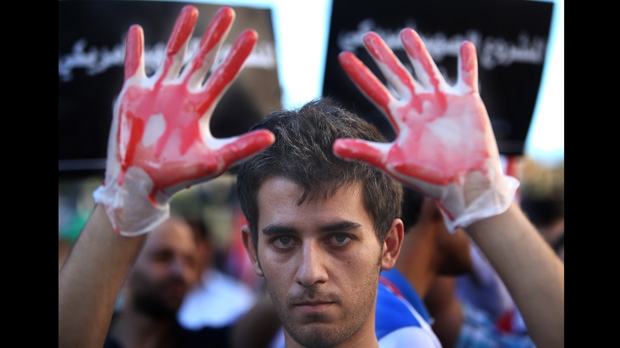
A Lebanese protestor, with hands painted red, at a demonstration against a U.S. strike against Syria, near the US Embassy. (Photo Courtesy CP24)

Additionally, the State Department issued travel warnings, urging Americans to avoid Pakistan, Turkey, and Lebanon.  These warnings and orders come less than a month after the U.S. closed nineteen embassies and consulates across Africa and the Middle East for a week because of terror threats.

Earlier this week, the State Department also issued a warning that urged Americans to avoid Iraq, as terrorist activity and violence “are at levels unseen since 2008.”  Consequentially, there is a high risk that Americans in Iraq could be kidnapped or subject to terrorist violence.  It has also been reported that the United States intercepted a message sent from Iran to militants in Iraq with instructions to attack U.S. interests in Baghdad if the U.S. launches a strike in Syria.

Though the State Department stated that the warnings were issued only “because of current safety and security concerns,” most believe that the warning reflects a growing concern that Syrian allies will either carry out or support terrorist attacks on the United States.

Hezbollah, a Syrian ally and Iranian supported group, is based in Lebanon and maintains a strong presence in Beirut.  Not only has Hezbollah sent fighters into Syria, but they are also involved in sporadic violence in many areas of Lebanon.

Acknowledging the threat Hezbollah creates, the US Embassy Beirut issued the following statement, “The potential in Lebanon for a spontaneous upsurge in violence remains.  Lebanese government authorities are not able to guarantee protection for citizens or visitors . . . should violence erupt suddenly. Access [out of Lebanon] can be interrupted with little or no warning [and] public demonstrations occur frequently with little warning and have the potential to become violent.”

As if on cue, shortly after the State Department issued its warnings and orders, 150 protestors gathered near the U.S. Embassy Beirut.  The protestors carried signs that read “No to War” and painted their hands red to symbolize blood.  With police in riot gear standing guard the protest remained peaceful.

Secretary of State John Kerry has since left for Europe, where he will confer with leaders from France, Britain and the Arab League to discuss current Middle East issues.


For further information, please see:

ABC – US Orders Diplomats Out Of Lebanon – 6 September 2013

CNBC – US Orders Nonessential Diplomats Out Of Lebanon – 6 September 2013

KY3 – U.S. Tightens Embassy Security In Lebanon And Turkey, Warns Americans – 6 September 2013

New York Times – U.S. Orders Nonessential Diplomats to Leave Lebanon – 6 September 2013

Central African Republic Moves to Disarm Rebel Fighters

By Erica Smith
Impunity Watch Reporter, Africa

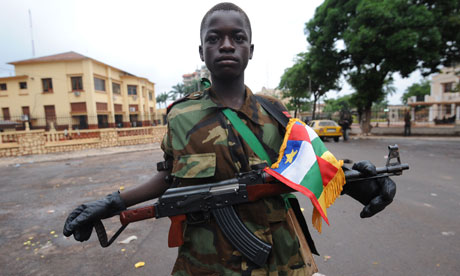
BANGUI, Central African Republic — As violence in the Central African Republic (CAR) mounts the government announced Wednesday that it will launch a campaign to disarm Seleka rebel fighters who overthrew the president in March.

A young Seleka rebel in front of the presidential palace after the March Coup ( Photo courtesy of Sia Kambou/AFP/Getty Images)

Minister of Public Security Jose Binoua announced the campaign in response to the growing concern over a surge in robberies, rapes, and murders throughout  the country. The campaign will focus on the capital Bangui around six designated military barracks where Seleka fighters will be given a location to hand in their weapons.  The city limits will be closed to cars for the duration of the program which is expected to last ten days.

The campaign is being carried out by the police in conjunction with Seleka leaders and the CAR military. A previous two month disarmament campaign led by the African regional force FOMAC had little success in decreasing the number of weapons in the streets.

There is a growing fear the the CAR will become a failed state. Prof. Emmanuel Yenshu Vubo, a political science lecturer at the University of Buea, Cameroon, told the Cameroon Tribune that the situation in the CAR is “a result of long standing instability in the country and the tacit understanding among Central African Republic elite that the force of arms can be a mode of getting to power. We can add the fact that the major international actors have been either accomplices or have actively supported the situation.” Yenshu Vubo went on to explain that the history of the CAR is one marked with continual military takeovers and the present leaders are unequipped to deal with the humanitarian problems the country now faces.

Even as the security situation in the country deteriorates the UN food agency is scaling up its operations to ensure that displaced persons will have food.  Humanitarian agencies are increasingly becoming a target for looting. There is also a concern that food and supplies will be harder to get into the country since Cameroon has closed its border with CAR after Seleka rebels attacked and killed a border guard.

For further information, please see:

All Africa — Central African Republic: Govt Moves to Disarm Rebel Fighters, Halt Violence — 4 September 2013

All Africa — Central African Republic: Tell-Tale Signs of Breakdown — 2 September 2013

All Africa — Central African Republic: ‘CAR Has Never Known Political Consensus’ — 2 September 2013

UN News Centre — Central African Republic: UN food relief agency scaling-up operations despite deteriorating security — 30 August 2013

Russia Plans to Discuss Removal of Children from LGBT Parents

By Ben Kopp
Impunity Watch Reporter, Europe

MOSCOW, Russia – Russian lawmakers will soon discuss a bill to remove children from homosexual parents. Among other issues, world leaders plan to express their concerns about Russia’s policy at the G20 summit in St. Petersburg.

Protesters demonstrate in over 33 cities upon hearing of Russia’s plan to remove children from homosexual parents. (Photo courtesy of the Moscow Times)

In June 2013, Duma Deputy Yelena Mizurina proposed both the “Gay Propaganda to Minors” bill—now law—and the idea of revoking parental rights from homosexuals.

Currently, under Russian law, sufficient grounds to revoke parental rights include alcoholism, drug addiction, and “premeditated crime against a child’s life.” If made law, the bill adds to such grounds the “fact of non-traditional sexual orientation.” Parental rights could be terminated whether one or both parents are homosexual.

With reference to the June 2013 law, Deputy Alexei Zhuravlev of Putin’s United Russia Party stated that homosexual “propaganda” must be prohibited in the public and “also in the family.”

In the bill, Russian lawmakers cited Mark Regnerus, an Associate Professor of Sociology at the University of Texas—Austin, who conducted a controversial study claiming that “gay parenting” results in psychological problems for children. Although the entire theory has been declared invalid by the American Sociological Association, Zhuravlev said, “The harm that could be inflicted on a child’s mental health if their parents are homosexual is immense.”

Head of the Kremlin’s Human Rights Council Mikhail Fedotov responded to the new bill, asking, “Will we deprive left-handed people of their driver’s licenses now too? They’re left-handed, you know, and all our vehicles have the steering wheel on the left side, so it’s harder for a left-handed person to drive.”

This law will create “unwanted tensions between Russia and the West”, predicted Leading LGBT activist Nikolai Alekseyev. “I cannot imagine how this initiative can be taken in the Duma. It is just another populist campaign [by Zhuravlev] to attract attention to himself. I don’t believe that such a law could possibly be signed by the President.”

While Putin attempted to cite Russia’s love for composer Pyotr Tchaiskovsky as proof that Russia appreciates its LGBT community, activists assert that fellow Russians are turning homosexuals into scapegoats for problems ranging from low birth rates to an HIV epidemic.

In anticipation of the G20 summit in St. Petersburg, activists held protests in over 33 cities.

On the importance of challenging Russia’s anti-homosexual laws, British Foreign Secretary William Hague said, “Britain cannot have a foreign policy without a conscience and I don’t believe it is ultimately in the nature of British people to act without a conscience.”

Without children in a household to be orphaned upon their parents’ arrest or disappearance, Russia’s new law enables the country to take the next step in removing rights from its LGBT community.

For further information, please see:

The Moscow Times – Gays’ Kids Could Be Taken by State under Proposed Bill – September 6, 2013

Euronews – Draft Bill Could See Russian Parents Lose Custody of a Child – Because They’re Gay – September 5, 2013

Irish Times – Russian Duma to Debate Bill That Would Remove Parental Rights of Gay People – September 5, 2013

Washington Post – Russian Lawmaker Proposes Bill That Would Deny Gay Parents Custody over Children – September 5, 2013

The Independent – Tchaikovsky Was Gay But Russians Love Him, Says Vladimir Putin as David Cameron to Raise Concerns over Russia’s Controversial Policies – September 4, 2013