Council of Europe’s Committee Approves Magnitsky Murder Report Despite Fierce Opposition from the Russian Delegation

Press Release
For Immediate Distribution

4 September 2013 – Today, the Legal Affairs and Human Rights Committee of the Parliamentary Assembly of the Council of Europe has approved the reportentitled “Refusing Impunity for the Killers of Sergei Magnitsky” (http://www.assembly.coe.int/Communication/20130904_ImpunityMagnitsky_EN.pdf). The report and a draft Resolution prepared by Rapporteur Andreas Gross, Swiss MP and member of the Socialist Group, were approved by all Committee members, except for 6.

At the previous Committee meeting on 25 June 2013 when the draft Magnitsky report was first released, the Committee agreed to give the Russian delegation more time and postponed the vote on the report until today’s meeting. Rapporteur Andreas Gross indicated that the information provided by the Russian officials during summer only confirmed his findings presented in June 2013 of a “massive cover-up” of the crime within the Russian government.

My initial conclusion, namely that we are in the presence of a massive cover-up […], finds itself further consolidated,” said Rapporteur Gross in the addendum to the Report discussed by the Committee today.

The draft Resolution “Refusing Impunity for the Killers of Sergei Magnitsky” is expected to be debated at the plenary session of the Parliamentary Assembly of the Council of Europe in January 2014.

The draft Resolution urges, in particular, to “close the posthumous trial against Mr Magnitsky and cease putting pressure on his mother and his widow to participate in these proceedings.”

The draft Resolution highlights the fact that in addition to the posthumous attack on Mr Magnitsky, other lawyers defending Hermitage against the same fraud Magnitsky had uncovered, remain under attack with criminal proceedings, and calls “to cease the persecution of other lawyers acting for the true owners of the fraudulently reregistered companies.”

The draft Resolution highlights how Sergei Magnitsky was beaten before his death and denied medical care, and calls to investigate the “possible criminal responsibility of all officials” and “hold to account for their acts and omissions all those who share in the responsibility for Mr Magnitsky’s death, in particular those who ordered his frequent moves between prisons and cells, with ever-deteriorating conditions of detention, failure to provide necessary medical treatment, and, just before his death at Matrosskaya Tishina prison, the beatings and the manner in which Mr Magnitsky was left alone in a cell in apparently critical condition.

Addendum to the Report “Refusing Impunity for the Killers of Sergei Magnitsky”:

http://www.assembly.coe.int/Communication/20130904_ImpunityMagnitskyAdd_EN.pdf

See a press release by the PACE on the adoption of the “Refusing Impunity for the Killers of Sergei Magnitsky” report:

http://www.assembly.coe.int/ASP/NewsManager/EMB_NewsManagerView.asp?ID=8995

For further information, please see:

Law and Order in Russia


Senate Drafts Resolution for Military Intervention in Syria

by Michael Yoakum
Impunity Watch Reporter, North America

WASHINGTON, D.C., United States – President Obama stated Wednesday that the “red line” drawn against Syria came not from him but from international treaties and Congressional action. The President added that in deciding whether to intervene in Syria, the credibility of Congress and the international community is on the line.

President Obama called on Congress to maintain credibility by authorizing military force against key Assad military targets. (Photo courtesy of USA Today)

The President’s statements came hours after news that the Senate Foreign Intelligence Committee completed a draft of a bill that would authorize limited military force against Syria for 90 days.

The proposed legislation would ban the deployment of US troops in Syria except in the event of rescue missions.  Additionally, the White House would be required to send Congress a plan for diplomatic solutions within 30 of the start of military operations.

President Obama’s call for authorization of force by Congress has split the GOP membership of whether to support such a resolution.

Two top House Republicans, Speaker John Boehner and House Majority Leader Eric Cantor, pledged Tuesday to endorse the President’s call for military intervention.

The Washington Post reported that a hearing to mark up the resolution was delayed by news that Sen. John McCain opposed the draft.  Sen. McCain is one of the leading GOP voices on issues of national security.

Amidst this news, President Obama was asked Wednesday what he would do if Congress refuses to authorize the use of military force. The President responded “I believe that Congress will approve it.”

Russian Prime Minister Vladamir Putin warned the US and its allies against unilateral action in Syria. Putin said that acting without authorization from the UN Security Council “can only be interpreted as an aggression.”

Russia, a permanent member of the UN Security Council, is expected by analysts to oppose any resolution for UN intervention in Syria. However, the Prime Minister said Wednesday that Russia has not ruled out supporting a UN Security Council resolution authorizing force.

For more information, please see:

BBC News – Russia’s President Putin warns US over Syria action – 4 September 2013

CNN – Obama: Red line on Syria is the world’s, not his – 4 September 2013

NBC News – Russia’s Putin warns US against ‘aggression’ in Syria without UN approval – 4 September 2013

The Washington Post – Officials press lawmakers to approve Syria strike; Obama invokes Congress’s credibility – 4 September 2013

USA Today – Obama: Congress, world credibility on the line with Syria – 4 September 2013

DR Congo Man Receives 3-Year Sentence for Outspoken Comments

By: Danielle L. Gwozdz
Impunity Watch News Reporter, Africa 

KINSHASA, Democratic Republic of Congo – A member of parliament, Muhindo Nzangi, was sentenced to 3-years in prison over comments he made on a radio program.  Nzangi’s comments revolved around a political debate about the M23 rebel group.

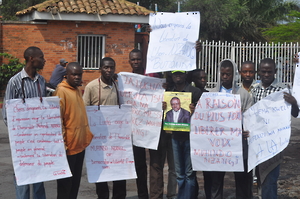
Protestors call for the release of Nzangi (photo courtesy of HRW)

Two days after speaking on the radio program, Nzangi was tried, convicted, and sentenced for endangering internal state security, revealing defense secrets, and insulting the president.

Because Nzangi was allegedly “caught in the act,” Nzangi was not protected by parliamentary immunity. His trial began immediately when he was flown to the capital, Kinshasa, and was denied the right to have adequate time to prepare a defense.

“A member of parliament was arrested, summarily tried and sent off to prison solely for expressing his views,” said Ida Sawyer, senior Africa researcher at Human Rights Watch. “This sadly is just the latest attempt by government officials to use the courts to silence dissent.”

Nzangi participated in a 2 ½ hour debate on Radio Kivu 1. They discussed the crisis concerning the M23, a Rwanda-backed rebel group active in North Kivu, and also discussed the role of civil society.

Nzangi stated that the Congolese people should call on the government to end talks with M23 rebels in Uganda and continue military operations against them. Further, he urged people to direct their pressure toward Congolese President Joseph Kabila as well as United Nations peacekeeping mission in Congo, by holding “peaceful actions,” such as marches and sit-ins.

In addition, Nzangi acknowledged the risk of demonstrations turning violent, but called for advanced measures to be taken to prevent and control risk.

Once the radio program ended, Nzangi told Human Rights Watch that someone called him and warned him that “The president is very upset with you. Flee if you can.”

One week after Nzangi was tried, convicted, and sentenced, police violently disrupted a peaceful sit-in by dozens of Nzangi supporters asking for the release of Nzangi. This sit-in occurred outside the North Kivu governor’s office in Goma.

The police brutally beat several protestors, arrested 4 protestors, and threatened protestors with rebellion charges. However, the 5 arrested protestors were released the next day.

Many believe that Nzangi’s arrest was politically motivated since Nzangi is a member of the Movement for Social Renewal (MSR), one of the largest political parties in the ruling presidential majority.

Human Rights Watch states that Congolese authorities should drop this questionable case against Nzangi and end the crackdown against his supporters. Further, it states that this prosecution reflects a broader government crackdown on free expression in the country.

Since May 2012, Human Rights Watch has documented 84 cases which politicians, political party activists, journalists, and human rights activists were arrested or threatened by the authorities because of their political views or published opinions.

International law provides that everyone convicted of a crime has a right to appeal their conviction to a higher tribunal.

“If President Kabila is serious about creating open dialogue, a first step should be to let politicians, journalists, activists and others say what they think without risking jail,” Sawyer said. “Everyone who is locked up for their peaceful political views should immediately be released and charges dropped.”

For further information, please visit:

Human Rights Watch – DR Congo: Outspoken Lawmaker Gets 3-Year Sentence – 29 August 2013
Africa Press Review – Democratic Republic of Congo – Outspoken lawmaker gets 3-year sentence in DRC – 30 August 2013
Ifex – Outspoken lawmaker gets 3-year sentence in DRC -30 August 2013
World News Inc. – DR Congo: Outspoken Lawmaker Gets 3-Year Sentence (HRW) – 29 August 2013
All Africa – Congo-Kinshasa: Outspoken Lawmaker Gets 3-Year Sentence – Freedom of Expression, Peaceful Assembly Under Attack – 29 August 2013
refworld – Democratic Republic of Congo: Outspoken Lawmaker Gets 3-Year Sentence – 29 August 2013
topix – DR Congo: Outspoken Lawmaker Gets 3-Year Sentence – 29 August 2013