
OTP Briefing: Prosecutor’s Mission to Côte d’Ivoire
[scribd id=163798422 key=key-lgsh2f3k6hbwpcm0m3d mode=scroll]
by Tony Iozzo
Impunity Watch Reporter, Europe
MOSCOW, Russia – Alexei Navalny was briefly detained by police on Sunday after holding a rally for his supporters in Sokolniki Park in Moscow.

Navalny, an opposition candidate in Moscow’s mayoral race, was arrested for alleged violations on the law of mass demonstrations.
A police spokesman stated that Navalny was “invited to a police department for a conversation in connection with violations” made during his rally.
Navalny, a starch opponent of President Vladimir Putin, is a notorious whistle-blowing blogger who gained fame in 2011 after leading a massive protest against President Putin during the winter of 2011. In a widely surprising move, Navalny was allowed to run for mayor after a court sentenced him to five years in prison last month for embezzlement charges that were believed to be politically motivated. Navalny was promptly released pending an appeal.
A YouTube video posted by Navalny’s campaigners shows two-dozen police officers sifting through the rally crowd, and Navalny can be heard telling the crowd to “go home” as he is escorted off the stage by officers. Navalny stated that he was taken to Northeastern Moscow in a police van and later released after an officer stated that “nobody detained him.”
About ten other individuals were also detained at the rally for “hooliganism” but were later released as well.
The Moscow Electoral Commission issued Navalny a verbal warning last Friday, accusing him of illegally distributing campaign literature. The Commission said it would soon discuss the violations of Navalny’s campaign.
His rival, incumbent mayor Sergey Sobyanin, is a pro- Kremlin politician who is considered the favorite to win the election next month.
“Opinion polls show that I have every chance to get into a second round and win. They will do everything to stop this scenario,” stated Navalny.
For more information, please see:
The Moscow Times – Navalny Briefly ‘Invited’ to Police Station After Rally – 26 August 2013
Al Jazeera – Russian Opposition Leader Briefly Detained – 25 August 2013
France 24 – Russian Opposition Leader Navalny Briefly Detained by Police – 25 August 2013
The Telegraph – Alexei Navalny Temporarily Detained After Campaign Rally in Moscow – 25 August 2013
By: Danielle L. Gwozdz
Impunity Watch News Reporter, Africa
ABUJA, Nigeria – More than 20 members of Nigerian vigilante groups have been killed by suspected Boko Haram fighters. These vigilante groups have been trying to fight back against Boko Haram in Borno, Nigeria. 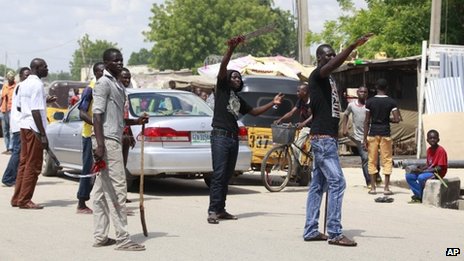
The deaths occurred on two separate attacks on Sunday and Monday, residents and military officials reported. These attacks have raised doubts about whether a military offensive against this group will succeed.
The military has been encouraging people to form vigilante groups to help it track down Boko Haram fighters as it pursues an offensive, attempting to end the Islamist extremists’ four-year insurgency.
In May, President Goodluck Jonathan declared an emergency in three north-eastern states, saying the group threatened Nigeria’s existence.
Now it seems that Boko Haram is taking revenge on these people who have formed these vigilante groups and observers have stated that they believe the groups may trigger the escalation of violence.
On Sunday, men disguised in military uniforms stormed a meeting of one vigilante group in Bama and opened firing, killing 14 people. Later, at a local hospital, it was reported that another 4 people died.
“They came in military uniform and pretended to be members of the JTF,” survivor Mallam Bakura Module said of the attack in Bama, referring to a security task force. “They asked after members of the vigilante group . . . but they opened fire on members of the group as we assembled for an address, killing 14 persons and injuring 10 others.”
The second attack took place on Monday night in the Borno village of Damasak, about 125 miles away.
Attackers crept up on sleeping members of the vigilante group, The Civilian Task Force, as they slept in a guesthouse and shot them dead.
Last week, gunmen had dressed as soldiers and opened fire on worshippers leaving a mosque in the village of Dumba, killing at least 35 people.
This fighting between Nigerian forces and Boko Haram has killed more than 3,600 people since 2009. Both sides have been accused of major abuses. Boko Haram claims it is fighting for the creation of an Islamic state.
Nigeria’s 160 million population is roughly divided between a mainly Christian south and mostly Muslim north.
For more information, please visit:
BBC News – ‘Boko Haram fighters’ kill vigilantes in Borno, Nigeria – 27 August 2013
The Voice of Russia – ‘Boko Haram gunmen’ kill 20 in Nigeria – 28 August 2013
Aljazeera – Dozens dead in Nigeria attacks – 27 August 2013
Reuters – Nigerian Islamists kill 14 vigilantes in Bama raid – 26 August 2013
Yahoo! News – Two suspected Boko Haram attacks kill 24 in Nigeria – 27 August 2013
International Criminal Court
Central African Republic & Uganda
Darfur, Sudan
Democratic Republic of Congo
Kenya
Libya
Cote d’Ivoire (Ivory Coast)
Africa
International Criminal Tribunal for Rwanda
Special Court for Sierra Leone
Europe
Court of Bosnia & Herzegovina, War Crimes Chamber
International Criminal Tribunal for the Former Yugoslavia
Domestic Prosecutions in the Former Yugoslavia
Middle East and Asia
Extraordinary Chambers in the Courts of Cambodia
Syria
Special Tribunal for Lebanon
Bangladesh International Crimes Tribunal
War Crimes Investigations in Burma
North and South America
United States
South & Central America
Columbia
Peru
Chile
Topics
Terrorism
Piracy
Gender-Based Violence
Reports
UN Reports
NGO Reports
Truth and Reconciliation Commissions
Nepal
Ivory Coast
Commentary and Perspectives
Worth Reading
Syrian Government’s forces targeted the delegation of the International UN committee investigating chemical weapons at the eastern entrance of Moadamiyet Al-Sham.
The UN committee investigating chemical weapons couldn’t enter the city of Moadamiyet Al-sham, because it has been targeted by a barrier known to all the residents of the region is located at the East entrance of Moadamiyet, and called Air Intelligence barrier in front of oil station known as military oil station, where security forces, militiamen, and Shabiha were stationed at this checkpoint. We do not have news of any casualties among the UN Commission of inquiry, although one of delegation’s car was affected by the attack.
After several attempts, the International Committee’s delegation was able to enter the city just shortly before.
UPDATE:
Inspectors entered and took samples from the patients and met with the families of the victims then returned to the hotel in Damascus .