This Week in Syria, Deeply: Monday, 12 August 2013
[scribd id=159784082 key=key-1eze2harmepyy17qj84c mode=scroll]
When the Syrian Government’s Troops and Shabiha attacked the Bayida village of Banyas and killed 244 residents, and cut children legs, the residents fled to the neighboring fields. No one thought to retreat to the neighboring Alawite villages, the same where the infamous massacre of the Ras Alnaaba neighborhood of Banyas occurred, where more than 227 residents were killed and families were forced to flee.
On the other side, on Sunday 4/8/2013(26 Ramadan), while Lattakia countryside battles intensified, the Syrian Islamic Liberation Front and Free Syrian Army initiated battles to liberate Syrian Army’s observatories: Anbatah, Tala, Baroda, Estrba, and Kafria. All these towns contain rocket launching stations.
Most of the youth in these villages, if not all of them, recruits for what is known as the National Defense Army and People’s Committees, which are assists in organizing Shabiha work. They are all armed fighters.
During clashes and continuous shelling from both sides, many women and children fled in the near villages of these observatories towards Latakia governorate, while others couldn’t because of the intensification of battles.
Specifically, in the nearby village, where the FSA existed, which was under fire, they couldn’t find their neighbors.
Tens of fleeing women and children from clashes from the following Alwite villages: down and upper Kafira, Bait Shaabor, Balotah, resorted to Wadi Shikhan and Dawrine Sunni villages.
A Clear example of national unity:
Om Ibrahim and the elder lady from Wadi Shikhan village, his big son Ibrahim who was working in KSA was arrested by Security forces when he came to visit his family two years ago. He was then killed under torture. Her husband Abo Ibrahim Trad was fired from his job because of the report he received from his Alwit friend. Their other sons joined FSA, and are from there:
Om Ibrahim received in her house the biggest number of displaced Alwite women and their children, she said literally: “Oh my mother they hurt their hearts, come and see them.”
The fleeing Alwite didn’t resort randomly, they went to specific people they knew from before the revolution, or by their friends.
According to SNHR documentation: There are no family members in Lattakia countryside of a victim , detainee, or whose house at least burned down or was destroyed by continuous shelling on their villages from a year and a half ago, but they kept their national unity.
It must be mentioned that during the regime attack on Hifa in August 2012, tens of Sunni families resorted to Mziraa and Manjila and Rodo Alwite villages.
This video shows a dialogue between an Alawite elder and the opposition fighter Abu Firas in the Astarba village located near the Salma area of Lattakia province after opposition forces managed to take its control. The old man is a resident of Ein Al-Jouzeh village and he was in Astarba at the moment it was taken under control by opposition fighters. The date is 6th of August 2013.
By: Danielle L. Gwozdz
Impunity Watch News Reporter, Africa
BANGUI, Central African Republic — UN Chief Ban Ki-moon says the Central African Republic (CAR) has suffered a “total breakdown of law and order” since rebels have seized power in March. It has been more than four months after rebels groups united to oust longtime president Franzois Bozize.
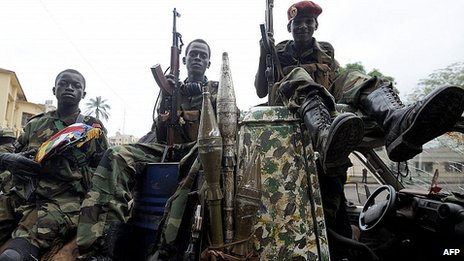
Michel Djotodia, the Seleka rebel leader, ousted president Franzois Bozize in March.
The Seleka rebels, also known as the “alliance,” make the law in CAR where coups and violent seizures of power have outnumbered fair elections four to one since independence.
Ki-moon has urged the UN Security Council to consider sanctions or to set up a panel of experts to monitor the situation.
A panel of UN observers have found that “the rule of law is almost non-existent” in CAR , the Fides News Service reports. The UN team have expressed concerns about “reports of killings, torture, arbitrary detention, violence against women, forced disappearances, acts of popular justice, as well as the general climate of insecurity and the absence of the rule of law established in the past 5 months.”
Church leaders in CAR have repeatedly warned others of the breakdown of law in CAR.
Armed groups in CAR have forced thousands to flee and pushed government and medical services close to collapse after these four months since rebels have seized the capital.
The UN and European Union humanitarianism chiefs told Reuters that “The country is in the grip of a humanitarian emergency while the international community looks on with indifference.”
In a report that UN Security Council will discuss on Wednesday, it stated that rebel infighting has led to widespread abuses. “They included arbitrary arrests and detention, sexual violence against women and children, torture, rape, targeted killings, recruitment of child soldiers and attacks, committed by uncontrolled Seleka elements and unidentified armed groups throughout the country,” the report said.
1.6 million people are now in urgent need of assistance including protection, food, water, health care, and shelter.
Mr. Ki-moon also said, “I call on the Security Council to consider appropriate options, including the adoption of sanctions or the establishment of a panel of experts, to ensure there is no impunity for perpetrators of gross human rights violations.”
In April, regional states agreed to send 2,000 peacekeepers to bolster a 500 strong multinational force that has been battling to help CAR government restore stability.
Although CAR has large deposits of minerals, including gold and diamonds, it still is an unstable and poor country.
For more information, please see:
msn news — Chaos in Central African Republic – 10 August 2013
Taipei Times — Central African Republic is ruled by chaos and living in crisis – 10 August 2013
Reuters — Central African Republic in chaos, abandoned: MSF – 9 July 2013
BBC News — Central African Republic in chaos, says UN chief Ban Ki-moon – 9 August 2013
CatholicCulture.org — Central African Republic in chaos, UN team finds – 7 August 2013
American Renaissance — Violent and Chaotic, Central African Republic Lurches Toward a Crisis – 7 August 2013
The New York Times – Violent and Chaotic, Central African Republic Lurches Toward a Crisis – 6 August 2013
By Ellis Cortez
Impunity Watch Reporter, South America
BRASILIA, Brazil – A jury has found 25 Brazilian police officers guilty of killing 52 inmates during the 1992 riot at Sao Paulo’s Carandiru prison. It was country’s bloodiest prison riot in which 111 prisoners died.

Judge Rodrigo Tellini de Aguirre Camargo sentenced those convicted to prison terms of 624 years each for their roles in what has been dubbed the Carandiru massacre. The officers, nine of whom are still on active duty, will also lose their jobs. Currently under Brazilian law there are no life sentences, and no convicted person can serve more than 30 years in jail. The officer’s attorney informed reporters that she would appeal the sentencing. The officers will be allowed to remain free pending the outcome of their appeal.
The lawyer for the officers, Ieda Ribeiro de Souza, argued they were only doing their duty and acted in self-defense, as many of the inmates were armed. She further stated that the fault lies with then Governor Luiz Antonio Fleury Filho, who oversaw security forces in the state.
“Who should be here is Dr. Fleury. He didn’t go [to Carandiru] himself” because he had political protection, said Ribeiro de Souza.
The riot, which began on October 2, 1992, was sparked by a fight between two rival gangs that started with a quarrel during a soccer game. It escalated into an uprising that quickly spread through the penitentiary, which was built to hold fewer than 4,000 inmates but was housing nearly 8,000. The riot went on for around three hours before more than 300 military police officers stormed the Carandiru prison. The officers gunned down more than 100 inmates within 30 minutes. No police officers were killed.
Autopsies showed the dead were riddled with an average of five bullets. The revolt ended in a massacre that exposed the harsh conditions of prisons in Brazil and it became an iconic example of how Brazil’s military police can sometimes kill with impunity.
Some survivors of the violence said police made little attempt to negotiate with the revolting prisoners. The officers entered firing, and continued to fire on prisoners who had surrendered or were hiding. Others said they hid among the scores of bodies, pretending to be dead, to avoid the gunfire.
The sentencing is the latest in a series of separate trials of police officers accused of executing inmates during the 1992 massacre. In April of this year, 23 officers were sentenced to prison terms of 156 years each for their part in killing 13 inmates during the same massacre. Another 31 officers will be tried in the coming months in connection with the slayings at the now-defunct prison.
Human rights groups have long decried conditions in Brazil’s prisons and the behavior of the military police. The Carandiru massacre gained special attention in Brazil because of its size and a popular 2003 movie.
For more information please see:
BBC – Brazil Carandiru jail massacre police guilty – 3 August 2013
Reuters – Brazil court sentences 25 police officers for prison massacre – 3 August 2013
Los Angeles Times – Brazil court sentences 25 police officers in 1992 prison massacre – 3 August 2013
The Wall Street Journal – Brazil Police Officers Found Guilty in 1992 Prison Massacre – 3 August 2013
Fox News – Jury finds 25 Brazilian police officers guilty of killing inmates in 1992 prison riot – 3 August 2013
By Brian Lanciault
Impunity Watch Reporter, Asia
COLOMBO, Sri Lanka — A mob of Buddhists attacked a mosque last night in Sri Lanka’s capital, injuring 12. This is the latest in a string of attacks against the minority Muslim community in the region.

A mob of Buddhists, who are mainly ethnic Sinhalese in Sri Lanka, threw stones at the three-story mosque and nearby houses in Colombo during evening prayers on Saturday. Hundreds of Muslim residents took to the streets, to prevent further attacks in their community.
“Support the police to maintain the law and order,” Inspector General of Police N.K. Ilangakoon told state media. There has been mounting violence against Muslims in Sri Lanka since last year, closely mirroring events in Buddhist-majority Myanmar, which has seen its own surge of attacks by members of the majority community against Muslims. In Myanmar, extremist Buddhist monks have been at the forefront of these violent campaigns against Muslims.
In Sri Lanka, the group Bodu Bala Sena (BBS), or the “Buddhist power force”, has been trying to win over Buddhists with their anti-Muslim platform. A spokesman for the BBS, Dilantha Vithanage, denied any involvement by his organisation in the latest mosque attack.
Buddhists make up about 70 percent of Sri Lanka’s 20.3 million population, while Muslims make up just 9 percent. The mosque damaged in the attack was only built a month ago after hardline Buddhists forced a nearby mosque to close.
The U.S. Embassy in Colombo said the incident was particularly troubling in light of a number of recent attacks against the Muslim community in Sri Lanka. “Targeting any place of worship should never be permitted and we urge calm from all sides. We call for prosecution of perpetrators in this attack and an end to religious-based violence,” the embassy said in its official statement. N M Ameen, president of Sri Lanka’s Muslim Council, said more than 20 mosques have been attacked since last year.
In a distinct incident, a hand grenade was thrown at a Buddhist temple in the Jaffna peninsula, on the northern tip of the island. There were no injuries reported. Jaffna is largely made of ethnic minority Tamil people, most of whom are Hindu and Christian. The area was fiercely contested in a 26-year war between government forces and Tamil separatists that ended in 2009. The longstanding unrest has left the entire region a powder keg for religious and ethnic tensions.
For more information, please see:
Reuters — Buddhist mob attacks Sri Lankan mosque, 12 injured — 11 August 2013
BBC — Sri Lanka Buddhist mob attacks Colombo mosque — 11 August 2013
Al Jazeera — Colombo mosque attack stirs tensions — 11 August 2013
Hindustan Times — Buddhist mob attacks Colombo mosque, 12 injured — 11 August 2013