Yemen Claims to Foil al-Queda Terror Plot; U.S. Drones Strike

By Thomas Murphy
Impunity Watch Reporter, Middle East

SANA’A, Yemen – On Wednesday, Yemen authorities claimed they had foiled multiple al-Queda terrorist plots aimed at blowing up oil pipelines, seizing oil and gas export facilities, and taking over two of the country’s main ports.

Security has tightened across Yemen since the U.S. issued warnings of a heightened risk of an al-Queda terrorist plot in the area. (Photo Courtesy of Reuters)

Rajeh Badi, a press adviser to Yemeni Prime Minister Mohammed Salem Basindwa, said, “The plot aimed to seize the al-Dabbah oil export terminal in Hadramout [province] and the Belhaf gas export facility, as well as the city of Mukalla,” referring to the Hadramout provincial capital.

Badi discussed specifics of the plan, stating that dozens of al-Qaeda members planned to dress in Yemeni army uniforms and seize the facilities on the twenty-seventh night of Ramadan, which was last Sunday.

Yemeni security forces have increased their presence in the country to protect likely terrorist targets. Hundreds of armored vehicles have been positioned around the capital city of Sana’a with tanks and troops surrounding foreign missions, government buildings, and the airport.

Since reports of the foiled terror-plots surfaced, U.S. drones have killed eight suspected militants over the past two days. Six were killed by a drone strike in the country’s southern province of Shabwa and two more in an attack in the eastern province of Hadramout. At least twenty-five suspected militants have been killed by U.S. drone attacks since July 28, but only one of the dead has been confirmed to be on Yemen’s twenty-five most-wanted terrorist list.

Despite the alleged foiled terror-plots, U.S. officials reiterated broad warnings of an increased risk of terrorist attacks in Yemen and the surrounding area. Yemen’s state news agency later cited government security officials that downplayed the alleged foiled plot and denied there had been a threat against oil facilities.

Recently, there have been complaints by U.S. officials that the Yemeni government is not doing enough to disrupt and eradicate Al-Queda in the Arabian Peninsula, otherwise known as AQAP. AQAP, believed to be behind the current terror warnings across the area, is considered to be one the most aggressive and well-organized al-Queda subdivisions.

For further information, please see:

Reuters – Drone strikes kill eight suspected militants in Yemen – 8 August 2013

Al Jazeera – Yemen: Plot to seize oil facilities foiled – 7 August 2013

BBC – Yemeni authorities ‘foil al-Queda plot to seize ports’ – 7 August 2013

New York Times – Yemen, on Alert for Terrorism, Says It Foiled a Queda Plot  – 7 August 2013

Wall Street Journal – Yemen Steps Back From Terror-Plot Claims, Highlighting U.S.’s Challenge – 7 August 2013

Obama Cancels Bi-Lateral Agenda Meeting with Russia

by Michael Yoakum
Impunity Watch Reporter, North America

WASHINGTON, D.C., United States – Following Russia’s decision to grant asylum to former NSA contractor Edward Snowden, President Obama announced that he will not be meeting with Russian Prime Minister Vladamir Putin at the upcoming G20 summit in St. Petersburg. The meeting, which aimed to set the two countries’ bi-lateral agenda, was set to take place in Moscow on the heels of the G20 summit.

President Obama remarked that he was “disappointed” with Russia’s decision to grant Snowden asylum instead of sending him home to face espionage charges. (Photo courtesy of TIME)

A White House statement cited “not enough recent progress in our bi-lateral agenda” as the reason for canceling the meeting. Gowever, the timing of the cancellation has led many news outlets to speculate that President Obama was “snubbing” Prime Minister Putin.

The Russian government’s reaction to this “snub” has been understated, with most domestic news outlets simply reporting that President Obama is coming to the G20 summit in St. Petersburg while not focusing on the now cancelled meeting in Moscow.

Foreign relations analysts predict that Obama’s “snub” could hurt US foreign efforts in China, Europe, and the Middle East, where Russia is a key player. Russia could be “a huge spoiler and also a major help [in these areas]” remarked Ariel Cohen, an expert on Russia from the Heritage Foundation.

Following President Obama’s announcement, Lon Snowden, father of Edward Snowden, had a lengthy interview with Reuters in which he reportedly said that Putin will not “cave” to political pressure from the United States. Snowden was more eager to remind Americans that the true story, the NSA mass surveillance program, was being obscured by the story of his son.

The fight isn’t in Russia,” Snowden observed. “The fight is right here. The fight is about these programs that undermine, infringe upon, violate our constitutional rights.”

Snowden has not seen his son since the former NSA contractor left the US, however, he plans to make a visit to Russia within the month.


For more information, please see:

TIME – How Obama’s Putin Snub Is Playing Out in Russia – 8 August 2012

Reuters – Putin will not ‘cave’ to Obama pressure: Snowden’s father – 7 August 2012

The Guardian – Edward Snowden: Obama criticises Russia for granting asylum – 7 August 2012

The Guardian – Obama cancels meeting with Putin over Snowden asylum tensions – 7 August 2012

USA Today – Obama snub won’t matter to Russia, analysts say – 7 August 2012


Thousands of War Crimes Documents from WWII Put Online

by Tony Iozzo
Impunity Watch Reporter, Europe

UNITED NATIONS – The International Criminal Court made over 2,200 documents of the United Nations War Crimes Commission available online in early July following an agreement with the United Nations.

The records include meeting minutes from the Commission. (Photo courtesy of The Himalayan Times).

The unrestricted records, which document thousands of cases against accused World War II criminals in Europe and Asia, are available to academics, researchers, lawyers and activists for the first time since the events themselves.

British academic Dan Plesch, who had been pushing for greater access to the archive for years, spurred the transfer of the documents to an online database.

Plesch, a researcher at the U.N. archive in New York, gave a guest lecture on the War Crimes Commission at the International Criminal Court in The Hague, Netherlands, in March 2012. Hans Bevers, the head of the prosecutor’s research office, told Plesch that the ICC might be interested in obtaining the archive and Plesch put him in touch with the U.N. office that manages the archives.

“Our goal is to make available as widely as possible open archives of the organization. The collaboration with ICC adds to the world’s permanent war crimes tribunal the historical record in international criminal justice,” said U.N. chief archivist Bridget Sisk.

The War Crimes Commission was established in October 1943 by 17 allied nations to issue lists of alleged war criminals and examine the charges against them and try to assure their arrest and trial.

U.N. spokesman Martin Nesirky said putting the unrestricted part of the archive online “will greatly enhance the availability of these materials to those engaged in research into the development of international criminal law, as well as to researchers from other academic disciplines.”

The International Criminal Court said more than 2,240 documents, totaling 22,184 pages, with search data for each document, have been added to the ICC Legal Tools Database.

The documents added to the archive relate to more than 10,000 cases.

“These files contain details of many charges of crimes that are not being prosecuted extensively today, including rape and forced prostitution, and crimes by ordinary soldiers,” Plesch said.

In 1949, the U.N. Secretariat drew up rules making the archive available only to governments on a confidential basis. In 1987, limited access was granted only to researchers and historians.

Plesch continues to seek access for researchers to the still- restricted sections of the files, which he said contain some 30,000 sets of pre-trial documents submitted to the commission by national and military tribunals to judge whether a given case should be pursued.

For more information, please see:

ABC News – Over 2,220 World War II Documents Now Online – 3 August 2013

The Himalayan Times – Over 2,200 World War II Documents Now Online – 3 August 2013

The Huffington Post – Over 2,200 World War II Documents Now Online – 3 August 2013

Military News – UN Puts 2,200 World War II Documents Online – 3 August 2013


Heightened Terrorist Activity and Security Threats Cause Evacuation in Yemen

By Darrin Simmons, 
Impunity Watch Reporter, Middle East

SANA’A, Yemen-Increased threats of terrorist activities have caused the evacuation of U.S. Citizens as well as other Western nations in Yemen.  Following an intercepted electronic message between al-Qaeda leaders, a total of twenty one embassies have closed down.

Police perform security checks on cars headed to the airport in Sana’a (photo courtesy of The Independent)

The U.S. State Department issued a statement saying: “U.S. citizens currently in Yemen should depart. As staff levels at the Embassy are restricted, our ability to assist U.S. citizens in an emergency and provide routine consular services remains limited…The security threat level in Yemen is extremely high.”

The statement also noted that attacks on the U.S. Embassy Compound in September 2012 and the death of a U.S. citizen in Taiz in March 2012 at the hands of al-Qaeda have caused additional reasons for concern.

Al-Qaeda in the Arabian Peninsula (AQAP), a highly sophisticated al-Qaeda affiliate, has been operating out of Yemen for many years, planning and attempting to carry out massive attacks on the U.S. both locally and overseas.  AQAP was behind the “underwear bomber” who attempted detonation of a bomb on a plane over Detroit in December 2009.

U.S. officials have claimed that it is unclear and there is still no information pertaining to a specific target or location of a potential attack.  However, the extroardinary and unprecedented security measures were put in place as the potential threat in Yemen has been classified  as one of the most serious threats since 9/11.

Approximately one hundred U.S. government personnel were evacuated and carried out by an US Air Force C-17 at dawn on Tuesday morning.  The personnel were headed for Ramstein air base in Germany with some essential embassy staff staying behind.

The heightened security measures have been implemented in the aftermath of a U.S. drone strike that hit central Yemen on Tuesday.  The drone strike killed four suspected al-Qaeda members hiding in Yemen with none being considered to be in high leadership positions.

George Little, the Pentagon Press Secretary stated that “the Defense Department continues to have personnel on the ground in Yemen to support the U.S. State Department and monitor the security situation.”

Yemeni Foreign Minister Abu Bakr al-Qirbi criticized the U.S. decision to evacuate saying, “Unfortunately, these measures, although they are taken to protect their citizens, in reality they serve the goals that the terrorist elements are seeking to achieve.”

“Yemen had taken these threats seriously and had taken all the necessary measures to protect all the foreign missions in the country,” claimed al-Qirbi.

The U.K. also evacuated its embassy staff and “strongly” urged British citizens to leave immediately.  “If you don’t leave the country now while commercial carriers are still flying it is extremely unlikely that the British government will be able to evacuate you or provide consular assistance,” said the U.K. government.

Former director of the National Counterterrorism Center, Michael Leiter, expressed his opinion that the activities in Yemen are “certainly nothing remotely close to the worst thing we have seen since 9/11.” However, he went on to say, “We have been wrong on stuff before.”

For more information, please see the following: 

Aljazeera – U.S. and U.K. urge citizens to leave Yemen – 6 August 2013

Guardian – Yemen security alert: US and British citizens told to leave  – 6 August 2013

Independent –  Yemen airlift: U.S. and U.K. fly staff out as al-Qa’ida terror threat level rises – 6 August 2013

NBC News – US personnel evacuated from Yemen; Americans urged to leave amid terror threat – 6 August 2013


Kenyan Hostages Freed by al-Shabab

By: Danielle L. Gwozdz
Impunity Watch News, Africa

MOGADISHU, Somalia – Two Kenyan hostages abducted by Somalia’s al-Shabab in January 2012 were released to their families on Thursday.

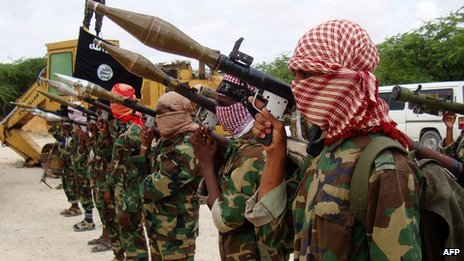
Al-Shabab still stages frequent attacks in Mogadishu (photo courtesy of AFP)

Yesse Mule and Fredrick Wainana were abducted from Gerille, Kenya by the al-Qaeda linked al-Shabab group.  They were seized three months after Kenya troops entered Somalia to fight al-Shabab.  They were moved to 19 different locations while being chained and blindfolded throughout the captivity.

Mr. Mule and Mr. Wainan, both government officials, were captured during an attack by about 100 al-Shabab fighters on a police camp in Gerille, a town on the Kenya-Somalia border.

“It was one of the worst moments. You are not sure about your life. You don’t know what will happen in the next second or minute.”  Mr. Mule told BBC.

Mr. Mule was the Wajir County district officer and Mr. Wainana a government clerk.  “We will continue to support them, including counselling them to ensure they get back to their normal life,” Interior Secretary Joseph ole Lenku told Capital News. “Once all that is done, we will post them to work at a station of their choice.”

Efforts to bring the two men back earlier had failed.  The militia stood their ground, however, demanding Muslim prisoners in Kenya be released.

While the two men were brought from location to location, Mr. Mule told BBC that at each location “Every room within a house is a cell. You are blindfolded and chained.  Both hands are padlocked to your legs.”

Kidnapping is a tactic used by militants to make a point or to publicize their activities.  Victims have been held captive for months or even years.  Some victims never make it back alive.  Al-Shabab has taken numerous foreign hostages throughout the years.

Kenya did not pay the ransom for the two men’s release.  Instead, al-Shabab handed them over to a group of traditional elders who negotiated their release.

The two men state they are not afraid to return to their jobs; however, the government has given them the option to transfer to a different region.


For more information, please visit:

Latin Business Today — Two Kenyan hostages released by al-Shabab — 2 August 2013

Metro News — Two Kenyan hostages released by al-Shabab — 2 August 2013

BBC News — Somalia’s al-Shabab frees Kenya’s Mule and Wainana — 1 August 2013

All Africa — Kenya: Al-Shabaab Releases Two Kenyan Hostages — 31 July 2013

Capital News — Kenyan officials abducted by Shabaab in 2012 freed — 30 July 2013