Judge Refuses to Dismiss “Aiding the Enemy” Charge Against Manning

by Michael Yoakum
Impunity Watch Reporter, North America

WASHINGTON, D.C., United States – A military judge Thursday denied a motion by Army Private First Class Bradley Manning’s attorneys to dismiss the key charge of “knowingly aiding the enemy.”  This charge is the most severe of the more than twenty charges levied against Pfc. Manning, who now faces a potential sentence of life in prison.

Pfc. Manning, 25, being escorted to his trial before Judge Colonel Denise Lind, who sits as judge and jury his case. (Photo courtesy of Associated Press)

Pfc. Manning made headlines in May 2010 when he was arrested in connection with the leaking of classified military to the information disclosure system WikiLeaks.

Pfc. Manning most notably provided a video, named “Collateral Murder” when it was released by WikiLeaks, which showed an American helicopter firing on a group of men in Baghdad which included two Reuters journalists.  “Collateral Murder” is widely viewed as the video that garnered WikiLeaks fame with free information supporters and infamy with national security proponents.

In the motion hearing Thursday, prosecutors presented evidence that information leaked by Pfc. Manning and posted on WikiLeaks ultimately ended up in computer networks owned by former Al-Qaeda leader Osama bin Laden.  The LA Times reported that Captain Angel Overgaard said in the hearing “[Pfc. Manning] knew exactly what he was doing in exposing that information.  The enemy was looking for this specific information.”

The Obama administration came under fire following Judge Col. Lind’s decision with many accusing the President of trying to deter whisteblowers.  Judge Col. Lind asked prosecutors on two separate occasions whether they would have prosecuted Pfc. Manning if he had leaked information to The Washington Post or the New York Times.  Prosecutors assured the Judge that they still would have prosecuted Pfc. Manning.

Many whisteblower advocates worry that Judge’s decision Thursday means that any classified information that ends up online could be met with charges of “aiding the enemy.” Ben Wizner, an attorney for the American Civil Liberties Union, told the Washington Post “By pressing forward with this dangerous and overbroad legal theory, the government has virtually ensured that any conviction of Manning will be vulnerable on appeal.”

Wizner went on to say that the “aiding the enemy” charge was designed to “transform what was widely seen around the world as a valuable leak into treason.”

For more information, please see:

BBC News – Wikileaks accused Bradley Manning loses challenge to most serious charge – 18 July 2013

CBS News – Judge won’t dismiss most serious charge against Bradley Manning in WikiLeaks case – 18 July 2013

LA Times – Bradley Manning must face aiding-enemy charge, military judge rules – 18 July 2013

The Guardian – Bradley Manning trial judge refuses to drop ‘aiding the enemy’ charge – 18 July 2013

The Washington Post – Judge in Bradley Manning trial declines to dismiss key charge – 18 July 2013

The Washington Post – Bradley Manning is at the center of the WikiLeaks controversy. But who is he? – 8 May 2011
Greek Parliament Approves Austerity Measure Despite Protests; Demonstrations Temporarily Banned Thursday in Athens

by Tony Iozzo
Impunity Watch Reporter, Europe

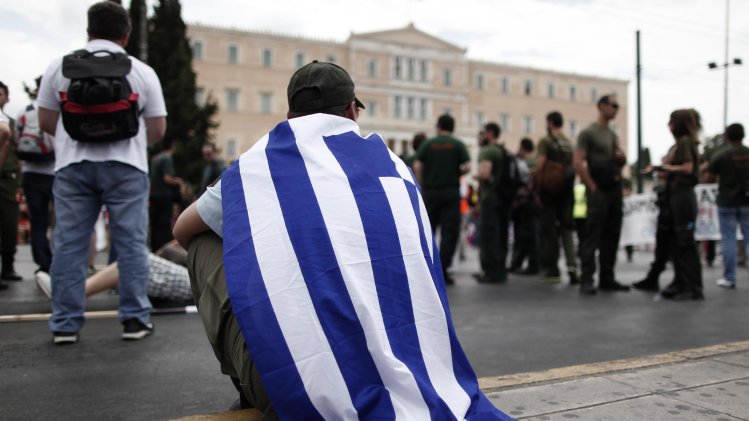
ATHENS, Greece – Greece’s Parliament passed an austerity measure bill on Wednesday despite rallying outside the building and a Tuesday strike that drew over 16,000 protestors on to the streets of Athens.

A Greek municipal worker carries a Greek flag draped over his back during a demonstration in Athens on Tuesday. (Photo courtesy of Yahoo News)

After a narrow vote of 153 to 140, the Greek Parliament passed the public sector reform bill which may cause thousands of civil servants to lose their jobs by 2014.

Under the newly-enacted bill, over 4,000 state employees will be dismissed from their posts this upcoming year; including teachers and municipal police officers. Another 25,000 workers will be placed into a “mobility pool” by the end of the year. Workers in the mobility pool will face decreased wages coupled with forced transfers or outright dismissals. In addition, the plan’s goal is to see an additional 15,000 workers cut from public payroll by the end of 2014.

Government employees have been occupying city buildings this week to protest the austerity measures. On Tuesday, thousands of public servants walked off their respective jobs to participate in a 24-hour strike, assembled by Greece’s two main labor unions.

“We will resist all those whose wrongheaded and dead-end choices have led the Greek people into poverty and wretchedness,” stated a spokesman from the labor union, Gsee.

Tuesday’s strike temporarily closed tax offices and governments services. Athens’ hospitals were reduced to emergency staff, and public transportation was suspended. Flights in and out of Athens were suspended from noon to 4:00 PM, as well. A police spokesman has stated that Tuesday’s gathering of over 16,000 protestors in Athens was “entirely peaceful.”

During Parliament’s vote on Wednesday, thousands of additional protestors gathered outside of the Parliament House, only to return home bitter and outraged.

The government, led by Prime Minister Antonis Samaras, has stated it has no choice but to adopt the budget cuts and enforce the measure. In order for Greece to secure the first installment of $9 billion in loans, the European Commission, the European Central Bank, and the International Monetary Fund mandated a showing that the Greek government is committed to fiscal change.

In response to the protests in Athens this week, Greek police have banned public protests in Athens on Thursday, while German Finance Minister Wolfgang Schaeuble is visiting the city.

Ban on Demonstrations

As Germany has been one of Greece’s biggest lenders in recent years, Schaeuble is one of the EU’s most outspoken advocates of tougher austerity measures in Greece.

But many feel that the complete city-ban on demonstrations is crossing the line.

“This action is fascist and undemocratic…” a spokesman for a Greek leftwing political party has stated.

The two labor unions responsible for Tuesday’s 16,000 person demonstration have stated they have no plans for an encore on Thursday.

For more information, please see:

Al Jazeera – Greece to Sack Thousands of Public Workers – 17 July 2013

BBC News – Greek MPs Back Public Sector Cuts Amid Protests – 17 July 2013

Ekathimerini – Greece Approves Scheme to Fire Thousands of Public Workers – 17 July 2013

Yahoo News – Greece Bans Protests During Schaeuble Visit – 17 July 2013

New York Times – Greece Hit by General Strike to Protest Austerity – 16 July 2013


U.S. Secretary of State John Kerry returns to the Middle East to discuss Israeli Palestinian peace

By Darrin Simmons
Impunity Watch Reporter, Middle East

AMMAN, Jordan – U.S. Secretary of State John Kerry made his sixth trip to the Middle East yesterday in order to resume peace talks between Israel and Palestine.  Since taking office on February 1st, Kerry has made it his mission to negotiate peace in the Middle East.

U.S. Secretary John Kerry discussing negotiations with Palestinian President Mahmoud Abbas (photo courtesy of Gulf Today)

It has been unofficially reported that countries represented at the peace negotiating meeting include Egypt, Lebanon, Jordan, Bahrain, Saudi Arabia, and Qatar.  Kerry met Palestinian President Mahmoud Abbas on Tuesday and today planned to meet Jordan’s King Abdullah II.

Jen Psaki, the U.S. State Department spokeswoman, said that Kerry scheduled the meetings to “provide an update on Middle East peace” and that “the Secretary would not be going back to the region if he did not feel there was an opportunity to keep making steps forward.”

Kerry has repeatedly stated that a point is nearing where Israeli and Palestinian officials will need “to make hard decisions about jump-starting the moribund peace talks.” The necessity of such a meeting is pressing as the United Nations General Assembly will address Palestinian statehood issues in September.

In June, Kerry spent nearly four days involved in extensive diplomacy working to end a three-year impasse between Israel and Palestine stating, “with a little more work, the start of final status negotiations could be within reach.”

Two advisers, Frank Lowenstein and Jonathan Schwartz, have been in the Middle East for the past couple of weeks to consult with both Israel and Palestine.  Remaining gaps to be resolved appear to be Israel’s failure to release Palestinian prisoners and refusal to agree to preconditions.

Kerry stated, “Through hard and deliberate, patient work, and most importantly through quiet work we have been able to narrow those gaps very significantly. We continue to get closer and I continue to remain hopeful that the sides will soon be able to come to sit at the same table.”

Palestine, who obtained “nonmember observer state” status in the U.N. last year, has made it clear that they will seek further recognition as a state and membership in the International Criminal Court if diplomatic progress is not made.

After the meeting, the Arab delegates issued a statement saying, “The Arab delegates believe Kerry’s ideas proposed to the committee today constitute a good ground and suitable environment for restarting the negotiations, especially the new and important political, economic and security elements.”

However, U.S. officials have reduced expectations that any sudden breakthrough or announcement on resuming direct Israel Palestine communication will occur as Kerry did not plan to visit Israel or Palestine on this trip.

For more information, please see the following: 

Aljazeera – Kerry to hold secret Middle East peace talks – July 17, 2013

Gulf Today – Kerry wins AL support for bid to restart ME peace talks – July 17, 2013

National – Kerry returns to Jordan for Mideast peace talks – July 17, 2013

New York Times – Kerry Returns to Middle East in Bid for Peace Talks – July 16, 2013

Egyptian Military Falls Short of Its Agreement to Allow Morsi Supporters to Peacefully Protest the Ousting of President Mohamed Morsi

By Kathryn Maureen Ryan
Impunity Watch Desk Reporter, Middle East

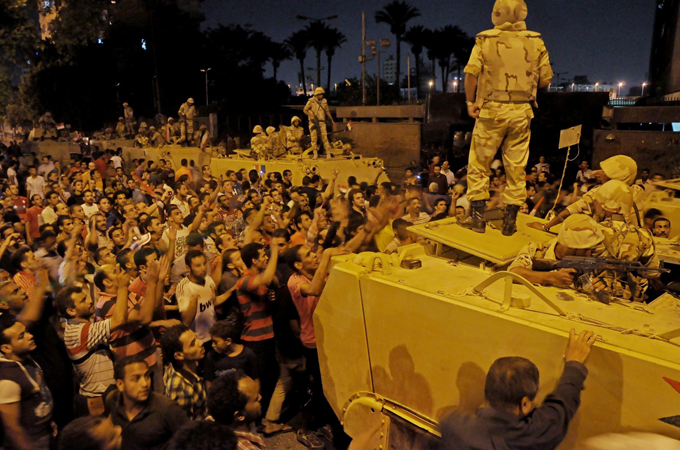
CAIRO, Egypt – Thousands of supporters of ousted President Mohamed Morsi have rallied in the streets of Cairo and across the country, largely following Friday prayers beginning on July 6. Prior to the breakout of pro-Morsi protests, the Egyptian military had said that it will guarantee supporters of the Muslim Brotherhood and the overthrown president the right to peacefully protest and the right to free expression. However, this announcement came as the military had been rounding up Muslim Brotherhood officials.

Egyptian military forces clash with protesters. (Photo courtesy of Al Jazeera)

Egyptian President Mohamed Morsi, the nation’s first democratically elected leader, was forcibly removed from office on Tuesday July 2. In the two weeks since his ouster, the streets of Egypt have been filled with both pro-Morsi and anti-Morsi protests. President Morsi’s removal from office followed days of mass protests, largely organized by the Tamarod [Rebel] movement. Protesters accused President Morsi and the Brotherhood of failing to address the country’s economic concerns, which were a catalyst to the 2011 revolution, as well as consolidating political power and supporting an overwhelmingly Islamist agenda without the support of the majority of the Egyptian people.

Egyptian judicial authorities have opened up and an investigation into accusations that former President Morsi and 15 other Islamists that had allegedly had insulted the judiciary. The investigating Judge Tharwat Hammad has imposed a travel banned on them all. Many of the senior leaders of the Muslim Brotherhood have been arrested are being held in Torah Prison in Cairo, the same prison housing deposed President Hosni Mubarak. Hundreds of Muslim Brotherhood officials have reportedly been arrested in since the coup.

While the ousting of Morsi was met with cheers of support from protesters in Tahrir Square and across Egypt, many of whom participated in the uprising that led to the resignation of Hosni Mubarak, the coup is a reminder of the historic power of the Egyptian military complex, which has at the heart of the Mubarak regime. The Coup has left many Egyptian holding their breath as Egypt’s future hangs in the balance.

The Military issued statements promising to allow for a peaceful transition to democracy after the establishment of a transitional government. Chief Justice Adly Mansour was sworn in as Egypt’s interim president, just hours after Mohamed Morsi was forced out of office in a military coup that occurred as a result of massive protests against his presidency.Under the transitional government, the nation’s constitution will be temporarily suspended, a “strong and competent” civilian Technocratic government will be installed though the transition processes and the Supreme Court is expected to pass a law setting standards for a parliamentary election and to prepare for both parliamentary and presidential elections.

Despite the military’s roundup of Muslim Brotherhood officials the interim president has promised to preserve the right to free expression in Egypt. He has said that the freedom to protest and to publicly express political beliefs is at the heart of the new Egypt, a right won on the streets of Cairo in 2011. However, in the weeks since that statement was made, Egyptian police forces have clashed on the streets with pro-Morsi demonstrators leaving several demonstrators dead, including seven protesters who were killed overnight in Cairo during a pro-Morsi rally that resulted in clashes with police forces. The killings came as US Deputy Secretary of State William Burns visited Egypt, marking the first time a high ranking US official to visit the region since the Coup.

For further information, please see:

Al Jazeera – Seven Dead in Cairo Clashes – 16 July 2013

CNN International – Deadly Clashes Strike Egypt as New Government Takes Shape – 16 July 2013

Al Jazeera – Living in Denial: US Policy & Egypt’s Military Coup – July 15, 2013

Al Jazeera – Pro-Morsi Supporters Stage Cairo Protest – 5 July 2013

Al Jazzera – Top Judge Sworn In as Egypt’s Interim President –5 July 2013

BBC – Egypt Army Permits ‘Peaceful Protest’ Amid Morsi Anger – 5 July 2013

CNN International – Morsy Supporters to Protest His Ouster, Arrests of His Allies – July 5, 2013

CNN International – Coup Highlights Egyptian’s Military Role – July 3, 2013

Ethnic Clashes Erupt in South Sudan’s Jonglei State

By Erica Smith 
Impunity Watch Reporter, Africa 

JUBA, South Sudan — Fresh clashes have erupted between rival tribes in South Sudan’s Jonglei state, South Sudanese officials said Thursday. Officials did not give information on the number of causalities. South Sudan army spokesman Col. Philip Aguer reported that the violence has erupted between the rival Lou Nuer and Murle tribes in Pibor county which is also hosting a military assault against a rebel group led by renegade colonel David Yau Yau.

South Sudan army troops (photo courtesy of UN News Centre

Col. Aguer said that the South Sudan army had not been given orders to intervene in the clashes because they are communal difficulties that should be handle by civilian authorities, such as the police. “If there are two communities fighting how do you separate them with firearms?” Aguer asked. “Since these are civilians fighting civilians we think it is the (civilian) authority that should come up with a decision.”

The United States Embassy in Juba was quick to condemned this line of reasoning and issued a statement calling on government and army leaders to urge armed youth to lay down their weapons. “We are deeply disappointed the SPLA did not establish a posture appropriate to defend civilians in vulnerable areas, despite advance warning of the mobilization of armed youth which has led to the current violence,” the statement said. “The lack of action to protect civilians constitutes an egregious abdication of responsibility by the SPLA and the civilian government.”

The United States Department of State further called on South Sudan to “…meet its obligation to ensure the safety and security of all civilians, and to protect and respect their universal human rights regardless of their background or ethnicity. The Government also has an obligation to hold accountable those individuals responsible for the violence and who have committed human rights abuses – including members of the security forces – through transparent judicial processes that respect the rule of law. We continue to encourage the parties to the conflict to implement the resolutions agreed at the All Jonglei Peace Conference, and to work toward peace, reconciliation, and tolerance.”

The United Nations Mission in South Sudan (UNMISS) also expressed deep concern about the reports of ethnic violence. “The mission calls on the leaders of all Jonglei communities and their youth, as well as on national and state authorities, to exercise maximum restraint and urgently engage in reconciliation efforts.” UNMIISS is trying to verify reports of violence and asses population movements through the use of aerial reconnaissance flights but their effectiveness is hampered by inadequate air assets.

South Sudan celebrated its second independence anniversary last Tuesday.


For further information, please see:

All Africa — South Sudan: Amid Reports of Fresh Clashes in Jonglei State, UN Mission Urges Restraint — 12 July 2013

Reuters — U.S. expresses ‘deep concern’ about South Sudan violence — 12 July 2013

Sudan Tribune — US condemns violent attacks in South Sudan’s Jonglei state — 12 July 2013

US Department of State — On-Going Violence in Jonglei State, South Sudan — 12 July 2013

Fox News — Fresh round of ethnic clashes erupt on South Sudan’s Jonglei state, death toll not known — 11 July 2013

Washington Post —Fresh round of ethnic clashes erupt in South Sudan’s Jonglei state, death toll not known — 11 July 2013