Human Ring around Bosnian Parliament Highlights Government Shortfalls

By Ben Kopp
Impunity Watch, Europe

SARAJEVO, Bosnia – On June 6, 2013, approximately 3000 protesters kept nearly 1500 lawmakers, government employees, and international bankers blocked inside Bosnia’s parliament building for fourteen hours. The protesters consisted primarily of students and young parents, who have been unable to get birth certificates or identification numbers for their babies since February 2013.

Undocumented babies increased due to delays in creating a new law. (Photo courtesy of WestPort News)

Dating back to the 1992-1995 war, ethnic divisions between Serbia and Bosnia heat the battle between a unified or divided country. Currently, Bosnia consists of two semi-autonomous mini-states, each with a president and parliamentary government. A joint parliament, government and a three-member presidency link the mini-states.

In early February 2013, an old law on identification numbers for Bosnian citizens lapsed. Disagreements among ethnic communities have delayed the creation of a new law, leaving undocumented babies born since the lapse. While Bosnian Serbs seek an identification system that reflects territorial agreements established after the war, Bosniaks and Croats seek a solution that unifies the country.

Recently, a baby in need of stem cell treatment in Germany could not leave Bosnia because she had no documentation. On June 5, young parents protested and trapped lawmakers inside parliament. Although the government reached an interim deal, protesters claimed that they would continue for as long as necessary to reach a long-term agreement. Every hour, more people joined the blockade. On June 6, thousands of protesters formed a ring around parliament, encouraged by protests in other Bosnian cities.

As parliament employees attempted to escape the building through windows, protesters shouted, “Get back to work!” before sending them back inside.

Tarik Celik said, “This is not just about the ID number. It is about their attitude toward us. It is about how unimportant we are to them as citizens.”

Additionally, parliament salaries angered protesters. Reports claim that lawmakers receive six times Bosnia’s average salary per month. However, poverty throughout the country has increased, and the unemployment rate hovers above twenty percent.

On the morning of June 7, police helped free the people trapped inside parliament, who decided to return after the weekend. Nevertheless, within hours, student protesters returned, and demanded improvements for impoverished citizens, rather than “ethnic bickering.”

“We just want to send a message to the politicians not to play with our future,” said protester Amar Nurkovic, “because their future is in our hands.”

Peter Sorensen, the head of the European Union mission in Bosnia, stated that such protests were “a clear demand on elected officials in Bosnia-Herzegovina at all levels to do what they have been elected to do — work in the interests of the citizens.”

As demonstrated in Sarajevo during a recent commission meeting, Bosnia and Serbia currently support each other on their path toward EU membership. For stability in the region, the Bosnian delegation emphasized a need for progress.

While Serbia appears to support EU membership for Bosnia, it appears that progress will be delayed until the government agrees to unify or divide the country. Only then can economic and social woes be fully addressed.

For further information, please see:

EuroNews – Parents in Bosnia in Birth Registrations Protest – 7 June 2013

Radio Free Europe Radio Liberty – Bosnian Police Evacuate Parliament Besieged by Protesters – 7 June 2013

Reuters – Protesters Allow Out Bankers, Lawmakers Trapped in Bosnian Parliament – 7 June 2013

Westport News – Bosnian Lawmakers Take Early Weekend after Siege – 7 June 2013

Bloomberg Businessweek – Thousands Protest Lack of Bosnian Law on ID Numbers – 6 June 2013

InSerbia News – Serbia and BiH Support Each Other on EU Path – 5 June 2013
Zimbabawe’s Security Forces Accused of Election Interference

by Erica Smith
Impunity Watch Reporter, Africa

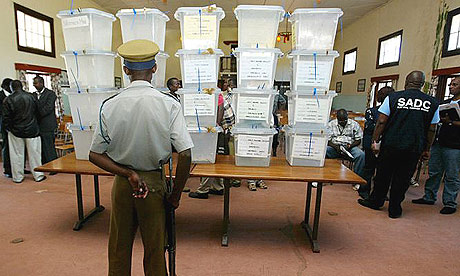
HARARE, Zimbabwe – Human Rights Watch has issued a new report accusing the Zimbabwean military and security forces of interfering with the upcoming election. The security forces are believed to be working to secure the reelection of current president Robert Mugabe and the Zanu-PF party.

The report comes as Prime Minister Morgan Tsvangirai, Mr. Mugabe’s opponent, says there is not enough time to institute security reforms before the court mandated election deadline of July 31st. The current government is a unity government formed between Zanu-PF and Mr. Tsvangirai’s party Movement for Democratic Change (MDC) after the 2008 election.

A police officer with ballot boxes during the 2008 election. (Photo courtesy of The Guardian)

Security forces were also accused of intimidation and interference in the 2008 elections.  Mr. Tsvangirai ran against Mr. Mugabe in 2008 and won the first round of voting but did not win enough votes to secure the election. Mr. Tsvangirai boycotted the second round of voting because his supporters were being targeted by security forces. Mr. Mugabe went on to win another term but had to form a unity government with MDC.

The new report details how security forces have openly supported Mr. Mugabe and have refused to meet with Mr. Tsvangirai about his security concerns. On May 4th, the Zimbabwe Defense Forces commander, Gen. Constantine Chiwenga told The Sunday Mail: “We have no time to meet sellouts. Clearly Tsvangirai is a psychiatric patient who needs a competent psychiatrist.” Police Commissioner General Augustine Chihuri has also said that the security forces would never meet with Tsvangirai and that anyone who reported on the issue risked being arrested.

The Human Rights Watch investigation has found that the army has deployed soldiers across the country to beat and intimidate anyone they believe to be a supporter of MDC.  The army has been accused of using food distribution programs and army research projects to gain admission into people’s homes and other areas. One MDC supporter told HRW:  “When I said I had voted in favor of the draft constitution they then asked me why I was wearing an MDC t-shirt and before I could respond they began to punch and kick me all over my body. They said I must vote for ZANU-PF in the coming elections without fail or they would come back for me.”

“Zimbabwe’s laws and constitution require neutrality and impartiality from the security forces but the security forces have shown no sign of meeting their obligations,”  Tiseke Kasambala, Africa advocacy director at Human Rights Watch said .  “The government needs to send a clear message by disciplining and prosecuting security force personnel and soldiers who violate the law for political reasons.”


For more information, please see:

Human Rights Watch – The Elephant in the Room – 5 June 2013

Human Rights Watch – Zimbabwe: Security Forces Pose Election Risk – 5 June 2013

BBC News – Zimbabwe’s Tsvangirai wants polls delayed for reforms – 5 June 2013

Aljazeera – Rights group slams Zimbabwe security forces – 5 June 2013

Zimbabwe Independent – Security reforms: Elephant in the room – 7 June 2013


Brazil Sends National Force Soldiers to Defuse Conflicts Over Indian Lands

By Ellis R. Cortez
Impunity Watch Reporter, South America

SAO PAULO, Brazil — The Brazilian Justice Ministry said on Wednesday, June 5th, that 110 National Force soldiers have been dispatched to Mato Grosso do Sul state where hundreds of Terena Indians are occupying a ranch they say is on ancestral lands.

An indigenous delegation met with government ministers in Brasilia on June 4th. (Photo Courtesy of BBC)

The ranch is at the center of a land dispute between its owner, a former congressman, and the Terena Indians. Approximately 200 Terena Indians occupied the ranch on May 15th. Two weeks later police evicted them in a violent clash during which a 35 year-old Indian man was shot dead. The following day, the Indians occupied the ranch again and on June 4th, another Indian man was injured in an attack by unidentified gunmen. Two others have been reported as missing.

“We must avoid radicalizing a situation that goes back a long way in Brazilian history,” Justice Minister Jose Cardozo told reporters after meeting lawmakers from Mato Grosso do Sul in Brasilia. “We’re not going to put out the flames by throwing alcohol on the bonfire,” he said.

A new eviction order was issued, and Funai, the federal indigenous affairs agency, was informed to peacefully move the Indians off the ranch on June 5th. However, Funai’s press office said a judge suspended the new eviction notice until a federal court rules on the case.

The Indians are also protesting a proposed constitutional amendment that would reduce Funai’s role in determining land for Indian reservations. Under the proposal, Congress and other federal agencies would also have a say in the demarcation of indigenous territory.

Justice Cardozo, however, stressed on June 4th, that Funai would continue to play a central role as the main institution that defends Indian rights, but others will be brought in to improve the process of deciding ancestral lands.

Brazil’s indigenous land policy, included in the country’s constitution, is considered one of the most progressive in the world, with about 13% of the nation’s territory set aside as indigenous territories.

Similar protests have now erupted across the country. In the Amazon region, the Munduruku indigenous group has been occupying the site where construction is underway on the controversial Belo Monte hydroelectric dam. The Belo Monte dam is set to become the world’s third largest dam and it would be capable of producing 11,233 megawatts of electricity, which is equivalent to about 10 percent of Brazil’s total current generating capacity.

For more information please see:

Washington Post  Brazil deploys elite National Force Troops to contain growing Indian-rancher conflicts  5 June 2013

BBC Brazil sends army to indigenous land dispute farm 5 June 2013

New York TimesBrazil Troops to Contain Indian-Rancher Conflicts 5 June 2013

Reuters Brazil calls in army to defuse conflicts over Indian lands 4 June 2013


Tunisia Expels Three As Trial of Femen Activists Begins

By Thomas Murphy
Impunity Watch Reporter, Middle East

TUNIS, Tunisia  The Tunisian Interior Ministry has said that it expelled three members of the Ukrainian feminist group Femen from the country. Alex Shevchenko was expelled Tuesday night and a Femen representative confirmed her association with the group. However, the two other expelled women, one Ukrainian and one Belarusian, denied any connection with Femen, as did a Femen representative. The two women were expelled as they arrived at the country’s main airport, the Belarusian on Tuesday and the Ukrainian on Wednesday.

One of the Femen protesters outside Tunisia’s Palace of Justice. (Photo Courtesy of Getty Images)

The women were accused by the Interior Ministry of planning to engage in a topless protest in front of the court where the trial of three other Femen activists began on Wednesday. The Femen activists on trial are charged with “debauchery” which entails the use of the female body to seduce. Debauchery carries a possible six month prison sentence. Patrick Klugman, the activists’ lawyer, was sent to Tunisia by the Femen group to defend the women.

Klugman defended the women saying, “Their bodies were not exhibited to seduce but to convey a political message…which is different than debauchery.”

The three women, Pauline Hillier, Marguerite Stern, and Josephine Markmann, appeared at the trial wearing the traditional white Tunisian headscarf, known as a sefseri.

The court denied the women bail and adjourned the case until June 12. It is also considering whether several Islamist groups will be allowed to join the proceedings as a civil party. Tunisian law permits outside groups to join the trial and sue as injured parties. The addition of the Islamist groups would likely cause the trial to be drawn out. Klugman was critical of the court following the adjournment.

“Without giving a word to the Femen activists, the court has right from the beginning listened to the Salafist associations, who are not even a part of this trial,” Klugman said.

The charges against the three women stem from a topless protest in front of Tunisia’s Place of Justice. The three called for the release of Femen member Amina Sboui, also known as Amina Tyler, by waving banners and painting messages on their topless chests. The protest was the first Femen protest of its kind in the Arab world.

Tyler was arrested for possessing pepper spray and has been convicted of carrying an incendiary object. She was also arrested for allegedly writing the word “Femen” near a cemetery in the religious city of Kairouan. Possible charges include indecency and desecrating a cemetery.

Tyler’s actions were in protest of a rally to be held by conservative Islamists known as Salafists. The Salafists have been pushing for a more pious society and are often accused of attempting to limit women’s rights.

For further information, please see:

AllAfrica – Tunisia: Feminist Activists On Trial in Tunisia – 5 June 2013

BBC – Femen activists on trial in Tunisia for topless protest – 5 June 2013

Guardian – Femen protests: Tunisia expels three in Ukrainian feminist group – 5 June 2013

Middle East Online – European Femen activists remain behind bars in Tunisia – 5 June 2013

Washington Post – Tunisia expels 3 Femen activists seeking topless protest at trial of their colleagues – 5 June 2013

NSA Surveillance Programs Come to Light

By Ali Al-Bassam
Impunity Watch Managing Editor, News

WASHINGTON D.C., United States — This week, news came to light that the National Surveillance Agency (NSA) had siphoned personal data from the main computer servers of nine major US internet providers, including Google and YouTube, and collected the phone records of millions of Verizon customers.

It was revealed that the NSA has been tracking Verizon customers’ call records and collecting private data from nine companies. (Photo Courtesy of The Independent)

In an initiative code named PRISM, the FBI and NSA was granted access to “audio, video, photographs, emails, documents and connection logs from Microsoft, Yahoo, Google, Facebook, PalTalk, AOL, Skype, YouTube, and Apple company servers.”  It was also reported that many companies did not know that the FBI and NSA had direct access to their servers.  Google, Apple, Yahoo, and Facebook immediately denied that the government had direct access, while Microsoft said that it “did not voluntarily participate in any government data collection,” and only complied with specific requests.

The Guardian first reported that Microsoft was the first of the nine companies to participate in PRISM in December 2007.  It reported that  Yahoo then joined in 2008; Google, Facebook, and PalTalk in 2009; YouTube in 2010; Skype and AOL in 2011; and finally Apple last year.

It was also revealed earlier this week that the NSA had access to to Verizon customer phone records under a secret court order.  Under this court order, labeled “Top Secret,” Verizon must disclose “all call detail records” of its customers to the NSA, including all local and long-distance calls within the US, and calls made between the US and overseas.  This program and PRISM were initiated in 2007 during George W. Bush’s presidency.

President Obama, defended the surveillance program on Friday, saying that his administration struck “the right balance” between security and privacy, and that US citizens and residents were not being targeted.  President Obama said that both NSA programs were repeatedly authorized by Congress and are subject to continual oversight by both congressional oversight committees and secret intelligence courts.  Claiming to be skeptic about the NSA programs when he was sworn into office, President Obama said that it was necessary to preserve them for the sake of national security.  “You can’t have 100% security, and also then have 100% privacy and zero inconvenience,” said President Obama.

In a statement made late-night on Thursday, Director of National Intelligence Jams Clapper denounced the leaks, and said that “Americans would suffer.”  “The unauthorized disclosure of a top secret US court document threatens potentially long-lasting and irreversible harm to our ability to identify and respond to the many threats facing our nation,” said Clapper.

For further information, please see:

ABC — US Declassifies NSA Program Details After Uproar Over Verizon Phone Records — 7 June 2013

BBC News — Barack Obama Defends US Surveillance Tactics — 7 June 2013

The Independent — Obama Defends Spying Tactics of Prism Programme Mining Private Data from Google, Apple, YouTube, and Facebook — 7 June 2013

Policymic — NSA Phone Records: A Look at the Courts That let the Feds Tap our Phones — 7 June 2013

USA Today — NSA Taps Data from 9 Major Net Firms — 7 June 2013

Engadget — Washington Post: NSA, FBI Tapping Directly into Servers of 9 Leading Internet Companies (Updates) — 6 June 2013

Wall Street Journal — Government is Tracking Verizon Customers’ Records — 6 June 2013