International Day Against Homophobia: Eastern European LGBT Communities Face Continued Adversity (Updated)

By Madeline Schiesser
Impunity Watch Reporter, Europe

MOSCOW, Russia – May 17th is International Day Against Homophobia.  LGBT (lesbian, gay, bisexual, and transgender) communities around the world plan to mark this day with events such as gatherings and rallies.  However, in Eastern European countries in particular, signs of discrimination against LGBT peoples remain prevalent.
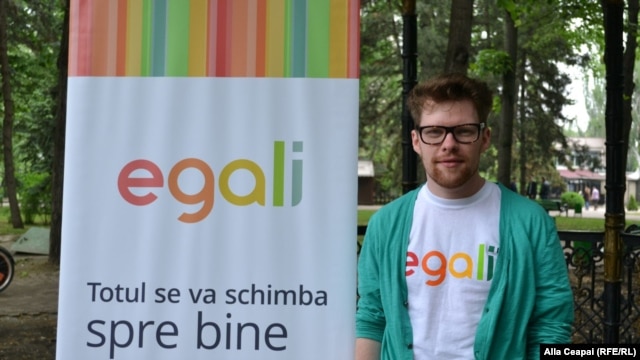
Moldovan gay-right’s activist Artiom Zavadovsky stands by a banner with the promise, “Everything will change for the better.” (Photo Courtesy of RFE/RL)

Last week, a man, age 23, in the southern Russian city of Volgograd was tortured and murdered by several of his companions when he admitted to them he was gay over a few beers, according to investigators.  Close friends and family of the victim deny the allegation he was gay.

At least two men, ages 22 and 27, were arrested in connection with the murder, and are belied to have allegedly beat the victim, sodomized him with a beer bottle, smashed in his skull with a stone, and then dumped his naked body.  A third has been questioned.  Activists in Russia say that it is rare for police to specify homophobia as the motive for a crime.

Local laws banning dissemination of “homosexual propaganda” to anyone under 18 have cropped up across the country, and a bill for a national ban on “homosexual propaganda” will receive a second reading in parliament later this month.

Authorities in Moscow rejected requests by the Russian LGBT community to hold a gay pride march later this month to celebrate 20 years since homosexuality was taken off the books as a criminal offense, despite the flexibility of the request to accept several alternative days for the march.  They claimed the venue the activists wanted was booked.

In St. Petersburg, one of the first cities to ban “homosexual propaganda,” authorities accepted an application for a rally to mark International Day Against Homophobia.  Despite the ban, portions of St. Petersburg and other cities, usually green-spaces, were designated, under the presidency of Dmitry Medvedev, as “free-speech zones” where citizens can hold events by simply notifying authorities in advance, without going through the often difficult process of receiving official permission which typically results in denied applications.  Activists took advantage of this procedure in St. Petersburg in order to hold their rally, despite several cries from anti-gay politicians to ban the event.

In Moldova, activists have been met with some success recently in combating intolerance and this week launched their 12th annual weeklong “Rainbow Over The Dniester” festival to coincide with International Day Against Homophobia in the conservative and predominantly Orthodox Christian country.  Festival organizer Anastasia Danilova believes that access to information has greatly helped people become more tolerant.

Despite the increasingly tolerant attitudes towards homosexuality in Moldova, Festival organizers decided to move the venue of a march scheduled for May 19th from downtown Chisinau to another part of the city due to pressure from authorities over concerns of clashes and social tensions.  The Orthodox Church has criticized the march and called for a counterdemonstration the same day.

In Ukraine, the parliament is considering two bills that if passed would infringe on the free-speech rights of the LGBT community.  The bills, similar to Russia’s “homosexual propaganda” laws, define propaganda as any public activity that spreads positive information about homosexuality, such as rallies, parades, demonstrations about LGBT rights, discussions, or special courses.  Violators of the laws could be sentenced to several years in prison.

Meanwhile, legislators have postponed discussion on a bill to prevent discrimination  against sexual minorities after about 300 protesters gathered in front of parliament May 14, carrying signs with slogans such as, “We are the majority, and we are against homosexuals!” and, “No to Homosexuals, Yes to Family, Save Ukraine!”  Presently, sexual orientation and gender identity are not prohibited grounds for discrimination.

A report released by the E.U.’s Fundamental Rights Agency (FRA) on Friday, based on a survey of 93,000 LGBT people throughout the E.U. and Croatia, confirmed that East European states had the highest records of  homophobic behavior, while over 1 in 4 respondents reported being attacked or threatened with violence in the last 5 years due to their LGBT identities.  Of those attacked, more than half reported that they did not report the incident to authorities because they believed no action would be taken.

However, despite the findings of the survey, Ioannis Dimitrakopoulos, head of FRA’s equality and citizens’ rights department, said there appeared to be a “pattern across Europe whereby things seem to be improving for the younger generation.”

The FRA survey of 93,000 LGBT persons shows high discrimination in Eastern Europe. (Photo Courtesy of BBC News)

For further information, please see:

BBC News – EU LGBT Survey: Poll on Homophobia Sparks Concern – 17 May 2013

Amnesty International – Ukraine: Discrimination and Violent Attacks in Pervasive Climate of Homophobia – 16 May 2013

HRW – Ukraine: Reject Discriminatory LGBT Laws – 16 May 2013

RFE/RL – Moldovan LGBT March Location Changed – 16 May 2013

RFE/RL – St. Petersburg LGBT Activists To Test ‘Propaganda Law’ With Tolerance Event – 16 May 2013

RFE/RL – Moldova’s LGBT Festival Seeks To Build On Recent Successes – 15 May 2013

RFE/RL – Ukraine MPs Postpone Antidiscrimination Debate After Protests – 14 May 2013

BBC News – Arrests Over ‘Anti-Gay’ Murder in Volgograd Russia – 13 May 2013

REF/RL – Russian Officials Say Volgograd Killing Was Homophobic Attack – 12 May 2013

Boko Haram Claims Responsibility For Attacks in Nigeria

By Ryan Aliman
Impunity Watch Reporter, Africa

ABUJA, Nigeria – Militant Islamist group Boko Haram just released a video where the group claimed responsibility for the recent attacks and hostage-taking in Nigeria.

A screenshot from the recent video released by Boko Haram. (Photo courtesy of BOKO HARAM/AFP)

Acquired by the AFP news agency last week, the video features Abubakar Shekau – the alleged leader of the Nigerian extremist group. Speaking in the Hausa language, Shekau personally admitted that it was his group who led the latest attacks on the northeastern region of the country.

“We are the ones that carried out the Bama attack,” Shekau said, referring to the May 7 assault in a village at Borno state near Nigeria’s north-eastern border with Cameroon. During the raid, 55 people, including soldiers and local law enforcers, were killed and 105 prisoners were freed on a police station, military barracks and government buildings.

“We also carried out the attack in Baga,” he added. This time he was referring to the April 16 raid in the town near Lake Chad which caused the death of approximately 200 people.

Seated on a rug with a kalashnikov resting behind his right shoulder, Shekau accused the army of illegally detaining the relatives of Boko Haram members, saying their release was a prerequisite for any truce. He further pointed out the excessive force employed by the soldiers in retaliating to the group.

“It was you, the security agents that went into town the following day and burnt homes and killed people at will,” Shekau said.

The military have reportedly told the press that it killed at least 30 Boko Haram members during the Baga assault. However, Shekau staunchly denied this in the video, saying, “none of our people were killed in Baga.”

Half way through the 12-minute video message, the screen splits, showing Shekau on the left with a group of unidentified women and children on the right.

“We kidnapped some women and children, including teenage girls,” he said.

According to Shekau, these people are currently held hostage in retaliation for the relatives of several Boko Haram members who were arrested by the army. Reports say that soldiers detained women, as well as children and infants, related to the group’s members in Kano, Bauchi and Damaturu.

“In a single house in Damaturu, eight of our women and 14 children were arrested. . . . As long as we do not see our women and children we will never release these women and children,” Shekau threatened.

The Boko Haram leader did not disclose the number and names of the women and children captured by his group.


For further information, please see:

African Spotlight – Boko Haram kidnaps women and children, releases hostage video – 13 May 2013

AFP – Nigeria Islamist video claims attacks, shows hostages – 13 May 2013

BBC News – Nigeria’s Boko Haram releases hostage video – 13 May 2013

TVC News – Nigeria: Boko Haram releases hostage video, claims recent attacks – 13 May 2013

Unlawful Killing of Syrian Women

7543 women including 2454 girls and 257 infants were killed by the Syrian Government’s Armed Forces since the beginning of the Syrian revolution.
Unlawful  killing of Syrian Women
Report Prepared by Syrian Network for Human Rights
SNHR —  By our daily documentation of Syrian victims, we have noted that the proportion of killed women is very high, and up to approximately 9% of the civilians victims toll.  In many days SNHR documented almost 30 female victims, although most of the killings occurred during the indiscriminate or deliberate shelling against civilians with TNT by warplanes, scud missiles, or artillery.  However there are hundreds of women who were killed deliberately during raids and massacres.
Due to our documentation’s methodology, we could not disclose any numbers without providing a statistic’s documented name, date of death, place of death, photo or video of the casualty, and how that person was killed.
Since the beginning of the Syrian revolution, to 30 April 2013, SNHR documented the killing of 7543 female victims: including 2454 girls, and 257 infants (less than 3 years old).  There are 155 female victims whose names are not known.  We have their photos, we know how they were killed and the dates of the incidents, but we could not get their names.
We would like to indicate that 421 women were intentionally sniped, that’s mean the snipers who killed them were fully convinced that they targeted, and killed, women.
Also, 24 women were tortured to death after being arrested.  They were exposed to systematically, and exceptionally cruel torturing methods.
Please find all details for each case in the following link:  https://docs.google.com/file/d/0B9Bj18tlYYKBZWNQNjFzNDNIbDA/edit
Female victims are distributed among the Syrian provinces below:
Homs : 1411
Damascus countryside : 1397
Aleppo : 1289
Idleb : 1088
Daraa : 667
Deir Alzor : 557
Hama : 483
Damascus : 339
Al-Raqqa : 75
Lattakia : 74
Not Syrian : 55
Al- Quneitra : 38
Al-Hasaka : 29
Tartus : 16
Al-Swidaa : 5

Legal conclusions :

1- Syrian Government Armed Forces committed extensive systematic crimes against humanity with unlawful killings;
2- Syrian Government Armed Forces committed these extensive systematic crimes in non international armed conflicts.  The killings should be deemed as war crimes;
3- The Syrian government, who killed and targeted civilians, violated both International Human Rights Law and International Humanitarian Law
Recommendations:
Human Rights Council:
1- Call upon the Security Council and relevant organizations to take upon their responsibility towards what is happening to the Syrian people, who are subjected to murder, rape, and displacement;
2- Exert pressure on the Syrian government to stop the torturing, and demand the release of all detainees;
3- Hold the Syrian government’s allies and supporters, Russia, Iran, and China, morally and physically responsible for  what is currently happening to the Syrian children;
4- Give serious attention to this case, give it a high priority, and give your best effort to take care of torture victims and their families.
Security Council:
1-Decision to refer all the criminals and the involved to ICC
2- Warn Syrian Government ‘s Armed Forces of therepercussions of using brutal methods and systematic killing and send clear messages about
Arab League :
1- Demand the Human Rights Council and United Nations to give this serious issue the right attention and to continuously follow up with the events;
2- Give serious attention to this case, give it a high priority, and try to take care of victims’ families mentally, physically, , and educationally;
3- Apply political and diplomatic pressure on the Syrian Government’s Armed Forces main allies – Russia, Iran, and China – to prevent them from continuously providing cover, international, and political protection for all the crimes committed againstthe Syrian people.  Also, hold them morally and physically responsible for all the excesses of the Syrian Government’s Armed Forces.