Syrian Government Reportedly Killed ‘at Least 85’ People in Damascus Neighborhood Massacre

By Ali Al-Bassam
Impunity Watch Reporter, Middle East

DAMASCUS, Syria — Opposition activists reported last Sunday that at least 85 people were executed by Pro-Assad Syrian forces in the town of Jdeidet Al-Fadel.  Other groups estimated the death toll to be around 250.  The Syrian Observatory for Human Rights said that they can confirm that 109 people were killed, but that the actual death toll could actually be closer to 500, making it one of the deadliest incidents to occur since the start of the revolution.  Women and children residing in the Damascus neighborhood were reported to be amongst those killed in the massacre.
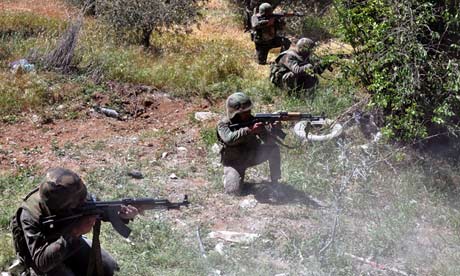
Syrian troops reportedly killed 85 – 500 people “at close range.” (Photo Courtesy of The Guardian)


“We documented 85 summarily executed, including 28 shot in a makeshift hospital after Assad’s forces entered Jdeidet Al-Fadel. We fear that the victims of the massacre are much higher,” said Abu Ahmad Al-Rabi, an opposition activist residing in the adjacent district of Jdeidet Artouz.

Inconsistent reports regarding the number of those killed is due to the Syrian military lockdown of the neighborhood.  Journalists and NGOs cannot provide a clear number because they cannot get close enough to the town to accurately report what is happening.  The lockdown also precludes information from getting out of towns, leaving the world to rely on observations made by observers and private citizens using social media sites such as Facebook and Twitter.

Syrian run SANA State News Agency reported that the military “inflicted big losses on terrorists in Jdeidet Al-Fadel and destroyed weapons and ammunition and killed and wounded members of the terrorist groups.”

Jamal Al-Golani, member of the Revolution Leadership Council, also believed  the death toll to be higher, and said that there could be more than 250 people who were killed, mostly shot at close range.  However, due to the presence of army patrols, it is difficult to determine.

Other Rebel groups called the offensive against JdeidtAl-Fadel, a “crime against humanity,” and “a massacre of epic proportions.”  Syrian National Coalition President George Sabra said that President Bashar Al-Assad explicitly ordered troops to “kill and massacre” civilians in the offensive.

Jdeidet Al-Fadel had long been held under rebel control, but was always surrounded by Syrian troops.  Some believe that the Syrian military took a step forward in reclaiming “lost ground.”  Tactically, opposition forces considered their control of the town to be a “lost cause” due to its close proximity to Damascus.  “Jdeidet Al-Fadel was militarily a lost cause from day one because it was surrounded by the army from every direction.  There are almost no wounded because they were shot on the spot,” said Al-Golani.

For further information, please see:

Arab News — Assad Forces Executive 85 — 23 April 2013

AntiWar — Syrian Rebels: 500 Dead in Damascus Suburb Offensive — 22 April 2013

Foreign Policy — Has the World Stopped Caring About Massacres in Syria? — 22 April 2013

The Guardian — ‘At Least 85 People Killed in Damascus’ as Pro-Assad Forces Storm Suburb — 21 April 2013

Nigeria: Violence Between Boko Haram and Army Leaves “Scores” Dead

By Hannah Stewart
Impunity Watch Reporter, Africa

BAGA, Nigeria — Between Friday and Sunday, fighting between Nigeria’s military and Islamic extremists reportedly killed at least 185 people and injured more than 70 in a fishing community in northeastern Nigeria.  During the attack, insurgents used fire rocket-propelled grenades and soldiers sprayed machine-gun fire into neighborhoods filled with civilians.

A young girl amid the burned ruins of Baga, Nigeria, on Sunday. (Photograph Courtesy of the Associated Press)

The fighting began Friday when Nigerian army forces surrounded a mosque where they believed Boko Haram members were hiding out.  The fighting broke out after Boko Haram militants killed a military officer, news agencies reported.  Nigerian security forces then surrounded a mosque that they described as a base for militants and Boko Haram fighters exchanged automatic weapons fire in civilian neighborhoods.

Military officials said the militants deployed heavy machine guns and rocket-propelled grenades and used the civilian population as “human shields.”  On Sunday, when government officials entered the city they found absolute destruction: homes, businesses and vehicles were burned throughout the area.

Many of the deaths occurred when a fire swept through the town, a small fishing town on the shores of Lake Chad in the Borno state near Nigeria’s three-way border with Cameroon and Chad.  It was not clear how many of the dead were soldiers, militants and civilians, in part because many were burned beyond recognition.

Borno state military spokesman Sagir Musa said initial reports were highly inflated.  “There could have been some casualties, but it is unthinkable to say that 185 people died,” Musa said, according to Agence France-Presse.  “On my honor as an officer, nothing like that happened.”

The assault marks a significant escalation in the long-running insurgency Nigeria faces in its predominantly Muslim north, with Boko Haram extremists mounting a coordinated assault on soldiers using military-grade weaponry. The killings also mark one of the deadliest incidents ever involving Boko Haram.

Boko Haram, which means “western education is a sin,” seeks to establish an Islamic caliphate in Nigeria, a country of 170 million split evenly between Christians and Muslims.

For more information, please see:

Al Jazeera  – Scores Killed in Nigeria Violence – 22 April 2013

BBC – Nigeria Fighting “Kills Scores” in Baga – 22 April 2013

Los Angeles Times – Dozens Killed in Gun Battles in Northern Nigeria – 22 April 2013

Reuters – Nigeria Says Heavy Fighting in Northeast, No Word on Casualties – 22 April 2013


Russian Government Appoints Anti-Terrorist Department to Search for Hermitage CEO

By Alexandra Sandacz
Impunity Watch Reporter, Europe 

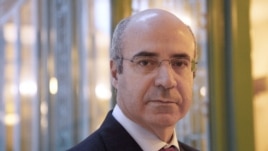
MOSCOW, Russia – The Russian government assigned the Anti-Terrorist Department of the Russian Interior Ministry to search for Hermitage CEO, William Browder. Browder is charged with illegally obtaining $70 million of stock in the energy company, Gazprom.

Russian government commences a search for Hermitage CEO, William Browder. (Photo Courtesy of RFE/RL)

General Major Sergei Borodulin of the Russian Interior Ministry commenced the latest sanctions against Mr. Browder. He is the same Russian official who authorized the opening of a posthumous criminal case against Sergei Magnitsky.

Despite the fact that this particular case has no legal foundation because the Gazprom shares were in fact purchased in open market transactions, a Moscow court issued an arrest warrant in absentia for the former Browder. The court accepted the arguments that Browder may influence witnesses or obstruct the criminal inquiry. As a result, Browder should be arrested to prevent such actions.

The court also supported the assertion Browder is actually currently hiding from Russian law enforcement agencies.

This will be the first case in Russian history where a foreign investor is “retroactively and arbitrarily” charged for conducting legal transactions.

Lt. Colonel A.K. Gubanov of the Anti-Terrorist Department visited the second secretary of the British embassy in Moscow “searching” for Browder. Gubanov’s search disregarded diplomatic protocol and legal procedures for police searches and mutual legal assistance requests.

Gubanov and another Russian police officer, Major P.I. Tambovtsev, requested that the British diplomat sign a Russian Interior Ministry procedure. However, the British diplomat declined to do so.

G.R. Sungurov, head of the 4th section of the Russian Interior Ministry’s Investigation Department, who is in charge of fighting organized crime and corruption, coordinated the latest search efforts for Browder.

A Hermitage Capital representative stated, “The misuse of the anti terrorist police in pursuing a political vendetta in relation to the Magnitsky Act shows how desperate the Russian authorities have become to try to protect their bank accounts and travel privileges. By the Russian government diverting their most important anti terrorist personnel at this sensitive time for private corrupt purposes is a clear sign of a complete breakdown in the law enforcement system in Russia.”

The warrant will have a very insignificant effect on Browder and his business relationships. Hermitage Capital’s interactions in Russia were minimized after Browder was barred from entering Russia in 2006.

For further information, please see:

Law and Order In Russia – Russian Government Employs Anti-Terrorist Unit to Search for Hermitage CEO in Retaliation for the US Magnitsky Act – 22 April 2013

RFE/RL – Moscow Seeks Arrest of Late Magnitsky’s Boss – 22 April 2013

Russia Beyond the Headlines – Moscow Court Orders Arrest of Magnitsky Boss Browder – 22 April 2013

The Voice of Russia – Russia Seeks Arrest of Late Magnitsky’s US-Born Boss – 22 April 2013

War Crimes Prosecution Watch: Vol. 8, Issue 27

Vol. 8, Issue 2 — April 22, 2013


INTERNATIONAL CRIMINAL COURT

Central African Republic & Uganda

Darfur, Sudan

Democratic Republic of the Congo

Kenya 

Libya

Cote d’Ivoire (Ivory Coast) 


AFRICA

International Criminal Tribunal for Rwanda


EUROPE

Court of Bosnia & Herzegovina, War Crimes Chamber 

International Criminal Tribunal for the Former Yugoslavia

Domestic Prosecutions In The Former Yugoslavia


MIDDLE EAST AND ASIA


Extraordinary Chambers in the Courts of Cambodia 


Syria


Special Tribunal for Lebanon

Bangladesh International Crimes Tribunal

War Crimes Investigations in Burma

NORTH AND SOUTH AMERICA
United States

South & Central America
Chile

Colombia

Guatemala

TOPICS

Terrorism


Piracy

Gender-Based Violence

REPORTS

UN Reports

NGO Reports

TRUTH AND RECONCILIATION COMMISSIONS

Nepal

Ivory Coast

Liberia

United States

COMMENTARY AND PERSPECTIVES

WORTH READING