Syrian Revolution Digest: Friday, 5 April 2013

Going for Broke!

Syrian Revolution Digest – April 5, 2013 

You picked a fine time to go broke UN. Then again, we all go for broke these days. Killers who don’t want to stop, governments that don’t want to intervene, governments that do want to intervene, and rebels who cannot afford to give up. Meanwhile, there is this little miracle child in North Korea who feels left out. What can a UN do?


News

Rebels say take army post near Syria’s southern border Fighters from the Free Syrian Army said they captured the Um al-Mayathen post on the main Damascus-Jordan highway in heavy fighting overnight that ended a siege that lasted more than a week. Dozens died in the clashes they said. “It (the garrison) is a major defense and now we will lay siege to the border crossing and cut their (the Damascus government’s) supply lines,” Abu Omar, commander of the Lions of the Sunna Brigade, told Reuters by phone.

Putin insists peace talks the only way to end Syria’s ‘massacre’Speaking to the German ARD television in remarks released by the Kremlin on Friday, he rejected the Western criticism of Russia for its continuing supply of weapons to Syrian President Bashar Assad’s regime. Putin said that such shipments don’t violate international law, and he criticized those who send weapons to the Syrian opposition. Putin said that peace talks should spell out the future of Syria and provide guarantees to all parties.

Syria: Humanitarian aid, a lifeline for displaced people The displacement of millions of people across Syria has resulted in complete dependency on humanitarian assistance in some parts of the country. Crossing front lines and finding ways to reach people in need is becoming more urgent than ever before.

Report: Hamas training Syrian rebels in Damascus area The Times reports that the military unit of Hamas, which broke ties with former ally Syrian President Bashar Assad in the wake of the insurgency, began training the rebels in the Damascus neighbourhoods of Yalda, Jaramana and Babbila. “The Kassam Brigades have been training units very close to Damascus,” a Western diplomat with contacts in both the Assad regime and the Syrian opposition told the London daily newspaper. “These are specialists. They are really good.” According to the Times, Hamas has assisted in the digging of a tunnel beneath Damascus in preparation for an attack on the city, a skill that Hamas has honed smuggling supplies from Egypt into the Gaza Strip.

Western sanctions put squeeze on ordinary Syrians, regime unfazed“We’ve been without electricity in the entire city for about two weeks now. We’ve only had a few hours of water too, as it takes electricity to pump water through the city,” he told The Daily Star over Facebook, adding that it was not unusual for hospitals to go for much of the day without power due to the lack of diesel for generators, and some have even stopped their services. “Sanctions only hurt normal people. The regime doesn’t care, and gets the weapons and fuel for its army from Russia, while the ordinary people suffer from high living costs and outages.”

Obama to meet regional leaders on Syria The White House said Jordan’s King Abdullah II would meet with Obama on April 26… Obama will then host Turkish Prime Minister Recep Tayyip Erdogan on May 16… Obama will also host Crown Prince Sheikh Mohammad bin Zayed al-Nahayan of the United Arab Emirates on April 16, and will meet with Qatar’s emir, Sheikh Hamad bin Khalifa al-Thani on April 23. Turkey, Jordan and Qatar have strongly backed the 2-year-old revolt against Syria’s President Bashar Assad.

Rebels look to extend gains from Raqqa Raqqa – a predominantly Sunni city that sits at a strategic gateway between Aleppo in the northwest, Deir al-Zor to the east and Homs in the center – fell to the rebels March 4 after a combined attack led by Islamist brigades. The fall of the city was swift and coordinated. Units from the Islamist Nusra Front and the Salafi al-Sham brigade, in coordination with other Islamist brigades, easily overran Syrian army units positioned at checkpoints around the city, sparsely manned by one army unit, Division 17.


Special Reports

Syria in ruins: Photos capture shocking devastation caused to war-torn country Buildings are in tatters and fallen drainpipes lay across the road after fierce fighting in Deir al-Zor in the war-torn country.

My new paper, prepared for a briefing in Washington, D.C. that took place on January 15, 2013, is now out and is titled “Syria 2013: Rise of the Warlords.” It should be read in conjunction with my previous briefing “The Shredded Tapestry,” and my recent essay “The Creation of an Unbridgeable Divide.


Below the Radar

* The Kurdish Majority city of Qamishly in the northeast corner of Syria has been ben witnessing some interesting developments of late. The city, in a sense, is being administered in accordance to an unofficial power-sharing arrangement of sorts allowing both regime representatives as well as leaders of local Kurdish parties, especially the PYD to take part in administering the city and its surroundings. Both sides in fact maintain a strong military presence on the city, the Kurds through the Popular Defense Committees (YPGs), and the regime through the local police force and loyalist militias. But power is really on the side of the Kurds, if the YPGs wanted to take complete control of the city, they could probably do it with minimal resistance. Indeed, yesterday, following an incident in which pro-regime forces killed three Kurdish activists, Kurdish groups held a major funeral in which thousands of people showed bearing arms. The YPGs also attacked several regime checkpoints killing three and arresting 7. The situation remains tense. http://youtu.be/Iii7MaGA0M0

* Meanwhile, in the Arab-majority city of Deir Ezzor also in the northeast, a new rebel group has been making a name for itself and is projecting itself as a tribal alternative to Jabhat Al-Nusra (JAN). Its founders, said to be Syrians based in Saudi Arabia and are disciples of the late Syrian religious scholar, Nasser Al-Din Al-Albani, seem to be trying to imitate the Sahwa movement in Iraq that challenged Al-Qaeda’s dominance in Sunni majority areas there. The group is called Jabhat Al-Assalah wa Al-Tanmiya (JAT), or the Front for Authenticity and Development, but it has so far garnered little attention beyond the borders of Deir Ezzor. This video shows a recent “exploit” by JAT members against their loyalist prisoners http://www.facebook.com/photo.php?v=493388297388460JAT was formed in early November 2012. This is their YouTube channelhttp://www.youtube.com/user/alasalawatanmya This is their Facebook pagehttp://www.facebook.com/alasalawatanmya?fref=ts


Video Highlights

Like marauding killer sharks, pro-regime tanks keep roving around the outskirts of the town of Daraya in Damascus Suburbs http://youtu.be/W25DzJVO9NYPounding their way in http://youtu.be/VCs0ognV_5w and outhttp://youtu.be/vhqpRha8IQg Other parts of town are targeted by missile launchers http://youtu.be/RjKuzVFbuXg , http://youtu.be/EHfbI2BGHX0 The result a wasteland http://youtu.be/9TA587zQ40E

To the East, the town of Eastern Ghoutah continue to come under aerial bombardment and missile attacks: Saqba http://youtu.be/OdQDH2AKiR0Kafar Batna http://youtu.be/UhN82JQkzWg , http://youtu.be/7pv3Kj33q8gZamalka http://youtu.be/X7kbLmZbkTM Jisreenhttp://youtu.be/gjQVBljS7Ss The pounding reaches the neighborhood of Jobarin Damascus City http://youtu.be/Txs29FU_3Zc ,http://youtu.be/8I52ZGJ3vnU

In Aleppo City, clashes in and around the Kurdish-majority neighborhood ofSheikh Maqsoud intensify http://youtu.be/TKBsaXfmXPM Despite the climate of panic that ensue following attacks, people rush to help the woundedhttp://youtu.be/Vn8SDZBFj-o

Elsewhere in Aleppo and across Syria, rallies like this one in Boustan Al-Qasrhttp://youtu.be/Aqx84g0oIFk and this one in Al-Wa’er neighborhood (Homs City) http://youtu.be/5yl7-zbOqaU took place as is the case on Fridays.
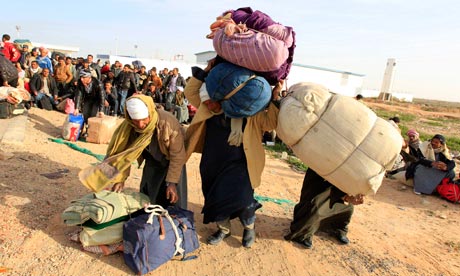
Egyptian law Could Kill NGOs

By Justin Dorman
Impunity Watch Reporter, Middle East

CAIRO, Egypt – Under Mubarak, NGOs were sterilized by lengthy application processes that lasted years in which a group could not truly act for fear of having their application rejected. Under the military dictatorship, NGO staffers were targeted and arrested. Despite the 2011 uprising, Egypt again may see the day where NGOs are rendered impotent if the parliament’s latest draft law becomes implemented.

Egyptian aid agencies, like the one pictured above helping Libyan refugees, may lose their effectiveness with the passing of a new bill by the Shura council. (Photo Courtesy of the Guardian)

The new draft law would require any international NGO to request permission from an Egyptian committee, consisting of state security officials, before the taking of every action. This committee could reject the NGOs action as counterintuitive to Egypt’s public morals, development goals, and national unity. Furthermore, local groups who receive foreign aid would additionally require authorization by this committee to act. Marwan Abi Samra, head of the democratic governance for the United Nations in Egypt, estimates that over the past decade that ninety percent of all funding for local human rights groups has come from abroad.

Bahey al-Deeen Hassan, the head of the Cairo Institute for Human Rights Studies explains that, “the law is an obvious bid to shift the civil working organizations from non-governmental to governmental societies.” He goes on to state that the draft proposal is “‘the worst law’ that had been drafted in the history of NGOs in Egypt.”

The Egyptian program director at the Cairo Institute for Human Rights Studies, Mohamed Zaree, feels betrayed. He says that when he was a participant in the Tahrir Square uprising, “the demands of the revolution were bread and freedom and social justice. Not bread and freedom and restricting the work of NGOs.”

The United Nations and European Union hate this law as proposed, as does the international human rights group, Human Rights Watch. The Egyptian director at Human Rights Watch, Heba Morayef, stated that the law, “haw very vague language that gives the government discretion to halt any activities that it doesn’t agree with substantively.”

While the committee may not completely reject the activities of an NGO, bureaucracy could bring the effectiveness of the NGO to a screeching halt. Gasser Abdel-Razek, the associate director at the Egyptian Initiative for Personal Rights, believes that ultimately the NGO will “really waste a lot of [its] resources in keeping [it]self alive, rather than in contributing to whatever [it] set out to do.”

Heba Morayef conjectures that one area this law may immediately hurt is women’s rights. She believes that it is a prerogative of the Muslim Brotherhood to not grant women any more basic rights and can envision a group whose mission is to work on women’s rights being told by this special committee that women’s rights is not a priority in Egypt and that the group should find something else to do.

It is vital for a human rights group to be able to act independently of the government which it is analyzing, condemning, or seeking to benefit. This law would destroy that independence, and any likely destroy any good that an NGO could do in Egypt.

For further information, please see:

Coast Week – NGOs Bill Sparks Fears in Egypt Over Freedom Restrictions – 5 April 2013

Guardian – Human Rights Groups Fear Impact of Draft Egypt law Restricting Their Work – 5 April 2013

Egypt Independent – UN Experts Condemn Shura Council’s NGO Bill – 28 March 2013

Al Monitor – Egypt’s NGOs Face new Strictures Under Ruling Party – 14 March 2013

U.N. Approves First Global Arms Treaty

By Madeline Schiesser
Impunity Watch Reporter, North America

NEW YORK, United States – On Tuesday, the United Nations (U.N.) General Assembly voted 154 to 3 (with 23 abstentions) to adopt a landmark treaty controlling trade in conventional arms.

The treaty will control trade believed to be worth $70 billion (£46 billion) annually, and according to Widney Brown, Senior Director of International Law and Policy at Amnesty International, “In the next four years, the annual trade in conventional weapons, ammunition and components and parts will exceed $100 billion. But today, states have put human beings and their security first.” (Photo Courtesy of the New York Times)

The treaty, seven years in the making, places prohibitions on exports of conventional weapons in violation of arms embargoes, or which the exporting state assesses could be used for acts of genocide, crimes against humanity, war crimes, organized crimes, or terrorism.  States must also act to prevent conventional weapons from reaching the black market.

Anna Macdonald, head of Oxfam’s campaign on arms control, described the treaty as “for the millions of people whose lives have fallen apart because of armed violence every day, from Guatemala to Kenya, Jamaica, Albania and a whole range of other countries.”

As the first major arms accord since the 1996 Comprehensive Nuclear Test Ban Treaty, the new regulations will cover exports of small arms and light weapons, as well as tanks, armored combat vehicles, large-calibre artillery systems, combat aircraft, military jets, attack helicopters, warships, battleships, missiles, and missile launchers.  The same type of international controls will be applied as currently govern nuclear, chemical and biological weapons.  The treaty does not place prohibitions on imports, however.

Furthermore, the agreement has no power over the domestic weapons trade in any country.  It will require national regulations controlling the transfer of conventional arms, parts and components and to regulate arms brokers, however.

“The world has been waiting a long time for this historic treaty. After long years of campaigning, most states have agreed to adopt a global treaty that can prevent the flow of arms into countries where they will be used to commit atrocities,” said Brian Wood, Head of Arms Control and Human Rights at Amnesty International, from the UN conference in New York.

Unfortunately, the arms treaty may lack teeth.  While it will be legally binding on those countries that ratify it, the treaty does not provide for an enforcement agency.  This leaves each signatory responsible for self-enforcement through the passage of new laws.  Supporters argue, however, that the stigma of breaking international law will provide a sufficient deterrent to illegal arms trades.

U.N. Secretary-General Ban Ki-moon was asked on behalf of nations backing the treaty to put it to a vote in the General Assembly on Tuesday.

Several major arms nations signed the treaty, including the United States, the United Kingdom, France and Germany.  Several emerging weapon trading countries also signed such as South Africa and Brazil.  African countries showed particularly strong support, with many of their governments emphasizing that in the long run, the treaty would curb arms sales that had fueled many conflicts on the continent.

Three members of the U.N. voted in opposition: Syria, Iran, and North Korea.  Iran and North Korea are under arms embargoes, while Syria’s government, fighting a two-year civil war, depends upon arms from Russia and Iran.  Syria argued that a draft of the treaty failed to refer to the arming of “non-state terrorist groups”.  Iran claimed the treaty was filled “loopholes” and ignored the “legitimate demand” to prohibit the transfer of arms to those who committed aggression, while North Korea purported it was unbalanced, saying the treaty would allow exporters to deny arms to importers that have a right to legitimate self-defense.

The dissent of the three prevented a consensus last week at a U.N. treaty-drafting conference, which forced a vote by the General Assembly on Tuesday.

“Despite Iran, North Korea and Syria’s deeply cynical attempt to stymie it, the overwhelming majority of the world’s nations have shown resounding support for this lifesaving treaty with human rights protection at its core,” said Brian Wood.

Abstaining were some of the world’s largest exporters: Russia and China.  The former cited concerns about ambiguities, such as how the terms like genocide would be defined.

“Having the abstentions from two major arms exporters lessens the moral weight of the treaty,” said Nic Marsh, a proponent with the Peace Research Institute in Oslo.  However, he noted, “By abstaining they have left their options open.”

The United States and Russia remain the largest suppliers of international arms. (Photo Courtesy of BBC News)

Other abstainers included Cuba, Venezuela, Bolivia, Nicaragua and other countries, including Qatar and Saudi Arabia, which are supplying weapons to Syrian opposition groups.  India, a major arms importer, also abstained, citing concerns tis current trade contracts could be blocked.

In Washington, U.S. President Obama’s administration welcomed the treaty, which Secretary of State John Kerry described as “strong, effective, and implementable.”  He further stated the treaty would “strengthen global security while protecting the sovereign right of states to conduct legitimate arms trade.”

Mexico released a statement on behalf of 98 U.N. members, declaring that “an effective implementation of this treaty will make a real difference for the people of the world.”

British Foreign Secretary William Hague said: “The world wanted this treaty and would not be thwarted by the few who sought to prevent the introduction of robust, effective and legally-binding controls on the international trade in weapons.”

However, the arms treaty almost did not come into fruition before the U.N.  Last year, treaty discussions fell apart when the United States, followed by Russia and China, backed out, claiming they needed more time to consider the issues.  For the U.S., 2012 was a critical presidential election year, and the Obama administration was under considerable domestic pressure from the National Rifle Association (N.R.A.) led gun lobby.

Presently, the N.R.A. has vowed to prevent the ratification of the treaty by the Senate, claiming it will undermine domestic gun-ownership rights.  More than 50 senators have already indicated their opposition.  However, the U.N. asserts that the treaty will have no impact on domestic gun sale legislation.  Furthermore, as a concession to the United States, an earlier draft of the treaty was modified to remove a provision requiring states to record importation of ammunition and to prevent the ammunition from being diverted to other countries.

Countries will decide individually whether or not to sign and ratify the treaty.  It will become internationally effective 90 days after the 50th ratification, which may take two to three years.

“This is not a panacea, it is not going to solve all problems overnight but it is an important step. We have seen time and again that international treaties affect the behavior even of those states who fail to sign up,” Anna Macdonald said.

For further information, please see:

Al Jazeera – UN Adopts Landmark Arms Treaty – 3 April 2013

Amnesty International – UN Puts Human Rights at Heart of Historic Arms Trade Treaty – 2 April 2013

BBC News – UN Passes Historic Arms Trade Treaty by Huge Majority – 28 April 2013

The Guardian – UN Approves First Global Arms Treaty – 2 April 2013

The New York Times – U.N. Treaty Is First Aimed at Regulating Global Arms Sales – 2 April 2013

Returns – U.N. Overwhelmingly Approves Global Arms Trade Treaty – 2 April 2013

The Washington Post – U.N. Approves Global Arms Treaty – 2 April 2013

Saudi Women Free to Ride Bikes Without Restrictions . . . April Fools

By Justin Dorman
Impunity Watch Reporter, Middle East

RIYADH, Saudi Arabia – This past week it was announced that women in Saudi Arabia would be allowed to ride bicycles and motorbikes. This was another extremely small step, for women in ultraconservative Islamic Saudi Arabia.

Women in Saudi Arabia can now ride bicycles in appropriate public areas as long as they are accompanied by a male relative and fully covered. (Photo Courtesy of Foreign Policy Blog)

In order to fight unemployment, in the 1980s, British politician Norman Tebbit would advise the unemployed to “get on yer bike” and look for a job. This is far from what the religious police were intending. It would be very unlikely that they would suggest to a women to get a job, and would certainly not advocate that stance without the consent of her male relatives.

Nor is the grant for women to ride bicycles related, in any sense, to any use of bicycles as a vehicle for transportation. The impetus for the allowance was to give women some form of entertainment in which they can pass time. It would be too good to be true if this magnificent source of fun did not come without its restrictions. The religious police have stipulated that women may only ride their bicycles in recreational areas like parks, that they must be wearing full head-to-toe Islamic garb, and that they must always be accompanied by a male relative. Additionally, it was suggested that they avoid riding in places in which young men may congregate and harass such women.

Saudi Arabia’s religious police chief found this whole matter fairly comical. He stated that no one really rides bicycles in Saudi Arabia so that it was never truly considered whether or not there was actually a ban on women from riding in the first place.

It may be difficult to consider the right to ride bicycles a real freedom considering women can only do so when confined to certain areas, properly chaperoned, and properly covered; but, it can still be considered a slight progress in what might be the golden age for women in ultraconservative Saudi Arabia. Last year, Sarah Attar, a Saudi Arabian woman, became the first to be allowed to compete in the Olympics. Two years ago, King Abdullah granted women the right to vote, and to run in municipal elections starting in 2015.  Over the past year, King Abdullah also appointed thirty women to Saudi Arabia’s Shura Council.

While bicycle riding may not be very important in Saudi Arabia, we should still consider the rotation of each woman’s tire as part of a revolution.

For further information, please see:

Foreign Policy Blog – Saudi Women Might not be Allowed to Ride Bikes After all – 3 April 2013

Guardian – Saudi Women are Allowed to Cycle – but Only Around in Circles – 3 April 2013

Time – Saudi Women Can Now Ride Bicycles in Public (Kind of) – 3 April 2013

Al Jazeera – Saudi Arabia Eases ban on Women Riding Bikes – 2 April 2013

Four Indian Women Suffer Severe Injuries from an Acid Attack

By Irving Feng
Impunity Watch Reporter, Asia

LUCKNOW, India – Four sisters in India suffered varying degrees of burn injuries after being brutally attacked with acid by two unidentified men on a motorbike.

Indian women in Delhi protest for greater protection from violence. (Photo Courtesy of BBC)

The four sisters are all teachers at a local government school in the town of Kandhla in Shamli district which is located in the western Uttar Pradesh state.  Their ages range from nineteen to twenty four.  The attack occurred when the four were on their way home after work.

Abdul Hameed, the senior police officer in charge of investigating the case, released a public statement saying that the youngest of the sisters, 19, suffered the severest of burns and was rushed to a hospital in Delhi for treatment.  Hameed also told the public that the motive behind the attacks is still unclear.

Proponents for greater protection of Indian women against violent abuse said that women who deny the orders or advances of lovers, husbands or even employers are often brutally attacked like the four sisters in the current case.

The cheap chemicals and acids used in these types of attacks are readily available in commercial markets in India.  “Tezaab,” a household cleaning agent designed to clean rust off tools is the weapon of choice in these attacks.  Human rights activists have clamored for greater restrictions on the sale of chemicals and acids that are generally used in the attacks.

President Pranab Mukherjee recently passed legislation that imposes harsher punishments on those who commit certain acts of violence against women.  The newly signed laws contain greater penalties for the crime of rape.  Rapists can now face the death penalty.

The punishments for attacking women with acid, however, have remained unchanged.  Perpetrators can face up to 12 years in prison depending on the amount of damage they inflict with their attack; however the offenders can be bailed out.

Reports by the London-based Acid Survivors Trust International estimate that about 1,500 acid attacks are carried out and recorded internationally per year.  However, this figure may be inaccurate because many of the victims of acid attacks do not officially report their injuries to the proper authorities and suffer in silence.

The majority of the acid attacks that occur throughout the world are carried out in South Asia in countries such as Bangladesh, Pakistan Afghanistan as well as India.  Pakistan, India’s neighbor, recently passed legislation in 2011 that increased the punishment of acid attacks.  Prison sentences range from 14 years to life and a minimum fine of one million Pakistani rupees is imposed.

For further information, please see:

Mmegi Online – Four sisters in India injured in acid attack – 4 April 2013

The Nation – 4 Indian sisters hurt in acid attack – 4 April 2013

BBC – India acid: Four sisters injured in Uttar Pradesh attack – 3 April 2013

Global Post – Acid attack on four Indian sisters – 3 April 2013