Syrian Opposition Opens its First Embassy

By Ali Al-Bassam
Impunity Watch Reporter, Middle East

DOHA, Qatar — The Syrian National Coalition (SNC) opened the doors to its first “embassy” in Qatar last Wednesday, just a day after the Arab League granted it recognition by giving it Damascus’s seat in the league.

SNC leader al-Khatib was in Doha, Qatar for the ribbon cutting ceremony of the Syrian rebel’s embassy. (Photo Courtesy of Al Jazeera)

The head of the SNC, Ahmed Moaz al-Khatib, and Qatari State Minister for Foreign Affairs, Khaled Al-Attiya, were at the embassy in Doha for the inauguration of the representative office, dubbed the “Embassy of the Syrian National Coalition.”  “This is the first embassy of the Syrian people,” said al-Khatib.  Al-Khatib said that the SNC’s next goal is to assume Syria’s seat in the United Nations.  Al-Khatib also used the ribbon cutting ceremony as a platform to voice his frustration with global powers for failing to do more to assist the SNC with toppling Syrian President Bashar al-Assad’s regime.  “There is an international willingness for the revolution not to triumph,” said al-Khatib.

NATO Chief Anders Fogh Rasmussen said last Wednesday that a political solution to the Syrian crisis must shapen, but ruled out Western military intervention despite Khatib’s plea.

The SNC named Nizar Haraki as its first ambassador to Qatar.  Haraki said that he will “soon” present his accreditation letter to the Emir of Qatar.  The SNC also named envoys in several countries including Britain, France, Libya, Turkey, and the United States, but has not yet proceeded with opening diplomatic missions in those countries.

Russia scolded the Arab League for taking “another anti-Syria step,” when the league recognized the SNC.  Russian Foreign Ministry Spokesman Aleksandr Lukashevich said, “In terms of international law, the decisions taken by the Arab League in respect of Syria are illegal and void because the government of the Syrian Arab Republic was and will remain the legitimate representative of the UN member state.”  Russia also said that the Arab League is supporting a “military solution” to the conflict instead of peace talks.

Iran also criticized the move, calling it illegitimate, and a “dangerous precedent” set by the Arab League.  “Handing Syria’s seat to the so-called provisional government is a danagerous precedent by the memberes of the Arab League,” said Foreign Minister Ali Akbar Salehi.

The original Syrian embassy’s doors were closed in November 2011, when diplomatic ties with the Gulf countries were severed after Syria rejected the Arab League’s peace proposal to end its campaign of violence against demonstrators, and instead resorted to a bloody crackdown on the rebellion.  The embassy continues to remain inactive.

For further information, please see:

Al Jazeera — Syria Opposition Opens Embassy in Qatar — 28 March 2013

Arab News — Syrian Opposition Opens ‘Embassy’ in Qatar — 28 March 2013

Global Times — Coalition Opens Syrian Embassy — 28 March 2013

Al Shorfa — Syrian Opposition Opens Office in Qatar — 27 March 2013

All Voices — Syrian Rebels Open new ‘Embassy’ in Qatar — 27 March 2013

Global Post — Syria Rebels Open ‘Embassy’ in Qatar — 27 March 2013

Ya Libnan — Syrian Opposition gets the Embassy in Qatar — 27 March 2013
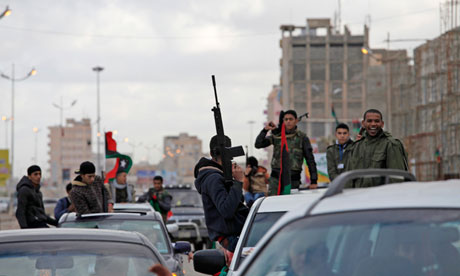
Three British Women Kidnapped and Sexually Assaulted During Aid Convoy in Libya

By Alexandra Sandacz
Impunity Watch Reporter, Europe

LONDON, United Kingdom – Two Libyans were arrested after allegedly sexually assaulting three British aid workers. The three women were abducted at a checkpoint near the city of Benghazi and held for hours. The British women were finally released on Wednesday.

Three British women, who were part of an aid convoy, were believed to be kidnapped and sexually assaulted in Benghazi. (Photo Courtesy of The Guardian)

This attack is the latest in a series of vicious assaults on aid agencies and diplomatic missions in Benghazi, which is considered a controversial area for most foreigners.

Libyan security officials believe the attacks happened Tuesday morning. A British-Pakistani family – a father with his two daughters – and another man and a woman decided to leave the convoy, which was delayed at the Libyan-Egyptian border. They intended to return to the UK.

The group took a taxi back to Benghazi, but they were stopped at the Sidi Al-Faraj checkpoint. From there, they were kidnapped and taken to a farm in the Sellouk area, which is where it is believed that the three British women were sexually assaulted.

Four Britons managed to escape and located a local police station. Subsequently, the fifth was rescued.

Deputy Prime Minister, Awadh al-Barassi, stated, “It is not clear how many of the three kidnapped women were abused. It has been reported that one was raped. I express my very deep sorrow at what happened. This heinous incident does not under any circumstances reflect the genuine generosity and morality of the Libyan people or the traditions of Arab-Islamic culture, and I demand the authorities to take the necessary action.”

However, Abdul Barghathi, commander of preventative security in the Libyan defense ministry, said the women were sexually assaulted; however, they were not raped. He also stated that it did not appear that the three women badly wounded, and consular staff is attending them from the UK.

He stated, “There was no rape, just touching (sexual assault). Because there is no British consulate here they were handed to the Turkish consulate.”

Four Libyan soldiers, who are understood to be members of the First Infantry Brigade of Libyan regular army, were arrested in connection with the abduction and rape. Another is wanted.

The group is currently safe in the Turkish consul and expected to return to the UK.

For further information, please see:

BBC – Libyans Held for “Sex Attacks’ On Britons in Benghazi – 29 March 2013Br

SkyNews – British Women in Aid Convoy Rapped In Libya – 29 March 2013

The Guardian – Britons in Aid Convoy Kidnapped and Sexually Assaults in Libya – 28 March 2013

Libya Herald – Kidnap and Sexual Assault of Aid Convoy Britons in Benghazi – 28 March 2013

Ahwazi Arabs Hunger Strike After Death Sentence

By Justin Dorman
Impunity Watch Reporter, Middle East

TEHRAN, Iran – It is not easy to be an Ahwazi Arab in Iran. Negative treatment in the arenas of education, employment, and culture have led many angered Ahwazis to demonstrate and some to call for separation. Iranian authorities have not appreciated such protests and have sentenced to death and killed a handful like Abd al-Rahman Heidarian, Taha Heidarian, and Jamshid Heidarian after an allegedly unfair trial. Five more men, Mohammad Ali Amouri, Hashem Sha’bani Amouri, Hadi Rashidi, Sayed Jaber Alboshoka, and Sayed Mokhtar Alboshoka have recently been sentenced to death after another highly questionable trial.

The five Ahwazi men pictured above have been sentenced to death and are now in the midst of a dry hunger strike in efforts to get an appeal. (Photo Courtesy of Payvand Iran News)

The Amouris, Alboshokas, and Rashidi, a few of which are teachers, all co-founded the cultural institute known as Al-Hiwar. The group organized conferences, poetry recitals, and arts and education classes before being banned in 2005. Since its ban, many former Al-Hiwar members have been arrested.

The five men have been charged under the vague claims of “enmity against God and corruption on Earth”, “gathering and colluding against state security”, and “spreading propaganda against the system.” These charges arise as of an alleged linkage between the men and a terrorist group who was involved in a shooting around Ramshir. Currently, no evidence was ever made public which showed any support of the allegations these five men faced. Additionally, their trials were held completely behind closed doors.

In an effort to protest their hunger strike and previous mistreatment while being detained in Karoun prison, the five men began a hunger strike. While being held, despite their requests, the men were denied medical examination and treatment. The need for treatment is believed to be as a means to treat injuries resulting from torture.

The torture was believed to be used to coerce confessions, false or true, out of the detained. These confessions are also often broadcast on television before a trial even begins. Such actions violate Article 38 of the Iranian Constitution and Article 9 of the Law on Respect for Legitimate Freedoms and Safeguarding Citizen’s Rights. The broadcasts violate trial obligations under Article 14 of the International Covenant on Civil and Political Rights, to which Iran is a party.

Hunger strikes often lead to negative publicity for the authoritarian regime which often has its hand forced to undo its previous action. To prevent that from happening, prison authorities banned the hunger striking Ahwazis from making or receiving phone calls. Eventually, families of the strikers were allowed to visit and were able to convince the detained men to begin drinking water again. Currently, they are still refusing to eat solid food.

For further information, please see:

Ahwaz News Agency – Profile of a Hero: Mohammad Ali Amouri – 28 March 2013

Guardian – Iranian Ahwazi Arabs on Hunger Strike Over Death Sentences -27 March 2013

Amnesty International – Urgent Action Dead row Ahwazi Arab men on Hunger Strike – 26 March 2013

Payvand Iran News – Iran: Death row Prisoners in Ahwaz Begin Hunger Strike – 9 March 2013

China Denies Firing Weapons at Vietnamese Fishing Boats

By Karen Diep
Impunity Watch Reporter, Asia

HANOI, Vietnam – On Tuesday, China responded to Vietnam’s accusation of unlawfully firing on one of its fishing boats near the Paracel islands as a legitimate action.

Vietnamese soldier in the Spratly islands, another area of dispute. (Photo Courtesy of BBC News)

According to BBC News, China claimed that its patrol boats acted “reasonably” in an alteration with the Vietnamese fishing boat in the South China Sea last week.  Furthermore, China states that it fired flares, not weapons, at the fishing boats.

“It [was] necessary and legitimate for China to take action against a Vietnamese shipping boat that has entered China’s waters for illegal activity,” stated Hong Lei, a Chinese Foreign Ministry spokesman.  “No damage was caused to the fishing boat from Vietnam at the time,” continued Mr. Lei.

Both China and Vietname claim the Paracel islands, a region China has controlled since a brief war with South Vietnam in 1974.

A Xinhua news agency report quoted an unidentified Chinese navy official characterizing Vietnam’s allegations as “sheer fabrication.”

“After the dissuasion by means of whistle-blowing, shouting and hand-flag guiding was of no avail, the Chinese naval vessels fired two red signal shells into the sky as a warning, and the signal shells burned out and extinguished in the air,” relayed the unidentified Chinese navy official.

However, Vietnam has filed a formal complaint with the Chinese embassy in Hanoi.

“Vietnam strongly protests, urging China to investigate and seriously deal with the wrongful and inhumane act, and compensate Vietnamese fishermen for their loss,” said Luong Thanh Nghi, a Vietnamese Foreign Ministry spokesman.

The South China Sea is a disputed area and has been the root of controversy.  According to China, it possesses the U-shaped strip of the sea and points to the UN Convention on the Law of the Sea (UNCLOS) for its authority.

Philippines, Malaysia, and Taiwan also have coinciding claims with China.  For instance, last year, the Philippines and China engaged in an extensive “stand-off” over another disputed area, the Scarborough shoal, straining their diplomatic relations. However, the Philippines is not the only country in the region whose relationship with China is deteriorating.

According to BBC News, this recent incident is fueling the existing anti-China feeling in Vietnam.  Before last week’s occurrence, a Chinese marine ship in the South China Sea chased two Vietnamese fishing boats.  Moreover, in recent months, China has increased its patrolling of the area.

The Chinese navy “are determined to safeguard the country’s sovereignty with their services on the South China Sea,” read the Xinhua report.

For further information, please see:

BBC News – China ‘fired flares’ at Vietnam boat in South China Sea – 27 March 2013

The Guardian – China denies starting fire on Vietnamese fishing boat – 27 March 2013

BBC News – China and Vietnam row over South China Sea clash – 26 March 2013

Special Election In Venezuela Hints At Electoral Misgivings

By Brendan Oliver Bergh
Impunity Watch Reporter, South America

CARACAS, Venezuela – Despite losing last year to Hugo Chavez in the Presidential election, Henrique Capriles is rising to call again as he faces hand-picked and acting interim president Nicolas Maduro in the special election for Venezuela’s Presidency.

Interim President Nicolas Maduro is defending his judicial appointment in a special election accused of electoral fraud. (Photo Courtesy of Venezuela Analysis)

While Venezuela gathers its base after the death of their President, Hugo Chavez, the country has been taking a hard pressed stance against the United States and their Western allies. After subtle accusations blaming the U.S. for assassinating Chavez – with an injection to give him cancer – interim president Maduro and the remaining cabinet have halted all official channels of communications between the countries. Venezuelan Foreign Minister Elias Jaua states that “until there is a clear message on what type of relationship the United States wants with Venezuela, it makes no sense to continue wasting time.

While U.S. Assistant Secretary of State for Western Hemisphere Affairs Roberta Jacobson called for open, fair and transparent elections in Venezuela there may be indications that the quick turnaround is hardly fair. The campaign of Henrique Capriles has accused the government of abuse of power and constitutional fraud in inaugurating Maduro as president. Capriles denounced the supreme court which allowed Maduro to become President and then run again in the special election. He has stated that “What the supreme court did I’ve qualified as an electoral fraud,” and insisted that the 60 day election opening, from the time of Chavez’s death to the April 14 election is likely to lead to a favored bias towards Maduro.  They have accused Venezuela’s National Electoral Council (CNE) as “no more than a tool of the regime to maintain its power.” This of course a massive description from the regimes coalition calling it “an excellent example of democratic institutions in the country.”

In order to adhere to fair elections the CNE has signed an agreement with the Union of South American Nations, in which they would send electoral teams in order to “witness the electoral process “ and hopefully ensure fair elections. Several Venezuelan electoral NGO’s have been invited to augment and observe the upcoming election.

Mr. Capriles has stated that “I feel that this fight… has become a spiritual struggle of a divine character, because those who live in Venezuela feel that this has become a struggle to break down a wall of evil.”

Despite allegations of electoral misgivings, polls have Mr. Capriles at 22%.

For further information, please see:

Telegraph – Capriles Says Venezuela Election Is A War Of  ‘Good And Evil’ – 25 March 2013

Venezuela Analysis – Maduro Counters Campaign To Discredit Venezuelan Electoral System – 25 March 2013

Press TV – Venezuela Suspends Communications With US Top Diplomat Ahead OF Election – 20 March 2013

Huffington Post – Venezuela Election Candidate Nicolas Maduro Has Upperhand As Chavez’s ‘Heredero’ – 14 March 2013

Guardian – Venezuelan Opposition Challenges Nicolas Maduro’s Legitimacy – 8 March 2013