Potential Legislation To Legalize Same-Sex Marriage In Colombia

By Brendan Oliver Bergh
Impunity Watch Reporter, South America

BOGOTA, Colmbia – Colombia is in the midst of progressing gay rights and supporting same-sex marriage. A court ruling has been mulling around the Colombian House of Representatives that would effectively legalize gay marriage. The A new bill has passed the first of four major votes, but is not expected to progress through the senate unless an impasse is found amongst legislators.

Same-Sex couples in Colombia are waiting for the legislature to pass comprehensive marriage equality laws before the courts implement their ruling. (Photo Courtesy of El Tiempo)

At this moment Colombia does not recognize gay marriage, but the country has been progressing since the homosexual activity was decriminalized in 1980s. Between 2007 and 2008, the Constitutional Court made three rulings that gave same-sex couples the same pension, social security, inheritance and property rights as heterosexual couples.

The bill making the rounds has a time limit. If the Congress does not pass a  “comprehensive, systematic and orderly legislation” by June 20, 2013, same-sex couples will automatically be granted all marriage rights. Their ruling held that the Colombian Constitution which defined a marriage between ‘man and woman’ does not “’imply a prohibition against a legal bond between homosexuals, similar or equal to that of the heterosexual couples.”

While the courts have been supportive, it seems unlikely that the legislature will be able to find a solution and the court’s ruling will take effect. According to Augusto Posada the Speaker of the House “the issue is not going, because I have not seen any initiative from the pews to pull it off,” indicating that religious opposition  may have something to do with senators indecision to find comprehensive legislation. Previously, six different bills attempting to legalize same-sex marriage have been proposed and defeated, with religious conservatives remaining opposed to any such legislation.

According to opposition within the Senate some believe that homosexuals cannot constitute a marriage or family, and if new legislation would grant those abilities as well as the ability to adopt would be the gateway to legitimatized pedophilia. While parts of the arguments seem archaic, Conservative party spokesman is weary of allowing the courts to dictate laws. Senator Hernán Andrade has called for the bill be put to a referendum, and see whether the citizens would support the bill.

According to polls taken back in 2010, Colombians seemingly support marriage equality, with 63% of Bogota supporting gay marriage.

For more information, please see:

El Tiempo – If There Is No Law, Gay Unions Would Be Entitled To Only Solemn – 23 March 2013

RCN Radio – Colombia Will Not marriages of Same-Sex Couples – 24 March 2013

Edge On The Net – Colombian High Court Stands Firm On Gay Rights Support – 13 March 2013

Gay Star News – Gay Marriage Bill Passes First Vote In Colombia – 5 December 2012

Mozambique Denies Harassing Family of Alleged Victim of SA Police Brutality

By Ryan Aliman
Impunity Watch Reporter, Africa

MAPUTO, Mozambique – The Mozambican government denied allegations that it was badgering the family of police brutality victim Mido Macia.

A screencap from a video footage of Mido Macia being dragged along road by South African police officers. (Photo courtesy of The Daily Mail)

Last February 26 in Daveyton, east of Johannesburg, South African policemen arrested taxi driver Macia for allegedly parking in the wrong spot. Despite protests by a crowd of bystanders, the law enforcers handcuffed Macia to the back of their car and dragged him along the road as he was struggling for his life.

A few hours after the incident, Macia was reportedly found dead in jail covered with severe bruises, as well as head and upper abdomen injuries.

Since then, Macia’s relatives have pressed charges against the police officers involved. They have also filed a civil case against South Africa’s Police Ministry.

However, Atty. Andrew Boerner, the lawyer representing Macia’s family claim that his clients were being “coerced” by the Mozambican government to drop the case and settle the matter outside of the courts instead. According to Boerner, Macia’s father was asked to meet with both Mozambican and South African officials and to surrender important documents about the case.

But Foreign Minister Oldemiro Baloi denied all these allegations and dismissed them as “absolutely false”.

“It doesn’t make sense”, Baloi told reporters several days ago. “When the nine policemen charged with the murder applied for bail, so that they could await the trial in freedom, our lawyer, together with the South African prosecution services, ensured that this did not happen. After this, no serious government would try to persuade the family to drop the case,” he explained.

Baloi also stressed out that the government is quite aware of its obligation to provide consular assistance to its citizens abroad in accordance to the Vienna Convention. “And this is what the government has been doing in a coherent, consistent and determined manner,” he insisted.

Meanwhile, the South African Police Ministry likewise denied any knowledge of and involvement on the alleged harassment of Macia’s family. “As people who understand, know and the respect law, we are not having an external court process. We have to respect the fact that suspects have been arrested and that the matter is before court,” said Zweli Mnisi, Police Minister Nathi Mthethwa’s spokesperson.

Macia’s case has caused outrage not only in Mozambique, but in South Africa too. As pointed out by Mamphela Ramphele, the leader of the opposition party Agang, it was “an example of the culture of impunity which has taken root in our public service.”


For further information, please see:

All Africa – Mozambique: Government Denies Pressure On Mido Macia’s Family – 21 March 2013

Eyewitness News – Macia’s family being harassed – Lawyer – 19 March 2013

The Daily Mail – Nine South African police officers accused of dragging taxi driver to his death hide their faces in court as they are denied bail – 14 March 2013

International Business Times – Oscar Pistorius and Mido Macia: South Africa is Peaceful Nation, Says President Jacob Zuma – 8 March 2013

Huffington Post – Mido Macia Death: Eight South African Police Officers Suspended In Dragged Man Case – 1 March 2013

20 Dead in Religious Clash Between Buddhists and Muslims in Myanmar

By Irving Feng
Impunity Watch Reporter, Asia

MEIKHTILA, Myanmar – Myanmar declared a state of emergency on Friday and imposed martial law in four districts, including the city of Meikhtila, after violence broke out between Buddhists and Muslims.

Riot police attempt to restore calm and control in Meikhtila. (Photo courtesy of Reuters)

A police report said the clash between the two religious groups started after a Buddhist couple had an argument with a Muslim gold shop owner.  The argument took a turn for the worse and sparked an eruption of violence involving hundreds of people.

At least twenty people have been killed so far and dozens more have been wounded.  One of the casualties was a Buddhist monk.  Thousands of other bystanders have been displaced from their homes due to the conflict and two camps have been set up to house the victims.

Mobs of Buddhists marched through Meikhtila’s Muslim districts with torches burning down Muslim homes and other establishments.  Myanmar’s state run television reported mosques burning in Yamethin along with 50 more homes.  Mosques and other Muslim buildings in Lewei and Naypyitaw were also set on fire.

Local residents in the affected cities and districts had complained that there were not enough local police forces to quell the unrest.  Myanmar President Thein Sein sent in national military forces to take charge of security.  An overnight curfew was also imposed to improve safety for the citizens.

Ethnic and religious tensions had been simmering underneath the surface of Myanmar’s communities during 49 years of military rule which ceased in March of 2011.  The military rule had quashed all dissent and kept conflicts in check.  The fledgling democracy is now challenged with the task of unifying one of Asia’s most ethnically diverse countries.

Myanmar is largely Buddhist; however, roughly 5 percent of the 60 million residents are Muslim.  Historically, there are well established and long standing Muslims communities in Yangon and Mandalay, two of Myanmar’s largest cities.

This most recent outbreak of violence is similar to the conflict between Rahkine Buddhists and Muslim Rohingya last year in western Myanmar that affected and displaced more than 100,000 residents.  Human rights groups had warned that the western conflict could spread to other parts of the country.

In a separate incident last year, Buddhist monks held rallies against Muslims in the central part of Myanmar near the city of Mandalay.  The current conflict is described by locals as “unpredictable and dangerous.”

Many residents of Meikhtila, where the fighting was the worse, do not feel safe in their own communities.  An estimated 6000 residents have already fled their homes, including 1200 Muslims and have taken refuge at a police station and a large event stadium.

For further information, please see:

Charlotte Observer – Buddhists-Muslims violence spreads in Myanmar – 24 March 2013

Tulsa World News – Sectarian violence kills 20 in Myanmar; state of emergency declared – 23 March 2013

Reuters – Myanmar riots stoke fears of widening sectarian violence – 22 March 2013

Daily Mail – Myanmar riots stoke fears of widening sectarian violence – 21 March 2013

U.N. Passes Resolution Urges Independent Investigation of Sri Lankan Civil War

By Karen Diep
Impunity Watch Reporter, Asia

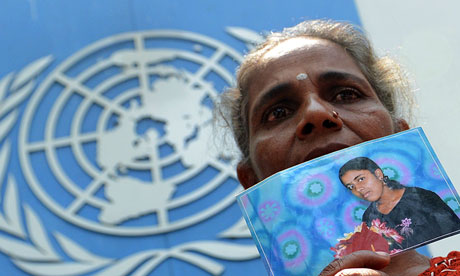
Sri Jayawardenapura Kotte, Sri Lanka – On Thursday, the United Nations’ Human Rights Council passed a resolution censuring Sri Lanka’s record.  In 2009, Sri Lanka’s military defeated separatist Tamil rebels after a brutal 26-year war; however, the war’s final phase is under heavy scrutiny.

A Sri Lankan Tamil woman holds a portrait of a missing relative. (Photo Courtesy of The Guardian)

Twenty-five countries voted in favor of the resolution, thirteen against, and eight absented.

The resolution urges Sri Lanka to implement an independent and credible inquiry into the alleged war crimes.

The Sri Lankan government has contended that its own investigation in 2011 should suffice. The Sri Lankan commission report cleared government forces of any violations. Despite the government’s report, human rights believe that Sri Lankan President Mahinda Rajapaksa’s administration has ignored prior demands for accountability and has delayed implementing the limited recommendations.

According to BBC News, during the United Nations’ Human Rights Council’s proceedings, representatives from Sri Lanka criticized the resolution for jeopardizing the current reconciliation process. Representatives also alleged that the Unites States is targeting countries that do not conform to its “political agenda.”

The resolution echoes the concern over recent Buddhist attacks on Muslims and Christians. It also recognizes development in reforming infrastructure and mentions “considerable work lies ahead in the areas of justice, reconciliation and the resumption of livelihoods.”

Amnesty International stated that the resolution highlighted violation rights but failed to create an independent and international inquiry into the issue.

Other concerns include concern over extra-judicial killings, disappearances, torture, threats to the rule of law, intimidation of civil society activists and journalists, and religious discrimination.

According to T. K. Elangovan, a DMK spokesman, the Sri Lankan government has not met commitments to rehabilitate its Tamil population.  “It is the moral duty of the government of India to see that these assurances were fulfilled or else to put pressure on the government of Sri Lanka to see these assurances are kept up. Why India is a silent spectator,” inquired Mr. Elangovan.

Keheliya Rambukwella, Sri Lanka’s media minister, stated that that matter has been blown up out of proportion. “As long as there are extreme elements in the world you have these things, in even the most five-star democracies,” said Rambukwella.

For further information, please see:

ABC News – Sri Lanka Criticizes UN Resolution on War Abuses – 22 March 2013

BBC News – UN passes resolution against Sri Lanka rights record – 21 March 2013

Voice of America – UN Vote on Sri Lankan Civil War Threatens Indian Government – 19 March 2013


Another Tunisian Charged with Criminal Defamation

By Justin Dorman
Impunity Watch Reporter, Middle East

TUNIS, Tunisia – Olfa Riahi, a blogger from Tunisia, has been charged with criminal defamation just two weeks after university professor and psychoanalyst Raja Ben Slama was charged with defaming a public official.

Olfa Riahi can face up to two years imprisonment for her posts implicating a public official with misconduct. (Photo Courtesy of Middle East Online)

Olfa Riahi’s charges stem from statements she posted regarding Rafik Abdessalem having misused public funds. The post included hotel receipts indicating that Abdessalem stayed at a posh hotel in Tunis at the public’s expense and that he transferred funds from a foreign government into a foreign ministry account. Rafik Abdessalem was the foreign minister of Tunisia. He abdicated his position shortly after Riahi’s accusations.

If Riahi is convicted, she may face a prison sentence. It boggles the mind that one who publicly exposes potential corruption could be imprisoned for up to two years. An individual convicted for defamation can be sentenced to six months of imprisonment, however, there is a potential two year imprisonment for defaming a public official. Also, there are various fines associated with the specific charges in addition to the imprisonment.

Riahi is officially charged with violations of articles 245 and 128 of the penal code and article 86 of the telecommunications code. Defamation under the telecommunications code occurs as a result, “harming others or disrupting their lives through public communication networks.” Article 245 of the penal code describes defamation as “any allegation or public imputation of a fact that harms the honor or the esteem of a person or official body.”

The international human rights group, Human Rights Watch, has called on Tunisian authorities to revise their stance on criminal defamation. The group requested that Tunisia convert defamation charges from criminal cases to civil cases, in order to “conform to international norms on freedom of expression.”

Human Rights Watch’s deputy director on the Middle East and North Africa, Eric Goldstein, stated that “criminal defamation laws have a chilling effect on freedom of expression and work against the public interest by deterring people from speaking out about corruption or other misconduct by public officials.”

The aforementioned statement directly applies to the post Riahi made concerning Rafik Abdessalem alleged corruption. Furthermore, Abdessalem’s decision to step down could be viewed as an admission to the alleged corruption, making Riahi’s assertion seem more like a fact than defamation. The ability to make such statements is necessary to maintain the international human right of freedom of expression and to a practical effect, to keep a government honest.

For further information, please see:

Tunisia Live – Human Rights Watch Condemns Defamation Laws in Tunisia – 21 March 2013

Guardian – Tunisian Blogger Faces Prison – 20 March 2013

Human Rights Watch – Tunisia: Repeal Criminal Defamation Law – 20 March 2013

Middle East Online – Human Rights Watch: Tunisia’s Defamation law Threatens Free Speech – 20 March 2013