UN Appeals Court Overturns War Crimes Conviction

By Alexandra Sandacz
Impunity Watch Reporter, Europe

AMSTERDAM, Netherlands – On Thursday, a United Nations appeals court overturned Momcilo Perisic’s, former Yugoslav Army chief, conviction of war crimes. He was originally sentenced to 27 years for aiding and abetting killings in Bosnia and Croatia, including attacks on Sarajevo and Srebrenica.

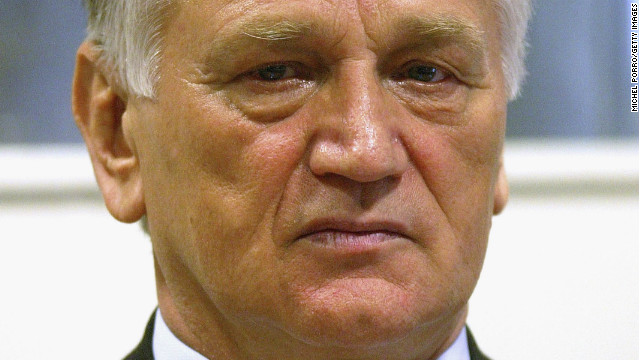
In 2011, Momcilo Perisic was convicted of aiding and abetting crimes against humanity. (Photo Courtesy of CNN)

In a 4 to 1 decision, the judges ruled that Perisic did not order Serbian forces into Bosnia-Herzegovina to commit war crimes. Furthermore, the judges also determined that he was not in a position to discipline soldiers for attacking the Croatian capital, Zagreb.

During Perisic’s trial, the record showed Perisic regularly attended the Supreme Defense Council’s meetings where Slobodan Milosevic, then the Serbian president, and other leaders approved sending weapons, fuel, police officers and military personnel to fight on behalf of the Serbs in Bosnia and Croatia.

However, the appeals judges said that regardless if Perisic knew about the crimes Serb or pro-Serb fighters committed in Bosnia and Croatia, he did not “directly or knowingly assist” in the atrocities, but rather he made decisions to support the war.

The United Nations appeal court ultimately decided that lower court committed an error by not showing that he was “physically present when criminal acts were planned or committed.”

Theodor Meron, president of the appeals chamber in the tribunal in The Hague, stated, “While Mr Perisic may have known of VRS [Serb Army of Republika Srpska, VRS] crimes, the Yugoslav Army aid he facilitated was directed towards the VRS’s general war effort rather than VRS crimes.”

However, this overturned conviction created some concerns. Various lawyers in The Hague said the ruling confused them.

The court’s ruling, which follows other recent acquittals by appeals court judges, can be seen as changing the story line of war. As a consequence, these recent reversals tightened the definition of crimes for which military commanders can be held responsible.

In the past, the crime of “aiding and abetting” only required knowledge that assistance was being used to commit serious crimes. Yet, the appeals court said that the “intention to commit crimes” is required for a conviction.

Nicholas Koumjian, a lawyer who has worked in several international courts, stated,  “I think this is a step backwards in the law; it contradicts all jurisprudence of this tribunal, even back to the findings of trials at Nuremberg after World War II.”

The International Criminal Tribunal for the former Yugoslavia’s appeals chamber in The Hague ordered Perisic’s immediate release.

For further information, please see:

BBC News – Momcilo Perisic: Yugoslav Army Chief Conviction Overturned – 28 February 2013

CNN – Tribunal Reverses Balkan War Crimes Verdict – 28 February 2013

RFE/RL – UN Appeals Court Overturns Ex-Yugoslav Military Chief’s Conviction – 28 February 2013

The New York Times – Court Overturns War Crimes Convictions of Former Chief Yugoslav Army – 28 February 2013

Violent Protests Erupt in New Delhi After Brutal Rape of a 7 Year Old Girl at School

By Irving Feng
Impunity Watch Reporter, Asia

NEW DELHI, India – Violent protests erupted in Delhi after a seven year old girl was reportedly sexually attacked and raped by an unknown man while at school.

Protesters damaged a government bus with stones outside Sanjay Gandhi Hospital. (Photo Courtesy of BBC)

The young female victim was taken to Sanjay Gandhi Hospital to be treated for her gruesome injuries after she was found lying in a pool of blood near her house.  The police report places the girl missing around 8pm on February 28th, and she was allegedly raped by the at large perpetrator on school grounds.

Dr. Sanjay Kumar, the young girl’s treating physician, reported to the press that her injuries were consistent with a patient who had suffered a rape.  Delhi’s chief minister, Sheila Dikshit, released a press statement calling the incident at the school “shameful” and “shocking.”

Protestors gathered outside of the hospital, in the Mangolpuri area of Northern Delhi, where the girl was being treated to show their outrage regarding the recent string of sexual crimes being committed against women in India.

India has been under intense international scrutiny over sexual violence against women after a student was raped and murdered on a local bus in December.  In a separate incident, another seven year old girl in the city of Kanpur, in Uttar Pradesh state, was raped, murdered and her body was dumped in a sewer.  These sexual assaults have sparked protests across the nation.

This most recent incident involving the young girl being raped in the school has sparked demonstrations that turned violent outside of Sanjay Gandhi Hospital.  Police resorted to beating protesters with clubs in an effort disperse the angry crowd.  The protestors retaliated by throwing stones at the police and caused damage to government property.

The protestors allege that the police have been doing a poor job at speedily investigating and resolving these heinous incidents of sexual assault.  The police report for the girl’s rape in Mongolpuri district was not filed until March 1.  Additionally, no arrests have been made yet, and police currently do not have any suspects.

Sushil Kumar Shinde, Home Minister in the area, told the press that at least one policeman had been suspended for their slow work of locating three sisters that had been abducted in Maharashtra last month.  Police in the current case, however, have been making efforts to interview all employees of the school and parents of the children who attend the local school where the violent sexual attack occurred.

The young girl has yet to identify any suspects for the police to investigate.  Rekha Gupta, chairperson for the New Delhi Municipal Council’s Education Committee, has vowed support for the family in the medical treatment of their child as well as full cooperation with the police during the investigation.

For further information, please see:

BBC – Delhi protest over ‘sex attack’ on seven-year-old girl – 1 March 2013

International Business Times – New Delhi Rape Crisis: 7-Year-Old Girl Abducted and Raped inside School – 1 March 2013

News Bharati – Minor girl raped inside Delhi school premises – 1 March 2013

Tiger News International – Another shocker from Delhi: 7-year-old girl raped inside municipal school – 1 March 2013

10 Arrested in Hong Kong for Attempting to Smuggle Baby Formula into Mainland China

By Irving Feng
Impunity Watch Reporter, Asia

HONG KONG, China – Ten individuals were arrested in Hong Kong for attempting to smuggle baby formula past customs out of the island territory and into mainland China.

Shelves of a Hong Kong store stocked with baby formula. (Photo Courtesy of The Sunday Times)

The Hong Kong government recently passed a new regulation which restricted the amount of baby formula travelers were allowed to take out of Hong Kong and into mainland China.  The regulation only allows travelers to take 1.8 kilograms (about 4 pounds) of formula through customs.

The individuals who were placed under arrest were both Hong Kong citizens and mainland Chinese citizens.  The smugglers were caught with a total of 53 cans of baby formula.  One man was attempting to smuggle 15 cans through customs by himself.

Under the new regulation, individuals caught with more than the allowed 1.8 kilograms of milk powder can face fines of up to 500,000 Hong Kong dollars (equivalent to about $65,000 U.S.).  Additionally, smugglers could also be subjected to up to two years in jail.

Travelers are taking the extreme risk of smuggling the baby formula out of Hong Kong and into mainland China because of the recent milk powder scandals that have been rampant in mainland China.  The most infamous of these scandals happened in 2008 when six infants died after ingesting milk which contained traces of the industrial chemical melamine.

Due to the high demand of baby formula from mainland Chinese citizens, Hong Kong has been experience severe shortages causing extreme tensions between the island territory and Beijing.  Hong Kong citizens have been having a hard time obtaining baby formula for their own children.

Hong Kong resident, Bruce Lui, says that every morning, parents are lined up outside shops and pharmacies for the opportunity to purchase formula.  Some are lucky if they can get even one can to feed their hungry infants.

Lui says that he walks from neighborhood to neighborhood attempting to hunt down the precious baby formula.  Sometimes he must walk through at least ten pharmacies and shops before he can get his hands on one can.  Other times, he is unlucky and comes home empty handed.

Adding to the distress of local Hong Kong parents, some shops and pharmacies will not sell to locals because they know that they can obtain higher profits from selling exclusively to mainlanders desperate for safe formula.  Some mainland Chinese parents are willing to pay up to 50 percent above retail for cans of powdered baby formula.

Proponents of the new regulation hope that the new law will help prevent shortages like one that happened last month in Hong Kong when stores sold out of the most popular brands of baby formula.

For further information, please see:

Shanghai Daily – 10 caught flouting Hong Kong’s new infant formula rule – 2 March 2013

Yahoo News Philippines – Hong Kong cracks down on baby formula trade – 2 March 2013

BBC – Ten arrested in Hong Kong over baby milk formula curbs – 1 March 2013

The Sunday Times – Hong Kong limits export of baby formula after furore – 1 March 2013

Syrian Revolution Digest: Friday 1 March 2013

The Cauldron!

Today’s rallies took place under the slogan “One Nation, One Flag, One War” – but the Nation in question is not Syria, rather, it’s the Islamic Nation, the flag is not the independence flag chosen by the early protest leaders but Al-Qaeda’s infamous black flag, and the War is not one for the liberation of Syria but one for the restoration of the Caliphate system! The extremists are gaining more and more grounds by the day in Syria. With its reluctance to intervene, the U.S. has already bungled the job there at the expense of $350 million to the American taxpayer in addition to the newly promised 60. The cost to Syrians is immeasurable. This wrong cannot be righted with halfhearted measures. But is it even perceived as a wrong? If not, what’s the point in suggesting remedies? If there is any silver-lining here, it’s found in the refusal by most protesters today to actually abandon the independence flag. The extremists managed to impose their slogan on today’s rallies, but they didn’t succeed in imposing their interpretation and message. The moderates remain in the majority and they are fighting back. But time does not seem to be on their side, especially if they continue to be left alone.


Today’s Death Toll: 125 martyrs, including 13 children 11 women and 1 martyr under torture. 54 in Aleppo, 45 in Damascus and Suburbs, 9 in Daraa, 6 in Homs, 3 in Hama, 3 in Idlib, 3 in Deir Ezzor, 1 in Raqqa and 1 in Qouniter (LCCs).

Points of Random Shelling: 324 points, including 11 point were shelled using warplanes; 2 using Scud missiles; 4 points using explosive barrels; 1 point was shelled using cluster bombs; artillery shelling was reported in 124 points; mortar shelling in 95 points and rocket shelling in 87 all around Syria (LCCs).

Clashes: 114. Successful FSA operations include bringing down a fighter jet in Aleppo, taking over the Yarobiya Checkpoint along the Syrian-Iraqi border to the northeast, and attacking a loyalist barracks in Eastern Khirbet Ghazaleh in Daraa(LCCs).


News

Assad forces take Aleppo village, reopening supply line The Syrian Observatory for Human Rights said the capture of Tel Shghaib marked the last step to creating a land supply route north into Aleppo from Hama province, crucial for Assad’s forces who have lost control of part of the main north-south highway. Rebels say they hold most of the city itself and nearly all the rural hinterland. But they have been unable to achieve a decisive victory and complain that they are outgunned and vulnerable to Assad’s air force, artillery and ballistic missiles, which killed dozens of people in Aleppo last week.

Syria risks “dissolution”, U.N. chief says He said the situation in Syria was deteriorating by the day after almost two years of conflict in which 70,000 people have died, but there was now a slim chance for peace talks. “This is a very small window of opportunity which we strongly support and encourage them to use that. The opportunity may soon close,” Ban said at a news conference in Geneva.

Syria crisis: European countries expected to start arming rebels Syrian opposition representative in UK says ‘breakthrough’ is expected after relaxation of EU rules.

Kremlin says Putin, Obama seek “new initiatives” on Syria “The presidents have instructed (Lavrov and Kerry) to continue active contacts focused on working out possible new initiatives aimed at a political settlement of the crisis (in Syria),” the Kremlin said in a statement.

Are Syria’s pro-Assad hackers up to something more nefarious? So what, exactly, does the Syrian Electronic Army hope to achieve? Some believe the answer may be something more insidious than the group’s stated purpose of “show[ing] the world the truth about the ‘Syria Revolution.’”… The Post’s James Ball has suggested that pro-government hackers have actually begun acting as a sort of quasi-intelligence unit, “using the Internet to uncover members of the opposition” by advertising fake Facebook and Skype software that is embedded with spyware.

U.S. aid to Syria should be “non-lethal,” new Pentagon chief says New U.S. Defense Secretary Chuck Hagel said on Friday he believed U.S. policy of giving only “non-lethal support” to Syria’s opposition was the correct one.

Scud missile fired in Syria lands near Iraqi village: mayor “A Russian-made Scud landed near the village of Yoush Tapa, 3 km from the Iraqi-Syrian border between Telafar and Baaj,” said Abdul Aal Abbas, the mayor of Telafar. “There were no casualities or damage, but it created fear among the Turkuman population of that village and they fled their houses”. Nineveh governorate spokesman Qahtan Sami said security forces had also said the rocket was of Russian provenance.

Desperate Situation in Syria: The Regional Director for the Middle East of the IRC talks about the conflict in Syria and the awful conditions that people are living in (Video).


Special Reports

In Syria, the U.S. Makes a Move
This is a hydra-headed war, a bit like a high-stakes poker game, and the best Washington can likely do is take a deep breath and sit down at the table to try its hand, hoping to make some profit by doing so and not lose the family farm in the process. Given the U.S. role in the world, there is no real option but to play, because out of Syria’s mess will come some kind of new reckoning between the world’s powers where everyone’s leverage lies in the new Middle East. The Russians have staked their bets, and, in their own way, the Chinese, the Iranians, the Turks, and the Saudis have, too. So has everyone else in the neighborhood, even the small fry. The result is a bloody stalemate. For better or worse, everyone is looking to the Americans to tip the balance, because that is the role that a superpower, still in the game, is expected to play. This is not about what’s right so much as it is about the game. If the Americans want the outcome to favor them and their allies they must try to help mold it. Direct aid may have its risks, but no move at all means losing, too.

U.S. Steps Up Aid, But Syria’s Rebels Want Arms
The U.S. has declined to supply the rebels with the heavier weaponry that could help neutralize the regime’s advantages in air power, armor and artillery, and is widely reported to have also restrained many of its allies from doing so. Still, Saudi Arabia has reportedly recently managed to supply some rebel forces with anti-tank and anti-aircraft missiles, and has openly agitated for the West to do the same. But the Administration sees arming the rebels — a plethora of small armed groups, some of the most effective among them being jihadists, and lacking a single overarching chain of command or political leadership — as a risky bet.

Syria solution – strategic attacks by West
Why couldn’t NATO forces take on targeted attacks like that to hasten Assad’s fall from power? (A transitional government and U.N. peacekeeping force would have to be ready, waiting.) Sen. John McCain, the Arizona Republican, is calling for using cruise missiles to destroy Syrian aircraft on runways.

Weighing U.S. Intervention: Syria v. Congo
Using the Bosnia precedent, and allowing for a population four times its size, up to 200,000 foreign troops could be needed in a post-war stabilization effort – if only for a time. But if their focus were on policing ceasefire lines, the number might be cut in half, with the U.S. share perhaps 20,000.

My new paper, prepared for a briefing in Washington, D.C. that took place on January 15, 2013, is now out and is titled “Syria 2013: Rise of the Warlords.” It should be read in conjunction with my previous briefing “The Shredded Tapestry,” and my recent essay “The Creation of an Unbridgeable Divide.

In Syria, Death is the New Normal
Below is my article at the Freedom Collection Website. I have to apologize to my Syrian readers in particular for not drawing a rosy picture in it or any of my recent writings, I prefer to describe reality and deal with it as it is in order to see what can be done to change it. For me, romantic notions don’t give me the necessary will or tools to do that. They might work for other people, but they don’t work for me. After all, I am not motivated by faith, but by a mixture of dutifulness and personal obsession, for better or worse.

As we approach the second anniversary of the Syrian Revolution, it’s important to remember a simple truth, if for no other reason than out of respect for all who have died or continue to suffer:

Although the revolution has unleashed one of the most brutal post-Cold War conflicts, it began as a peaceful protest movement calling for democratic reform. However, the massive crackdown ordered by the Assad regime, the inaction of Western leaders, and the political ineptness of the Syrian opposition have gradually transformed this nonviolent protest movement into a full-fledged civil war that has devastated the country.

In its current condition Syria is no longer a viable state, and no political settlement seems conceivable at this stage. Though the civil war remains asymmetric with the bulk of the massacres being perpetrated by regime-linked militias, extremist groups (including some with Al-Qaeda connections) are proliferating on the side of rebel forces. Over the preceding year, the struggle between the two sides has been transformed into an identity conflict and a veritable holy war ruling out the possibility of compromise. Law and order has broken down across the country, except in a few pockets along the coast, in Kurdish-majority areas in the north and northeast, and in the Druze-majority province of Suweida in the South. With the introduction of Scud missiles to pound rebel-held territories alongside fighter jets, the nihilistic dimension involved in the conflict can no longer be ignored.  I fear the fate of the country has been irrevocably sealed.

The Syrian National Coalition’s near boycott of the Friends of Syria meeting in Rome and of their scheduled meetings in Moscow and Washington underscores the point that politics in the current context have been rendered irrelevant. The world can either intervene to put a forceful end to this tragedy, irrespective of the risks involved, or it can choose to maintain course and watch Syria implode perhaps seeking to alleviate some of the suffering.

The problem with the latter approach, beyond the grave humanitarian implications, is that it ignores the potential for spillover into neighboring countries and across the region. It also ignores the security ramifications of seeing various Syrian regions become havens for new Jihadi terrorist groups. More importantly, with so many autocratic regimes around the world facing the potential for similar revolutions, inaction by the international community against the Assad regime’s atrocities sends the wrong message to tyrants worldwide.

Meanwhile, in Syria’s quest for liberty or death, we are likely to see more death than liberty for years to come.


Video Highlights

The intermixing of the flags, as we see in the protest rally in Manbij, Aleppo, is a clear indication that the battle for the soul of Syria, and its majority Sunni-community in this case, is far from over http://youtu.be/_MphSpnG3sA the intermixing was seen in many communities: Massakin Hanano, Aleppo http://youtu.be/wtF0MiyTgbIBoustan Al-Qasr, Aleppo City http://youtu.be/hby0buKC17o Alboukamal, Deir Ezzor http://youtu.be/yEszBeD3HlE Kafrenbel, Idlib http://youtu.be/Iex1xos-SvQ

But we can already see pockets of extremists emerging in different parts of the country, in the town of Maarabah in Daraa Province for instance, extremists seems to have taken over with some popular backing http://youtu.be/V9ZPnrg_oU8 InDouma, Damascus Suburbs, the black flags intermixed with the white flags of the extremist Islamist party Hizb Al-Tahrir http://youtu.be/-LRmVQ06-bw Same in Old Homs, Homs City http://youtu.be/arle-TNDlhk , http://youtu.be/zIzRFPw-qUE But in Al-Waer Neighborhood there is some intermixing http://youtu.be/m2Vni02LZhA

In the town of Binnish, Idlib, despite the presence of some independence flags, the speaker was chanting for the Caliphate. The town has been taken over by extremists belonging to Jabhat Al-Nusra and Ahrar Al-Sham but not all inhabitants are happy with this http://youtu.be/1P1xIi6M_jE

All three flags made their appearance in the town of Yabroud, Damascus Suburbshttp://youtu.be/KfvZPv-5NQk

But in the majority of rallies that took place today, the black flag was completely absent: Kafar Zeiteh, Hama http://youtu.be/IE9hOVu7Gmk Tawhid Street, Hama City http://youtu.be/FYooyh-IwKU Sarmada, Idlibhttp://youtu.be/I8D5TASuLR4 Houleh, Homs http://youtu.be/zTigj76OEOUBouqrous, Deir Ezzor Province http://youtu.be/C74wWSHFSfA Babbila, Damascus Suburbs http://youtu.be/DJRFV7p5ip4 Bayanoun, Aleppohttp://youtu.be/qlzMKGwuQkQ Al-Kashif, Daraa City http://youtu.be/xfKClZ7wfO0Bza’ah, Aleppo http://youtu.be/QyV-_mqL_cs Ellatamneh, Hamahttp://youtu.be/o4rMt3F7yzw El-Bab, Aleppo http://youtu.be/ElBgO_R9je0Maarrat Masreen, Idlib http://youtu.be/AqcYgI7W2Ps

Of course, in Kurdish-majority areas, such as in Salhiyeh, Al-Hassakeh Province, the independence flags intermixed with Kurdish flags and people didn’t even raise today’s slogan http://youtu.be/urRxJpMxySU Same in Al-Qamishlyhttp://youtu.be/t7pqiSJnzVY

Elsewhere, the battles and the bombing continued: Zamalka, Damascus Suburbs MiGs take part in the pounding http://youtu.be/8n-lt5UMT3I , http://youtu.be/FXm-MVJFPCA , http://youtu.be/yYKidTON1ZU

Clashes between loyalist militias and rebel groups continued across the country: Old Aleppo, Aleppo city http://youtu.be/5UUNxqNgRNE , http://youtu.be/hi3dsva9dZ8Daraa Al-Balad, Daraa City http://youtu.be/RgLAjeOo2n8

International Criminal Justice News Roundup: February 2013

Dear all,

Please find below the news headlines on international criminal justice from February. You can find past headlines and other relevant resources on the International Association of Prosecutors’ (IAP) Forum for International Criminal Justice(FICJ) website.
The FICJ is password protected and only IAP members have access. This is meant to facilitate open and frank dialogue between prosecutors. Please contact Evie Sardeman, Office Manager (OM@iap-association.org) or Janne Holst Hübner, Communication Manager (CM@iap-association.org) with questions about IAP membership and website access.


******

28 February
Haiti’s ex-ruler ‘Baby Doc’ Duvalier attends court 
(Source: BBC News)
Haiti’s former ruler Jean-Claude “Baby Doc” Duvalier has appeared in court for a hearing to determine if he can be charged with crimes against humanity. At the hearing he denied responsibility for abuses carried out during his time as president, between 1971 and 1986. Human rights groups say hundreds of political prisoners were tortured or killed under his rule…

Bangladesh war crimes tribunal sentences Jamaat-e-Islami leader to death 
(Source: Jurist)
The International Crimes Tribunal Bangladesh (ICTB) on Thursday sentenced to death Jamaat-e-Islami party (JI) leader Delwar Hossain Sayeedee. Following the death sentence, violence between police and activists from Sayeedee’s party ensued throughout the country resulting in at least 30 deaths while more than 300 were wounded…

ICTY overturns ex-Yugoslav army chief’s war crimes conviction 
(Source: Jurist)
The appeals chamber of the ICTY on Thursday overturned the convictions of ex-Yugoslav army chief Momcilo Perisic for crimes against humanity and violations of the laws or customs of war. The appeals chamber found that the court’s trial chamber had failed to apply the law correctly when it determined that “specific direction is not an element of aiding and abetting liability.”…

27 February
Trial delay likely for Kenya’s ICC accused 
(Source: Al Jazeera)
Kenyan presidential candidate Uhuru Kenyatta and his running mate, William Ruto, have won a reprieve in their legal fight against accusations of crimes against humanity…”At the same time, the prosecution recognises that logistical constraints such as courtroom availability make a trial on April 11, 2013, unlikely. Therefore, the prosecution does not object to a reasonable adjournment, to allow time for protective measures to be put in place for the witnesses whose identities remain to be disclosed and to provide the defence with adequate time to prepare.”..

26 February
Britain pledges £1.4 mn for Cambodia war crimes court
(Source: AFP)
Britain pledged £1.4 million ($2.1 million, 1.6 million euros) on Monday to fund Cambodia’s Khmer Rouge war crimes court, which is close to running out of money. British Foreign Secretary William Hague said the court, which is trying top leaders of the murderous communist regime that ruled Cambodia in the late 1970s, was one of the most important since the post-World War II Nuremberg trials…

23 February
Uruguay high court declares dictatorship trials unconstitutional 
(Source: Jurist)
The Uruguay Supreme Court ruled on Friday that a 2011 law allowing for investigations into crimes committed during the country’s 1973-1985 dictatorship is unconstitutional. Uruguay’s legislature passed the law in 2011, allowing the government to investigate human rights violations that occurred during the 12-year dictatorship and not subjecting these violations to a statute of limitations…

21 February
Jury convicts Rwandan of lying about genocide to enter U.S.
(Source: Los Angeles Times)
A year after her first trial ended without a verdict, a Rwandan-born woman was convicted by a second jury Thursday of lying about her role in Rwanda’s 1994 genocide to gain entry to the United States. A judge immediately stripped 43-year-old Beatrice Munyenyezi of her citizenship, 10 years after she was granted it in the same Concord, N.H., courthouse where her two trials took place. Munyenyezi became the fourth member of her family to be convicted of crimes stemming from Rwanda’s 1994 political turmoil and genocide, which left hundreds of thousands of people dead across the East African nation…

20 February
I. Coast’s Gbagbo ‘responsible’ for post-poll bloodshed, ICC hears
(Source: AFP)
Ivorian ex-president Laurent Gbagbo bears responsibility for some of the worst crimes committed during a bloody post-election standoff in the west African nation two years ago, the International Criminal Court’s chief prosecutor said on Tuesday. “We will show that Mr Gbagbo and forces under his control are responsible for the death, rapes, serious injuries to, and arbitrary detention of countless law abiding citizens,” Fatou Bensouda told judges at the Hague-based ICC…

Rwanda: ICTR Speaks Out On Genocide Cases in France
(Source: allAfrica)
The Registrar of the International Criminal Tribunal for Rwanda (ICTR) has said that structural concerns are the reason France has delayed to try cases of Wenceslas Munyeshyaka and Laurent Bucyibaruta which were referred to Paris under the tribunal’s completion strategy in 2007…

18 February
U.N. Rights Officials Urge Syria War Crimes Charges
(Source: New York Times)
The United Nations Security Council should refer Syria to the International Criminal Court in The Hague to prosecute those responsible for war crimes and other abuses committed in nearly two years of conflict, Carla del Ponte, a United Nations human rights investigator, said Monday…

17 February
Rwandan jailed in Norway genocide trial
(Source: The Local)
A 47-year-old Rwandan was on Thursday jailed for 21 years by an Oslo court for being complicit in the massacres of more than 2,000 people in his home country in 1994. Sadi Bugingo, a 47-year-old Hutu who has lived in Norway since 2001, was found guilty of being an accessory to genocide for ensuring that orders issued for the killings were carried out. He did not face any charges of having carried out any killings himself. The 21-year-sentence demanded by prosecutors is the maximum available in Norway…

14 February
Bangladesh: Post-Trial Amendments Taint War Crimes Process
(Source: Human Rights Watch)
Retroactive legislation that violates fair trial standards undermines the legitimacy of the work of Bangladesh’s International Crimes Tribunal (ICT). The amendments were offered to enable an appeals court to overturn a life sentence imposed on Abdul Qader Mollah and impose the death penalty…

11 February
Kenya’s Odinga taunts vote rival over war crimes court
(Source: Reuters)
Raila Odinga, the frontrunner in Kenya’s presidential election, taunted his rival Uhuru Kenyatta in a debate on Monday, asking how he would be able to rule from the Hague, where Kenyatta goes on trial shortly on charges of crimes against humanity…

10 February
Bangladesh to amend war crimes law amid protest

(Source: Reuters)
Bangladesh is planning to amend a law to allow the government to appeal for tougher penalties for war criminals, the law minister said on Sunday, the sixth day of protests since a convicted Islamist leader got a sentence many people think was too light…

Rwanda: ICTR’s Weak Legacy Further Tarnished By Acquittals

(Source: allAfrica)
While the International Criminal Tribunal for Rwanda (ICTR) has in the past already been criticized for having a relatively low output compared to its huge budget, at least it contributed to justice with its convictions and a few mostly justified acquittals.That legacy, however, is now being eroded by a series of incomprehensible acquittals by the appeals chamber, especially of people who were high-ranking officials at the time of the Genocide against the Tutsis…

9 February
Senegal war crimes court starts work on Habre trial

(Source: AFP)
A special African court set up to try ex-Chadian president Hissene Habre for war crimes and crimes against humanity officially began its work on Friday in Senegal, where he has lived in exile for over two decades. The trial against Habre, delayed for years by Senegal where he has lived since being ousted in 1990, will set a historic precedent as until now African leaders accused of atrocities have only been tried in international courts…

7 February
Thousands in Bangladesh war crimes protest 
(Source: Aljazeera)
Tens of thousands of protesters have rallied in cities across Bangladesh for a third consecutive day, demanding the execution of a religious political leader who was sentenced to life in prison for war crimes committed during the country’s 1971 war of independence. The sentencing of Abdul Quader Mollah by a war crimes tribunal on Tuesday for charges including murder, rape and torture was the second verdict in trials that have reopened the wounds of Bangladesh’s struggle to break away from Pakistan…

ICC: Libya Must Hand Over Gadhafi Spy Chief 

(Source: VOA News)
International Criminal Court judges ordered Libya on Thursday to hand over Moammar Gadhafi’s former spy chief and let him see his lawyer, raising the stakes in a dispute over who has the right to try the deposed strongman’s top lieutenants. The statement placed the Hague-based court on a collision course with Libya’s new rulers, who say Gadhafi-era leaders in their custody should face local justice over charges of mass killings and other atrocities…

6 February
Kenyan war crimes suspect asks international court to reconsider trial decision
(Source: Washington Post)
One of four prominent Kenyans charged with involvement in crimes including murder and deportation following disputed elections wants the International Criminal Court to reconsider its decision to put him on trial, saying it was based on “fraudulent evidence.” In a written motion released Wednesday, lawyers for Deputy Prime Minister Uhuru Kenyatta have asked the court to halt the April 11 start of his trial and again assess whether prosecution evidence is strong enough to warrant his prosecution…

5 February
Bangladesh: Abdul Kader Mullah gets life sentence for war crimes
(Source: BBC News)
A war crimes tribunal in Bangladesh has found a leader of the main Islamist party guilty of crimes against humanity during the war for independence from Pakistan in 1971. Abdul Kader Mullah of Jamaat-e-Islami, who denied all the charges, was sentenced to life in prison. Official estimates say more than three million people were killed in the war…

A flawed international tribunal [Bangladesh]
(Source: The Law Society Gazette)
…Sadly, the so-called international tribunal, which is trying 12 individuals, is tainted. Opponents describe it as a political witch-hunt against Jamaat-e-Islami. In December, the tribunal chairman, Mohammed Nizamul Huq, resigned when a dossier of emails and telephone conversations came to light suggesting collusion between the government, prosecution counsel and judges…

4 February
Rwanda genocide: ICTR overturns ex-ministers’ convictions
(Source: BBC News)
A UN-backed court has overturned the genocide convictions of two Rwandan former ministers and ordered their immediate release. Justin Mugenzi and Prosper Mugiraneza had been sentenced to 30 years in prison in 2011 for complicity, and incitement, to commit genocide. Analysts say Rwanda’s government is likely to be angry at their acquittal…