Britain Warns Against Travel to Nigeria

By Heba Girgis
Impunity Watch Reporter, Africa

ABUJA, Nigeria—Britain today advised its citizens against traveling to several regions of Northern Nigeria after a recent increase in attacks that have been blamed on Islamist militants and the kidnapping of several foreigners earlier this month.

Crowds fill the central market after authorities relaxed a 24 hour curfew in northern region of Nigeria. (Photo Courtesy of Reuters).

The country also advised against “all-but-essential travel” to the Kaduna, Kano, Jigawa and Katsina states of Nigeria. These attacks by Islamist groups in this region have become the biggest threat to stability in Africa’s top oil producer.

Most recently gunmen killed a security guard and abducted a Brit, an Italian, a Greek and four Lebanese workers after storming and attacking the compound of a Lebanese construction firm in the Bauchi state of Northern Nigeria on February 16. This kidnapping was considered the worst case of foreigners being kidnapped in this region.

Western governments are also concerned that the militants may link up with other groups in the region including al Qaida’s North Africa wing, especially given the conflict in nearby Mali.

The Islamist group Ansaru claimed responsibility for the attack on the Lebanese compound, Setraco. The raid was “based on the transgression and atrocities done to the religion of Allah by the European countries in many places such as Afghanistan and Mali,” said the group which has also kidnapped other foreigners in Nigeria in the past. The group’s full name is Jama’atu Ansarul Musilimina Fi Biladis Sudan, which translates roughly to “Vanguards for the Protection of Muslims in Black Africa.” The group is also believed to be a breakaway group from the better-known Islamist sect Boko Haram. The Boko Haram group has killed hundreds in recent months in its own attempt to carve out an Islamic state in Nigeria which is a country truly split roughly equally between Christians and Muslims.

In November, Britain had put the Ansaru group on its official “terrorist group” list, noting that it was aligned with al Qaida and was behind the kidnapping and abduction of two Europeans killed last year during a failed rescue attempt.

This violence is not only affecting travel, but is also stunting economic development in North Nigeria and risks increasing the divide with the wealthier and largely Christian south, which is also the home to the commercial hub Lagos and the oil-producing Niger Delta region.


For further information, please see:

Business Day – Britain Warns Citizens Against Visits to Northern Nigeria – 27 February 2013

Reuters – Britain Warns Against Travel to Northern Nigeria After Islamist Raids – 27 February 2013

Channels – France Says Will Not Negotiate With Boko Haram Over Family Hostage – 26 February 2013

Daily Nation – Nigeria Military Claims It Kills 17 Islamists in Raid– 2 February 2013

Syria Revolution Digest: 24 February 2013

Autocrat Gone Wild!

Syrian Revolution Digest – February 24, 2013 

Is it good for international stability, and for the credibility and viability of the existing international order to allow mayhem in Syria to continue? To allow for the likes of Assad to get away with the systematic destruction of a whole country, with the systematic decimation of an entire population? Forget about the disintegration of Syria and the eventual spillover of ethnic violence and instability into neighboring countries, there are other hotspots in this world, with other dictators and other rebels, watching, waiting… What lessons would they draw, I wonder, from international inaction on Syria? Hint: don’t think in too rational terms while looking for an answer, because reason often takes a backseat when identity conflicts are involved. In short, the only thing more criminal than what Assad and his sectarian militias are doing in Syria, is Russian and Iranian connivance, and the dithering of Western leaders.


Sunday February 24, 2013


My new paper, prepared for a briefing in Washington, D.C. that took place on January 15, 2013, is now out and is titled “Syria 2013: Rise of the Warlords.” It should be read in conjunction with my previous briefing “The Shredded Tapestry,” and my recent essay “The Creation of an Unbridgeable Divide.


First, let me apologize for failing to provide any updates for the last 10 days, but traveling and conferencing allow little time for serious blogging. But a quick roundup of main events seems in order before returning into the full swing of things…


Death of a Country


The Economist declares the death of Syria in an editorial that might as well be a summary of my own recent take on the subject.


As the world looks on (or away), the country jammed between Turkey, Lebanon, Jordan, Iraq and Israel is disintegrating. Perhaps the regime of Bashar Assad, Syria’s president, will collapse in chaos; for some time it could well fight on from a fortified enclave, the biggest militia in a land of militias. Either way, Syria looks increasingly likely to fall prey to feuding warlords, Islamists and gangs—a new Somalia rotting in the heart of the Levant.


If that happens, millions of lives will be ruined. A fragmented Syria would also feed global jihad and stoke the Middle East’s violent rivalries. Mr Assad’s chemical weapons, still secure for now, would always be at risk of falling into dangerous hands. This catastrophe would make itself felt across the Middle East and beyond. And yet the outside world, including America, is doing almost nothing to help.


Death of a Comedian


But, as fate would have it, we are bound to continue mourning this country, one figure at a time:


A prominent Syrian comedian has been killed in Damascus after apparently being caught in the crossfire between rebels and government troops. The SANA state news agency says Yassin Bakoush was killed Sunday by a rebel mortar round that landed on his car in the Yarmouk Palestinian refugee camp in southern Damascus. The anti-regime Syrian Observatory for Human Rights activist group says Bakoush was killed when a rocket-propelled grenade launched by government troops slammed into his car. The part of Damascus where Bakoush was killed has been hit by fierce clashes between rebels and regime forces in recent months. The 75-year-old Bakoush was known for playing characters that were likeable but naive and dim-witted.


Videos: Bakoush is greeted at a rebel checkpoint in Yarmouck Camp in late January http://youtu.be/lgpwYDyl4-M Rebels show Bakoush’s body shortly after his car was hit with an RPJ round http://youtu.be/850vzLa6a2c


The New Toy


And how could a country avoid death, when Scuds are now being used to punish rebel areas? This is the kind of devastation the first Scud attack has caused


Videos: the aftermath of a second Scud hit on Al-Hamrah http://youtu.be/2xW09AZanPk


Enter the Mullas


As Syria disintegrates, Iran continues to reassert its commitment to remain relevant there, with Mahdi Taeb, a senior hardline cleric claiming Syria as Iran’s 35th province. Of course, he was speaking figuratively and by way of stressing the strategic importance of Syria to Iran, or at least one hopes, but the point is made.

“Syria is the 35th province [of Iran] and a strategic province for us. If the enemy attacks us and wants to take either Syria or Khuzestan [in western Iran], the priority for us is to keep Syria….If we keep Syria, we can get Khuzestan back too, but if we lose Syria, we cannot keep Tehran.” Hojjat al-Islam Taeb, the head of the Ammar Strategic Base (an organization established to fight the “soft war” against the Islamic Republic of Iran) said.


Khuzestan province provides 90 % of the Iranian oil . It is about 6.5 times the size of Lebanon and has a population of about 4. 5 million. The inhabitants of Khuzestan are usually referred to as Ahvazi or ( Ahwazi) Arabs . They speak Arabic but are not allowed to have Arabic language teaching schools .


Iran actually has 31 provinces, but Taeb may have considered each of the three UAE islands that were occupied by Iran as a province and that is how he may have come up with the number 35 after adding Syria.


Iran occupied in November 1971 the three UAE islands of Greater and Lesser Tunb and Abu Musa.


Taeb also pointed to the Islamic Republic’s support of Syrian militias through Iranian advisors inside the the country. He explained:


Syria had an army, but did not have the ability to manage a war inside Syria’s cities. It is for this reason the Iranian government suggested that, to manage an urban war you must form a Basij …The Syrian Basij was formed with 60,000 [members] of Hezbollah , who took over the war in the streets from the army.”


The Hezbollah Intervention


Well, while a figure of 60,000 Hezbollah fighters sounds like an exaggeration, local reports from the Lebanese-Syrian borders near the town of Qusayr speak of a 15,000 member Hezbollah contingent planning an incursion into Syrian territory to take over the restive town and protect the Shia villages there. Already 6 villages inside Syrian territory have now come under Hezbollah occupation.


The Lebanese news site al-Kalima Online reported last week that the Free Syrian Army accused Hezbollah of occupying six Syrian villages on the Lebanese border. The occupation of the villages, according to an FSA spokesperson, followed clashes between Hezbollah and FSA forces along the border.


The FSA on Thursday lashed out against what it said were Hezbollah hostilities and bombarded the group’s positions inside Lebanon for the first time. Earlier last week, Hezbollah and Syrian rebels clashed on the Lebanon-Syria border, leaving at least one Hezbollah fighter and five rebels dead.


More Videos


Meanwhile, the bloodshed continues: rebels arrive too late to rescue prisoners held at a prison in Marrat Al-Nouman, Idlib. Pro-Assad militias had executed all prisoners before leaving (Feb 19) http://youtu.be/4U25hEiLz5Q


MiGs continue to pound cities, including Rastan http://youtu.be/mQ19hX6SS4g


In Daraa, more sophisticated weapons are allowing rebels to score more hits and to push back pro-Assad militias by destroying their tanks: Sahwah http://youtu.be/D4XJdvM7EMM


In Deir Ezzor Province, battles intensify, and so do the defections. Here is a video showing the defection of an entire unit http://youtu.be/DxEbEhU-EK0


A video found on the cellphone of an arrested pro-Assad militiaman shows how his particular group divided up their loot http://youtu.be/nRbQzs_pxro

 

Wyoming to Become Last State to Ban Human Trafficking

By Mark O’Brien
Impunity Watch Reporter, North America

WASHINGTON, United States — Wyoming is expected to become the last state in the nation to ban human trafficking when the governor signs legislation into law by the end of the month.

Wyoming Gov. Matt Mead is expected to sign a human trafficking ban into law this week, making the state the last in the nation to do so. (Photo Courtesy of The Huffington Post)

Gov. Matt Mead will sign the law this week, according to the Huffington Post, once the state attorney general finishes a review.  The bill would outlaw human trafficking, given local police the ability to arrest anyone breaking the new law.

“We did not want to be the only state without that,” Mead told the Huffington Post.

International anti-human trafficking advocates made a last-week push before state lawmakers passed the law on Feb. 20.  According to the Wyoming Tribune Eagle, the law passed nearly unanimously with a 29-to-1 vote.

The law would make it a felony to knowingly recruit, harbor, receive, or participate in any other way in forced labor or sexual servitude.  A similar ban already exists on the federal level, but supporters of the Wyoming law said a state ban was essential to punish perpetrators and help victims.

“In committee, we heard testimony of cases where human trafficking is happening and where law enforcement doesn’t have the ability to prosecute it as they should,” Rep. Kendell Kroeker (R-Evansville) told the Casper Journal.  “I think this legislation will fix that and give us a chance to bring justice to the victims by prosecuting the criminals.”

Lawmakers modeled the bill on laws already in place in other states, and they said the time for this type of law was now.

“In Wyoming, we don’t consider ourselves as a place where trafficking happens,” Rep. Cathy Connolly (D-Laramie) told the Huffington Post.  “This is a recognition that it does happen here.”

Fellow State Rep. Tom Walters (R-Casper) agreed.

“If all the other states have a law, it makes Wyoming a safe haven for this type of activity,” Walters told the Casper Journal.

“Like anything, there may be issues that come up that need to be ironed out, but this bill is good for the state of Wyoming,” Walters added.

Among those who pressed Wyoming for the law change was Academy Award-winning actress Mira Sorvino, who is a United Nations goodwill ambassador focused on human trafficking.  In December, Sorvino criticized Wyoming while speaking at the National Conference of State Legislatures.  She urged State Sen. John Hastert (D-Green River) for a change during a meeting at the conference.

For further information, please see:

The Huffington Post — Wyoming Human Trafficking Ban to Become Law Next Week — 23 February 2013

KULR8 — Wyoming Senate Passes Human Trafficking Bill — 21 February 2013

Casper Star-Tribune — Wyoming Legislature Passes Bill to Outlaw Human Trafficking — 20 February 2013

Casper Journal — Human Trafficking . . . in Wyoming ­– Bill Would Outlaw Nasty Crime — 18 February 2013

Boko Haram Posts Video of French Family Hostages

By Hannah Stewart
Impunity Watch Reporter, Africa

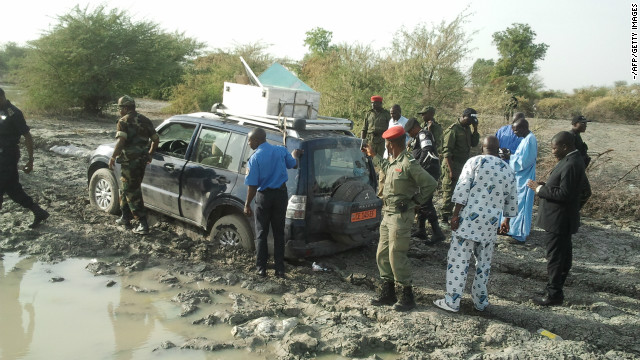
ABUJA, Nigeria — France will not negotiate with gunmen claiming to be from the Nigerian Islamist group Boko Haram who kidnapped a French family of seven, Defense Minister Jean-Yves Le Drian said on Tuesday.  Moreover, while Le Drian deplored the fact children were among the hostages, he stated: “We do not play this bidding game.”

Cameroonian security stands at the French family’s vehicle that they drove before being abducted last week.
(Photo courtesy of CNN)

He went on to say, “we will use all [other] possible means to ensure these and other hostages are freed.”

The three adults and four children were abducted in Cameroon last week.  The father reportedly works for the French company G.D.F. Suez, which is based in Yaounde, Cameroon.  G.D.F. Suez is currently developing a natural gas liquefaction project in Cameroon.  Reports state that the family is being held in Nigeria.

In a video posted on YouTube on Monday, gunmen threatened to kill the family unless authorities in Nigeria and Cameroon release prisoners held there.  The masked man, who identified himself as a Boko Haram agent, states that French President Francois Hollande “started war against Islam, and we must fight him everywhere.”

Boko Haram is believed to have killed at least thousands since 2009 in an attempt to establish an Islamist state in Nigeria.

The kidnapping has illustrated the heightened risk to French citizens in Africa due to France’s involvement in Mali combating Islamic militants.

However, the abduction was the first case of foreigners being seized in the predominantly Muslim north of Cameroon.  This region – with typically porous borders – is considered to be within the operational sphere of Boko Haram and other Nigerian militant groups.

Simultaneous to this abhorrent event, the conflict between Nigerian troops and Boko Haram continued this week in Maiduguri, the capital of Borno state and main base of Boko Haram.

Nigerian troops reportedly killed a suspected Boko Haram commander and three of his lieutenants during a recent operation.  The operation was conducted in order to apprehend Boko Haram fighters thought to be involved in attacks that killed three civilians and left six soldiers wounded last week.

For more information, please see:

BBC – French Family Kidnapped in Cameroon “Shown in Video” – 26 February 2013

CNN – France Blasts “Cruelty” as Boko Haram Displays Kidnapped Family – 26 February 2013

News.com.au – Nigeria Kills Boko Haram Commander – 26 February 2013

Reuters – France Says Will Not Negotiate with Cameroon Hostage-Takers – 26 February 2013

Declassified Documents Reveal Late General Pinochet Planned on Overturning 1988 Referendum Results

By Pearl Rimon
Impunity Watch Reporter, South America

SANTIAGO, Chile — Recently declassified documents revealed that the late Chilean military leader, Augusto Pinochet, wanted to stay in power despite losing a referendum in 1988. Pinochet died in 2006, before he could be brought to trial for numerous charges for corruption and various human rights abuses.

General Pinochet. (Photo Courtesy of AP)

The documents reveal that Pincohet urged his closest military allies in his attempt to overthrow the results. Pinochet’s allies refused and he was forced out of office. His plan was to use military force to seize the country’s capital, Santiago.

In 1990, citizens elected a civilian government to replace Pinochet. The documents released from the U.S. National Security Archive reveal that Pinochet said he would do “Whatever was necessary to stay in power.” He confided in his advisers, “I’m not leaving, no matter what.” U.S. officials warned Chilean leaders against violence if Pinochet used force to stay in office.

The declassified papers reveal that Pinochet was angered after the October 5th 1988 referendum and attempted to overturn the results by summoning members of the military government.  Air Force commander, Fernando Matthei rejected Pinochet’s plans for throwing out the results, and other generals followed suit. A CIA informant present at the meetings said, “Pinochet was prepared on the night of 5 Oct to overthrow the results of the plebiscite,” this information is located in a report by the State Department titled: “Chilean junta meeting the night of the plebiscite.”

The papers also reveal that the anti-Pinochet referendum campaign was supported by the U.S. government despite its early support of the military government due to its overthrow of former president Salvador Allende.

The country voted for a civilian government in 1989, and in 1990, Patricio Aylwin became the country’s first democratic president.The former military government of Chile is estimated to have killed more than 3,000 people between 1973 and 1990.

Pinochet died while under house arrest. The country is divided on how to view Pinochet’s regime, to some he is seen as a violator of human rights due to outlawing political parties, forcing thousands into exile, and having a brutal police force. Pinochet’s loyalist see him in a positive light due to Chile’s growth in economic prosperity.

The newly declassified papers were released at the same time as the movie “No”,  centering on the campaign that caused Pinochet’s downfall. The film was nominated in Sunday’s Academy Awards for Best Foreign Film.

For more information, please see:

Global Post — US pressed Pinochet to accept defeat: documents – 24 Feb 2013

South China Morning Post —

Declassified papers show Pinochet tried to ‘cling on to power’ in 1988 – 24 Feb 2013

 BBC News — Chile’s Gen Pinochet ‘tried to cling to power’ in 1988 – 23 Feb 2013

Times Standard — Report: Chile’s Pinochet wanted anti-vote violence – 23 Feb 2013