25 February 2013 – Financial intelligence experts from six EU member states have joined forces to investigate the money laundering trail uncovered and exposed by late whistle-blowing Russian lawyer Sergei Magnitsky, reported EU Observer.
“The FIUs are working on the case and there will be a follow-up meeting before the summer,” a source at the EU Commission told EU Observer.
According to the EU Observer, the European Commission has formed a joint investigation at a meeting of the Financial Intelligence Units platform on 7 February (http://euobserver.com/magnitsky/119156).
The EU Financial Intelligence Units’ Platform is a group set up in 2006 by the European Commission, which gathers financial intelligence units from the member states. Its main purpose is to facilitate cooperation among national financial intelligence units.
Prior to his arrest and death in custody, Mr Magnitsky gave testimony detailing how a group of Russian government officials and organized criminals stole companies from his client, the Hermitage Fund, and $230 million they had paid in taxes to the Russian treasury. The Magnitsky investigation identified that the thefts from the budget were systematic and took place through the same Russian tax offices both before and after the $230 million theft.
“As EU countries start cooperating and sharing information, eventually the whole money laundering scheme will become crystal clear,” said a Hermitage Capital representative.
By Alexandra Sandacz Impunity Watch Reporter, Europe
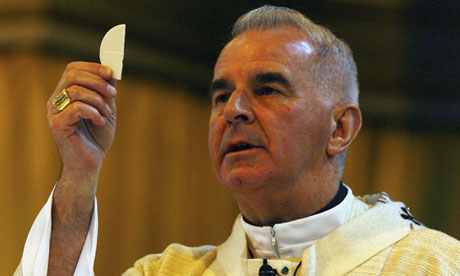
LONDON, United Kingdom – The United Kingdom’s top cardinal, Keith O’Brien, is to step down as an archbishop after news reports of inappropriate behavior toward various priests in the 1980s surfaced. Furthermore, he will not to take part in the election of the next pope to succeed Pope Benedict XVI.
Cardinal Keith O’Brien steps down as archbishop after allegations of “inappropriate behavior” surface.
Cardinal O’Brien’s announcement comes a day after a the British newspaper, The Observer, reported that three priests and one former priest brought allegations against O’Brien that date back 30 years.
One former priest claims Cardinal O’Brien made an inappropriate approach towards him in 1980, after night prayers, when he was a seminarian at St Andrew’s College, Drygrange. Furthermore, he resigned as a priest when Cardinal O’Brien was first made a bishop.
Another complainant says while he was living in a parish, inappropriate contact took place between him and O’Brien. A third complainant stated that he consistently experienced “unwanted behavior” by the cardinal in the 1980s. Lastly, the fourth complainant claims the cardinal used night prayers as an “excuse for inappropriate contact”.
James Robbins, BBC’s world affairs correspondent, reported that for years, the Vatican squashed criticism of other cardinals who might have been involved in covering up sexual abuse. For example, Cardinal Roger Mahony of Los Angeles is attracting attention for his role in the cover-up of sexual abuse by priests.
However, the recent accusations will be taken more seriously because Cardinal O’Brien was allegedly involved directly in improper behavior towards other priests.
Ironically, Cardinal O’Brien is famous for his outspoken defense of Catholic teaching on abortion, euthanasia and homosexuality.
Last year, Stonewall Scotland, a gay rights group, named O’Brien “Bigot of the Year” after he said gay marriage was a “grotesque subversion of a universally accepted human right”.
Catherine Deveney, author of the relevant Observer piece, stated her story was important because the Cardinal set a very adamant “moral blueprint” for the way other people should lead their lives.
She further stated, the four accusers were “men of integrity” who had “done a difficult thing and acted according to their conscience”.
Although Cardinal O’Brien contested the allegations, he stated he would not attend the conclave because he not wish media attention in Rome, during conclave, to be focused on him. Consequentially, Britain will have no voice in the conclave to choose Pope Benedict’s successor.
By Brendan Oliver Bergh Impunity Watch Reporter, South America
PORT-AU-PRINCE, Haiti – Jean-Claude Duvalier, Haiti’s former dictator known as “Baby Doc” return to Haiti was not the homecoming he might have expected. Fleeing the country in 1986 fearing political upheaval and pressure from the United States the ex-president returned to Haiti in early 2011 after a 25 year exile. Upon his return a Haitian court has levied charges of embezzlement; however human rights groups have demanded that he not be excused for his regimes human rights abuses.
Ex-President Jean Claude Duvalier return from exile in Haiti is potentially facing human rights charges. (Photo Courtesy of BBC)
Duvalier took the office of “President for Life” at age 19 after his father, Francois “Papa Doc” Duvalier in 1971. Baby Doc ruled Haiti with his brutal militia in order to maintain control of the country.
Some people speculate that Duvalier’s return may have been for legal impunity. While a January 2012 Haitian court declared that Mr. Duvalier would have to stand trial on the count of embezzling public funds, the court also declared that the statute of limitations had run out on the charges of murder, torture and forced disappearances.
While the statute of limitations may have run out for murder according to Haitian courts, Amnesty International and Navi Pillary, the High Commissioner of the United Nations for Human Rights was quick to point out that there is no limitation for international crimes such as torture, extrajudicial executions, and violations under international law. Pillary continued that Haitian authorities must not allow crimes and abuses from the regime go unpunished, as crimes done in an official capacity do not bar a sovereign from claiming immunity from the civil or criminal jurisdictions of foreign states.
Ex-President Duvalier was supposed to stand before a Court of Appeals judge earlier this month to see if he would stand trial for human rights abuses. The ex-President already missed a January 31st and February 7th hearing date which would have decided whether or not he would face a Haitian court for human rights abuses for crimes committed under his regime.
The exiled leaders’ refusal to attend a hearing where he might be charged with crimes against humanity has been seen as an affront to his victims and their families. There have been suggestions from Haitian human rights groups that he be seized and stripped of his diplomatic passport so he would meet his next court date and not flee the country. So far the former president has not been penalized for his blatant skirting of the law and its procedures.
By Dylan Takores Impunity Watch Reporter, Middle East
JERUSALEM, Israel – Palestinian inmate Arafat Jaradat, 30, suffered a fatal heart attack on Saturday, February 23, while detained in an Israeli prison. His death sparked a wave of protests throughout the Middle East in solidarity with the Palestinian cause.
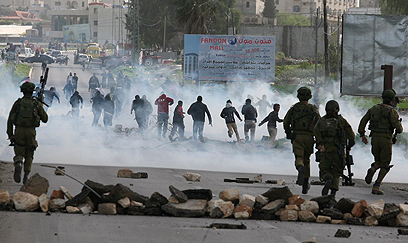
Protests near Hebron. (Photo Courtesy of AFP)
Jaradat was one of the approximately 4,500 Palestinians currently held in Israeli prisons. He was arrested for allegedly throwing stones at Israeli soldiers last week. His death reportedly occurred following an interrogation session by Israeli guards.
Hundreds of Palestinian inmates are presently engaged in a hunger strike, protesting the unjust treatment of Palestinian detainees. Sympathizers to the Palestinian cause view Jaradat’s death as a prime example of the mistreatment that the inmates suffer while in Israeli detention.
In response to Jaradat’s death, Issa Qaraqaa, the Minister for Prisoners’ Affairs for the Palestinian National Authority (PNA), stated in a news conference that the Israeli guards subjected Jaradat to physical and psychological torture.
Qaraqaa continued, “he was harshly interrogated, and Israel is the only country which still uses such inhuman methods.” He added that the torture Jaradat suffered “contradicts with the international law of human rights.”
Palestinian protestors in Gaza openly confronted Israeli soldiers. The unarmed protestors waved flags, chanted, and some hurled stones at the armed forces. The Israelis fired tear gas and stun grenades into the crowds causing injuries to several protestors.
Two Palestinian protestors, Helmi Abdul-Aziz, 24, and Mustafa Hilal, 14, were shot on Saturday during a protest in the village of Kusra on the West Bank. The wounds were not fatal, but both suffered severe injuries. Israeli military officials maintain that it was Israeli civilians that shot the protestors because the soldiers were not using live ammunition.
Other clashes broke out near Jenin, Ramallah, and in Jaradat’s home town of Hebron. Outside of Israel, Egyptian activists also scheduled a protest to take place Sunday in Cairo near Tahrir Square.
Though the official Israeli autopsy claims Jaradat died of cardiac arrest, Qaraqaa believes that Jaradat’s death was a direct result of the torture. The autopsy found internal bleeding and broken ribs, but the source of these injuries is still unknown.
Yitzhak Molcho, a personal representative for the Israeli Prime Minister Benjamin Netanyahu, made an “unequivocal demand” to the PNA to quell the rising protests. PNA spokesman Adnan Damiri responded that the Palestinian resistance to Israeli troops is a “legitimate right given to any people to defend themselves and get rid of the occupation.”
By Madeline Schiesser Impunity Watch Reporter, Europe
KARLSRUHE, Germany – In a historic step, Germany’s highest court last week handed down a ruling which will strengthen gay couples’ adoption rights. The same day, the European Court of Human Rights ruled against an Austrian policy that had denied certain adoption rights to gay couples.
Last Tuesday, High Courts in Europe handed down decisions expanding adoption rights of gay couples in Germany and Austria. (Photo Courtesy of Spiegel International)
The German Court ruled that same-sex couples have the right to adopt the adopted or step-child of his or her registered partner, a practice known as successive adoption. German laws allow for the adoption of a same-sex partner’s biological child, while a married heterosexual person can already adopt a partner’s adopted children.
Germany does not permit marriage between homosexual couples, but homosexuals have had the right to form civil partnerships since 2001. The government has been accused of procrastinating on the issue of legalizing same-sex marriage when compared with other countries such as France and the United Kingdom, which are actively addressing the issue. However, Chancellor Merkel’s spokesman said the government views the ruling “with great respect” and is in the process of considering how to comply with it.
Giving the government until June 2014 to amend the law in conformance with the ruling, the Court explained, “The exclusion of successive adoption by registered partners violates the general principle of equality.”
The Court further reasoned, “In marriage as in a civil partnership, adoption provides the child in the same way with legal security and material advantages in terms of care, support and inheritance law.”
However, the ruling stopped short of allowing same-sex couples to adopt children as a couple. Much to the frustration of Germany’s main gay rights group, under the ruling, same-sex couples are restricted to adopting the same child on an individual basis.
The case was brought before the Court by a doctor from Münster who had been denied the right to adopt her long-term partner’s adopted Bulgarian daughter.
Volker Beck, an openly gay senior lawmaker with the opposition Green Party, greeted the ruling enthusiastically as “a breakthrough in equal treatment.” He has announced that the Green Party will propose a draft law in the German Parliament to grant gay couples equal adoption rights with heterosexual couples, including tax breaks.
By contrast, an Austrian lesbian couple went all the way to the European Court of Human Rights (ECHR) to earn the right to jointly be recognized as the parents of one of the partner’s biological son.
While Austrian law allowed unmarried heterosexual couples to adopt the biological child of one’s partner, no such right was extended for homosexual couples. The Austrian government argued before the Court that the purpose of its current law were to uphold a traditional family model.
However, the ECHR ruled against the Austrian government, finding its adoption legislation discriminated based on sexual orientation. The court stated, “No convincing reasons had been advanced to show that such difference in treatment was necessary for the protection of the family or for the protection of the interests of the child.”
The court further asserted, “there is not just one way or one choice when it comes to leading one’s family or private life,” emphasizing that the government had failed to show that an LGBTI couple could not adequately provide for the needs of a child.
Martin K.I. Christensen, Co-Chair of the International Lesbian and Gay Association-Europe’s Executive Board said: “We hope that this judgment will pave the way towards the removal of the remaining legal barriers for [LGBTI] families in Europe.”