Tear Gas Present at Funeral for Chokri Belaid

By Justin Dorman
Impunity Watch Reporter, Middle East

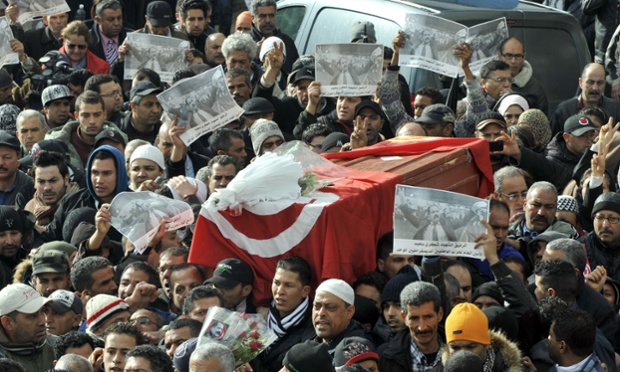
TUNIS, Tunisia – Popular secular politician, Chokri Belaid, was shot in the neck and head and killed just outside his home in Tunis, on his way to work, a couple of days ago. This was the first time a politician was assassinated in Tunisia since the Arab Spring uprising of January 2011. Today thousands of supporters attended his funeral while many others protested all throughout the country.

Tens of thousands of Tunisians attend the funeral of assassinated secular political leader Chokri Belaid.

Belaid was a human rights activist and lawyer who was the co-head of the leftist Democratic Patriots Party. Although the party lacked much power in Tunisia, Belaid was seen as an outspoken critic of the government who, for many, symbolized the Tunisian revolution.

French President Francois Hollande stated that, “[t]his murder robs Tunisia of one of its most courageous and free voices.”

A day before his assassination, Belaid partook in a televised interview in which he blamed the moderate, Islamist Ennahda party for giving “an official green light” to political violence. He also claimed that Ennahda and Salafists attacked a meeting of his liberal supporters this past Sunday.

The prime minister, Hamadi Jebali, has promised to act swiftly in arresting the perpetrator of what he deems to be a terrorist act. President Moncef Marzouki said that, “[t]here are many enemies of our peaceful revolution. And they’re determined to ensure it fails.”

Despite not yet knowing who committed the murder, in the wake of Belaid’s death, demonstrators have set an Ennahda party building on fire in Mezzouna. Others ransacked raided the party’s offices in Gafsa where petrol bombs were used. At least half a dozen Ennahda buildings have been destroyed so far.

Additionally, crowds of protestors have been chanting “Ghannouchi, assassin, criminal” and that they want a “second revolution.” Rachid Ghannouchi is the leader of the Ennahda party.

Throughout the many protests across the country, the police have fired tear gas at the demonstrators to disperse them. The use of tear gas was not absent from Belaid’s funeral either; however, this time the police were not trying to get rid of Belaid’s supporters.

The funeral was rather peaceful for a while, with little security intervention. Reports have indicated though, that while the mourners’ procession approached the cemetery to lay Belaid’s body to rest, that young men just outside the cemetery were attempting to steal mourner’s phones cameras, and cars. When police tried to stop these individuals, the young men began throwing stones at the police and began to set the cars ablaze. As a result, the police were forced to use tear gas which ultimately found its way into the cemetery.

Reports out of CNN indicate that the tens of thousands of mourners last stop in its procession may not be the cemetery. Apparently, there may also be a plan to march to the Ministry of the Interior after the funeral. Police fired tear gas there just a day ago to get rid of protestors.

For further information, please see:

Alchourouk – Two Days MRA Assassination Belaid Preoccupation with Security Back: Congestion in the Street and Horror Among Citizens – 8 February 2013

Assabah – The Final Lesson – 8 February 2013

Guardian – Tunisia Turmoil: Chokri Belaid’s Funeral and General Strike – Live Updates – 8 February 2013

BBC – Tunisia: Chokri Belaid Assassination Prompts Protests – 6 February 2013

Chilean Marines Caught On Tape Chanting Xenophobic Tunes

By Brendan Bergh
Impunity Watch Reporter, South America

SANTIAGO, Chile – Discomfort rocks the already uneasy relations among in the South American continent. The Chilean government has felt the sting of embarrassment as a video surfaced early Wednesday morning of Chilean Marine Cadets jogging through town chanting what is being called, a ‘xenophobic’ chant. “Argentinos kill, fusilare Bolivian, Peruvian killeth,” the video echoes, or translated as “Kill Argentines, shoot Bolivians and slit the throats of Peruvians.”

A video showing Chilean Marine students chanting xenophobic songs surfaced earlier this week. (Photo Courtesy of BBC)

The posted video was recorded by tourists visiting the coastal city of Las Salinas. Nearby the Naval Polytechnic Academy was busy, training the new batch of Chilean marines and technical soldiers for the new age. Late in the afternoon a group of ‘apprentices’ began trotting by in formation, led by a superior, chanting as they made their way to the city’s main attraction – a large flower clock tower – before returning to base.

Upon the videos dissemination via the internet the Navy immediately began the process of identification and within hours was able to identify all participants.  According to the Chilean Secretary of State, the event took place on January 28, at about 1600 hours. The Navy was almost immediately able to identify the 27 apprentices from the Academy Polytechnic, including the sergeant who was acting as an instructor.  According to reports, many of the 27 were engineering students, second year apprentices training in the mechanical field for senior technical positions before graduating as a marine. The Navy and Secretary of State were quick to denounce the apprentices actions emphasizing that “these practices are far from their doctrine” and believed that the songs were improvised to move along with the normal military marching songs.

But according to Internet users from twitter and social media, this may not have been a singular instance. While some came to the Academy’s defense, claiming that this was merely the isolated incident, others including a former graduate from the Polytechnic Academy explained that these chants are sung every day during their physical training. Another user managed to quote an allegedly missing line: “and we’ll drink their blood.”

Reeling back from the controversy, the secretary of state was quick to point out that while sanctions and punishments were to be leveled, it is currently unclear where blame should be associated with. Merely the recruits jogging and chanting, or their sergeant. Either way, the State Department will has stated that they establish an administrative inquiry within 20 days to determine possible sanctions.

For more information, please see:

La Nocion – The Chilean Navy Already Plans Xenophobic Chants Sanctions – 8 February 2013

Noticias Terra – Argentina Expressed “Discomfort” With Chilean Sailors Xenophobic Chants – 7 February 2013

Noticias Terra – Government And Xenophobic Chants: “Lyrics Are Offensive” – 7 February 2013

Latercera – Navy Report On Video Identifies Higher By Apprentices And Sets 20 Days To Assess Penalties – 7 February 2013

BBC – Chile Navy Investigates ‘Xenophobia’ In Video – 6 February 2013

Ireland Releases Report on Forced Labor at Magdalene Laundries

By Madeline Schiesser
Impunity Watch Reporter, Europe

DUBLIN, Ireland – Describing the severe conditions in the Magdalene laundries, one survivor revealed: “In our heads, all we could think of is we are going to die here. That was an awful thing to carry.”  A report released Tuesday by Ireland’s Department of Justice and Equality found “significant” State involvement in their suffering.

Girls as young as 9 were institutionalized at the Magdalene laundries under a regime of intimidation, prayer, and unpaid work. (Photo Courtesy of BBC News)

The Magdalene laundries constitute an infamous chapter in Irish history in which between 1922 and 1996 more than 10,000 women, aged 9 to 89, were institutionalized in ten workhouses run by several Catholic congregations under conditions described as “cold with a rigid and uncompromising regime of physically demanding work and prayer and many instances of verbal censure, scoldings and humiliating put-downs.”  The women and girls worked to exhaustion each day behind locked doors, without wages, from 8:30am to 7pm in strict silence.  Some worked to death.

Following the report’s publication, survivor Mary Smyth described her experience: “You got up at six in the morning and went to the laundry, then ate at two o’clock.  The food was just horrific – dripping every day.  Six o’clock was the rosary, then back to bed we went.  Nobody was allowed to talk whatsoever. It was worse than any prison.”

The Irish government commissioned an inter-departmental committee, chaired by Senator McAleese, to investigate state involvement with the Magdalene laundries after the UN Committee Against Torture called on the government to do so in 2011.

The report also found from interviewing survivors that certain allegations such as severe physical and sexual abuse had been exaggerated, except in isolated cases.  More often, the inquiry, led by Senator Martin McAleese, found that the women had been subjected to “verbal abuse,” “belittling comments” and “mental cruelty.”

One woman told the inquiry: “The nuns were very nasty.  They’d say, ‘Your father is a drunkard’ in front of everyone.  It would degrade me.”  Another said: “They were very, very cruel verbally – ‘Your mother doesn’t want you, why do you think you`re here.’”

Girls from the laundries gained a reputation as “troubled” or being what were then called “fallen women.”  Despite a rumored reputation for such, the report found no evidence that unmarried girls had babies in the laundries or that many of the women were prostitutes.

However, the report did find that half the women shut away in the laundries to do “harsh and physically demanding work” were girls under the age of 23, and that 40%, or more than 4,000 women, spent more than a year incarcerated.  15% of women were kept in the laundries for more than 5 years, although the average term was 7 months.  Some were incarcerated more than once.  Of the deaths on record, the youngest victim was 15, while the oldest was 95.

Mary Lou McDonald, deputy leader of the Sinn Féin party, described the findings of the report as “a very Irish form of slavery.”

The statistics were compiled from only eight of the ten laundry workhouses because two, both operated by the Sisters of Mercy in Dun Laoghaire and Galway, were missing a substantial portion of their records.  The inquiry committee also stressed that it had interviewed just a small sample of survivors who “cannot be considered representative”, and that the interview data was “biased towards more modern years.”

While according to the report nearly a fifth (19%) of the women entered the laundries voluntarily and one in ten (10%) were sent by their families, more than a quarter (26%) were institutionalized by the state.  Petty offences including failure to pay a train ticket, school truancy, and vagrancy were sufficient to land a girl in the Magdalene laundries.  Furthermore, if a girl was recalled to the laundries or ran away, she could be arrested without a warrant by the police.

Previous Irish governments had claimed that the Magdalene Laundries were run purely privately, an assertion flatly contradicted by the findings of the report.  It also appears that the government either directly or indirectly funded the laundries by providing a significant portion of their business.

Fergus Finlay of the Barnardos children’s charity asserted that the report catalogues “how the state turned a blind eye to the appalling conditions in which women lived, while supporting the religious orders who enslaved them in financial and other ways. These women were treated like slaves.”

The Religious Sisters of Charity, one of the orders that operated the laundries applauded the report, while simultaneously apologizing for and defending its actions, saying: “We apologi[z]e unreservedly to any woman who experienced hurt while in our care. In good faith we provided refuge for women.”

Irish Prime Minister Enda Kenny, while expressing sympathy for survivors and the families of those who died, stopped short of issuing a formal government apology.  Instead, he stated: “To those residents who went through the Magdalene Laundries in a variety of ways, 26 percent of the time from state involvement, I am sorry for those people that they lived in that kind of environment.”

Survivor advocacy group Justice for Magdalenes rejected Kenny’s statement and demanded a full, frank admission of responsibility from the government and religious orders involved, saying that the prime minister’s statement fell “far short of the full and sincere apology deserved by the women who were incarcerated against their will in Ireland’s Magdalene laundries”.

There have also been calls for compensation for the survivors, to which the government has not responded, desiring to wait until after the lower house of Ireland’s parliament debates the report in two weeks.  However, Irish president Michael D. Higgins has expressed his support for compensation and a state apology, saying Thursday, “[W]e need a public response, an institutional response and a State response and the State no doubt will make its own decisions and take its own actions.”

Of the women and girls of the Magdalene laundries, report author Senator McAleese wrote: “None of us can begin to imagine the confusion and fear experienced by these young girls, in many cases little more than children, not knowing why they were there, feeling abandoned, wondering whether they had done something wrong and not knowing when, if ever, they would get out to and see their families again.”

For further information, please see:

Irish Times – President ‘Moved by Their Story’ – 7 February 2013

Irish Times – ‘All We Could Think of is We are Going to Die Here. That was an Awful Thing to Carry’ – 6 February 2013

Irish Times – Kenny Under Fire for Failure to Issue Full Apology to Magdalene Women – 6 February 2013

Al Jazeera – Irish PM Says ‘Sorry’ for Laundries Abuse – 5 February 2013

BBC News – Irish PM: Magdalene Laundries Product of Harsh Ireland – 5 February 2013

The Independent – Ireland Issues Apology to the ‘Fallen Women’ it Sent to Catholic Workhouses – 5 February 2013

Irish Times – State had ‘Significant’ Role in Magdalene Laundry Referrals – 5 February 2013

Department of Justice and Equality – Report of the Inter-Departmental Committee to Establish the Facts of State Involvement with the Magdalen Laundries – 5 February 2013

South African Teen Dies After Gang Rape Attack

By Heba Girgis
Impunity Watch Reporter, Africa

CAPE TOWN, South Africa—Today, Wednesday February 6, 2013, a 17-year-old South African girl died of injuries inflicted on her in a gang rape several days before. Her death stimulated outrage today in a country that has one of the world’s highest levels of sexual violence.

Many reports of sexual violence continue to go unreported in South Africa. (Photo Courtesy of BBC News)

The young victim had been sliced open from her navel to her genitals and left on a building site in the town of Bredasdorp, about 130 kilometers east of the country’s capital. The victim was able to identify one of her attackers before she died as the hospital staff who fought to save her life also counseled her due to the horrific nature of her injuries.

In the hours after the attack, the young girl was taken to three different hospitals—the town’s Otto du Plessis hospital, then the main hospital in Worcester, and finally the Tygerberg hospital.

Troy Martens of the ANC Women’s League said, “It is difficult to find reason behind the many different acts of gang rape, child rape, rape of the elderly, corrective rape and male rape.” The South African police figures and records show that about 64,000 sexual offense cases were reported last year, and that many attacks still go unreported.

South Africa’s statistics agency concluded 13 years ago, in the year 2000, that it had the highest reported rape rate of all 120 Interpol member countries. The report also recognized that even when suspects are caught, only about 12 percent of cases end in a conviction. With these statistics comes the reality that sexual crimes rarely spark outrage; until today.

The death of this young girl has sparked outrage in South African and has been condemned by female politicians of the country’s governing party. Martens argued that the women’s league and the other few women’s non-governmental organizations would no longer be the “lone voices crying out against rape.”

Martens continued saying, “Men and women need to join hands around this issue and fight this epidemic together. The Women’s league and a few women’s NGOs can no longer be the lone voices crying out against rape.”


For further information, please see:

BBC News – South African Gang Rape Murder Angers ANC Women – 6 February 2013

IOL News – Girl, 17, Identifies Attacker Before Dying – 6 February 2013

Reuters – South African 17-Year-Old Dies of Gang Rape Injuries – 6 February 2013

Voice of America – South African Teen Dies of Gang Rape Injuries – 6 February 2013

Syria Revolution Digest: 5 February 2013

How You Failed Syria!

Syrian Revolution Digest – February 5, 2013 

How you failed Syria, let me count the ways: you abandoned her when her movement for democratic change was nonviolent. You let Assad violate her and kill her children. You turned your back on her children when they rushed to her rescue, and pretended you were unaware. You uttered words of sympathy and encouragement, and sent few blankets and tents to people who were at the mercy of mortars and MiGs, not only the elements. You tied her fortunes to complicated geopolitical agendas that are beyond her control or interest. You let her legitimate aspirations and her all too human and humanitarian needs be the last entry on a long list of objectives. What do you expect of her now? Would tell her she is wrong to hate you? Would you blame her should she implode? Do you really think she would care anymore?


Tuesday February 5, 2013


Today’s Death Toll: 113 martyrs (including 6 women and 11 children): 41 in Aleppo, 41 in Damascus and Suburbs, 9 in Daraa, 4 in Homs, 4 in Idlib, 4 in Raqqa, 3 in Hama, 2 in Deir Ezzor and 1 in Lattakia (LCCs).


Points of Random Shelling: 281 points, 17 points were shelled by warplanes, 1 point by Phosphorus Bombs, 1 point by Thermobaric Bombs and Cluster Bombs and 1 points by barrel bombs. Artillery Shelling was reported in 138 points, mortar shelling in 96 points and missile shelling in 47 points across Syria (LCCs).


Clashes: 131. Successful rebel operations included an aerial raid mounted by a defect pilot against loyalist militias in the village of Safsafiya in Hama. In Aleppo, FSA rebels forced down a helicopter and liberated the Mulhab Barracks in the neighborhood of Khaldiyeh. In Daraa, rebels gained control of a loyalist checkpoint in Daraa Al-Balad (LCCs).


News

Ahtisaari: Major powers failing Syria Nobel Peace Prize Winner Martti Ahtisaari blames the lack of progress in Syria on the divided UN Security Council. He tells DW that he sees elections – not an interim government – as the best option.

UN warns of deepening humanitarian crisis in Syria “If the violence continues unabated, we could, in the short term, see considerably more than the current four million in need of urgent assistance and more than two million internally displaced in Syria,” the spokesperson for the UN Office for the Coordination of Humanitarian Affairs (OCHA), Jens Laerke, told a news conference in Geneva. “Organizations are struggling to reach more people, in more places, with more aid, but lack of access is still a major obstacle,” he added.

Disease spreads as Syria casualties and drug shortages grow: WHO “The biggest concern for us is the breakdown of the water and sanitation system and the increasing numbers of water-borne diseases,” WHO representative Elisabeth Hoff told a news briefing about the deteriorating health situation on the ground. Hepatitis A, a viral liver disease that can cause explosive epidemics, has been reported in Aleppo, Idlib – where there has been intense fighting – and some crowded shelters for the homeless in the capital, she said by telephone from Damascus. Aid groups have had to start using alternatives to purify water because the import of chlorine gas has been banned over fears it could be misused as a chemical weapon.

Pressure mounts on Assad over Syria opposition’s offer Assad himself has yet to comment on the offer from Ahmed Moaz al-Khatib, leader of Syria’s opposition National Coalition, but pro-regime Al-Watan newspaper described it as a political “manoeuvre” that comes two years too late.

Syria opposition ponders course as leader offers talks Sheikh Moaz Alkhatib, the moderate Islamic cleric who leads the 70-member assembly, said he would be ready to meet Assad’s ceremonial deputy, Farouq al-Shara, if Assad fulfils conditions including the release of tens of thousands of political prisoners. “The Coalition needs to convene to chart an urgent strategy after the reverberations of the initiative and seize on the momentum it has created, regardless of the reservations of some members,” one Coalition official said. While some opposition figures have criticized Alkhatib’s offer to talk to Assad’s representatives, others say it could expose Assad’s proposals for dialogue as hollow.

Islamic summit to urge Syria transition: draft The declaration, due to be issued after a two-day summit of 56-member Organisation of Islamic Cooperation in Cairo starting on Wednesday, does not mention President Bashar al-Assad and pins most of the blame on his government for continued violence… “We strongly condemn the ongoing bloodshed in Syria and underline the Syrian government’s primary responsibility for the continued violence and destruction of property,” the draft communique said. “We express grave concern over the deteriorating situation the increasing frequency of killing which claims the lives of thousands of unarmed civilians and the perpetration of massacres in towns and villages by the Syrian authorities.” It was not clear whether Syria’s ally Iran, which is attending the OIC summit, would back the tough wording.

Syria rebels tighten noose around key Idlib city Insurgents have tightened their noose around the city of Jisr al-Shughur, held by forces loyal to President Bashar al-Assad, but refrain for now from staging further attacks, and an eerie calm prevails in surrounding villages.

Palestinian Officials to Try to Secure Syria Camps Ahmed Majdalani said Tuesday that representatives will meet Syrian officials to try to protect Palestinian areas from fighting that has engulfed parts of the capital Damascus. Generations of Palestinian refugees have lived in the crowded Damascus area of Yarmouk since their forefathers fled, or were forced to flee, their homes during the 1948 Mideast war surrounding Israel’s founding. Majdalani said they also will try to convince Palestinian factions to stay out of the fighting. The some 500,000 Palestinians in Syria are divided between supporters of rebels and government forces.

Third Iron Dome station in North amid Syria tensions An army spokeswoman said that the anti-rocket systems were continuously in the process of being moved, and did not draw a link to the deployment with any current events… The Army Radio report said that the deployment “does not signal pinpoint information on an expected missile attack on Israel, but in light of the reports of an Israeli attack in Syria [last week], and the threats being heard in Lebanon and Iran, the IDF is not taking any chances.”

Syria scales back threats against Israel over airstrike, suggests it won’t retaliate Syria’s defense minister signaled Monday that his country won’t hit back at Israel over an airstrike inside Syria, claiming the Israeli raid was actually in retaliation for his regime’s offensive against rebels he called “tools” of the Jewish state. “The Israeli enemy retaliated. When the Israeli enemy saw that its tools are being chased and did not achieve any (of their) goals, they interfered,” he responded. “It was a response to our military acts against the armed gangs,” al-Freij added. “The heroic Syrian Arab Army, which proved to the world that it is a strong army and a trained army, will not be defeated.” In surprisingly candid remarks, al-Freij said that rebels have made Syrian air defenses across the country a focus of their attacks over the past months, attacking some with mortars while attempting to seize others in order to incapacitate them. In response, he said the Syrian leadership decided to station them all in one safe place, leading to “gaps in radar coverage in some areas.” “These gaps became known to the armed gangs and the Israelis who undoubtedly coordinated together to target the research center,” he said. He suggested the army was overstretched and finding difficulty retaining control over several positions across the country, adding they had to abandon some areas to minimize casualties.


Special Reports

‘The Kiss’ In Syria: Artist Tammam Azzam Goes Viral With His Take On Gustav Klimt’s Artwork (PHOTOS)

Syrian artist Tammam Azzam took the twittersphere by storm last week when he posted an image of Gustav Klimt’s “The Kiss” superimposed on the facade of a bullet-ridden building in Damascus. The photoshopped image — which some mistook for an actual street-side mural — brought the eye of the art world to the artist’s war-torn home country.

Syrian rebel raids expose secrets of once-feared military

Former regime strongholds are now being picked clean – and some are underwhelmed by what lies behind the perimeter walls

Through Social Media, Tracking Rape In Syria

The Women Under Siege project is live-tracking how sexualized violence is being used in Syria. What’s new is the data: information collected through crowdsourcing – reports on Facebook, Twitter and YouTube from inside the country — which is then analyzed by public health researchers at Columbia University. The project’s crowdmap keeps an up-to-date tally in visual form: incidents of sexual violence are represented by dots on a map — the larger the dot, the more reports of rape.

The Rise of Syria’s Kurds

In a remarkably short time, the PYD has succeeded in setting up a well-armed military of about 10,00 fighters, known as the Popular Protection Units (or Yekineyen Parastina Gel, or YPG), as well as local, self-organized civilian structures under the label of the “Movement for a Democratic Society” (Tevgera Civaka Demokratik, or TEV-DEM). In theory, the PYD shares power with some 15 other Kurdish parties (who form the Kurdish National Council, or KNC) in the framework of the Kurdish Supreme Council, which was established in July 2012 through the mediation efforts of Massoud Barazani, president of Iraqi Kurdistan and leader of Iraq’s Kurdistan Democratic Party (KDP). Yet on the ground, the PYD is dismissing its council partners as nothing more than proxies for Barazani himself, whose close relationship with Turkey the PYD deeply mistrusts. Additionally, the PYD has prevented any armed Kurdish presence besides its own loyalist Populist Protection Units; most recently, armed altercations were reported with the Kurdish Union Party in Syria (Yekiti) in the towns of al-Darbasiyah and Qamishli.

Killed By the Regime: Aleppo’s River of the Dead

For weeks now, the river has brought new bodies almost every night. The corpses arrive without any identification and the hands are generally tied together with plastic strings. The men have all been shot. The week before last, the river carried three bodies on some days, and seven on others. Last Monday there were five, but on Tuesday there were almost 80. There had been heavy rain in the night, the river level had risen, and now corpses were lining the muddy river bank… The dead were students enrolled at the University of Aleppo who had come from other cities to stand exams.

Syrian Justice and Accountability Center: Lionesses and Sectarianism

News of the women’s unit, a part-time and volunteer fighting force known as the “Lionesses for National Defence,” made headlines mid-January. A video from the Russia Today Arabic TV shows the soldiers in uniform as they train and chant pro-Assad slogans. They have already been deployed in Homs and carry out security operations and guard checkpoints. The rationale for the women’s unit has been explained by Assad’s need for new recruits and perhaps as a morale-boosting tactic aimed to draw his supporters into a closer community.

Syria’s Fate Hinges on Whom It Hates Most, U.S. or Iran?

Benign neglect, however, hasn’t been so benign. Syria’s humanitarian crisis has reached epic proportions, with more than 60,000 people killed and 2.5 million people displaced. The sense of abandonment and desperation felt by many Syrians has served to strengthen the most radical elements of the rebel forces, some of whom are thought to be aligned with al-Qaeda. Syria’s hemorrhaging will continue to fuel radicalism until there is a change of political leadership in Damascus. In order to expedite this process, the U.S. administration must inhibit Iran’s ability to arm and finance Assad… A greater U.S. role won’t render Syria an American-allied democracy. That possibility, if it ever existed, has long been lost. But continued U.S. inaction risks leaving Syria at the mercy of Iran and Sunni extremists whose intolerance, and hatred of the U.S., dwarfs any concerns they may have for the well- being of Syria and its people. Such an outcome would haunt Syria, the Middle East and the U.S. for years to come.


My new paper, prepared for a briefing in Washington, D.C. that took place on January 15, 2013, is now out and is titled “Syria 2013: Rise of the Warlords.” It should be read in conjunction with my previous briefing “The Shredded Tapestry,” and my recent essay “The Creation of an Unbridgeable Divide.


Responses


My friend, Daniel Serwer, from SAIS, refers to my earlier posting on Alkhatib’s and Assad’s “finitiatives,” and expresses certain doubts as to whether Alkhatib’s move will serve to “weaken or strengthen his position,” as opposition leader, noting that “the uncertainty is itself debilitating.” He is right. Alkhatib made quite a gamble, but that’s what real leaders need to do in times of crisis in order to break the stalemate. There are no guarantees of success. But a political move was clearly needed, and I think what Alkhatib started is the right move at this particular time on the political front, even if it failed.


Meanwhile, the Guardian found my endorsement of Alkhatib’s “finitiative” to be surprising, considering my hawkish background and my affiliation with a neocon think tank:


Khatib’s call for conditional dialogue with the Syrian government has been backed by unlikely the source – Ammar Abdulhamid a usually hawkish Syrian dissident and blogger. Abdulhamid, fellow at the Foundation for Defense of Democracies, which is regarded as a NeoCon thinktank, said an armed struggle should continue alongside Khatib’s call for talks.


But I am not motivated by ideology. I stared preaching a jasmine revolution long before it became fashionable to do so, but, when people opted for armed struggle, people like me were not in a position to contradict them and dissuade them from doing so: I did not have the standing or the leverage to do this. So, my best option at that stage was to make sure that the rebels had the material and political support they need to win. If you cannot prevent a certain development, you can at least try to guide it or influence it to the best of your ability. The objective is still democratic change in the region, and not only Syria, breaking the Assad regime is simply the beginning of a long process, a generational process.


Video Highlights


Rebels from the Syrian Islamic Front attack a loyalist convoy near the town of Zabadani, Damascus (February 4) using a roadside bomb http://youtu.be/Xz4a6MQwXpk


Rebels in Eastern Ghoutah, Damascus, attack the Tamico Checkpoint using RPGs http://youtu.be/-yAQ8y7EKng Even cows are not safe from random shelling by the regime, as this clip from a farm in the village of Hujairah in Eastern Ghoutah shows http://youtu.be/gd1X4XLLn7I A plane overfly the village in preparation for another raid http://youtu.be/JS1Ue-mNzxA Houses catch fire in Sbeineh http://youtu.be/U2U5Rv4lYNA


Not too far, in Damascus City, a MiG carry out an aerial raid against Al-Qadam neighborhood http://youtu.be/k5MSL-q-93I , http://youtu.be/QoDuEQH2EOQ


Back to the west, and in the town of Daraya, rebels destroy a marauding regime tank http://youtu.be/IT6N8URM9YY But other tanks keep wreaking havoc http://youtu.be/hXP8Byq8uvs And the clashes continue http://youtu.be/zZeoIbJpsMc


The bodies of loyalist soldiers from the Republic Guard are strewn in a side street in Deir Ezzor City http://youtu.be/Fk-tYoFrok8 On the outskirts of the city, rebels target loyalist positions with their own heavy artillery http://youtu.be/nUFYa_QK19k


Rebels from Al-Tawhid Brigade in Daraa City storm a loyalist checkpoint http://youtu.be/yXSG0_a2M1o


In Aleppo, rebels clash with loyalist troops in Massakin Al-Sabeel http://youtu.be/KIGlt2FBdms , http://youtu.be/k6nM5iWVJ6w , http://youtu.be/MtkvvaLWhj4