Somali Rape Victim Charged Over Rape Report

By Ryan Aliman
Impunity Watch Reporter, Africa

MOGADISHU, Somalia – On Tuesday, the Somali government prosecuted a woman who accused members of the army of raping her.

Somali journalists protest as they demand for the release of a colleague who wrote about women who were allegedly raped by Somali soldiers. (Photo courtesy of Human Rights Watch/Badri Media)

Since then, the United Nations and various international human rights groups have demanded that the charges against her be dropped.

Earlier this month, Al-Jazeera English published a story about government soldiers raping internally displaced women in Mogadishu camps. Several days after the publication, the Somali police’s Central Investigation Department (CID) in Mogadishu arrested the reporters involved in writing the story.

2 weeks later, a Mogadishu court charged one of the women interviewed for the Al-Jazeera report. She was charged of insulting the government on the basis of false evidence. According to the court’s decision, she fabricated the rape allegations against the Somali soldiers making her guilty of spreading false accusations. Doing so, she effectively “insulted and lowered the dignity of a National Institution,” said the court.

The woman’s husband was also charged and arrested. He was accused of helping his wife evade investigation and secure a profit for the rape allegation. The government claimed that he and his wife agreed to the Al-Jazeera interview, not only with the intention of discrediting the administration, but also of profiting from it.

After the couple’s arrest, the alleged rape victim recanted her story. She later admitted that all the accusations she made against the Somali security forces were “bogus”.

Her conviction sparked outrage among human rights advocacy groups. They believe that it will deter rape victims from coming forward in spite of recent efforts of trying to empower them.

“Allegations of rape should be met with objective investigations by the proper authorities, not detention for victims who come forward or arrest for journalists who report on such crimes,” insisted Zainab Hawa Bangura, the UN Special Representative on Sexual Violence in Conflict.

Fartuun Adan, a volunteer who runs a shelter for abused women in the country, expressed her concern and fear about the consequences of the woman’s prosecution. “Women are now asking me, ‘Who’s going to protect us?’ ” she told local newspapers. “They’re saying, ‘What are we supposed to do?’ ”

According to Daniel Bekele, the Africa director at Human Rights Watch, the case is “politically motivated”. “The police ‘investigation’ in this case was a politically motivated attempt to blame and silence those who report on the pervasive problem of sexual violence by Somali security forces,” he said. “Bringing charges against a woman who alleges rape makes a mockery of the new Somali government’s priorities,” Bekele added.


For further information, please see:

Al Jazeera – Somali journalist charged over rape report – 31 January 2013

Huffington Post – Somalia: Government Charges Woman Who Says She Was Raped By Security Forces – 31 January 2013

All Africa – Somalia: Somali Authorities Lay Charges Against Alleged Rape Victim and Journalist – 30 January 2013

The New York Times – Somalia Moves to Prosecute Woman Who Accused Soldiers of Rape – 30 January 2013

Kremlin Opens New Posthumous Case Against Magnitsky Holding him Responsible for Russian Default in 1998

Press Release
Hermitage Capital

1 February 2013 – Today it was reported by RIA-Novosti Russian news service that Russian law enforcement agencies have begun investigating Sergei Magnitsky for allegedly being responsible for the Russian default during the 1998 financial crisis. This is the fourth posthumous accusation put forward by Russian authorities, who refuse to investigate officials responsible for the thefts uncovered by Mr Magnitsky, his arrest, ill-treatment and death in custody. Mr Magnitsky died more than three years ago, on 16 November 2009 when he was found dead on the cell floor after the use of rubber batons and handcuffs.

“The Russian authorities look like they have gone completely mad,” said a Hermitage Capital representative. “In their attempt to escape from US and EU visa and financial sanctions for the death of Mr Magnitsky, they are coming up with crazier and crazier attacks against Magnitsky in the hope of clouding the debate about who killed him and why.”

RIA Novosti reported that a source in the Russian law enforcement agencies said “We can talk about fraudulent schemes before the default in Russia in 1998, when the Federal Reserve Bank of New York wired $4.8 billion intended for the stabilization of operations of the Central Bank of Russia to the account of Republic National Bank of a Browder’s companion Edmond Safra. Subsequently, it was not possible to trace the money, Safra died in the fire in Monaco in 1999,” (http://russian.rt.com/Russia/3721/)

The same source told RIA Novosti that the Russian law enforcement agencies are initiating a further posthumous case against Magnitsky for “illegal purchasing of Gazprom shares”. The trading of Gazprom shares by locally-held branches of foreign firms was reviewed at the time by the Russian Federal Securities Commission, who found that those purchases were in compliance with Russian law. The purchase of Gazprom local shares by foreigners was organized by Gazprom’s own bank as well as dozens of market participants.

“Following the ban on adopting orphan’s, the expulsion of USAID, the termination of cooperation in drug trafficking, the Russian government is now issuing multiple posthumous accusations against Sergei Magnitsky, one more outrageous than  the next, and clearly following a political order from the very top,” said a Hermitage Capital representative.


For further information please contact:

Hermitage Capital
Phone:             +44 207 440 1777
Email:              info@lawandorderinrussia.org
Website:          http://lawandorderinrussia.org
Facebook:        http://on.fb.me/hvIuVI
Twitter:           @KatieFisher__
Livejournal:     //hermitagecap.livejournal.com/

Syrian Revolution Digest: Wednesday, 30 January 2013

Impossible Dialogue, Improbable Politics!

In the absence of leaders, no dialogue is possible, and in the absence of dialogue no salvation is possible for a state crumbling along ethnic and regional lines. But with killers representing one side and nincompoops the other, our tragedy is bound to drag on for many months to come, and Syria’s fate might have already been sealed. Our only hope lies in having those few voices of rationality out there, represented by the like of opposition leader Moaz Al-Khatib and the Revolution’s top thinker, Yassin Al-Haj Saleh, finding enough soulmates in time to enable the opposition to project a strong alternative that can be embraced and empowered both by the international community and rebel leaders. Perhaps when one side finally stumbles on capable leadership and a viable program, the other side will be compelled to do the same to stave off defeat.

Today’s Death Toll: 144 martyrs, including 7 children and 3 women: 39 in Aleppo, 42 in Damascus and suburbs, 27 in Homs, 13 in Idlib, 7 in Hama, 6 in Hasakeh, 3 in each of Raqqah, Deir Ezzor, and Dara’a, and 1 in Qunteira(LCCs).

Points of Random Shelling: 374 points, including 13 points from warplane shelling, 2 points have been recorded from the use of phosphorus bombs, and 1 point each from cluster bombs, Thermobaric bombs, and TNT barrel. Artillery shelling has been recorded as 146 points and was most violent in Damascus, followed by 130 points of mortar shelling, and 80 points of missile strikes (LCCs).

Clashes: 133 locations. Successful operations included the downing of two warplanes in Karnaz and Kafar Nabouda in Hama, liberating the military Gas Station on Aleppo-Latakia Highway, and hitting various loyalist checkpoints in Harran Al-Awamid and Qadam neighborhoods in Damascus (LCCs).


News

Israeli Jets Blast Arms Shipment Inside Syria The early-morning strike in a border area west of Damascus targeted a convoy of trucks carrying Russian-made SA-17 missiles to Hezbollah, the anti-Israel Shiite militant and political group in Lebanon, according to a Western official briefed on the raid.

Syria Opposition Leader Would Talk to Assad Regime Al-Khatib was chosen in November to head the Syrian National Coalition, a new umbrella group designed to represent most of the rebels and soothe Western concerns about the ability of the opposition to pull together and present a viable alternative to Assad’s rule. His offer to talk to regime officials threatened to fracture the opposition once again. After an outcry, al-Khatib said he was just expressing his own opinion.

Piecing Together Accounts of a Massacre in Syria The rebels and the government have blamed each other for the mass killing, but Ms. Sherlock, of The Daily Telegraph, reported that many of the dead were residents of rebel-held areas whose families said they disappeared after traveling to government-held areas. “It was impossible to be certain who was responsible for their deaths. But those identified, at least half the total by nightfall, were from rebel-held districts, and locals blamed government checkpoints on the other side of the river.”


Special Reports

The Battle for Syria’s Minakh Air Base
Located on flatlands and ringed by wheat and potato fields that offer little cover or concealment, the base and the village at its eastern side have even been nigh unapproachable. To venture near has been to risk machine-gun and rifle fire, as well as high-explosive ordnance from armored vehicles and tanks or an attack from one of the patrolling aircraft that serve as the lifeline for entrapped soldiers within. The rebels hope to change that this winter. In recent weeks they have rejoined the battle for Minakh with greater intensity, driven in part by a sense that the government garrison on the base – thinned by casualties and defections – is significantly weaker than what it was.

Will Syria Bleed Hezbollah Dry?
Reports indicate that Hezbollah recently expanded its actions in Syria to include its most valued resource — its highly trained and strategically irreplaceable special forces units. Hezbollah’s secretive military wing is reportedly composed of 2,000 to 4,000 professional soldiers and thousands of reservists hailing from Shiite villages south of the Litani river and the Bekaa Valley, meant to be called into action to repel a future Israeli invasion. During the 2006 conflict with Israel, the loss of roughly one quarter of Hezbollah’s special forces was assumed to constitute the group’s most severe setback. Varying reports from Syria suggest that the direct participation of these special forces units in combat zones nationwide has increased, and additional forces may be on the way.

Impossible Dialogue, Improbable Politics
The willingness of Syrian opposition leader Moaz Al-Khatib to dialog with the Assad regime was misrepresented and misinterpreted by all. For in order to conduct such dialog with regime figures, Mr. Al-Khatib stipulated the release of all 160,000 political prisoners currently languishing in regime jails, granting Syrian passports to all Syrian exiles, and holding the talks somewhere outside Syria. A regime that has already failed to honor its commitment to release 2,300 detainees as part of a much publicized prisoner exchange program that led to the release of 50 Iranian hostages held by rebels, the regime released only 200 detainees to date, is unlikely to accept these conditions, and Mr. Al-Khatib knows it. So, why even make the overture, one might ask? Smart politics.

Rejecting dialog outright when international leaders are calling for a political solution is simply not smart politics, entering dialog without any conditions as some opposition groups who recently met in Geneva seem willing to do is equally dumb. But asking for something that makes sense, sch as freedom for all political detainees so they can take part in monitoring the dialogue, and so that conditions on the ground for making dialogue possible are created, now that’s smart politics. That’s brave politics, and Mr. Al-Khatib has shown to be a capable leaders. Unfortunately though, he has also shown himself to be a lone voice in a political wilderness. The criticism he has received from the very coalition he is leading proves it.


Video Highlights

The regime pound the city of Tabaqa, Raqqa Province, with barrel bombs http://youtu.be/Kql50ylJHsI  Rebels try to take down the planes with their heavy guns http://youtu.be/TPeuzf38y0Y

I have commented on this leaked video before, but now it comes with English subtitles: Soldiers of Al Assad’s army arrest a civilian and torture him to entertain themselves. They try not to hit him hard in order to keep him alive so that they can have more fun. He begs them to let him see his kids one last time, but they insult him by agreeing on one condition which is letting them sleep with his wife. At the end of this footage, some of them get angry and sad because he died and they lost their enjoyment! http://youtu.be/XGcQoScTWn8

Sounds of clashes in Ariha, Idlib http://youtu.be/ZM6puYOfEMg , http://youtu.be/Iqshyo4vWdc

Rebels in Deir Ezzor City celebrate the liberation of the political security headquarters http://youtu.be/DpCdnu50d-w

Rebels in Al-Qadam Neighborhood, Damascus City keep repelling attempts by regime forces to storm the neighborhood http://youtu.be/bobI6rme95U , http://youtu.be/JlWP2gqB1xA , http://youtu.be/Zp6T29uHhF8 The pounding of the nearby Yarmouk Camp continues http://youtu.be/_92HRVUSWpc In Eastern Ghoutah, this goes for a quiet day in the suburb of Harasta http://youtu.be/cmZXt-kJfPo

Rebels in Salaheddine Neighborhood, Aleppo City, stand by a no-man’s land separating them from positions of regime loyalists http://youtu.be/u7uj67yevu0

French-Australian Journalist Detained in Iraq

By Justin Dorman
Impunity Watch Reporter, Middle East

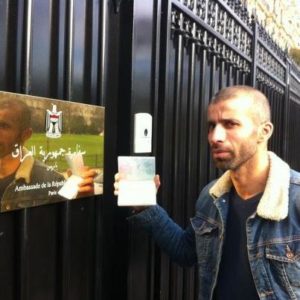
BAGHDAD, Iraq – French-Australian journalist, Nadir Dendoune, was arrested in Iraq for taking pictures in a restricted area of Baghdad without formal permission. Dendoune, who had first entered Iraq on January 16th, has been held in detention since January 23rd. Iraqi government officials claim that the journalist for the Le Monde Diplomatique is healthy, and that his case is still being investigated.

Dendoune in front of the Iraqi embassy in Paris showing his visa he received to conduct journalism. (Photo Courtesy of the Iraq Civil Society Solidarity Initiative)

The Committee to Protect Journalists, who admonishes the Iraqi government’s actions, claims that the arrest was a result of Iraq’s 2011 media law which places a series of impediments between journalists and the ability to gain information.

Sherif Mansour, a spokesman for the Committee to Protect Journalists further stated that, “[t]he arbitrary jailing of a journalist is a vestige of the Saddam Hussein regime that is completely out of place in Iraq’s democracy today.”

Iraqi officials have stated that Dendoune had lacked the requisite permits to take photographs by the water treatment plant in the southern Dora district. “[He] did not tell authorities about his activities, and did not ask for authorization to take photos,” said such official.

Those who support Dendoune, have not been sitting idly by and waiting for his release. Patrick Le Hyaric, Director of Humanity, has written letters to Viviane Reding, the Commissioner for Justice, Fundamental Rights and Citizenship and Vice-President of the European Commission, to Catherine Ashton, High Representative of the Union for Foreign Affairs and Security Policy, and to Fareed Yasseen, the Iraqi Ambassador in France.

The embassy has been working diligently with Iraqi officials to ensure that Dendoune has the healthiest of detention conditions and to find out why he is seemingly being arbitrarily held. Despite requests made by the embassy, Dendoune has been denied any consular visitation.

Additionally, a Facebook page was created by Dendoune’s family and friends, with articles, pictures, and information for support rallies, which aim to shed light on Dendoune’s situation. Others who have demanded the release of the journalist from arbitrary detention include Reporters Without Borders, the Iraqi Civil Society Solidarity Initiative, and the National Union of Iraqi Journalists.

The Journalistic Freedoms Observatory points out that this is not the first time that the Iraqi government has detained a foreign journalist. Just last year, Daniel Smith, an American journalist  was arrested and held for five days before he was granted release by order of the Prime Minister.

For further information, please see:

Guardian – Journalist Arrested in Iraq for Taking Photos – 31 January 2013

Iraqi Civil Society Solidarity Initiative – Immediate Release of Nadir Dendoune, Respect Freedom of Press and More Protection for Journalists Working in Iraq – 31 January 2013

Radio France International – Nadir Dendoune, un Journaliste Engagè Dètenu en Irak – 31 January 2013

Committee to Protect Journalists – International Journalist Detained in Iraq for a Week – 30 January 2013

Facebook – Comitè de Soutien Pour la Libèration de Nadir Dendoune – 30 January 2013

L’Humanitè – Patrick Le Hyaric: “Libèration Immèdiate Pour Notre Confrè Nadir Dendoune” – 30 January 2013

Evidence Presented in Genocide Case of Former Guatemalan Dictator

By Mark O’Brien
Impunity Watch Reporter

GUATEMALA CITY, Guatemala — A Guatemalan judge began accepting evidence Thursday in the case against former dictator Jose Efrain Rios Montt.

Relatives of victims during Guatemala’s civil war listened to court proceedings last week in the case against Jose Efrain Rios Montt, who is the first former president charged with genocide and crimes against humanity in Latin America. (Photo Courtesy of the New York Times)

The hearing to accept testimonies, documents, and other evidence marked the final step before Montt’s trial would begin.  Montt, who rose to power during a coup in March 1982, is accused of ordering the murder, torture, and displacement of more than 1,700 indigenous peoples between 1982 and 1983.

Earlier this week, Judge Miguel Angel Galvez ruled that Montt could stand trial on charges of genocide and crimes against humanity in the so-called “scorched earth” campaign aimed at eliminating support for leftist guerrillas when he was president from 1982 to 1983, one of the bloodiest periods in Guatemala’s 36-year civil war.

Montt is the first former president to be charged with genocide by a Latin American court.  Many human rights advocates say his trial also will shine the spotlight on the United States’ involvement in Guatemala’s civil war.

In an effort to prevent the spread of communism into Latin America, the United States supported the Guatemalan government during the war — a government that was responsible for much of the human rights violations.

In 1983, despite confirmation of mass killings in Guatemalan villages by anti-guerrilla forces, U.S. President Ronald Reagan overturned an arms embargo imposed by U.S. President Jimmy Carter three years earlier.  Reagan pointed to improving human rights conditions in the Central American country.

Lifting the embargo allowed the United States to provide military, economic, and political assistance — including military weapons and vehicles — to the Guatemalan government.  Meanwhile, a CIA cable at that time highlighted an increase in suspicious violence resulting in more bodies being discovered in ditches.

Critics of the United States’ role in the Guatemalan war blame its actions decades earlier.  In 1954, the CIA helped organize a coup to remove a reformist government from power.  Many believe Guatemala’s civil war may not happened if the CIA had not exercised its influence in the coup.

The United States has tried to make amends since Guatemala’s civil war ended in 1996.  It released 1,400 pages of documents in 1997 about its role in the 1954 coup and the civil war.  Several of those documents have been used in trials in Guatemala.  In 1999, U.S. President Bill Clinton apologized during a visit to Guatemala for the U.S. support during the conflict.

The United Nations estimated more than 200,000 people were killed during the civil war, which lasted from 1960 to 1996.  Human rights advocates have tried for years to have Montt prosecuted.  Montt’s attorneys argue he was never aware of the massacres committed by the army, and they planned to appeal the decision to let the trial move forward.

Also facing trial for the crimes against humanity is former general Jose Rodriguez.

For further information, please see:

Al Jazeera — Meet the First Head of State to Head to Trial in the Americas for Genocide — 31 January 2013

GlobalPost — Final Hearing Starts Before Guatemala Genocide Trial — 31 January 2013

Syracuse.com — Consider This: In Guatemala, Justice Is Delayed, but Not Yet Denied — 31 January 2013

The Washington Post — Judge Begins Accepting Evidence in Genocide Case Against Former Military Dictator Rios Montt — 31 January 2013

The New York Times — Ex-Dictator Is Ordered to Trial in Guatemalan War Crimes Case — 28 January 2013

The New York Times — Accused of Atrocities, Guatemala’s Ex-Dictator Chooses Silence — 26 January 2013

PBS — Timeline: Guatemala’s History of Violence