21 January 2013 – The authorities of Lithuania have joined three other European countries in launching money laundering investigations into the funds stolen from the Russian treasury through a scheme exposed by late Hermitage Fund’s lawyer Sergei Magnitsky, according to Business Week magazine.
The article quotes Donatas Puzinas, a Lithuanian prosecutor, on the investigation currently underway.
“It’s quite complex analytical work,” Mr. Puzinas told Business Week.
“The money generally is split up among several companies. Some of the money, after being transferred, goes back to the original account and then is transferred somewhere else,” said prosecutor Puzinas.
Now authorities in four European countries – Switzerland, Cyprus, Latvia, and Lithuania – are investigating the trail of $230 million stolen money from the Russian budget through a sophisticated scheme involving Russian officials and criminals which has been exposed by Sergei Magnitsky. After Mr Magnitsky testified against officials involved, he was himself arrested and killed in Russian police custody.
Through investigations carried out by Hermitage and a team of investigative journalists from the NGO, Organised Crime and Corruption Reporting Project, $130 million of the stolen $230 million have been traced to eight foreign jurisdictions. That information formed the basis for criminal complaints filed in those eight countries.
PESHAWAR, Pakistan – Thousands of demonstrators took to the streets of Peshawar to protest the alleged extra-judicial killings carried out by Pakistani paramilitary forces.
Demonstrators display dead bodies in protest in Peshawar. (Photo Courtesy of The News International)
The Frontier Corps, a division of paramilitary forces in Pakistan, has been blamed for 18 deaths which resulted from overnight raids in the Khyber tribal area. The paramilitary forces have been fighting Islamic militants in the area and were conducting a late night raid when the deaths occurred.
Human rights groups and local residents of the tribal area say that the operations carried out by the Pakistani military frequently cause civilian deaths. The bodies of the dead were found by local residents discarded on the side of a road.
The protestors openly displayed the bodies of the dead in Peshawar in public areas and across the street from the governor’s house to mourn the deaths of family members and to demand vengeance for the wrongful actions of the paramilitary forces.
This strategy of displaying the wrapped dead bodies is very rare and used sparsely by protestors to make a point to local governments. Anti-military slogans were also shouted at army officials and other government officials. One of the signs displayed by the protestors read, “We are also Pakistanis. Don’t kill us.”
The protestors called for a stop to the military operations in the Khyber tribal area of Pakistan where frequent military exercises and raids of this type are carried out. The protestors also called for the government to compensate the victims and their families and to end a five year old curfew still enforced in the area.
Pakistani police in the city of Peshawar responded to the protestors with barrages of tear gas. The police forces, desperate to keep peace in the volatile city, also used water cannons to disperse the scores of protestors outside of the governor’s house.
Protestors are at a loss as to where to seek justice for these alleged extra-judicial killings. The locals believe that there is nowhere to turn for help to stymie the growth of barbarism perpetrated by the Frontier Corps and their fellow citizens continue to be murdered in cold blood.
The leaders of the paramilitary forces, however, have privately denied responsibility for the deaths of the 18 civilians that were dumped on the side of the road and used in the demonstrations by protestors in Peshawar. The paramilitary forces are simply doing their jobs to rid Pakistan of the Islamic militants.
Locals vehemently contend that the tribal people in the Khyber region are being persecuted by both the paramilitary forces and the militants. The civilians are essentially caught in the middle of the two conflicting groups. Amnesty International accused Pakistani officials last month of failing to remedy the thousands of human rights abuses prevalent in this area.
By Madeline Schiesser Impunity Watch Reporter, Europe
ATHENS, Greece – A florist in Athen’s Amerikis Square praised them for cleaning up the neighborhood, saying that, “The first phone number people call is no longer the police. It’s Golden Dawn.” However, with slogans such as “Clean up the Stench,” and “Greece for the Greeks,” the ultra-nationalist, neo-fascist party, Golden Dawn (Chrysi Avgi) has been accused of taking the law into its own hands and attacking immigrants, despite its denial of violent activity.
Demonstrators in Athens protest the murder of Pakistani immigrant Shehzad Luqman. (Photo Courtesy of BBC News)
“Before, there were only ugly words. Now they are on the point of killing people,” says Javed Aslam, an elected leader of the Pakistani community since 2003.
In the latest act of violence directed at the immigrant community, a 27-year-old Pakistani man on his way to work was stabbed and died Wednesday. Shehzad Luqman, who had been living in Greece for 6 years, was traveling on his bicycle in the early morning when he was attacked by two men on motorcycle, according to police. A witness claims one of the men attacked Luqman from behind with a knife after an argument. Two accused men, a 29-year-old firefighter and a 25-year-old private sector employee, later admitted to stabbing Luqman in the chest.
The attack is believed to be racially motivated. Fifty Golden Dawn pamphlets, along with bats and knives, were found in the home of the 25-year-old man.
Athens’ Mayor Giorgos Kaminis called for an end to authority’s failure to punish racism on Friday: “The impunity must stop and getting to the bottom of the murder of the 27-year-old citizen from Pakistan could represent a significant starting point . . . The City of Athens, Greek society and democracy cannot tolerate such repulsive behavior any longer.”
On Saturday afternoon, an Anti-Racism rally in central Athens’s Omonia Square drew a crowd of some 3,000 immigrants and Greek human rights activists. The demonstrators carried banners with phrases such as “Neo-Nazis out” and “Punishment for the fascist murderers of Shehzad Luqman.” Earlier that day, about 300 Pakistani immigrants also gathered outside the Athens city hall, bearing Luqman’s coffin; a prayer was held around the coffin. The demonstrators’ goal was to protest the death of Luqman and draw attention to the continuing failure of Greek authority to protect immigrants in Greece.
“Perhaps his murder will bring hope that these attacks will stop. We are protesting for the government to take measures to stop racist attacks,” Javed Aslam told Reuters.
Nevertheless, Greece remains hostile to foreign immigrants, as was demonstrated by the results of the June 2012 parliamentary elections in which Golden Dawn won seven percent of the vote. Running on a platform essentially of anti-immigration and crime and financial fears (one in four workers is without a job and nearly 20 percent of the economy has dried up) the party now occupies 18 of the 300 seats in the Greek Parliament. Moreover, their popularity continues to grow; an October opinion poll showed that support for Golden Dawn had grown from 7.5 percent in June to 10.4 percent in October.
Numerous times members of Golden Dawn have been involved in violent attacks against immigrants. The watchdog 1 Against Racism says vigilante groups in Athens neighborhoods “approach migrants in public places, usually at night, ask them where they’re from and then attack.” Golden Dawn Members are identified by victims or witnesses as part of the attacking group because “they carried the party’s emblems or because they were recognized from other party events in the same area.”
To members of the immigrant community, it seems as though the police have turned a blind eye. “There are two separate laws. The police leave the fascist alone, and if a foreigner does the slightest thing he goes to jail,” Aslam says. “It is clear that practically they don’t stop them.”
For many immigrants, Greece is the gateway to the European Union, with more than 80% of immigrants to the EU, many from Africa and Asia, passing through. However, under Golden Dawn’s philosophy, all immigrants should be ejected from Greece, and its boarders militarized with landmines and armed patrols.
Amnesty International has stated that Luqman’s murder demonstrates the “continuing failure” of the Greek authorities to take action to put an end to racist violence.
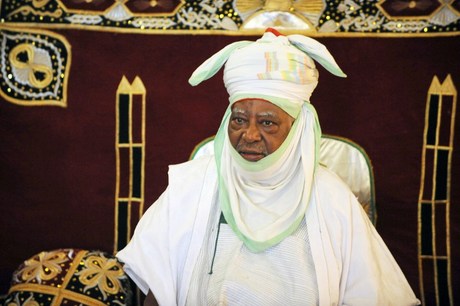
ABUJA, Nigeria—At least six people were killed today, January 20, 2013, when a number of gunmen attacked the convoy of the Emir of Kano, Alhaji Dr. Ado Bayero. Around noon today, the gunmen attacked the convoy of the Emir along the Zoo road. The gunmen killed the driver, his orderly and the traditional guard who tried to protect the Emir. The gunmen also wounded two of the Emir’s sons who were also part of the convoy. The Emir’s sons, the Turakin Kano and the Ciroman Kano Alh sustained some injuries and have been taken to the hospital for treatment.
The Emir and his sons have recently fled the country after the traumatic events of the attack. (Photo Courtesy of Naharnet)
Kano police spokesman Magaji Majia said, “The interim chairman of Kura local government and his driver were also killed by some gunmen who pursued them from the scene of the attack on Emir Ado Bayero.” Another official in Kano also reported, “Nothing is clear, but people are saying the attackers were not from Kano because one of them apparently asked, ‘who is the emir.’” “Two of those who died did so while shielding him from bullets,” he continued.
The Emir had been on his way back from a Quranic graduation ceremony that had taken place at Masallcin Murtala when his convoy was attacked. During the attack, the window opposite where he was seated in the vehicle was shattered, but there have been no indications that he suffered any injuries.
The 82 year old Emir fled the country after the attack and found refuge in the United Kingdom. An official noted, “The Emir left for London around 1:15pm to cool off after the traumatizing event of yesterday.”
This incident comes just one day before the first anniversary of the deadly bombings and shootings that killed 184 people in Kano last year. The assault was blamed on the Islamist sect called Boko Haram. This group has called for Sharia, Islamic law, to be applied more widely and more strictly across Nigeria. This attack marks the third such attack by gunmen on Muslim figures in northern Nigeria since July of last year. The violence linked to Boko Haram’s insurgency has left about 3,000 people dead since 2009, also including people killed during operations by the country’s security forces.
Shehu Sani, a civil society activist from northern Nigeria said it was unlikely that the attack was directly related to the events in Mali, where French soldiers have joined the Malian government against al Qaeda linked militants. “This Kano attack is a continuation of other attacks on emirs in Nigeria, who are viewed by Boko Haram as the traditional wing of the political establishment and opposed to their own Islamic agenda,” Sani said.
HARARE, Zimbabwe – On Friday, several Zimbabwean rights groups condemned what they suspect is a crackdown against President Robert Mugabe’s critics. In a joint statement, around 58 civic organizations said that human rights activists and journalists, especially those known for criticizing the incumbent administration, have been experiencing a “well-calculated and intensified” harassment through “slander, intimidation, raids, arrests, prosecutions and persecution.” The statement was released a few days after the Chairperson of Crisis in Zimbabwe Coalition and Director of Zimrights, Okay Machisa, was arrested.
According to local news, human rights activist and Director for the Zimbabwe Human Rights Association (Zimrights), Okay Machisa has long been a target of President Mugabe’s camp. (Photo courtesy of Front Line Defenders)
Machisa was charged with publishing false statements prejudicial to the State, as well as fraud and forgery, after allegedly conducting illegal voter registration. On Monday, he handed himself to the police and has not been released since.
Last month ZimRights Education Programmes Manager Leo Chamahwinya and ZimRights Local Chapter Chairperson Dorcas Shereni, who are known critics of President Mugabe’s party, Zanu-PPF, were likewise arrested for the same charges.
All three were denied bail last week based on two grounds: that the case is a matter of national interest; and that the investigations are so complex that the prosecution needs more time to complete them.
Local media and civil society groups see these series of arrests as an affront to freedom of expression, justice and democracy. They suggest that these are among the administration’s tactics “to intimidate civil society in the run-up to this year’s elections”. According to them, such measures taken by President Mugabe’s camp are meant to keep NGO’s from influencing the masses on the voting process for the upcoming elections.
These alleged attacks on the press and civil society groups come despite President’s Mugabe’s call for free, fair and peaceful elections last year.
“We condemn this calculated assault on activists that is meant to cow civil society organizations that are fighting for democratic reforms before the next election,” NGO Crisis Coalition stated in a recent press release . “We reiterate our position that the political environment in Zimbabwe is not yet conducive for a free and fair election.”
Crisis Coalition also appealed for regional and international pressure on the Zimbabwe government to respect the rule of law. “Such action is important to militate against a possible surge in the harassment and detention of activists especially as we head toward the general election,” urged the organization.
On January 19, the Office of the High Commissioner for Human Rights (OHCHR) issued a statement condemning the arrests of Machisa and other human rights activists. “We condemn recent attacks against human rights defenders in Zimbabwe, including arbitrary arrests, intimidation and harassment. . . We are concerned about the crackdown on non-governmental organisations and dissenting voices seen as critical of President Robert Mugabe’s rule and apparently politically motivated prosecutions,” said Rupert Colville, spokesperson for the OHCHR.