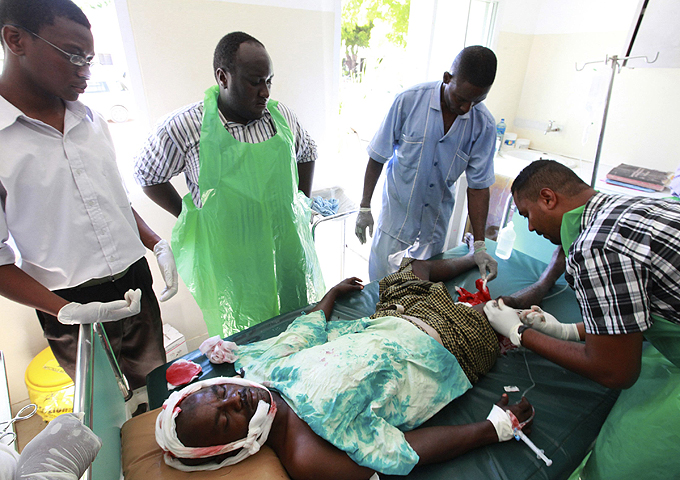
Today’s Death Toll:118 (including 3 children and 3 women)
47 martyrs were reported in Idlib most in Al-Mastumeh, 35 in Damascus and its Suburbs, 15 in Deir Ezzor, 9 in Aleppo, 6 in Homs, 3 in Daraa and 1 in Hama (LCCs).
Points of Random Shelling: 193
11 points shelled by warplanes, 80 points shelled with heavy caliber artillery with the fiercest shelling reported in Damascus Suburbs, 52 points with mortar, 50 points with rockets (LCCs).
Clashes: The Free Syrian Army clashed with the regime forces in 84 locations. FSA rebels managed to shoot down a regime helicopter gunship over Taftanaz Military Airport, they also attacked the regime Malaab checkpoint located in Salah Al-Dein neighborhood in Aleppo. Rebels also repelled the attempts of regime forces to storm Busr Al-Harir in Daraa and the Mouadamieh and Darayya subirbs in Damascus. They also took control of the military security headquarter in Harasta. In Deir Ezzor, FSA rebels targeted an aircraft loaded with ammunition and set it on fire, they also blew up the building occupied by regime forces in the neighborhood of Jbeila, and destroyed the ammunition depot when they targeted Deir Ezzor Military Airport (LCCs).
News
Fighting Flares in Palestinian Camp in Damascus
Family of James Foley, journalist kidnapped in Syria, pleads for information
Nearly 9,000 Syrians flee to Jordan in six days: govt
Syrians brush off Assad speech as fighting rages Damascus residents said Assad’s speech, which offered no concessions to his foes, was met with celebratory gunfire in pro-Assad neighborhoods. But even there, some saw no sign peace was closer: a loyalist resident of southern Damascus reached by internet said the speech was eloquent but empty. “It sounded more like gloating than making promises,” said the woman, who gave only her first name, Aliaa. “I agree with the ideas but words are really just words until he takes some action. He needs to do something. But even so, everything he suggests now, it is too late, the rebels aren’t going to stop.”
Syria conflict blocks aid to 1 million needy, U.N. agency says The World Food Program says fighting has prevented deliveries of aid. In addition, hundreds of thousands are ill-equipped for the harsh winter.
UK meeting plans for possible post-Assad Syria The meeting will take place on Wednesday and Thursday, and delegates will include Syria experts, academics in post-conflict stabilization, representatives of the Syrian National Coalition (SNC) opposition group and other agencies. The gathering highlights jitters over the shape of a post-Assad Syria, and experts fear regional and sectarian rivalries could extend the bloodshed and destabilize other countries in the strategically sensitive and volatile region.
World ignoring Syria’s systematic ruin: Jumblatt World powers are abandoning Syria to be “systematically destroyed” by a civil war which has already wrecked whole cities in a once-great Arab nation, Lebanon’s Druze leader Walid Jumblatt said. Accusing them of “indifference or conspiracy”, Jumblatt said none of the international players, which are deeply divided over the 21-month-old uprising against President Bashar al-Assad, had shown any urgency to stem the bloodshed. Jumblatt has called for foreign states to do more to help rebels defeat Assad swiftly and avoid the partition of Syria, home to majority Sunni Muslims as well as minorities including Assad’s Alawites, Christians, Kurds, Shi’ites and Druze.
France’s Le Pen says ‘blind West’ aiding Syrian war Le Pen spoke to SAMA TV, which is part of Dounia TV, a conglomerate run by businessman and cousin of Bashar al-Assad, Rami Makhlouf, in a video that was uploaded to YouTube on January 2. The interview is the first accorded to a French politician since the start of the Syrian uprising. Speaking of an “Islamist fundamentalist” takeover of the country, the far-right leader said from her office in Paris that the rebellion had been “in part aided by the blindness of Western countries”. Le Pen said that Western powers were “doing in Syria exactly the same thing as they did in Libya, but secretly”. She said that by allegedly supporting Qatari and Saudi schemes to arm dissident militants in Syria, European leaders were “helping to fuel the civil war of which civilians are the first victims”.
Syria Refugee Camp Riot Breaks Out In Jordan A winter storm is magnifying the misery for tens of thousands of Syrians fleeing the country’s civil war, turning a refugee camp into a muddy swamp where howling winds tore down tents and exposed the displaced residents to freezing temperatures. Some frustrated refugees at a camp in Zaatari, where about 50,000 are sheltered, attacked aid workers with sticks and stones after the tents collapsed in 35 mph (60 kph) winds, said Ghazi Sarhan, spokesman for the Jordanian charity that helps run the camp. Police said seven Jordanian workers were injured. After three days of rain, muddy water engulfed tents housing refugees including pregnant women and infants. Those who didn’t move out used buckets to bail out the water; others built walls of mud to try to stay dry. Conditions in the Zaatari camp were “worse than living in Syria,” said Fadi Suleiman, a 30-year-old refugee.
Israel reportedly told Pentagon about Syria poison gas Israel notified the Pentagon that Syria was preparing a chemical believed to be deadly sarin gas and loading it into dozens of 500-pound bombs destined for airplanes. Israel’s warning to the United States at the end of November, involving intelligence showing up on satellite imagery, brought together the U.S., Arab states, Russia and China to deal with Syria’s deadly civil war, The New York Times reported Tuesday.
Fears raised over Syria uranium stockpile Nuclear experts in the US and Middle East have raised concerns about the security of up to 50 tonnes of unenriched uranium in Syria amid fears that civil war could put the stockpile at risk. Since the start of the uprising against Bashar al-Assad two years ago, western governments have been heavily focused on the fate of Syria’s chemical weapons and worries that those stocks might be taken over by militant groups. But government officials and nuclear experts have also expressed fears to the Financial Times about what may be a significant stockpile of uranium inside Syria.
Study shows rise of al Qaeda affiliate in Syria A jihadist group with links to al Qaeda has become the most effective of the different factions fighting the regime, according to a new analysis, and now has some 5,000 fighters. The group is Jabhat al-Nusra, which was designated an al Qaeda affiliate by the United States government last month. It is led by veterans of the Iraqi insurgency “and has shown itself to be the principal force against Assad and the Shabiha,” according to the study.
Syrian minister: Enemies ‘brainwashed’ slain rebel son A Syrian Cabinet minister confirmed the death of his rebel son, and, without a trace of grief, coldly rejected the young man’s embrace of the opposition, according to a state news report. “I disapprove and condemn whatever my son did,” said Mohammad Turki al-Sayyed, minister of state for the People’s Assembly Affairs, who acknowledged the death of his son, Bassim. “I said it before and I disavow him again, fully even after his death.”
Special Reports
The Rebellion
The Long, Hard Slog That Is Syria
Syrians know this will be a long war. Most still believe in victory, but many know that victory is a distant dream that could take years to achieve. History is not on the side of expediency — civil wars through history have lasted an average of seven to fifteen years and the Lebanese Civil War (Syria’s neighbor with a similarly sectarian population) was one of those that lasted fifteen. The fact is, the Syrian Civil War is just getting started. Assad may fall in the next few years, perhaps faster with Western support or another dramatic development, but the war after the war could rage for several years more. But none of this matters, and it certainly doesn’t matter to that FSA commander who is questioning the revolution. These are academic discussions which belonged in the room when the decision to revolt was being made. It doesn’t matter now, there is no going back and the only path forward is victory at any cost. “We will fight or we will die. We have no choice now.” He’s right.
Hints of Syrian Chemical Push Set Off Global Effort to Stop It
The combination of a public warning by Mr. Obama and more sharply worded private messages sent to the Syrian leader and his military commanders through Russia and others, including Iraq, Turkey and possibly Jordan, stopped the chemical mixing and the bomb preparation. A week later Defense Secretary Leon E. Panetta said the worst fears were over — for the time being. But concern remains that Mr. Assad could now use the weapons produced that week at any moment. American and European officials say that while a crisis was averted in that week from late November to early December, they are by no means resting easy.
In Syria, war is the new normal
After nearly two years of civil strife, neither side sees a reason to quit fighting… The regime does not seem to have lost its taste for bloodshed, and it may even believe that it can fight on indefinitely from Alawite bastions (mainly the coastal area between Latakia and Tartus) even if the opposition is able to take Damascus. The resistance, for its part, has gained battlefield experience the hard way and is a far better fighting force than it was in the early months of the war. It is now better-armed as well, and its international support is growing as Assad’s wanes. With neither side feeling pressure to negotiate a settlement involving power-sharing, the Syrian war grinds on.
The Opposition
Fred Hoff: Forming a Syrian Opposition Government: The Time is Now
… a functioning bureaucracy will be central to any transition plan due to the need for continuity of government. Ministries, departments, and agencies—including the security services—employ people and provide services, albeit often ineffectively and corruptly. The preservation of these organs, as imperfect as they are, can facilitate the rapid dispersal of international assistance post-Assad and reassure millions of Syrians who fear the chaos of revolutionary rule. Reform will come in time. It is important to distinguish government and its associated bureaucracy from the ruling clique, which has become a militia, willing and even eager to risk destroying Syria to try to save itself.
Radwan Ziadeh: Time for a Syrian transitional government
Many Syrian opposition political forces still refuse to form an interim government on the ground, claiming that to do so would be premature. This may once have been true, but no longer. The preconditions which certain opposition members have demanded before forming the transitional government will never come to fruition. Therefore, the transitional government or government-in-exile should be formed immediately … the longer the forming of the transitional government takes, the more chaotic the situation will be, the more difficult it will be to establish a central authority, and the more difficult it will be to provide the liberated areas with social services, judicial institutions, health services, and humanitarian assistance.
The Country
Syria on Video
Whether people can forgive and live together again has been a contested issue in the recent history of many countries, from South Africa to Rwanda, the former Yugoslavia, Chile, Cambodia, Lebanon and Iraq. There is no universal solution, and while the blood is still flowing even to ask the question may seem premature. It can probably only find an answer once a minimum of justice has been achieved. But it has to be raised, and the sooner the better. Once Syrians emerge from the present nightmare – in one, three or ten years – they will be forced to look into one another’s eyes. They will have seen and heard things they wish they hadn’t.
The Humanitarian Front
UN Can’t Help 1 Million Going Hungry (WHAT YOU CAN DO)
The World Food Program said Tuesday it is unable to help an estimated 1 million Syrians who are going hungry, blaming a lack of security in the war-stricken country. This month, the agency aims to help 1.5 million of the 2.5 million Syrians whom the Syrian Arab Red Crescent says need food aid, spokeswoman Elisabeth Byrs said. The poor security and the agency’s inability to use the Syrian port of Tartous for shipments means that a large number of people in the some of the country’s hardest hit areas will not get help, she said. “Our main partner, the Red Crescent, is overstretched and has no more capacity to expand further,” Byrs said.
Aleppo misery eats at Syrian rebel support
As government forces fight on in parts of Aleppo, in large areas that have been under rebel control for six months or more complaints are getting louder about indiscipline among the fighters, looting and a general lack of security and necessities like running water, bread and electricity in districts that have been pounded by tanks and hit by Assad’s air force. Recognizing that mistrust, rebel units have set up command and policing structures they see forming a basis of institutions which might one day run the whole country and which, meanwhile, they hope can show Arab and Western supporters that they have the organization to handle aid in the form of money and weapons. For those who fear the worst for Syria now that the revolt has unleashed long suppressed ethnic and sectarian rivalries, however, evidence in Aleppo that these new institutions have had little practical impact on often rival rebel groups is ominous. And all the while relations grow testier between the rebels and Aleppines, for whom many fighters harbor some disdain after the urbanites’ failed to rise up on their own against Assad.
Safety first for Syria’s teachers and pupils
The 29-year-old teacher opened his makeshift school in the abandoned palace after Syrian rebel fighters took over previous, official schools in the northern city as their barracks and headquarters, resulting in all becoming targets for government shelling. Dozens of children study in the improvised classrooms set up around the building’s courtyard as the chatter of light weapons and the boom of artillery shells and mortars echo from not far away.
How I survived Syria’s killing fields
Before the revolution, Mohammed, 29, was working as a tailor in Beirut, but last August returned to his home in the rebellious town of Harithan, a few kilometres northwest of Aleppo, for Ramadan. On August 22 he went into the city to buy a mobile phone SIM card, but the regime’s shabiha thugs stopped him at a checkpoint in Sadala Square, discovered that he came from Harithan and arrested him.
Geopolitics
Assad and the U.S. are blind to reality in Syria
The tragedy is that there is scant sign that Mr. Assad will be compelled to face reality any time soon. Despite their gains, Syria’s rebels continue to lack the heavy weapons necessary to break the regime’s hold over Damascus or to stop the artillery, missiles and planes Mr. Assad is using to pummel cities. With the United States and other Western governments refusing to help, recent reports have said that rebel arms supplies are drying up.
Syria’s regime and a populist left
Syria under the rule of Hafez al-Assad acquired the image of a bastion of intransigent anti-imperialism that made it attractive to a section of the western left. The process reflected changes in regional politics whose effects are felt to this day, say Hazem Saghieh & Samer Frangie.
The Electronic Front
Apple Rejects iOS Game Exploring Syria’s Civil War
U.K. game developer Auroch Digital launched Endgame: Syria as part of its Game The News project, which aims to get the public interacting with and reconsidering the concept of gaming, with politically and socially relevant topics infiltrating a medium usually reserved purely for fiction. The latter, says Auroch Digital’s creative director Tomas Rawlings, is a trend that we should not be afraid to challenge.
As Syria Worsens, Art.sy Changes Unique URL
Last Friday, the high-profile art startup Artsy changed its primary URL from Art.sy to Artsy.net, prompted by tensions in the Middle East and a 36-hour site outage Wednesday. The .sy top-level domain was a large part of the site’s identity, even factoring in the company logo, which suggests a line before the last two letters of the name. But while the Manhattan-based company has prominent investors from around the world, Wendi Murdoch and Dasha Zhukova among them, the change means they’ll be losing ties to one country they’d probably just as soon do without: Syria, which hosts the .sy web suffix and whose recent problems, server-related and otherwise, accounted for the site’s going down.