Putin Plans to Sign U.S. Adoption Ban

By Madeline Schiesser
Impunity Watch Reporter, Europe

MOSCOW, Russia – Russian President Putin announced Thursday that he intends to sign into law an act that would ban American families from adopting Russian children.  The act is part of several Russian legislative measures in response to the recently passed U.S. Magnitsky Act, which implements sanctions against Russians accused of human rights violations.

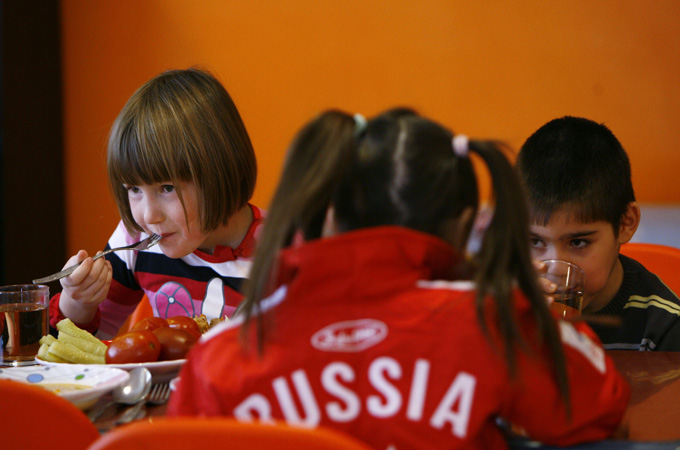
A Russian ban on U.S. adoption places children in the middle of a political storm. (Photo Courtesy of Al Jazeera)

The announcement follows passage of the act by the Federation Council, Russia’s upper house of parliament, unanimously (143 senators present) Wednesday, and by the State Duma, Russia’s lower house of parliament, last week in a vote of 441-7.

The ban would terminate the bilateral adoption agreement between Russia and the United States and forbid U.S. adoption agencies from working in Russia, effectively halting adoption of Russian children by US families.

Mikhail Margelov, chairman of the Council’s foreign affairs committee, however, has stated that the agreement currently in place binds Russia to notify the U.S. of a halt in adoptions 12 months in advance.

Putin also said he plans to sign a presidential decree to improve Russia’s troubled child welfare system.  Putin said the decree would “chang[e] the procedure of helping orphaned children, children left without parental care, and especially children who are in a disadvantageous situation due to their health problems.”

The legislation is also partly in response to several adoptions in recent years of Russian children by Americans that ended unfortunately.  For example, in 2010, an American woman returned a 7-year-old boy to Russia, saying that he had behavioral problems and that she no longer wanted him.  In 2008, a 21-month-old Russian boy died of heatstroke in July when his American adoptive father accidently left him unattended in a car for nine hours.  The father was later found not guilty of involuntary manslaughter.  Some Russian legislators are unofficially calling the adoption ban the Dima Yakovlev Bill in the boy’s honor.

Alexei Pushkov, chairman of the Duma’s Foreign Relations Committee, said: “Cases of the death of our children in the United States continue, and cases of not-guilty verdicts; we decided to take this tough decision to deprive Americans of the right to adopt Russian children.’

Last week at a press conference, President Putin, called the bill an “emotional but adequate” reaction to the Magnitsky Act, but expressed his desire to see the exact language of the bill before reaching a final conclusion.  Putin further suggested that the majority of Russians “have a negative attitude toward adoption of our children by foreigners” and would support the ban.  Putin discussed his intent to sign the bill with his senior government officials last Friday.

However, there has also been opposition to the bill.  A petition, signed by 100,000 in opposition to the ban was filed with the Duma.  Furthermore, Russian Foreign Minister Sergei Lavrov said last week that banning Americans from adopting Russian children would be “wrong.”  Additionally, police have detained protestors both this week and last outside Parliament for protesting the ban.

Said one protestor: “These black mourning ribbons in our opinion symbolize today’s draft law which is useful neither for our children nor our national security and our priorities.”

Ilya Ponomaryov, a state Duma deputy, member of the opposition party A Just Russia, and one of the few legislators to vote against the ban stated directly: “As I’ve said many times: I think this law is absolutely outrageous, amoral, and despicable.”

Education Minister Dmitry Livanov, explained that an “eye-for-an-eye logic” would put at risk children who fail to find adoptive parents in Russia.

Last year, 3,400 Russian children were adopted by foreign families, and of those, 956 – nearly a third – were adopted by Americans, according to official figures.  Eighty-nine of those adopted were disabled children, who often have a lower chance of adoption within Russia.

Due to increased regulations U.S.-Russian adoptions have declined over the past years, however, Russia is still the third largest source of adoptions for the U.S.  Presently, there are about 740,000 children without parental custody in Russia, according to UNICEF.  In the past two decades, American families have adopted more than 60,000 Russian children.

Currently, the adoptions of 46 Russian children to American families would be voided of the bill becomes a law, despite court rulings in some of the cases authorizing the adoptions.

“The children who have been chosen by foreign American parents . . . who were seen, whose paperwork was processed, who came in the sights of American agencies,” said Pavel Astakhov, Russia’s child rights commissioner and a major proponent of the ban, “[t]hey will not be able to go to America, to those who wanted to see them as their adopted children. There is no need to go out and make a tragedy out of it.”

The bill further contains language to outlaw U.S.-funded “nonprofit organizations that engage in political activity” by suspending and freezing their assets if they receive funding from US citizens or organizations or if their leaders or members are Russian citizens who have US passports.  Under the bill, any nongovernmental organization (NGO) that engages in “political” work that “harms Russia’s interests” would be suspended and also have its assets frozen.

In Washington, D.C., State Department spokesman Patrick Ventrell expressed the United States’ “concern[]” that “[t]he welfare of children is simply too important to be linked to political aspects of our relationship.”

“What’s particularly concerning here is in this present legislation, what this would do is prevent children from growing up in a family environment of happiness, love, and understanding. That’s the basic premise of our bilateral adoption agreement, it’s something we’ve worked for many months with the Russians on, and so really it’s Russian children who would be harmed by this measure.”

But Margelov, claims the bill is “a natural and a long overdue response [to the U.S. Magnitsky legislation].”  He further stated that “[c]hildren must be placed in Russian families, and this is a cornerstone issue for us.”

For further information, please see:

New York Times – Putin Says He Will Sign Law Barring U.S. Adoptions – 27 December 2012

Al Jazeera – Protesters Arrested Outside Russia Parliament – 26 December 2012

BBC News – Russia’s Upper House Approves Ban on US Adoptions – 26 December 2012

Independent – Anti-US Adoption Bill Unanimously Endorsed in Russia – 26 December 2012

HRW – Russia: Reject Adoption Ban Bill – 21 December 2012

RFE/RL – Russian Duma Approves U.S. Adoption Ban – 21 December 2012

RFE/RL – Russian President Backs U.S. Adoption Ban – 20 December 2012

Al Jazeera – Russian Parliament Supports US Adoption Ban – 19 December 2012

Christmas In Argentina Sees Country Wide Looting

By Brendan Oliver Bergh
Impunity Watch Reporter, South America

BUENOS AIRES, Argentina – For the first time in eleven years Argentina has succumbed to massive looting when on Dec. 20, groups of masked individuals began invading and looting six supermarkets in San Carlos de Bariloche. The looting spread throughout the province as stores in major cities from Rosario to Santa Fe were set ablaze before looters began looting Beunos Aires.

An Argentinian supermarket after looters ransacked the market. (Photo Courtesy of Reuters)

Early Thursday President Cristina Fernández de Kirchner dispatched a regiment of 400 militarized police before the country descended into chaos. Since then, the police have been mobilized in all areas experiencing this country wide state of mayhem.

Historians have noted the similarities between those broke out in December 2001, which resulted in some 40 deaths and the resignation of then-president Fernanndo de la Rúa. The rioting was seen as a direct result from the collapse of the banking industry, the recession and country default on public debts.

While Fernandez was quick to question the Labor unions involvement with the organization, leaders from the Federation of Argentine Workers and the general Confederation of Labor Hugo Moyano were quick to deny responsibility, claiming “This is probably triggered by the difficult situation the people of Argentina are facing.”

President Fenandez may have been right to question the Labor unions, who late last month organized mass work stoppages which caused some spare looting. Workers are struggling as the economy failed to expand beyond 2% this year, despite a steady growth rate of about 8% for the past ten years. This year has also marked a stark increase in food prices with inflation increasing well above 20%.

Activists who have used similar tactics in the past tend to traditionally block access to supermarkets during December and demand free food. Beyond the millions of rioters in 2001, these protests rarely turn violent.

While the militarized police force were forced to employ the use of tear gas and rubber bullets to turn looters back, gunshot victims are not immediately associated with the polices use of force. At least 3 people were shot and killed during the initial clash on Thursday evening, with another 21 injured as a result of the violence.

As the police have attempted to restore order, hundreds have been arrested for their participation and aggression among the mayhem.

While another blow to President Fernandez’s waning popularity, her administration has stressed that despite complaints about food prices that is not what is being stolen. Looters have been using the opportunity to steal computers and televisions, not food staples as one would expect from a protest against economic policies.

 For further information, please see:

Rosario – She Died A Woman Who Was Shot In The Looting – 26 December 2012

World War 4 Report – Argentina: Massive Looting Returns After 11 Years – 25 December 2012

BBC – Argentina Looting Spreads To Buenos Aires Province – 22 December 2012

The Wall Street Journal – Looting Tests Leader In Argentina – 21 December 2012

Morsi Signs new Constitution Into law

By Ali Al-Bassam
Impunity Watch Reporter, Middle East

CAIRO, Egypt — On a late Tuesday evening, President Mohamed Morsi signed into law a new constitution, which was approved by a referendum monitored by the media, judges, and non-governmental organizations just hours earlier.

Egyptian President Mohammed Morsi signed the final draft of the constitution into law last Tuesday. (Photo Courtesy of Daily News Egypt)

The constitution itself was criticized by opponents of Morsi for what was within its provisions and the ratification process it followed.  Some say that it sacrifices individual and minority rights for the sake of ensuring power for the religious and military establishments.  Others criticized the constitution and its passing through a series of unilateral moves that silenced the dissent within both the judiciary and Constitutional Assembly.

A spokesman for the main opposition group, the National Salvation Front (NSF), said that they will still continue with their protests, and will hold one in Tahrir Square and elsewhere in Egypt on January 25, the second anniversary of Hosni Mubarak’s overthrow.

The NSF alleged that there were a few incidents of fraud during the vote, but Judge Samir Abou el-Maati, head of the electoral commission, denied the allegations, saying that the judicial supervision involved with the referendum successfully prevented the occurrence of fraud.

Despite the criticism, the final draft of the constitution passed with the support of just over ten million of Egypt’s 85 million citizens, supporting it during two rounds of votes.  Out of the 33% of citizens who came to the polls, 65% of voters approved of the final draft.

On Wednesday, Morsi addressed the nation to show his support for the constitution’s passing, emphasizing that the powers granted by the document is for the sake of maintaining a democracy and not a dictatorship.  “Today we celebrate our new constitution.  It is a historic day.  Egypt has a free constitution chosen chosen by the people.  It is not a grant from a king or an obligation from a president or dictation from an occupier,” said Morsi.

In his speech, Morsi stressed his focus on the economy, saying that the passing of the constitution will bring security and stability for the people.  “I will deploy all my efforts to boost the Egyptian economy, which faces enormous challenges but has also big opportunities for growth…”

Morsi also promoted the opportunity of working together with his criticizers, yet condemned those who responded with violence.  Morsi also promised Egyptians to relinquish the powers he granted himself once a national charter was passed.

In response to Morsi’s Wednesday address, NSF spokesman Hussein Abdel Ghani accused the government of trying to create an “autocratic tyranny in the name of religion,” and that the dialogue “lacked serious business.”

For further information, please see:

Al Bawaba — Morsi Addresses the Nation, Says Talking is the Answer — 26 December 2012

Al Jazeera — Egypt’s Morsi Signs Draft Charter Into Law — 26 December 2012

BBC News — Egypt’s President Morsi Hails Constitution and Urges Dialogue — 26 December 2012

Daily News Egypt — Morsy Addresses Nation After Passing new Constitution — 26 December 2012

Human Rights Groups Criticize Kenya’s Decision to Move Refugees

By Ryan Aliman
Impunity Watch Reporter, Africa

NAIROBI, Kenya – Human rights groups say Kenya’s decision to move refugees and asylum-seekers out of urban areas and into rural camps is “discriminatory” and “unlawful”.

The Dadaab refugee complex reportedly hosts four times the population it was built for. (Photo courtesy of BBC News/AFP)

Last Tuesday, the Kenyan government issued an order requiring Somali refugees and asylum-seekers living in urban centers including Nairobi, Nakuru and Mombasa to transfer to the Dadaab refugee camp complex in north-eastern Kenya, while those from other countries will be required to transfer to the Kakuma camp.

The government contends that this decision is meant to ensure the safety of Kenyan citizens since refugees have been allegedly involved in recent attacks in the capital and various parts of the Northeastern region.

On Friday, President Kibaki called for support to have them returned to their home countries. “There is no dignity in living in refugee camps,” he told the press after a meeting with Somali President Hassan Sheikh Mohamoud. “Our two governments will work together to enable the hundreds of thousands of Somalia people who are living in refugee camps return to their homes . . . We also call on the international community to play their part and help the people of Somalia live in honourable lives in their homes,” he said.

Once the order is implemented, Kenya will no longer receive and register any new refugees and asylum-seekers. Registration centers in the mentioned urban areas will also close down. The Commissioner for the Department of Refugee Affairs Badu Katelo has also requested the UN agency for refugees (UNHCR) to stop giving any services to those in urban areas.

However, the UNHCR, along with the Amnesty International, refused to acknowledge the resolution calling it illegal and in violation of international law regarding the protection of refugee rights.

The UNHCR claimed that the Kenyan government did not consult with relevant and concerned stakeholders before carrying out the order. The UN agency also said that the government failed to consider that most camps in the rural areas are already overcrowded. Thus, the resolution was “insensitive to the rights and plight of refugees.”

Amnesty International shared the same view. “This restriction on freedom of movement is likely to lead to other serious human rights abuses in already overcrowded, insecure refugee camps,” said Amnesty International’s East Africa observer Kathryn Achilles.

Medecins Sans Frontieres, which provides health aid and services in Dadaab, reported that it was already struggling to cope with the number of refugees in the camp.

Both the UNHCR and Amnesty International reminded the Kenyan government that it is a signatory to the 1951 UN Refugee Convention and the 1969 OAU Refugee Convention. Therefore, it is under an obligation to protect those seeking asylum on its territory.

“Kenya must live up to its obligations under international law, and must have the support of the international community to do so, including through increased funding and resettlement programmes,” urged Amnesty International in a recent press release.


For further information, please see:

Daily Nation – Kenya tightens resolve on Somalia refugees – 23 December 2012

All Africa – Kenya: Fury Over Order for All Refugees to Go to Daadab – 22 December 2012

BBC News – Kenya’s Somali refugee plan unlawful, says Amnesty – 21 December 2012

Reuters – Amnesty says Kenya sending refugees to camps unlawful – 21 December 2012

Amnesty International – Kenya’s decision to confine refugees and asylum-seekers in camps is unlawful – 20 December 2012

Kenya’s First Openly Gay Politician Faces Funding Issues

By Heba Girgis
Impunity Watch Reporter, Africa

NAIROBI, Kenya—David Kuria, Kenya’s first openly gay politician to run in the country’s election was forced to withdraw from the race. Kuria’s supporters were more than disappointed when he announced that he could not carry out the senate race because of lack of funds. He could not raise enough to cover personal security and logistics of the race. He also received many threatening text messages saying that his candidacy would bring “a curse to the land.”

Kuria, 40, was forced to drop out of the race because of funding issues. (Photo Courtesy of Kenya Today)

Kuria told the Guardian, “It is one of the saddest decisions I have had to make during my years working as a human rights activist. I had seen changes in the way our people in the villages view gay people. For many people gay people and gay rights are perceived though mediated interpretation of politicians and religious leaders. For the first time it was possible to talk with people, answer their questions as well as point out the nexus areas of different forms of marginalization, including poverty and other challenged that affect them, too.”

Kuria, age 40, was the first openly gay person in Africa to run for political office outside of South Africa. His campaign could not go forward after his fundraising campaign raised only 4% of its target. Kuria also never lacked opposition, especially in Kenya’s conservative Christian heartlands. Moses Wetangula, a cabinet minister, noted that if Kuria was elected, a revolt would surely be carried out against the government. Wetangula also said that an openly gay man should not “have an opportunity or privilege to lead a country that is founded on religious morality.”

Under Kenyan law, acts of homosexuality are punishable up to 14 years in jail. In 2011, the Kenyan Human Rights Commission took a survey that revealed that only 18% of LGBT Kenyans had opened up about their sexual orientation to their families and that of these 89% of them had been disowned. Homosexuality is also outlawed in 36 African countries with many politicians finding gay people to be “unafrican.” Kuria addressed this issue, saying, “Again that is one of those stories that have been told over and over again that it has come to be seen as true. But there are also very few public LBBT voices—these need to increase for the narrative to be debunked.”


For further information, please see:

Mail and Guardian – Kenya’s First Gay Political Candidate Reveals Why He Quit Race – 26 December 2012

Kenya Today – Kenya’s First Gay Political Candidate Reveals Why He Quit Race – 25 December 2012

The Guardian – Kenya’s First Gay Political Candidate Reveals Why He Quit Race – 25 December 2012

Topix – Kenya’s First Gay Political Candidate Reveals Why He Quit Race – 25 December 2012