10 December 2012 – On this year’s Human Rights Day, human rights lawyers like Nasrin Sotoudeh, Mohammad Ali Dadkhah, Mohammad Seifzadeh, Abdolfattah Soltani and others are incarcerated in the jails of the Islamic Republic of Iran (IRI) for their representation of clients in politically sensitive matters. Threats to the independence of lawyers in the IRI have increased significantly in recent years, particularly with the passage of legislation designed to diminish the role of defense attorneys in the IRI’s legal system. To provide a personalized view of these negative trends, IHRDC releases the witness testimony of Mahnaz Parakand, a renowned Iranian defense attorney who was forced to flee Iran on account of the pressures on her ability to do her job. The full witness testimony can be read here.
By Emily Schneider Impunity Watch Reporter, Middle East
DAMASCUS, Syria– “The regime started to fall and deteriorate. It’s coming to its end,” said retired Major General Adnan Sillou in an interview in a hotel near Antakya, Turkey. Sillou, a former top general in President Bashar al-Assad’s Syrian forces, is now sharing what he believes might be President Assad’s next move.
Former Syrian Major-General Andan Sillou. (Photo courtesy of ABC)
“It’s highly possible that he’ll start using [chemical weapons] to kill his own people because this regime is a killer,” Sillou said.
Sillou told ABC News that he was the chief of staff on the defensive side of the chemical weapons program. In addition to his responsibilities in training soldiers in attacks and contact with chemical weapons, he procured safety equipment to help guard the forces against the weapons. In his most recent post, he was second in command to Said Ali Khalil, a member of Assad’s ruling Alawite sect, an offshoot of Shiite Islam.
Syria does not officially acknowledge its chemical weapon program, but Sillou says the military has weapons that employ mustard gas, sarin, VW and tabun nerve agents. U.S. intelligence reports confirmed the presence of sarin as recently as last week. In fact, according to U.S. intelligence officials, sarin had already been mixed with its catalyst agent and loaded into bombs to await the final order from President al-Assad.
Sarin is an extraordinarily lethal agent. In 1988, Iraqi President Saddam Hussein used sarin in a single attack, killing 5,000 Kurds
“They’re idiots, crazy. Simply they are killers,” Sillou said of the Syrian regime. He believes that if Aleppo, Syria’s most populous city, falls to the rebels President al-Assad won’t hesitate to deploy chemical weapons.
U.S. Secretary of State, Hilary Clintong, has warned President Assad that if he used chemical weapons, he would “cross a red line.”
Today, U.S. President Barak Obama took U.S. support of the opposition to the next level by announcing that the U.S. now recognizes the Syrian opposition as a legitimate representation of the country’s people.
“We’ve made a decision that the Syrian opposition coalition is now inclusive enough, is reflective and representative enough of the Syrian population that we consider them the legitimate representative of the Syrian people,” he told ABC’s Barbara Walters. Britain, France, Turkey, and the Gulf Cooperation Council already recognized the opposition as legitimate.
But, as one U.S. official put it, if President al-Assad chooses to use chemical weapons, “there’s little the outside world can do to stop it.”
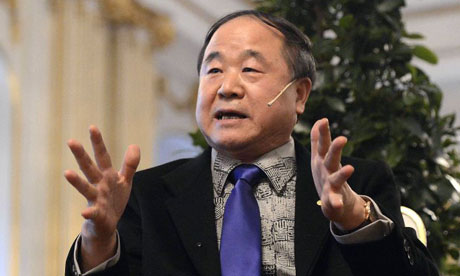
BEIJING, China – Mo Yan, the first Chinese national to win the Nobel Prize for Literature in 2012, refused to sign an appeal, supported by 134 other Nobel laureates, calling for the immediate release of detained Chinese rights activist and former Nobel Peace Prize winner, Liu Xiaobo.
Mo Yan, winner of the Nobel Prize for Literature, speaks in Stockholm. (Photo Courtesy of The Guardian)
Former Nobel Peace prize winners, African Archbishop Desmond Tutu and Taiwanese-American chemist Yuan Lee, are among the supporters that characterized Liu Xiaobo’s eleven year prison term as a heinous violation of international law.
Liu Xiaobo’s wife, Liu Xia, has also been detained, serving out her sentence under house arrest concurrently with her husband’s. Liu Xia is under 24 hour guarded surveillance in her downtown Beijing apartment with no internet or phone line to connect her to the outside world.
When asked about his opinion regarding his fellow Nobel laureate and compatriot, Liu Xiaobo, Mo Yan refused to answer and told reporters that if they wanted to know his opinion, they should search the internet for the statements that he made back in October when it was first announced he had won the Nobel Prize for Literature.
Liu Xiaobo was arrested and imprisoned by the Chinese government for his criticism of the Communist party and his call for democratic reforms. The Chinese government accused Liu Xiaobo of interfering with the central government’s internal affairs as well as creating issues for the country abroad.
Mo Yan stated, in regards to China’s censorship of Liu Xiaobo, that censorship is necessary to guard against defamation or the spread of damaging false rumors. He did, however, say that censorship should not stand in the way of the truth.
The Chinese author likened the practice of censorship to airport security checks, reinforcing his assertion that censorship was indeed a necessary tool. Mo Yan conveyed that when he was passing through airport security, they wanted to check Yan for any dangerous items, making him take off his belt and shoes. He believes that censorship is as necessary as these airport security checkpoints.
Herta Muller, winner of the Nobel Prize for Literature in 2009, called Mo Yan’s award a “catastrophe.” Hu Jia, a dissident of the Communist Chinese government also expressed his disappointment, wondering why Yan could not even say one sentence in support of Liu Xiaobo.
Mo Yan maintained that he is an independent thinker and will not be bullied into adopting ideas or making statements that are not his own. He insisted that this is an outlook he has adopted for years and that his prize is about literature and not politics.
The 57 year old author’s real name is Guan Moye. He adopted the pen name “Mo Yan” for his literary works, which, when translated into English means, “don’t speak.”
By Alexandra Sandacz Impunity Watch Reporter, Europe
BRUSSELS, Belgium – This year, an 82-foot abstract tree of lights was installed in Brussels to replace the traditional Christmas pine tree that is normally displayed on the Grand Place. Consequentially, the new structure sparked controversy and protest demanding respect for “values and traditions.”
The new Christmas structure in Brussels sparks criticism and protest. (Photo Courtesy of BBC News)
Critics accuse officials of parting from traditional ways because of fear of offending non-Christians, especially Muslims.
Despite the criticism, the municipality defended the structure and said it wanted to “blend the modern and the traditional to show off the city’s annual winter fair.”
President of Brussels Tourism, Philippe Close, said, “Let’s be clear, there’ll be a Christmas tree and a nativity scene. Christmas traditions will be respected. The theme this year is “winter pleasures” at the huge Christmas market that has a worldwide reputation. We wanted to emphasize culture and modernity, so asked artists to reinvent the Christmas tree, which is actually a pagan symbol.”
However, Bianca Debaets, a city councilor from the Christian Democrat and Flemish party sparked the controversy when she claimed “the Socialist-run municipality was pandering to the sensitivities of non-Christians by scrapping the traditional tree. “What next? Will Easter eggs be banned from the city because they make us think of Easter,” she asked.
Erik Maxwell, a Brussels citizen, offered his opinion, “We think the tree has been put up for cultural reasons. A tree is for Christmas and Christians but now there are a lot of Muslims here in Brussels. So to avoid discussions they have just replaced a tree with a couple of cubes! I am more traditional, I prefer the usual tree. That’s better for the Belgian people.”
In response to Bianca Debaets comments, Semsettin Ugurlu, chairman of the Belgian Muslim Executive, maintained that his organization did not harbor any issues with any kind of Christmas tree. He stated, “We know we are living in a country with a Christian culture, we take no offense over a traditional Christmas tree.”
The online protest has acquired over 11,000 signatures, and also triggered a Facebook page attacking the new feature.
By Ali Al-Bassam Impunity Watch Reporter, Middle East
CAIRO, Egypt — On Wednesday, Egyptian President Mohammed Morsi issued a new decree granting the military the power to arrest anyone for a temporary period, in what is seen as a response to protests regarding the recent constitutional decree.
Morsi’s decree grants the army the power to arrest any civilian temporarily. (Photo Courtesy of Al Bawaba)
Last Saturday, Morsi participated in a national dialogue and rescinded the constitutional decree issued last November which received criticism for its granting of executive powers. Morsi issued a new constitutional decree, which will be the subject of a referendum scheduled to proceed on December 15 despite protests demanding its cancellation.
Morsi’s intention in granting arresting powers to the army was to ensure “the protection of vital installations in the country.” The army will have the right to arrest civilians until the results of the constitutional referendum are announced.
Opponents fear that the decree is an indication that Egypt may move back into military rule, but Morsi said that the intention of the decree is to assist the police force which is considered to have weakened considerably since the fall of former President Hosni Mubarak. The decree itself requests the military to coordinate with the police for the sake of keeping the peace until the referendum passes, stating that “[T]he armed forces must support the police service in complete cooperation in order to preserve security and protect vital state institutions for a temporary period…”
Mohamed Lofty from Amnesty International Egypt said that it is necessary to read the law in conjunction with the powers granted to the general prosecutor, which Lofty said, “allows detainees to be held for six months in an effort to “protect the revolution.” Lofty believes that the crimes considered to harm the revolution “are broadly defined and therefore threaten the freedom of the media, the freedom to assemble, and the freedom of workers to strike.” “Along with the new law for the military,” said Lofty, “it is a dangerous combination.”
Last Monday, the military increased their presence near the presidential palace,deploying tanks and building a concrete wall to seal off the palace, where a majority of the protesting has occurred.
Opposition groups remain unfazed, and have called for protests against the referendum to continue on Tuesday. In an interview with the BBC, former Foreign Minister Amr Moussa said that the opposition’s goal was to not topple Morsi, but to let him know their demands for a better constitution. “The National Salvation Front announces its total rejection to the referendum and will not legitimize this referendum which will definitely lead to more strife,” said Same Ashour on behalf of the coalition of Opposition Parties.