New law Punishes Those who are Criticial of the Government on the Internet

By Justin Dorman
Impunity Watch Reporter, Middle East

ABU DHABI, United Arab Emirates – Never before has an amendment restricted internet freedom in the United Arab Emirates like the most recent federal decree has. Not only does the law forbid copyright infringement, pornography, and gambling, but it also punishes those who criticize the nation’s rulers online.

The new amendment to the Emirati media law punishes those who criticize the government with imprisonment or deportation. (Photo Courtesy of BBC)

Anyone who publishes news, photographs, information, or caricatures that “pose threats to the security of the state and to its highest interests or violate its public order” may face sanctions such as deportation or a multi-year jail sentence. Such interests of the state include defending the Constitution, laws, rulers, and religion of Islam from criticism. Additionally, one who attempts to organize an unauthrotized demonstration online can also face jail time or deportation.

The minimum jail sentence for a crime under this law will be a three-year term. The jail sentences will be enforced against citizens of the United Arab Emirates. Those who are foreign nationals and are convicted under this law will be deported.

Such policies are not rare in the Middle East. Similar policies restricting and punishing those who exercise their international right to freedom of expression, by criticizing the government, exist in countries like Iran, Qatar, Bahrain, Tunisia, and many others.

While the United Arab Emirates do not normally experience the regular uprisings and protests that some of its neighbors do, it has nonetheless detained sixty advocates since March. These individuals are believed to be connected to al-Islah, an advocacy group dedicated to Islamic tenets that is made up of students and human rights lawyers.

One prominent human rights activist who has been punished by the Emirati government for his outspoken blogging has been Ahmed Mansoor. Mansoor managed a website uaehewar.net that criticized government officials, and was a member of the Human Rights Watch Middle East and North Africa Advisory Committee.

Mansoor was sentenced to a three-year prison term but was pardoned after just seven months after engaging in a sixteen day hunger strike. Since being released, Mansoor claims he has been subject to physical attacks, defamation, death threats, and illegal government hacking of his computer and e-mail account. Mansoor’s passport was also confiscated so that he could not leave the country.

Middle East director at Human Rights Watch Sarah Leah Whitson finds it, “hard to dissociate the verbal and physical attacks against Mansoor from the government’s widespread campaign of intimidation, fear and arrests against all of the country’s reform activists.”

She added that, “[i]t’s becoming clear that anyone who exercises their right to free speech and criticizes the status quo faces an uncertain future in the UAE.”

Mansoor refuses to be affected by the new law. “The only limits that I put to myself are the ethical limits. . .I believe free speech is the prerequisite for any development to happen in any place and any country, and I’m driven totally by my passion and my love to this country,” said Mansoor.

For further information, please see:

International Business Times – United Arab Emirates Clamps Down on the Internet Freedom. . .Before it’s a Problem – 14 November 2012

BBC – UAE Places Restrictions on Online Dissent – 13 November 2012

Free Speech Debate – Ahmed Mansoor on Blogging his way into a UAE Prison – 18 October 2012

Human Rights Watch – UAE: Investigate Attacks on Rights Defender – 3 October 2012

DRC Death Toll Exceeds 200 According UN Report

By Ryan Aliman
Impunity Watch, Africa

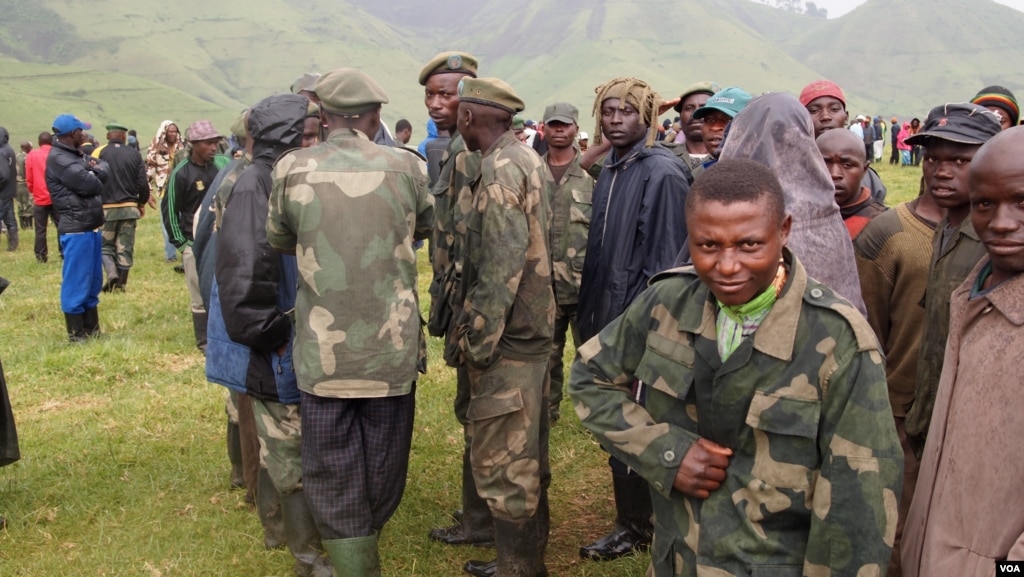
 KINSHASA, Democratic Republic of Congo – Over 200 civilians, including children, were arbitrarily killed by various rebel groups in the eastern province of the Democratic Republic of Congo (DRC) says a UN report published on Wednesday.

Nyatura militia combatants at an army camp in the North Kivu province. (Photo courtesy of N. Long, VOA)

In a news release from the UN Joint Human Rights Office (UNJHRO), the Geneva-based organization stated that “at least 264 civilians, including 83 children, were arbitrarily executed by armed groups in more than 75 attacks on villages between April and September this year.”

On a six-mission operation, the UNJHRO investigators conducted more than 160 interviews with victims and witnesses where they also found evidence of what UN High Commissioner for Human Rights Navi Pillay described as “the most serious [human rights violations] we have seen in recent times in the DRC.”

The investigators found out that most of the victims of these reported atrocities were hacked to death with machetes. Other victims were burnt alive in their homes at the southern town of Masisi in the North Kivu province.

However, the UNJHRO pointed out that the actual number of killings could be considerably higher than the statistics published in the report. According to the UN agency, the UNJHRO investigators experienced “security concerns” that prevented them from probing other reported violations.

“The ethnic dimension of the attacks is of particular concern in eastern DRC where tensions over the past 15 years, while fundamentally rooted in competition over land and natural resources, have resulted in cycles of violence committed along ethnic lines,” explained the report.

The main suspects of these attacks are the Raia Mutomboki and the Nyatura.

The Raia Mutomboki is a homeland defense militia whose aim is to cleanse the region of Hutus and Kinyarwanda speakers. Reports show that it has also seized the North Kivu villagers it purports to be protecting, using them as porters.
On the other hand, the Nyatura — an ethnic Hutu militia who took part in the 1994 genocide of Tutsis in Rwanda — have usually targeted people from the Tembo community.

The UNJHRO report also uncovered several cases of sexual violence involving the rape of 12 women. Other human rights violations mentioned in the report included mass forced displacement, large-scale looting, and destruction of private property.

The Secretary-General’s Special Representative for DRC and head of MONUSCO, Roger Meece, expressed his concern about the likelihood that the the security situation in the country could worsen, noting a “significant increase” in human rights violations throughout the Kivus this year.

“The risk of intensification of this ethnically charged conflict is real, and gives rise to serious concerns for peace and for the security of civilians in the region,” he said.

Meanwhile, High Commissioner Navi Pillay urged the Congolese government to “take immediate measures to protect civilian populations and to combat the persistent impunity which only serves to embolden the killers.” The High Commissioner also expressed the willingness of the UN to offer support to the DRC’s recently launched judicial investigation into the human rights violations, saying that these “must lead to the prosecution of those responsible for these acts and ensure justice for the victims.”


For further information, please see:

Afrika.no – Congo-Kinshasa: Evidence of hundreds arbitrary killings in the east this year, UN says – 16 November 2012

United Press International – DRC vows to repel M23 – 16 November 2012

AFP – Mass slaughter of civilians, children in DR Congo: UN – 15 November 2012

All Africa – Congo-Kinshasa: UN Report Finds Evidence of Arbitrary Killings in Eastern DR Congo, Prompts Calls for Action – 14 November 2012


Breaking News: Magnitsky Act Passes in the U.S. House of Representatives With Congressional Intent to Make the List Public

Press Release
Hermitage Capital

16 November 2012 – Today, the U.S. House of Representatives passed the Sergei Magnitsky Rule of Law Accountability Act (365 in favour, 43 against).

The U.S. House of Representatives. (Photo Courtesy of AFP Photo/Getty Images)

The bill creates targeted sanctions for the officials involved in the case of Sergei Magnitsky as well as other gross human rights abuse in Russia.

Speaking before the vote, U.S. Congressman Jim McGovern, the original sponsor of the bill, and Co-Chair of Tom Lantos Human Rights Commission, stated the understanding of “the Congressional intent” to make public the list of sanctioned individuals. Congressman McGovern noted that the congressional intent is to make use of a classified annex only in cases of national security interest. His understanding was shared by other speakers on the floor.

The Russian Foreign Affairs Ministry promised a “tough” response, according to Russian Deputy Foreign Affairs Minister Ryabkov.

U.S. Congressman Smith speaking before the vote said: “All howls from Kremlin show we are on to something here.” Congressman Smith stated it was important that Russian officials be held accountable for “the crimes against their own countrymen”. The bill is a clear statement that “murderers and torturers are not welcome here,” said Congressman Smith on the House floor.

Russian human rights activists welcome the bill. Leader of the For Human Rights movement Lev Ponomaryev told Interfax news agency: “I am sure that the Magnitsky Act is necessary.” According to him, if the USA passes the law, this would encourage the Russian authorities to fully investigate Magnitsky’s death.

“Sooner or later, they will have to resolve this problem in Russia. Whether this issue will be addressed immediately after the USA passes the law, I do not know. Nevertheless, the adoption of the law in the USA will be a step in the right direction,” the activist said, according to Interfax.

To become a law,  the bill has to be voted by the Senate and signed by US President.

The Sergei Magnitsky Rule of Law Accountability Act imposes assets freezes and visa bans on those who was responsible for the detention, abuse or death of Sergei Magnitsky, financially benefitted from his detention or abuse, concealed their legal liability, or was involved in the criminal conspiracy uncovered by Sergei Magnitsky, as well on those responsible for extrajudicial killings, torture and gross violations of human rights of whistle-blowers and activists.

Within 120 days of enactment, the Act requires the Departments of State and Treasury to compile, publish, and report on a list of these persons. Listed persons would be ineligible for entry into the United States, have any existing visas revoked, and have their financial assets frozen.

The Sergei Magnitsky Rule of Law Accountability Act points out that no officials have been brought to trial for Magnitsky’s “false arrest or for the crime he had uncovered,”  notes “the impunity since his death of state officials he testified against for their involvement in corruption and the carrying out of his repressive persecution,” and says:

The systematic abuse of Sergei Magnitsky, including his repressive arrest and torture in custody by officers of the Ministry of the Interior of the Russian Federation that Mr. Magnitsky had implicated in the embezzlement of funds from the Russian Treasury and the misappropriation of 3 companies from his client, reflects how deeply the protection of human rights is affected by corruption.”

For further information please contact:

Hermitage Capital
Tel:                    +44 207 440 17 77
Email:               info@lawandorderinrussia.org
Website:           http://lawandorderinrussia.org
Facebook:        http://on.fb.me/hvIuVI
Twitter:            @KatieFisher__
Livejournal:    http://hermitagecap.livejournal.com/

Child Prostitution Network Uncovered in Chile, Famous Clients Revealed

By Brendan Bergh
Impunity Watch Reporter, South America

SANTIAGO, Chile – Early Thursday, a four month investigation came to a head when Chile’s Investigative police (PDI) raided, uncovered and shutdown a child prostitution ring in downtown Santiago.

Police uncover a child prostitution network in downtown Santiago. (Photo Courtesy of Profesor Baker)

The network prostituted girls from the ages of 12-17. They were then sent to clients’ homes and neighborhoods to engage in their illicit business.

While prostitution is not technically illegal in Chile, the prostitution of children is, as is the operation of a brothel. And police shut down two underground brothels in conjunction with their investigation. Subsequent raids were launched throughout the night, with a strike force of about 60 officers who began arresting clientele.

This raid and subsequent arrests are due to President Sebastian Pinera’s much lauded mandate to combat child sex abuse. To effectively combat this, they have begun a system similar to the United States convicted sex offenders database, along with banning convicted pedophiles from working with or near children.

A client list was also uncovered, and those listed on its rolls should be worried. Whether intentional or through negligent leaks, the names of famous clients have been revealed to the media. Ranging from former mayoral candidate of the Christian Democrat Party to the creator of a popular children’s’ comic book, who when arrested and questioned denied all allegations to having relations with a minor. He insisted that he paid the brothel for “a girl over 18 years of age.” However the big name seems to be Jaime Román, a local television personality and music producer. According to police reports he was actively having sex with a minor when police broke down his door. These infamous individuals were arrested during the subsequent raids which raised the arrested number up to 19.

Of the 19 arrested, five were arrested at the brothel and will be subsequently charged for obtaining sexual services from minors, while the owners will be charged with the prostitution of minors.

The Christian Democracy party has formally denounced the formal mayoral candidate, and if found guilty noted that “[W]e declare that any member of the Christian Democracy involved in this kind of case, will be expelled from the party.”

The shocking information revealed by the investigation is that many of the girls abused and active in the child prostitution ring were there with their parents’ knowledge, and their parent’s permission. The Interior Minister has condemned the actions of all those involved, but it is uncertain at this moment what levels of liability the parents may face.

For further information, please see:

BBC News – Chile Police Raid ‘Child Prostitution Ring’ in Santiago – 16 November 2012

I Love Chile News – Child Exploitation Ring Busted In Santiago – 16 November 2012

Santiago Times – Chile’s Investigate Police Uncover Child Prostitution Ring – 16 November 2012

La Segunda Online – Thwart Child Prostitution Ring: Today Formalized 19 Arrested – 16 November 2012

I Love Chile News – My Two Cents: Cafe con Piernas – Legs with your Coffee? – 26 October 2012


Children’s Health Book Chastises Meat-Eaters in India

By Karen Diep
Impunity Watch Reporter, Asia

NEW DELHI, India New Healthway, a book focusing on health and hygiene, is stirring public criticism against the government.  The book, which aims at eleven and twelve year olds, accuses meat-eaters of “easily cheat[ing]” and “commit[ting] sex crimes.”

The cover of New Healthway. (Photo Courtesy of BBC News)

This has led academics pressing the Indian government to exercise more caution in regulating press and activists protesting in response to such infringement against press.

“The strongest argument that meat is not essential food is the fact that the Creator of this Universe did not include meat in the original diet for Adam and Eve.  He gave them fruits, nuts and vegetables,” reads the chapter entitled “Do We Need Flesh Food?”

The book further examines the alleged benefits of vegetarianism and continues to list characteristics found in non-vegetarians.  “[Non-vegetarians] easily cheat, tell lies, forget promises, they are dishonest and tell bad words, steal, fight and turn to violence and commit sex crimes,” read an except from New Healthway.

Another passage reads, “The Arabs who helped in constructing the Suez Canal lived on wheat and dates and were superior to the beef-fed Englishmen engaged in the same work.”

According to a 2001 consensus, approximately 80 percent of India’s population is Hindu and 13 percent are Muslim, and due to religious purposes, Hindus do not consume beef and Islam forbids pork consumption.

It is unknown the extent to which New Healthway has been purchased and circulated amongst schools in India.  Nonetheless, faculty are more worried that such a book is available to their students.

“This is poisonous for children,” shared Janaki Rajan, a faculty member at Jamia Millia University, to BBC News.  “The government has the power to take action, but they are washing their hands of it,” continued Ms. Rajan.

However, others have stated that schools have the utmost responsibility to monitor and regulate textbooks in the classroom.

According to the Huffington Post, a representative for India’s Central Board for Secondary Education relayed to NDTV that schoolbooks are not monitored for content.

Moreover, Principle Annie Koshy of St Mary’s school in New Delhi, where New Healthway is not used, further relayed to NDTV that although the CBSE recommends some publishers, such do not produce particularly good books.  “It’s a great way for us to actually see whether teachers are reading the books and teaching what the books say,” said Mr. Koshy.

Although BBC News has requested to speak to the publishers, S. Chand, no response was given.


For further information, please see:

BBC News – India textbook says meat-eaters lie and commit sex crimes – 16 November 2012

CBS News – India text teaches meat-eaters “commit sex crimes” – 16 November 2012

Huffington Post – ‘Meat-Eaters Lie, Cheat And Commit Sex Crimes,’ Claims Indian School textbook – 16 November 2012